Hennessy and Patterson: The Quantitative Approach
Abstract
John Hennessy (born 1952) at Stanford and David Patterson (born 1947) at Berkeley led the two university projects that turned RISC from an IBM research finding into an industry, then wrote the textbook that taught the field to argue with measurements instead of opinions. Patterson later named RAID and helped define RISC-V; Hennessy founded MIPS Computer Systems, ran Stanford for sixteen years and chairs Alphabet. They shared the 2017 Turing Award. The company Hennessy founded outlived its own instruction set: MIPS switched to Patterson’s RISC-V in 2021.
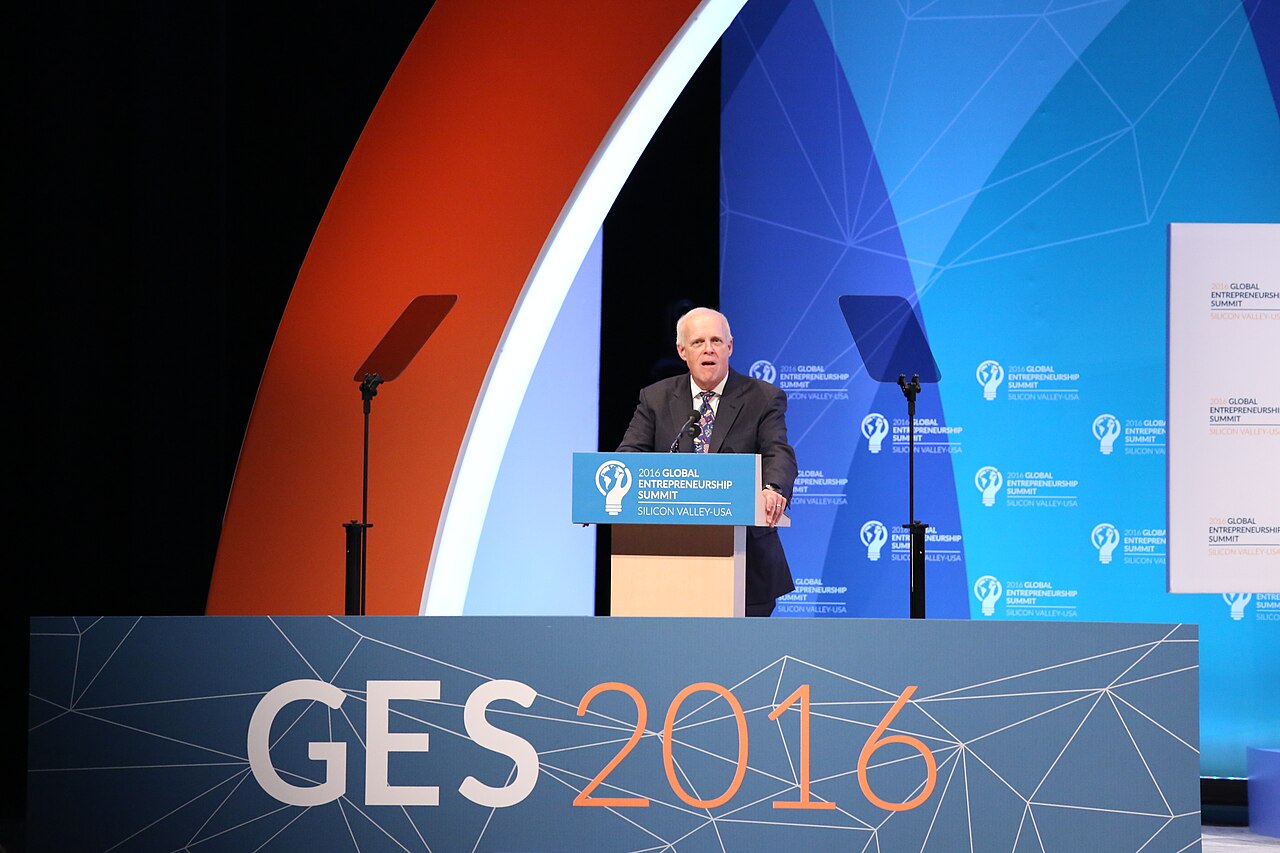
Two Campuses, Forty Miles Apart
David A. Patterson was born on 16 November 1947 in Evergreen Park, Illinois and grew up in Torrance, California. He did all three degrees at UCLA: a BA in mathematics in 1969, an MS in computer science in 1970 and a PhD in 1976 with a dissertation on the verification of microprograms, under David Martin and Gerald Estrin. He joined the Berkeley faculty the same year and stayed forty years.
John L. Hennessy was born on 22 September 1952 in Huntington, New York, one of six children of an aerospace engineer and a teacher. He took a BS in electrical engineering at Villanova and an MS and PhD in computer science at Stony Brook, finishing in 1977 with a thesis on a real-time language for small processors. Stanford hired him that year.
Neither had set out to design processors. Patterson’s thesis was about microcode, the layer of tiny programs inside a CPU that implemented its complex instructions; Hennessy’s was about a programming language. Both arrived at the same question from the software side: what did compilers actually use?
Berkeley RISC
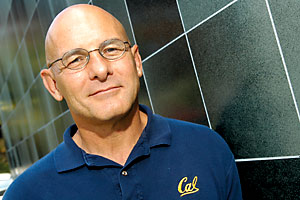
Patterson had studied the VAX, whose instruction set was the most elaborate of its day, and concluded that most of it was dead weight. John Cocke’s 801 group at IBM had reached the same conclusion in the mid-1970s but published almost nothing. In October 1980 Patterson and David Ditzel of Bell Labs put the argument in print as “The Case for the Reduced Instruction Set Computer,” and the acronym stuck. The Berkeley RISC project that Patterson led with Carlo Séquin from 1980 built two chips, RISC I (1981) and RISC II, with graduate students doing the VLSI layout. The design’s distinctive feature, register windows, went into Sun’s SPARC, which commercialised the Berkeley design from 1987. The story of the argument itself, and how it ended, is in RISC vs. CISC.
Patterson kept the name. Berkeley’s later architecture projects were SOAR (1984) and SPUR (1988), and when Krste Asanović started a “three-month summer project” in 2010 to design a clean instruction set for teaching and research, Patterson joined and it became RISC-V: the fifth Berkeley RISC. The RISC-V Foundation was formed in 2015 to hold the specification, moved to Switzerland in 2019 over concerns about US export rules, became RISC-V International in March 2020 and had more than 4,500 members by 2025. Patterson co-wrote the instruction set manual and, with Andrew Waterman, The RISC-V Reader (2017).
Stanford MIPS
Hennessy started the MIPS project at Stanford in 1981: Microprocessor without Interlocked Pipeline Stages, the name being a claim that the compiler, not the hardware, would keep the pipeline out of trouble. In 1984, on sabbatical, he co-founded MIPS Computer Systems with Chris Rowen and others from the Stanford group to sell the design. The R2000 shipped in 1986, the R3000 in 1988; DEC and Silicon Graphics built workstations around them, and MIPS chips later sat in the Sony PlayStation and the Nintendo 64.
The company went public in December 1989 and ran into trouble almost at once, trying to be both a chip designer and a systems vendor. Silicon Graphics bought it in 1992 for $333 million and renamed it MIPS Technologies. Hennessy had long since gone back to Stanford, where he directed the Computer Systems Laboratory (1989–93), chaired the computer science department (1994–96), was dean of engineering (1996–99), provost (1999–2000) and, from 1 September 2000 to 31 August 2016, the university’s tenth president. In February 2016, in his last months in office, Stanford announced the Knight-Hennessy Scholars, a graduate scholarship endowed at $750 million on a $400 million gift from Nike co-founder Phil Knight, with Hennessy as its first director. He sat on Google’s board for years before becoming chairman of Alphabet in February 2018.
The Textbook
The two had known each other since the RISC years and shared the conviction that computer architecture was being taught as a catalogue of designs rather than as an engineering discipline. Computer Architecture: A Quantitative Approach (Morgan Kaufmann, 1990) fixed that. Its method was to state a design choice, measure it on real programs, and report the number; the book’s running example was a simplified MIPS, and its lesson that every architectural feature had to earn its transistors. The undergraduate version, Computer Organization and Design, followed in 1994. The graduate book reached its sixth edition in 2019 and the undergraduate one has a RISC-V edition (2017), so that a student now learns the subject on Patterson’s fifth instruction set rather than Hennessy’s first.
The Turing citation of 2017 was written for the book as much as for the chips: “for pioneering a systematic, quantitative approach to the design and evaluation of computer architectures with enduring impact on the microprocessor industry.” Their joint Turing lecture, “A New Golden Age for Computer Architecture,” argued that the end of Dennard scaling and Moore’s Law meant the discipline’s future lay in domain-specific hardware and open instruction sets; it ran in Communications of the ACM in February 2019.
RAID and the Rest of Patterson
Patterson’s second billion-dollar acronym came in June 1988. With his student Garth Gibson and colleague Randy Katz he presented “A Case for Redundant Arrays of Inexpensive Disks (RAID)” at SIGMOD: cheap PC drives ganged together, with redundancy so that a failure of one did not lose data, could beat the large expensive disks of the mainframe world on cost, throughput and reliability. The paper’s five “levels” became product categories, and the industry quietly changed the I to “Independent” once the disks stopped being cheap. The Berkeley Network of Workstations project of the mid-1990s did the same for computing: clusters of commodity machines in place of a supercomputer, the pattern every later data centre followed.
He was ACM president from 2004 to 2006, chaired the Computing Research Association, and retired from Berkeley in 2016, then joined Google as a Distinguished Engineer. There he was one of the seventy-six authors of the 2017 ISCA paper on the Tensor Processing Unit, Google’s custom chip for neural-network inference: a domain-specific architecture of exactly the kind his Turing lecture predicted. In 2022 the National Academy of Engineering gave Hennessy and Patterson the Draper Prize jointly with Steve Furber and Sophie Wilson of Acorn, whose ARM was the RISC design that reached the most devices.
Dead End: MIPS, the Company
Hennessy’s company is the odd case of an architecture that won the argument and lost its own name. After the SGI purchase, MIPS Technologies was spun out again in 1998 as a licensing house, competed with ARM in embedded systems, and passed through a series of owners until Wave Computing bought it in 2018. Wave went bankrupt, and in 2021 the reorganised company announced it would stop developing the MIPS architecture and build its future chips on RISC-V.
The reasons are the ones that killed most workstation-era RISC lines: the company tried to sell whole systems against its own chip customers; the PC market went to Intel, which by the mid-1990s was decoding x86 into RISC-like micro-operations internally; and the embedded market, where MIPS survived longest, went to ARM, which licensed cores rather than selling chips and did so earlier and more cheaply. What finally replaced MIPS was free. RISC-V had no licence fee at all, and by 2021 that mattered more than thirty-five years of compatibility.
📚 Sources
- Wikipedia: David Patterson (computer scientist) — birth, UCLA degrees and advisors, Berkeley 1976–2016, ACM presidency, Google, awards, students
- UC Berkeley EECS: David A. Patterson faculty page — RISC, RAID, NOW, RISC-V, TPU, award years, current posts
- Wikipedia: John L. Hennessy — birth, Villanova and Stony Brook, Stanford posts and presidency dates, MIPS 1981/1984, boards, Turing citation, awards
- Wikipedia: MIPS Technologies — founding 1984, R2000/R3000, IPO December 1989, SGI purchase 1992 for $333 million, 1998 spin-out, Wave Computing, 2021 switch to RISC-V
- Wikipedia: Berkeley RISC — commercialised by Sun as SPARC
- Wikipedia: RISC-V — 2010 origin, the “fifth generation” naming, Foundation 2015, Switzerland 2019–20, membership
- Stanford Report: Stanford launches Knight-Hennessy Scholars Program, 23 February 2016 — $400 million gift, $750 million endowment
- Patterson & Ditzel, “The Case for the Reduced Instruction Set Computer,” SIGARCH Computer Architecture News 8 (6), October 1980, pp. 25–33 (DOI 10.1145/641914.641917)
- Patterson, Gibson & Katz, “A Case for Redundant Arrays of Inexpensive Disks (RAID),” SIGMOD 1988, pp. 109–116 (DOI 10.1145/50202.50214)
- Jouppi et al., “In-Datacenter Performance Analysis of a Tensor Processing Unit,” ISCA 2017 (DOI 10.1145/3140659.3080246) — Patterson among the authors
- Hennessy & Patterson, “A New Golden Age for Computer Architecture,” Communications of the ACM 62 (2), February 2019, pp. 48–60 (DOI 10.1145/3282307) — the Turing lecture
- Open Library: Computer Organization and Design, first published 1994 and Internet Archive: Computer Architecture: A Quantitative Approach, Morgan Kaufmann 1990
- Wikimedia Commons: John L Hennessy 2016 — lead image, Global Entrepreneurship Summit, 24 June 2016
- Image: David A Patterson.jpg by Peg Skorpinski (CC BY-SA 3.0), via Wikimedia Commons