Lotfi Zadeh
Abstract
Lotfi Zadeh (1921–2017) spent the first half of his career inside the mathematical establishment, co-writing the z-transform paper that sampled-data control theory was built on and chairing Berkeley’s electrical engineering department. In July 1964, alone in New York after a dinner was cancelled, he worked out the idea of a set whose members belong to it by degree. The 1965 paper that followed made him, for two decades, an outsider in his own field: Rudolf Kálmán called it “scientific permissiveness,” his Berkeley colleague William Kahan called it “wrong, wrong, and pernicious,” and a US senator put his grant on a list of wasteful spending. Japanese engineers built it into trains and washing machines instead, and by 2021 the 1965 paper had passed 120,000 citations. He was born in Soviet Baku, raised in Tehran, made his career in America, and was buried in Baku with state honors.
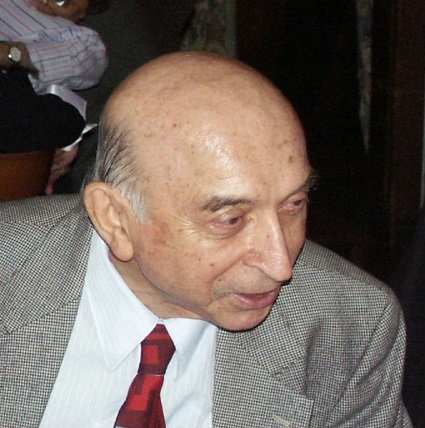
Baku and Tehran
Zadeh was born on 4 February 1921 in Baku, the capital of Soviet Azerbaijan, to Rahim Aleskerzade, an Iranian Azerbaijani journalist from Ardabil posted to the city, and Fanya Korenman, a Jewish pediatrician from Odesa. He was an only child. In 1931, as Stalin’s restrictions on foreign residents tightened, the family moved to Tehran, where he was enrolled at Alborz College, a Presbyterian missionary school. “Every morning, we had to go to chapel,” he said later, “that was a drastic change from what I had experienced at the Soviet atheistic schools.” Before he was twelve he was working in four languages, Russian, Azerbaijani, Persian and English, across three scripts.
He took a degree in electrical engineering at the University of Tehran in 1942, in a faculty whose professors had mostly been trained in France. Iran was then occupied by British and Soviet troops with an American supply mission attached, and Zadeh made money trading with the US Army. That money paid for the passage: he arrived in the United States in 1944, took a master’s degree at MIT in 1946, and moved to Columbia, where John Ragazzini supervised his doctorate, awarded in 1949.
Asked decades later what he owed to which country, he refused the question’s premise. “The question really isn’t whether I’m American, Russian, Iranian, Azerbaijani, or anything else,” he said. “I’ve been shaped by all these people and cultures and I feel quite comfortable among all of them.” From Azerbaijan he claimed he had taken “obstinacy and tenacity. Not being afraid to get embroiled in controversy.”
Columbia and Berkeley
Nothing in Zadeh’s first fifteen years of work suggests a heretic. He taught at Columbia from 1946, became an assistant professor in 1950 and an associate professor in 1953, and worked on the orthodox problems of the day: time-varying networks, the hierarchy of nonlinear systems, and the extension of Norbert Wiener’s prediction theory (see Norbert Wiener and Cybernetics). The 1952 paper with Ragazzini on sampled-data systems introduced the z-transform formulation that digital control and signal processing still use.
In 1959 he moved to Berkeley. He chaired the electrical engineering department from 1963 to 1968 and pushed through its expansion into the Department of Electrical Engineering and Computer Sciences, which is how Berkeley’s computer scientists came to sit inside an engineering department rather than beside the mathematicians. With Charles Desoer he wrote Linear System Theory: The State Space Approach (1963), a standard text. He was, at that point, a department chair with impeccable credentials in exactly the mathematics he was about to relax.
The Cancelled Dinner
The idea arrived in July 1964, in New York, where Zadeh was visiting his parents. A dinner engagement fell through and he spent the evening alone, turning over classification problems he had agreed to work on for RAND. “The idea occurred to me then to introduce the concept of grade of membership,” he said. Two weeks later he described it to Richard Bellman, who was enthusiastic, and in June 1965 Information and Control published “Fuzzy Sets”: a set in which an element belongs to a degree between 0 and 1, with intersection, union and complement defined as minimum, maximum and one-minus.
He chose the word knowing what it would cost him. “I think it is better to be visible and provocative than to be bland,” he said. The technology that followed, the linguistic variable of 1973, Mamdani’s controller, the cement kilns, the Sendai subway and Japan’s washing-machine boom, is told in Fuzzy Logic.
Twenty Years of Being Wrong
The reaction in the United States was worse than indifference. Rudolf Kálmán wrote in 1972 that “fuzzification is a kind of scientific permissiveness” tending to “socially appealing slogans unaccompanied by the discipline of hard scientific work,” and connected Zadeh’s enthusiasm to “the prevailing political climate in the United States, one of unprecedented permissiveness.” William Kahan, three floors away in the same Berkeley department, said in 1975: “Fuzzy theory is wrong, wrong, and pernicious. The danger of fuzzy theory is that it will encourage the sort of imprecise thinking that has brought us so much trouble.” Senator William Proxmire’s Golden Fleece program, which publicized federal grants Proxmire considered wasteful, took aim at Zadeh’s NSF funding. American money for the field stayed thin into the 1980s.
Zadeh kept a photograph of himself with a sign above the table reading ODIN, Russian for “alone.” “It was a proclamation of my independence,” he said. He answered the criticisms in print rather than ignoring them, and he built the institutions the idea needed: the Berkeley Initiative in Soft Computing, founded as an industrial liaison program in 1991 with Zadeh as director, and a stream of edited volumes and conferences that gave the field somewhere to publish.
Possibility, Soft Computing, Words
The later work extended the 1965 move in the same direction. “Fuzzy Sets as a Basis for a Theory of Possibility” (Fuzzy Sets and Systems 1, 1978) proposed possibility as a measure of uncertainty distinct from probability: the statement “Hans ate X eggs for breakfast” makes some counts easy and others hard, independently of how often each happens. From the early 1990s he grouped fuzzy logic with neural networks and evolutionary computation under “soft computing,” techniques that trade precision for tractability. “Fuzzy logic = computing with words” (IEEE Transactions on Fuzzy Systems, 1996) argued that words rather than numbers should be the objects of computation where the data are perceptions, and his last construction, the Z-number (Information Sciences, 2011), paired a fuzzy value with a fuzzy reliability, so that “usually about 45 minutes” is a single computable object.
None of the later proposals traveled the way the 1965 paper did. The citation record shows where the weight sits: of roughly 269,000 citations by late 2021, the 1965 paper alone accounted for 122,743.
Back to Baku
Zadeh married Fay, whom he had met at Alborz in Tehran; she published a memoir, My Life and Travels with the Father of Fuzzy Logic, in 1998. They had a daughter, Stella, and a son, Norman Zada. He was awarded the IEEE Hamming Medal in 1992, the IEEE Medal of Honor in 1995, and the BBVA Foundation Frontiers of Knowledge Award in 2012, by which time the washing machines had been shipping for two decades.
He died at home in Berkeley on 6 September 2017, aged 96. Azerbaijan claimed him: his body was flown to Baku and buried on 29 September in the First Alley of Honor, the state cemetery in Baku. The man who had spent twenty years being told his mathematics was a category error was given a state funeral for it.
📚 Sources
- Lotfi A. Zadeh — A2C2 (American Automatic Control Council) biography (the Berkeley Initiative in Soft Computing established in 1991 as an industrial liaison program with Zadeh as director)
- Lotfi A. Zadeh — Wikipedia (birth 4 February 1921 in Baku; parents Rahim Aleskerzade and Fanya Korenman; Alborz 1931–1939; Tehran BSEE 1942; MIT 1946; Columbia PhD 1949; Columbia ranks; Berkeley from 1959 and the chairmanship 1963–1968; z-transform with Ragazzini 1952; Linear System Theory with Desoer; the 1965, 1975, 1996 papers; Hamming Medal 1992, Medal of Honor 1995, BBVA 2012; Fay, Stella and Norman; death 6 September 2017; burial 29 September 2017 in the First Alley of Honor; 269,091 citations in November 2021 and 122,743 for the 1965 paper)
- Lotfi Zadeh and the Birth of Fuzzy Logic — IEEE Spectrum (the cancelled dinner in July 1964, RAND, “grade of membership,” Bellman two weeks later; Kahan 1975 and Kálmán 1972 quoted; Proxmire’s Golden Fleece and the NSF grant; the ODIN photograph; “better to be visible and provocative than to be bland”)
- Lotfi Zadeh, Creator of Fuzzy Logic — Betty Blair, Azerbaijan International 2.4 (Winter 1994) (Alborz College and the chapel quote, four languages and three scripts, the French-trained faculty at the University of Tehran, “the question really isn’t whether I’m American, Russian, Iranian, Azerbaijani,” obstinacy and tenacity, the only child)
- Oral History: Lotfi Zadeh, IEEE History Center, 24 July 1991, interviewed by Andrew Goldstein (Columbia appointments from 1946, time-varying networks and sampled-data systems, the extension of Wiener’s prediction theory, “conventional techniques are much too precise for the pervasive imprecision of the real world”)
- Lotfi Zadeh, inventor of fuzzy logic, dies at 96 — Berkeley News, 12 September 2017 (emigration in 1944 after selling goods to the US Army during the war; the EECS reorganisation; emeritus from 1991; death in Berkeley)
- Zadeh — Fuzzy sets, Information and Control 8(3), 1965, 338–353
- Zadeh — Fuzzy sets as a basis for a theory of possibility, Fuzzy Sets and Systems 1(1), 1978, 3–28
- Zadeh — Fuzzy logic = computing with words, IEEE Transactions on Fuzzy Systems 4(2), 1996, 103–111
- Zadeh — A note on Z-numbers, Information Sciences 181, 2011, 2923–2932
- Image: Lotfi Zadeh2005 1.jpg by BBR100 (CC BY-SA 4.0), via Wikimedia Commons