Norbert Wiener and Cybernetics
Abstract
Norbert Wiener was a mathematical prodigy who entered Tufts University at 11, received his Harvard PhD at 18, and spent his career at MIT developing ideas that would shape robotics, control theory, information science, and the philosophy of artificial intelligence. His 1948 book Cybernetics: Or Control and Communication in the Animal and the Machine introduced the concept of feedback loops as a universal organizing principle, applicable equally to mechanical thermostats, biological nervous systems, and social institutions. Cybernetics was not just a technical theory but a philosophical claim: that intelligence, control, and communication shared common mathematical structure regardless of whether they occurred in silicon, neurons, or social systems. The claim was too ambitious for the science of 1948. It was also prescient in ways that became clear only decades later.
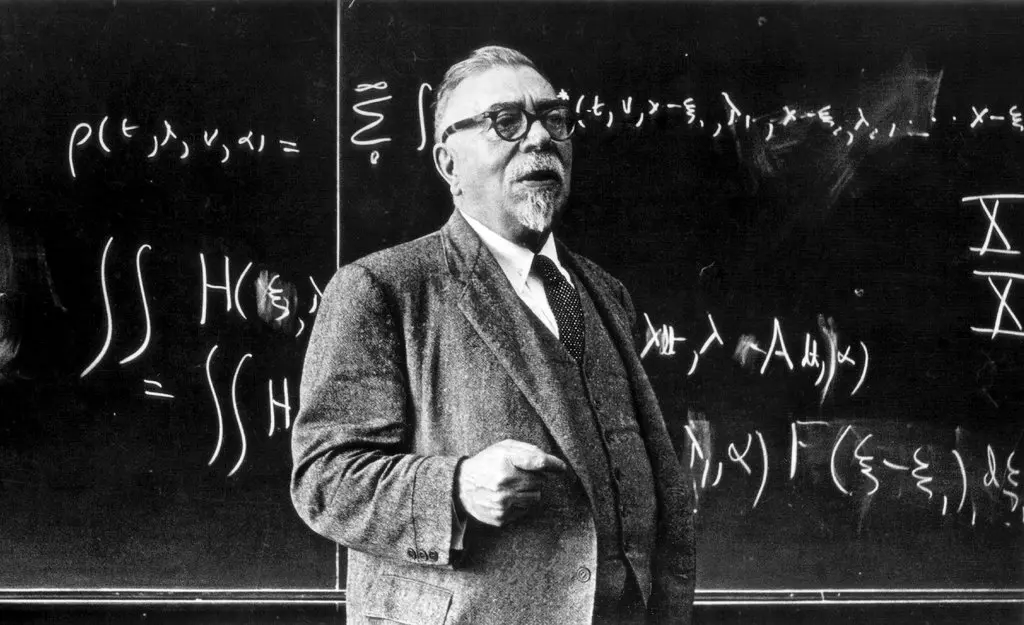
The Child Prodigy
Norbert Wiener was born in Columbia, Missouri in 1894. His father, Leo Wiener, was a Harvard professor of Slavic languages who conducted an aggressive home-schooling experiment on his eldest son, forcing rigorous intellectual training from early childhood. The results were spectacular and potentially traumatic: Wiener could read and write at 3, entered Tufts College at 11 with exceptional mathematical ability, and received his bachelor’s degree at 14.
He then moved through graduate programs in zoology (Harvard), philosophy (Cornell), and finally mathematics (Harvard again), receiving his PhD in mathematical logic at 18 under Karl Schmidt. Post-doctoral study with Bertrand Russell in Cambridge, David Hilbert in Göttingen, and G.H. Hardy in the UK gave him exposure to the leading mathematical minds of the early 20th century. By his early twenties, he had the mathematical foundations he would draw on for the rest of his career.
Wiener joined MIT’s mathematics department in 1919 and remained there until his death in 1964. His early career focused on harmonic analysis, Brownian motion, and potential theory, abstract mathematics that would later find application in signal processing and communication engineering.
The War and the Feedback Principle
World War II transformed Wiener’s research direction as it did for most American scientists. His contribution was in anti-aircraft fire control. The problem: a gunner trying to hit an aircraft must aim not where the aircraft is but where it will be when the shell arrives, perhaps a second or two in the future. The aircraft’s position must be predicted from its current trajectory. But the aircraft’s trajectory depends on the pilot’s anticipating where the gunner will aim. The gunner and the pilot are in a recursive game of prediction and counter-prediction.
Wiener’s approach was statistical: model the aircraft’s future position as a prediction problem in time series analysis, using Wiener filter theory to separate signal (predictable trajectory) from noise (random variation). The mathematical framework he developed (Wiener filtering) became fundamental to signal processing. But the work also led Wiener to a deeper question: what is the mathematical structure of purposive, goal-directed behavior?
The anti-aircraft problem was a control system: sensors track an aircraft, a predictor computes expected position, a gun is aimed and fired, and the result (hit or miss) feeds back to adjust the predictor. This is a feedback loop, a system that uses information about its own output to adjust its behavior toward a goal. Wiener recognized that this structure was not unique to anti-aircraft systems. It described thermostats, biological reflexes, economic markets, and social institutions.
The key insight, developed with collaborators Arturo Rosenblueth (a Mexican physiologist) and Julian Bigelow (an engineer): purposive behavior is defined by feedback. A system that seeks a goal is a system that computes the difference between its current state and a target state, and uses that difference to guide future action. This is true whether the system is a servo-motor, a neuron, or a human reaching for a glass.
Wiener and Rosenblueth published this argument in a 1943 paper: “Behavior, Purpose and Teleology.” It was one of the most interdisciplinary papers of the 20th century, arguing that the concept of purpose (historically reserved for biological organisms and dismissed as unscientific when applied to machines) was a mathematically precise property that could be defined, measured, and engineered.
Cybernetics: The Book That Named a Field
In 1948, Wiener published Cybernetics: Or Control and Communication in the Animal and the Machine. The title introduced the term “cybernetics,” derived from the Greek kubernetes (helmsman, the one who steers), the root that also gives us “governor” and, eventually, “cyber” in all its modern forms.
The book’s central claim was that control and communication were the same phenomenon analyzed from different perspectives. A thermostat is a communication system (it reads temperature as a signal) and a control system (it acts on the temperature). A nervous system is a communication network and a control system. The mathematical theory of communication (information theory, which Shannon was developing simultaneously) was therefore also a theory of control.
Wiener proposed “cybernetics” as the name for a unified science of control and communication in both machines and animals. The book ranged across topics that would now be separated into distinct disciplines: servomechanism design, neuroscience, statistics, economics, and what we would now call artificial intelligence. The ambition was explicitly interdisciplinary: Wiener believed that the fundamental phenomena cut across disciplinary boundaries that were historical accidents.
Simultaneous with Shannon
Wiener and Claude Shannon developed complementary theories of communication in the same period, and their formulations of information entropy are mathematically similar. They knew each other and acknowledged the overlap. The difference: Shannon’s information theory focused on communication channels and encoding; Wiener’s cybernetics focused on feedback and control. Shannon’s formulation became the foundation of information theory as a discipline. Wiener’s cybernetics became the broader philosophical framework.
The Macy Conferences on Cybernetics (1946–1953), which Wiener helped organize, brought together mathematicians, engineers, biologists, anthropologists, and psychologists (including John von Neumann, Margaret Mead, Gregory Bateson, and Warren McCulloch) to develop the interdisciplinary synthesis Wiener envisioned. The conferences were intellectually remarkable and practically chaotic; the synthesis was never fully achieved.
The Social Critique: Technology and Human Control
Wiener was unusual among scientists of his generation in combining technical work with serious social philosophy. In The Human Use of Human Beings (1950), a popularized version of Cybernetics, and in God and Golem, Inc. (1964), written shortly before his death, Wiener addressed the social consequences of the automation and intelligent machines he was helping to create.
His concerns were prescient. He worried that automated machines would displace workers faster than the economy could absorb them. He worried that feedback-controlled weapons would make war more automated and therefore more catastrophic. He worried that the mathematics of control, applied to social institutions, could produce systems that optimized efficiently for the wrong goals, serving the formal criteria of optimization rather than human welfare.
In the 1940s, Wiener was already writing about the dangers of autonomous weapons systems. He refused to consult for the military after World War II because he was uncomfortable with how his work would be used. He wrote directly to companies that requested his assistance for military projects, explaining why he was declining. He published his refusals openly, unusual behavior for an academic at the height of the Cold War.
The social critique in Wiener’s work anticipated arguments that would become mainstream in AI ethics discourse in the 2010s and 2020s: that automated systems can be precise in their optimization while being wrong about their objectives; that the people most affected by automation are rarely the people who design it; that speed and scale of automated systems can outpace human ability to understand or correct their behavior.
Influence and Aftermath
Cybernetics had immediate and lasting effects, though rarely under its own name.
Control theory (the engineering discipline concerned with the mathematical design of feedback control systems) absorbed Wiener’s mathematical contributions directly. PID (Proportional-Integral-Derivative) controllers, now in every industrial machine, thermostat, and autopilot, are implementations of Wiener’s feedback principles.
Systems biology and computational neuroscience grew partly from the cybernetic program of understanding biological systems through feedback and information. McCulloch and Pitts’s 1943 paper on neural networks (which modeled neurons as logical gates in a feedback network) was a direct product of the cybernetics intellectual circle.
Artificial intelligence absorbed the cybernetic vocabulary of purposive behavior and goal-directed systems, though the first-generation AI community (McCarthy, Minsky, Simon, Newell) was skeptical of Wiener’s emphasis on analog and feedback-based approaches, preferring symbolic and rule-based computation. The tension between cybernetic (connectionist, statistical, feedback) and symbolic (logic-based, rule-based) approaches to AI ran through the field’s history until the deep learning era vindicated the connectionist approach.
The word “cybernetics” itself largely disappeared from mainstream technical discourse by the 1970s, absorbed into more specialized fields. It survived in “cyberspace” (coined by William Gibson in his short story “Burning Chrome,” 1982, and popularized in his novel Neuromancer, 1984), “cyberattack,” “cybersecurity,” and the prefix “cyber-” that now attaches to almost any digital phenomenon.
📚 Sources
- Wiener, Norbert: Cybernetics: Or Control and Communication in the Animal and the Machine (1948), MIT Press
- Wiener, Norbert: The Human Use of Human Beings: Cybernetics and Society (1950), Houghton Mifflin
- Conway, Flo and Jim Siegelman: Dark Hero of the Information Age: In Search of Norbert Wiener (2005), Basic Books
- Rosenblueth, A., Wiener, N., and Bigelow, J.: “Behavior, Purpose and Teleology” — Philosophy of Science, Vol. 10, No. 1, 1943
- Galison, Peter: “The Ontology of the Enemy: Norbert Wiener and the Cybernetic Vision” — Critical Inquiry, 1994