Palmer Luckey
Abstract
Palmer Luckey (born 1992) was a homeschooled teenager in Long Beach who collected old head-mounted displays, decided they were all bad, and built his own in the garage from a phone screen and a pair of lenses. John Carmack showed the prototype at E3 in June 2012, the Kickstarter for the Oculus Rift raised $2.4 million in August, and Facebook bought the company in March 2014 for $2 billion, which restarted an industry that had been dead since the 1990s. Facebook removed him in 2017, after a $10,000 donation to a pro-Trump meme group became a news story, and he founded Anduril, a weapons company that builds surveillance towers, autonomous drones and a fighter-sized robot aircraft, and that was valued at $61 billion in 2026. He is the rare person to have started two industries’ second acts before turning thirty-five, and the political fight over the first is the reason for the second. Its figures reflect the state of play when the article was last reviewed, in September 2026.
The Garage
Palmer Freeman Luckey was born in Long Beach, California, on September 19, 1992, the son of a car salesman, and was educated at home by his mother. He took community-college courses from fourteen, enrolled at California State University, Long Beach, in 2010 to study journalism, and spent his money, earned by repairing iPhones, on head-mounted displays: by his own count he owned the largest private collection in the world, and every one of them had a narrow field of view, a heavy optic and a lag that made people sick. From 2009 he built his own, more than fifty in all, and in 2011 posted on the Meant to Be Seen forum about a prototype with a 90-degree field of view, a single cheap LCD panel, and lenses whose distortion he corrected in software rather than glass. He was working part-time at the University of Southern California’s Institute for Creative Technologies, where Mark Bolas’s laboratory had been doing the same thing with phone screens, and the two lines of work met.
Oculus
Carmack, who had been reading the forum, asked for a prototype, wrapped it in duct tape, and demonstrated it running Doom 3 to journalists at E3 in June 2012 (see John Carmack). Luckey had set up Oculus VR in April 2012 to sell the headset as a kit; after E3 he dropped out, and Brendan Iribe joined as chief executive, with Michael Antonov and Nate Mitchell. The Kickstarter for the Oculus Rift developer kit opened on August 1, 2012, asking $250,000, and closed with $2.4 million from 9,522 backers. Andreessen Horowitz led a $75 million round in December 2013. On March 25, 2014, Facebook announced it would buy the company for $2 billion in cash and stock, before it had shipped a consumer product; Mark Zuckerberg’s stated reason was that virtual reality would be the next computing platform after the phone. Backers who had paid $300 for a kit and received nothing of the $2 billion complained, and Luckey’s answer, that they had bought a kit and got one, was correct and unpopular. The Rift’s consumer version shipped on March 28, 2016, at $599. The wave it started, and why the platform has not yet arrived, is in The History of Virtual Reality.
ZeniMax, Carmack’s former employer, sued Oculus in 2014, alleging that Carmack had taken its technology and that Luckey had breached a non-disclosure agreement; a jury in February 2017 found that Oculus had breached the NDA and infringed copyright but had not stolen trade secrets, and awarded $500 million, $200 million of it against Luckey and Iribe personally for false designation of origin; the judge halved the award in June 2018, and the parties settled that December.
September 2016
On September 22, 2016, The Daily Beast reported that Luckey had given $10,000 to Nimble America, a group posting anti-Hillary Clinton billboards and memes, and had posted on Reddit in support of it. In an industry that was overwhelmingly opposed to Donald Trump, developers announced they would drop Oculus support, and Luckey published an apology which, he later said, Facebook had drafted and which stated positions he did not hold. He was removed from public view and, on March 30, 2017, left the company. Facebook said the departure was unrelated to politics; in 2018, questioned by Senator Ted Cruz, Zuckerberg said it was not because of a political view, and the Wall Street Journal reported that it was. Luckey has since said that he was fired for the donation. Whatever the mechanism, the effect was that the founder of the company was gone three years after the sale.
Anduril
His next company was incorporated on April 20, 2017, with Trae Stephens of Founders Fund, formerly of Palantir, Brian Schimpf as chief executive, and Matt Grimm and Joe Chen. Anduril Industries, named after the sword in The Lord of the Rings, was built on an argument Luckey and Stephens had been making since 2014: that the defence contractors of the 1950s had been Silicon Valley’s ancestors, that the modern Valley’s refusal to do military work had left the Pentagon buying from companies that could not build software, and that a firm that developed products with its own money and sold them finished would beat one that billed by the hour. Its first product was the Sentry tower, a solar-powered mast of cameras and radar whose software, Lattice, found people crossing the desert and told an agent; the first ten weeks of a Border Patrol trial in 2018 produced 55 arrests, and more than 290 towers stood on the southern border by 2023. Then came Ghost, a quiet autonomous helicopter drone; Anvil, a quadcopter that rams hostile drones; Roadrunner (2023), a jet-powered interceptor that lands and reloads; and Fury, a stealth combat drone the size of a small fighter, which flew on October 31, 2025, in the Air Force’s Collaborative Combat Aircraft programme. In February 2025 Anduril took over from Microsoft the Army’s IVAS programme, the augmented-reality headset for soldiers, which brought Luckey back to head-mounted displays on a programme once valued at up to $22 billion; in 2025 the company partnered with Meta on the successor, EagleEye.
The valuation went from $1 billion in 2019 to $14 billion in August 2024, $30.5 billion in June 2025 and $61 billion in May 2026, with about 7,000 employees and a $1 billion factory, Arsenal-1, under construction near Columbus, Ohio, to build weapons at the volumes of a car plant. Civil-liberties groups argue that the towers push migrants into more dangerous crossings; critics of autonomous weapons ask who is responsible when Lattice picks a target. Luckey, who wears Hawaiian shirts and flip-flops to Pentagon meetings and says so, answers that the alternative is a Pentagon armed by companies that cannot ship, and that deterrence is cheaper than war. He also, in 2024, released the Chromatic, a $200 hand-built Game Boy clone, through his hobby company ModRetro, because he wanted one. Forbes put his fortune at about $6 billion in September 2026.
📚 Sources
- Palmer Luckey — Wikipedia
- Anduril Industries — Wikipedia (the April 20, 2017 incorporation and founders, Lattice and the Sentry towers, the 2018 border trial, the product line, the IVAS takeover, the valuation series to $61 billion in May 2026, Arsenal-1, the criticisms)
- Oculus Rift — Wikipedia (the E3 2012 demonstration, the August 2012 Kickstarter and its $2.4 million from 9,522 backers, the March 2014 Facebook purchase, the March 28, 2016 consumer release at $599)
- ZeniMax v. Oculus — Wikipedia (the February 2017 verdict)
- The Facebook Near-Billionaire Secretly Funding Trump’s Meme Machine — The Daily Beast, September 22, 2016
- Palmer Luckey Left Facebook After Backing Trump — The Wall Street Journal, November 11, 2018
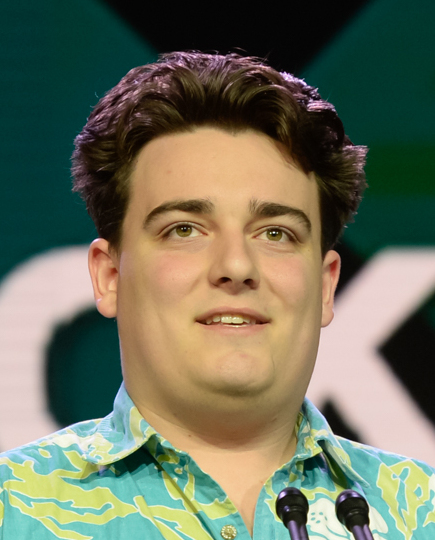
- Image: Palmer Luckey at GDC 2016 (25825558676) (cropped).jpg by Official GDC (CC BY 2.0), via Wikimedia Commons