Poland's Computing Industry: Elwro, the Odra, and the Man Who Went to Breed Pigs
Abstract
Poland broke Enigma before the war and built its first electronic computer, the XYZ, in 1958. For the next fifteen years it had a real computer industry: the Elwro works in Wrocław turned out the Odra mainframes, one of which ran a railway freight yard until 22:00 on 30 April 2010, and a Warsaw engineer named Jacek Karpiński designed the K-202, a 35-kilogram minicomputer that ran close to a million operations a second and was priced to compete with DEC’s PDP-11. The state closed the K-202 project after thirty units, Karpiński went to the countryside to raise pigs, and Poland’s designers were folded into the Soviet-bloc programme of copying IBM. The article follows the country’s computing from the Cipher Bureau to CD Projekt, with the K-202 as its central dead end.
Before the Computer
Poland’s first contribution to computing was mathematical and secret. In 1932 three young mathematicians of the Polish Army’s Cipher Bureau, Marian Rejewski, Jerzy Różycki and Henryk Zygalski, reconstructed the wiring of the German Enigma machine from intercepted traffic and built the bomba, the electromechanical device that Bletchley Park’s bombe later descended from. That story is told in The Polish Cryptologists Who Broke Enigma and Alan Turing and the Enigma; the building in Poznań where the three had trained as students now houses the Enigma Cipher Centre, opened on 25 September 2021. The war then destroyed the country’s universities and killed a large part of its educated class, and Polish computing had to start again from almost nothing after 1945.
The XYZ and the Institute
The first Polish computer to work was the XYZ, completed in 1958 at Śniadeckich 8 in Warsaw by the Academy of Sciences group under Leon Łukaszewicz. Its logic followed a simplified IBM 701 and its electronics used the dynamic flip-flops of the Soviet M-20: about 400 valves and 2,000 diodes, a 680 kHz clock, mercury delay-line memory of 2.25 KiB and a 36 KiB drum, around 1,000 additions and 350 multiplications a second. It had an assembler, a macro-assembler and a high-level language, SAKO, and in 1960 a programmer named Bogdan Miś made it play tic-tac-toe on an oscilloscope for a visiting film crew. The XYZ was the laboratory prototype for the ZAM-2 series that the group, by then the Institute of Mathematical Machines, built in the early 1960s.
Elwro and the Odra
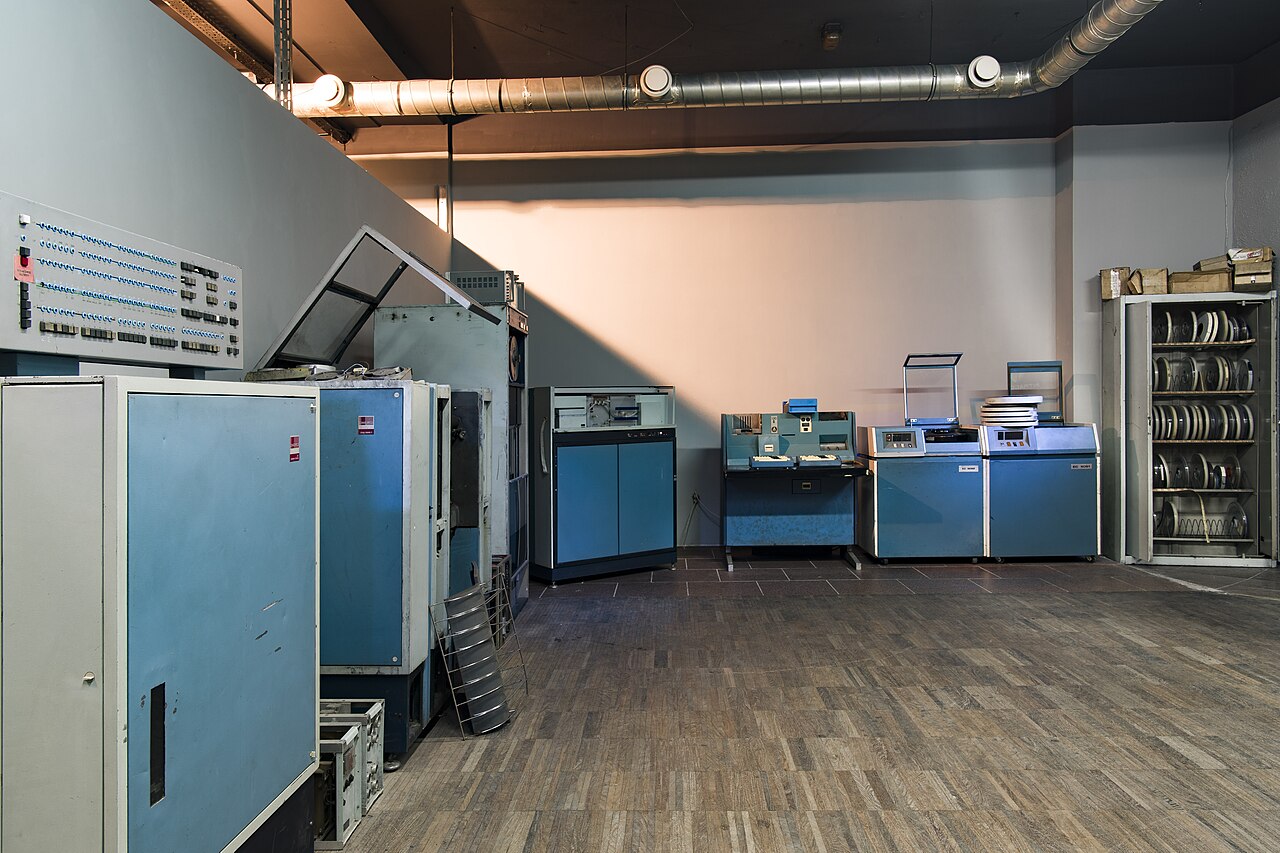
Serial production came from Wrocław. Elwro, the Wrocław Electronic Works, was founded on 6 February 1959, and its first design, the valve-based Odra 1001, was released in December 1960. The transistorised Odra 1002 followed in 1962, capable of 100 to 400 operations a second; that year an Elwro engineer, Witold Podgórski, wrote the game Marienbad on a prototype of the Odra 1003, the plant’s first machine built in numbers, from 1963. Elwro also built twenty-five UMC-1 computers between 1962 and 1965. By 1966 the factory had delivered its hundredth computer and that year built the Odra 1204 with 16K words of core memory.
The decisive step was a licence rather than a design. Elwro reached a software agreement with Britain’s ICL, and the Odra 1304 and Odra 1305, both in production from 1970, were functional counterparts of the ICL 1905 and 1906, able to run the large library of ICL 1900 software; the last model, the 1325, was likewise based on two ICL machines. It gave Polish users Western software on domestic hardware and gave Elwro, at its peak employing up to 6,000 people, a product it could sell across Comecon. The machines were built to last. One Odra 1305 ran the freight yard at Wrocław Brochów railway station until it was switched off at 22:00 on 30 April 2010, and the Katowice museum began recommissioning another in 2017.
Dead End: Karpiński and the K-202
Jacek Karpiński was born in Turin on 9 April 1927, joined the Home Army’s Zośka battalion at fourteen by claiming to be seventeen, took part in the intelligence work for the killing of SS General Kutschera and in the Warsaw Uprising, where a 9 mm bullet lodged in his spine and left him paralysed for a time. He was awarded the Cross of Valour three times. He graduated from the Warsaw Polytechnic in 1951, joined the Academy’s Institute of Basic Technical Problems in 1955, and began building machines: the valve-based AAH harmonic analyser in 1957, the AKAT-1 of 1959, described as the first transistorised differential-equation analyser in the world and now in the Warsaw Museum of Technology, and in 1964 a perceptron, the first known in the Communist bloc. A UNESCO award in 1960 sent him on a year’s tour of about twenty American universities and laboratories. Between 1965 and 1968, with a team of seven at the Academy’s Institute of Physics, he built the KAR-65, a machine for analysing bubble-chamber photographs that ran 100,000 operations a second.
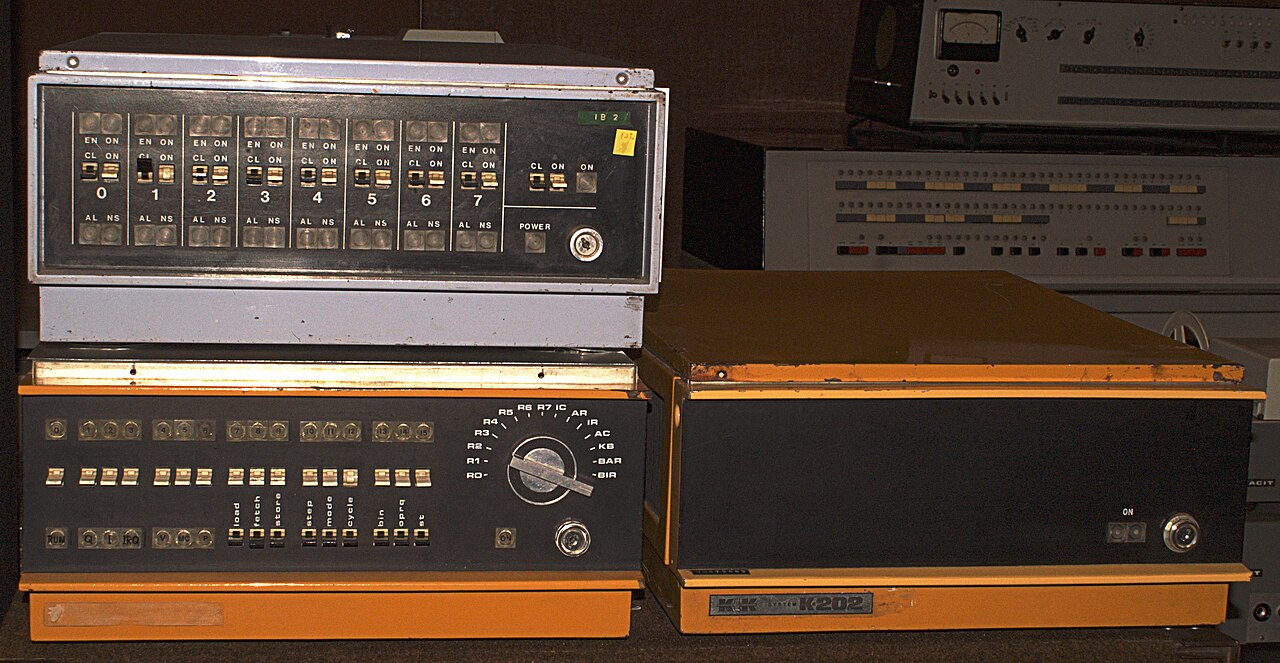
The K-202 was the product of that experience. Designed between 1970 and 1973 with a team that grew to 113, and financed through the British firms Data-Loop and MB Metals because Polish industry would not fund it, it was a 16-bit minicomputer weighing 35 kilograms that ran close to a million operations a second, could work with up to 64 storage devices at once, was compared in the trade press with DEC’s PDP-11 and CTL’s Modular One, and was priced at $6,500 for export. Then the state intervened: the British partners were pushed out, the project was closed and Karpiński was removed. Only thirty K-202s were ever built. The design outlived its designer. The Mera 400, modelled on the K-202 with Elżbieta Jezierska-Ziemkiewicz as chief designer, was built at the Mera minicomputer works in Warsaw from 1976 to 1987, 650 systems by 1985, and at least one was still in use in 2018.
Karpiński left Warsaw in 1978 for a farm near Olsztyn, where he raised pigs and chickens, emigrated to Switzerland in 1981 and came back in 1990 to a country that had stopped building computers. Files opened after 1989 showed that he had also been registered as an informant by the security service from 1961, most actively during his American trip, and that the reporting dried up in the 1970s as he became a target of surveillance himself. He received the Officer’s Cross of Polonia Restituta in 2009 and the Commander’s Cross posthumously; he died in Wrocław on 21 February 2010, ten weeks before the last Odra was switched off in the same city.
The Comecon Turn
What ended independent Polish design was a decision taken in Moscow. Soviet planners proposed a unified, mutually compatible computer series in 1966 and chose the IBM System/360 as the model; cloning began in 1968, production in 1972, the other Comecon countries joined after 1968, and more than 15,000 ES EVM (Ryad) mainframes were eventually built in the USSR, Poland, East Germany, Czechoslovakia, Hungary, Bulgaria and Romania. Elwro’s assigned machine was the R-32 (EC 1032), which its engineers redesigned to fit in one cabinet where the Soviet original took three; a prototype series of six was built in 1973, eight in 1974, and mass production began in 1975. The Odra line was allowed to run down (see Comecon Computing). Poland still made computers, but they were other people’s computers, and by the 1980s the interesting hardware was small: from 1985 to 1990 Elwro built the Elwro 800 Junior for schools, and the home market was served by imported and smuggled ZX Spectrums, Commodores and Ataris sold at Warsaw’s computer bazaars. Elwro was privatised in 1993 and bought by Siemens, which closed the computer works; the site passed to the American firm Telect in 2000, and in 2015 the city named the place ELWRO Square.
After 1989
The computer bazaars produced the next industry. Two teenagers who had sold imported games at one of them, Marcin Iwiński and Michał Kiciński, founded CD Projekt in Warsaw in May 1994, the year Poland extended copyright protection to software; its studio CD Projekt Red released The Witcher in 2007 and made the country a centre of game development (see Estonia and Eastern Europe’s Tech Industry). Kraków, Warsaw and Wrocław became nearshore software centres for Western clients in the 2000s, and Wrocław, the city of the Odra, hosts development offices of the companies whose machines replaced it. The pattern of the Polish case is the opposite of Italy’s: nobody sold the industry, but a planning system that could build a hundred mainframes by 1966 could not tolerate a designer who had raised his own money, and it chose the copy over the original.
📚 Sources
- Jacek Karpiński — Wikipedia
- Elwro — Wikipedia
- Odra (computer) — Wikipedia
- XYZ (computer) — Wikipedia
- Enigma Cipher Centre — Wikipedia
- ES EVM — Wikipedia
- R-32 — Wikipedia (Polish)
- “Elwro – produkcja komputera R-32 (EC 1032)” — historiainformatyki.pl
- Mera 400 — Wikipedia (Polish)
- CD Projekt: Corporate History
- Image: K-202 zestaw.jpg by Topory (CC BY-SA 4.0), via Wikimedia Commons
- Image: SYSTEM ODRA 1305.jpg by MHKII (CC BY-SA 4.0), via Wikimedia Commons