Raph Koster
Abstract
Raph Koster (born 1971) has a master’s degree in poetry and has spent thirty years finding out what happens when thousands of people are put into the same simulated world. He ran a text MUD with his wife from 1994, was lead designer of Ultima Online (1997), the first graphical world to reach 100,000 paying players, and creative director of Star Wars Galaxies (2003), whose player-run economy was the most ambitious ever shipped and whose redesign in 2005 is the industry’s standard example of how to lose your customers. His “Laws of Online World Design” (1998 onward) are aphorisms the field still quotes, and A Theory of Fun for Game Design (2004) argued that fun is the feeling of learning a pattern. He is still building worlds: Stars Reach, from his studio Playable Worlds, crowdfunded on Kickstarter in 2025.
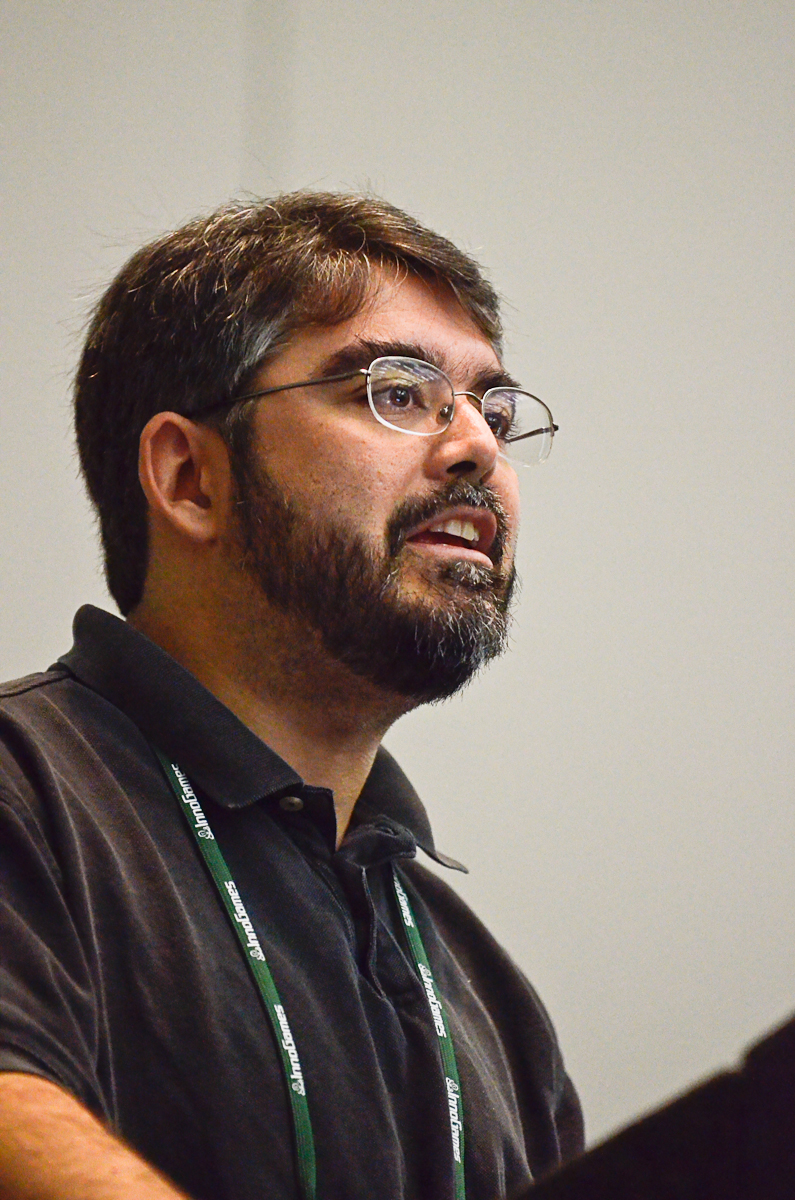
Poetry and LegendMUD
Raphael Koster was born on Long Island on September 7, 1971, and spent six years of his childhood in Peru and time in Barbados and Haiti, where his mother worked for UNICEF. He took a bachelor’s degree in English and Spanish at Washington College in Maryland in 1992 and a master of fine arts in poetry at the University of Alabama in 1995, and while there he and his wife Kristen, with two others, opened LegendMUD in February 1994, a text world set in real historical periods, on the DikuMUD codebase descended from Richard Bartle’s original. The two of them ran it as its administrators, which is where Koster learned the thing his career has been about: a designer of a shared world does not control it, and the interesting design problems are the ones players create for each other.
Ultima Online
Origin Systems in Austin hired him in 1995 for the online game Richard Garriott was producing with Starr Long, and he became its lead designer. Ultima Online, released on September 24, 1997, was the first graphical world built on the MUD model at scale, and Koster’s part of the design was the simulation: a persistent world with an ecology, in which grass fed rabbits and rabbits fed wolves and a player who hunted the deer to extinction would find the wolves coming into town. The ecology never got the chance. Players killed everything faster than the system could respawn it, and it was removed. What survived was the open economy, in which players made and sold most of the goods, the housing, and a design philosophy Koster published in his “designer letters” to the players: that the world’s job was to give people room to make their own stories.
The famous stories were not the intended ones. On August 9, 1997, during a beta event, a player named Rainz cast a fire-field spell on Lord British, Garriott’s supposedly invulnerable avatar, whose immortality had lapsed after a server reset, and killed him in front of the crowd. Player killing was so pervasive that in May 2000 the world was split into Trammel, where fighting required consent, and Felucca, where it did not; most players moved to Trammel and the game’s population grew. Electronic Arts had planned for 15,000 subscribers. There were 100,000 within six months and about 250,000 at the peak in 2003. The genre it started is in MMORPGs and Virtual Worlds.
Koster began writing down what he had learned. “The Laws of Online World Design”, compiled from 1998 and presented at the Game Developers Conference in 1999, is a list of rules with attributions, some his, some from Bartle and the MUD administrators’ lists: that players will optimise the fun out of a game if allowed; that any system can be gamed; that the players own the world’s culture, not the designers; that if you give players a means of communication they will use it to organise against you. It is still assigned reading.
Star Wars Galaxies
Sony Online Entertainment hired him in 2000 as creative director of Star Wars Galaxies, released on June 26, 2003. It was the largest attempt yet to make a world run on its players: 34 professions in interlocking skill trees, no character classes, a crafting economy in which almost every item was made by a player from resources whose quality varied across planets, entertainers who healed the wounds of combat in cantinas, cities that players founded and governed. A million boxes had sold by 2005. Koster became chief creative officer of Sony Online in 2003 and left in 2006. Between those dates the company decided the game was too complicated for the Star Wars audience it wanted. The Combat Upgrade of April 2005 rebuilt the fighting system, and the New Game Enhancements of November 15, 2005, announced with two weeks’ notice, cut the 34 professions to nine, made Jedi a starting choice, and discarded most of what the existing players had spent two years building. Subscriptions collapsed; Sony’s president later called the changes stupid decisions. The servers closed on December 15, 2011. Koster has written that he opposed the NGE and that it is the reason his name is attached to both the most ambitious and the most cautionary MMO of the decade.
Theory of Fun
A Theory of Fun for Game Design (2004) was drawn from a lecture and illustrated with his own cartoons. Its argument: a game is a pattern the brain wants to learn, fun is the pleasure of learning it, and boredom is what a game becomes once the pattern has been mastered. That reframed game design as a branch of teaching and gave designers a vocabulary for why a game stops being interesting. The book is on most game-design syllabi.
He founded Areae in 2006 and built Metaplace, a platform on which anyone could make a small virtual world in a browser; it opened in 2009, closed in January 2010, and the company was sold to Playdom, then Disney, where Koster stayed until 2013. In 2018 he and Eric Goldberg founded Playable Worlds near San Diego to build a cloud-native MMO with simulated ecology and player-governed planets, which is Ultima Online’s original design with twenty-five years of hardware behind it; Stars Reach raised about $750,000 on Kickstarter in 2025. He received the Game Developers Choice Online Awards’ Online Game Legend award in 2012 and keeps a long-running blog at raphkoster.com in which he continues to explain online worlds to the people who play them.
📚 Sources
- Raph Koster — Wikipedia
- Ultima Online — Wikipedia (the September 24, 1997 release, Koster as lead designer, the ecology that players hunted out, the August 9, 1997 death of Lord British, the May 2000 Trammel/Felucca split, EA’s 15,000 projection, 100,000 in six months and 250,000 by 2003)
- Star Wars Galaxies — Wikipedia (the June 26, 2003 release, 34 professions, a million boxes by 2005, the April 2005 Combat Upgrade and November 15, 2005 NGE, Smedley’s comment, the December 15, 2011 shutdown)
- Koster, Raph — “The Laws of Online World Design”, raphkoster.com
- Koster, Raph — A Theory of Fun for Game Design, Paraglyph Press, 2004 (2nd ed. O’Reilly, 2013)
- LegendMUD — Wikipedia (the February 1994 opening with Kristen Koster)
- About Raph — raphkoster.com (Peru, Barbados and Haiti, Metaplace in 2006, the 2012 Online Game Legend award)
- Koster, Raph — “Tired of hearing about the NGE”, 2007
- “Stars Reach’s final Kickstarter haul inches past $750,000”, Massively Overpowered, March 27, 2025
- Playable Worlds — company site
- Image: Raph Koster - Game Developers Conference Online 2012 - 04.jpg by Official GDC (CC BY 2.0), via Wikimedia Commons