MMORPGs and Virtual Worlds
Abstract
In 1978 two students at Essex University wired a text adventure to a network so several people could play at once, and called it a Multi-User Dungeon. That idea, a persistent shared world that keeps running whether you are logged in or not, grew from telnet text on university mainframes into graphical worlds holding hundreds of thousands of players, then millions. Along the way these games produced things their designers never intended: real economies with currencies stronger than national ones, a labor market of Chinese gold farmers, player-run governments and 21-hour wars costing real money, and the first serious question of what laws apply inside a place that exists only on a server. The subscription MMORPG peaked with World of Warcraft and then faded, but the persistent online world it proved out is now how most large games are built.

The Word Was Dungeon
The genre has a precise birthday. In 1978 Roy Trubshaw, a student at Essex University in England, wrote a multiplayer adventure game in assembly language for a DEC PDP-10, then rewrote it in BCPL, the language that led to C. He called it MUD, for Multi-User Dungeon, after the “Dungeon” variant of Zork he had enjoyed (see Colossal Cave, Zork, and Interactive Fiction). In 1980 Trubshaw handed the game to a fellow student, Richard Bartle, who built out the world, the puzzles, and the rules. Essex MUD, later called MUD1, ran on the university network until late 1987, reachable from outside once the machine was connected to early packet networks. Players typed commands, read rooms described in prose, killed monsters and each other, and, crucially, did it together in a world that persisted between sessions.
The shared-world idea was not wholly new. On the PLATO education system in Illinois, students had been writing multiplayer dungeon crawls like dnd, Oubliette, and Avatar since the mid-1970s. What MUD added was a name, a networked home outside a single closed system, and a design that other people could copy. And copy it they did.
The Codebase Explosion
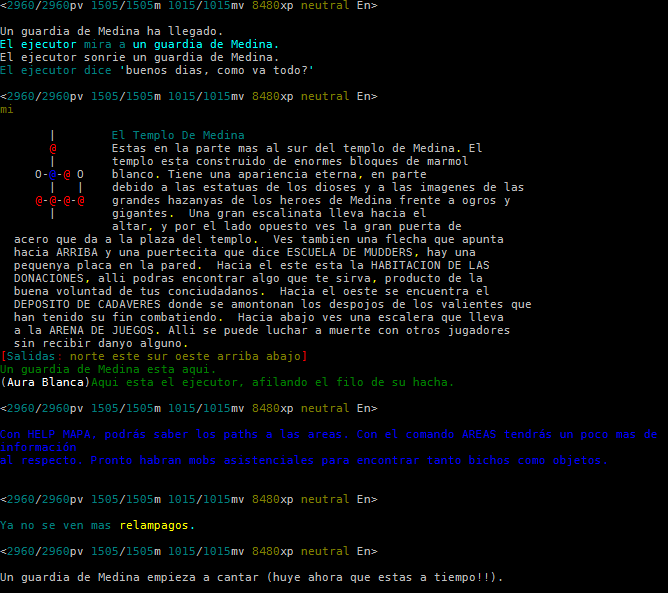
MUD spread the way software spreads: someone rebuilds it, gives the code away, and the code branches. The first widely shared codebase was AberMUD, written in 1987 by Alan Cox (later a central Linux kernel developer) and named for the University of Wales, Aberystwyth. Cox had played Essex MUD; his version was first written in the language B for a Honeywell mainframe, then ported to C in 1988, which let it spread across Unix machines everywhere.
AberMUD seeded a family tree. LPMud (1989), by the Swedish student Lars Pensjö, added a built-in programming language, LPC, so that the people running a world could script new rooms and creatures without touching the server core, turning players into designers. DikuMUD (1990–1991), written at the Department of Computer Science at the University of Copenhagen (Datalogisk Institut Københavns Universitet, hence “Diku”), took the opposite approach: a fixed, combat-focused, class-and-level design that was easy to run and instantly familiar. The Diku model of levels, hit points, character classes, and monster “spawns” became the template that graphical games would inherit almost unchanged. A separate branch, TinyMUD and later MOOs, dropped the combat entirely and built social spaces where players talked, role-played, and constructed rooms out of text, worlds that were societies rather than games.
By the early 1990s there were hundreds of MUDs running on university machines, mostly for free, mostly unofficial, and the entire vocabulary of the online game, guild, raid, level grind, spawn, nerf, was already in place before the graphics arrived.
Bartle’s Four Players
Bartle did more than build the first MUD; he wrote the theory that named its players. In a 1996 essay, “Hearts, Clubs, Diamonds, Spades: Players Who Suit MUDs,” he divided players into four types by what they wanted from a world: achievers chasing goals and levels, explorers mapping the systems, socialisers there for other people, and killers who enjoyed acting on others, usually by fighting them. The insight was that a world’s design decides which types thrive and which leave, and that the mix is unstable: too many killers drive off the socialisers, whose departure eventually starves the killers of prey. The “Bartle taxonomy” became a standard tool of game design, cited far outside the MUDs it described, because it framed an online world as a social ecology to be balanced rather than a game to be won.
The Worlds Get Faces
Graphics turned a campus hobby into an industry. Meridian 59 (1996) is generally credited as the first 3D graphical MUD sold commercially. The breakout was Ultima Online, launched on 24 September 1997 by Origin Systems, designed by Raph Koster under Ultima creator Richard Garriott. Ultima Online put players into a shared, top-down medieval world with a simulated ecology and an open economy, and reached about 250,000 subscribers by 2000. Garriott is usually credited with coining the term MMORPG, massively multiplayer online role-playing game, to describe it.
Ultima Online also learned the first hard lessons of running a society. Its designers had tried to model a living world, with resources that could be depleted and animals that bred; players optimized and broke every system, hunted the ecology to collapse, and killed each other so relentlessly that the developers had to split the world into safe and lawless zones. The famous test came when a scripted assassination of Lord British, Garriott’s in-game avatar, went wrong at a public event and a player killed the supposedly invulnerable god-king. The world did what players make worlds do.
EverQuest (Sony Online Entertainment, March 1999) rendered the Diku formula in first-person 3D and made it a mass habit. Its world, Norrath, demanded enormous time, grouping, and travel, and rewarded it with progression and status; players nicknamed it “EverCrack.” It passed Ultima Online within a year and peaked around half a million subscribers, and it set the shape, the raid, the loot table, the server community, that the next game would scale up.
Warcraft and the Mass Market

World of Warcraft, released by Blizzard Entertainment on 23 November 2004, took everything EverQuest had proven and made it accessible enough for people who had never touched a MUD. It smoothed the punishing parts, kept the social hooks, and grew without an obvious ceiling. WoW passed 12 million subscribers by October 2010, holding a Guinness record for the largest MMORPG, and generated over a billion dollars a year in subscriptions. Its 40-player, later 25- and 10-player, raids became scheduled social institutions; guilds ran raid nights like sports teams ran practice, and players arranged their real weeks around virtual commitments (see The Video Game Industry).
Mass scale brought the first mass problems. Researchers and clinics documented players neglecting work, relationships, and health for progression; “MMO addiction” entered public debate, and China imposed real-name registration and playtime limits for minors. The escapism that Second Life explored as a non-game virtual world found its mass-market form in a game with levels and a subscription.
Economies That Left the Game
The strangest thing these worlds produced was real money. In 2001 the economist Edward Castronova studied EverQuest’s Norrath and calculated, from the real prices players paid each other for virtual goods, that Norrath had a gross national product per capita between that of Russia and Bulgaria, and that its currency traded stronger than the Japanese yen. Time spent in a game world was producing value that leaked into the real economy at measurable exchange rates.
That leak became an industry. Gold farming, playing an MMO as wage labor to harvest currency and items for resale to other players, grew into a business estimated in the hundreds of millions to over a billion dollars, with an estimated 80% or more of farmers working in China, often in shifts in small workshops. Brokers like IGE (Internet Gaming Entertainment) built companies on the trade, most of their revenue coming from World of Warcraft gold, until game publishers fought real-money trading and Chinese in-game traders undercut them. Blizzard banned the practice; it never stopped it.
No world took the economy further than EVE Online (CCP Games, May 2003). EVE runs almost all of its players in a single shared universe, a “single shard” of over 7,000 star systems, rather than splitting them across copies. Its economy is almost entirely player-made: players mine, manufacture, trade, and set prices, and CCP employs economists to watch inflation. Its politics are player-made too, with alliances controlling territory, running espionage, and fighting wars over it. In January 2014 the Battle of B-R5RB, triggered by a single missed rent payment on a star system, ran 21 hours, drew over 7,500 players, and destroyed virtual ships whose in-game cost translated to an estimated $300,000 in real terms, at the time the largest and most expensive battle in gaming history.
Virtual Societies and Their Laws
Once thousands of people share a persistent space, the questions stop being about games. The point was made early. In 1993, in the text-based LambdaMOO, a user calling himself Mr. Bungle used a scripted tool to force other players’ characters into violent acts against their will; the journalist Julian Dibbell wrote it up as “A Rape in Cyberspace,” and the community’s argument over how to respond, and its eventual decision to expel him, was one of the first cases of an online world confronting the need for governance, justice, and law of its own. EVE’s players elect a Council of Stellar Management that formally advises the developer. Every large virtual world eventually grows a politics, because a place where people spend years accumulating property and reputation is a place where power, fairness, and rules come to matter as much as they do anywhere else.
What Happened to the Genre
The subscription MMORPG as a category peaked and declined. World of Warcraft shed subscribers after 2010; most challengers that spent hundreds of millions to build “WoW killers” failed to hold players and converted to free-to-play with item shops. The dedicated persistent-world-as-your-whole-hobby model narrowed to a devoted core in games like EVE and Final Fantasy XIV.
But the idea won by dissolving into everything else. The persistent online world, the shared server, the live economy, the social progression, and the always-running world that MUDs invented on university mainframes are now standard equipment. Live-service games, battle royales, Fortnite, Roblox, and Minecraft servers, and the whole “metaverse” pitch are the MUD idea at consumer scale, usually without the label. The genre that looked like it had faded had actually become the default. A design first typed out in BCPL at Essex in 1978 turned out to describe how online play would work for everyone.
📚 Sources
- Multi-user dungeon — Wikipedia (MUD1, AberMUD, LPMud, DikuMUD, TinyMUD/MOO lineage)
- MUD1 — Wikipedia (Trubshaw, Bartle, Essex University, 1978–1987)
- Richard Bartle, “Hearts, Clubs, Diamonds, Spades: Players Who Suit MUDs” (1996) — the player taxonomy
- Ultima Online — Wikipedia (1997, Koster/Garriott, subscriber peak, MMORPG term)
- EverQuest — Wikipedia (1999, Norrath, subscriber figures)
- World of Warcraft — Wikipedia (23 November 2004 release; 12 million subscribers, October 2010)
- Most popular subscription-based MMORPG videogame — Guinness World Records
- Edward Castronova, “Virtual Worlds: A First-Hand Account of Market and Society on the Cyberian Frontier” (2001) — Norrath’s GNP
- Gold farming — Wikipedia (China, real-money trading, IGE)
- Eve Online and Battle of B-R5RB — Wikipedia (single-shard economy, 2014 war)
- Julian Dibbell, “A Rape in Cyberspace”, The Village Voice (1993) — LambdaMOO governance
- Image: Richard Bartle, 2011 (cropped).jpg by J. G. Bartle (CC BY-SA 3.0), via Wikimedia Commons
- Image: Captura mud.png by GozerBCN (CC BY-SA 4.0), via Wikimedia Commons