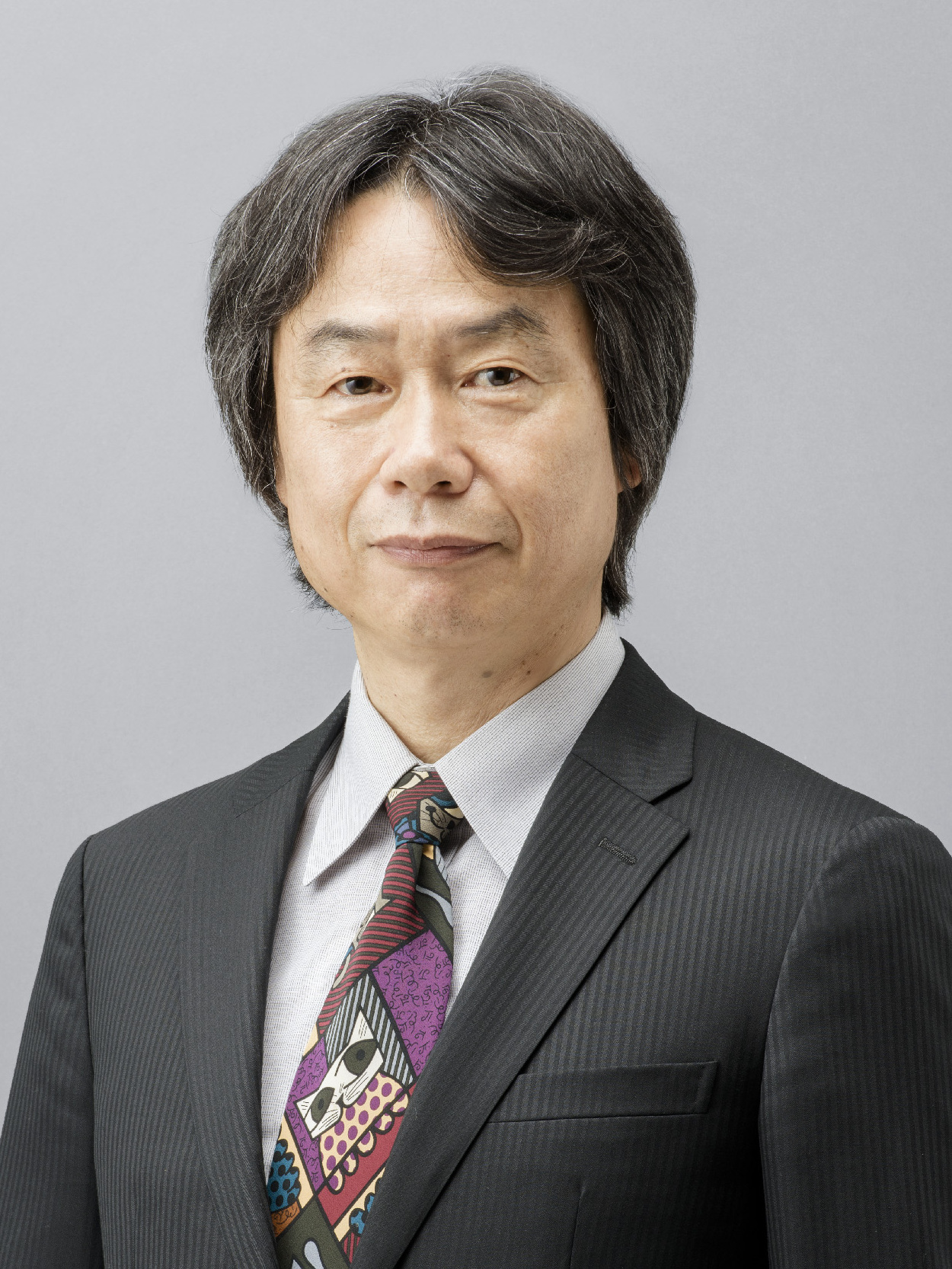
Shigeru Miyamoto
Abstract
Shigeru Miyamoto (born 1952) joined Nintendo in 1977 as its first staff artist, with a degree in industrial design and no programming skills. Told in 1981 to make something out of two thousand unsold arcade cabinets, he designed Donkey Kong, and with it Mario. Super Mario Bros. (1985) and The Legend of Zelda (1986) set the conventions of the side-scrolling platform game and the open adventure; Super Mario 64 (1996) did the same for movement in three dimensions. He has been at Nintendo for nearly fifty years.
Sonobe
Miyamoto was born on 16 November 1952 in Sonobe, a rural town in Kyoto Prefecture, where his father taught English. The family had no television for much of his childhood, and he spent his time outdoors. He has often told the story of finding the mouth of a cave in the hills near his home and returning several days in a row before he had the courage to go in with a lantern.
He wanted to draw manga. He studied industrial design at the Kanazawa municipal art college, took five years over it, and graduated without a job. His father knew Hiroshi Yamauchi, the president of Nintendo, and arranged an interview in 1977. Miyamoto brought toys he had designed, among them clothes hangers for children in the shape of animals. Yamauchi hired him as an apprentice in the planning department. Nintendo had engineers; he was the first person employed there to draw.
Radar Scope
His early work was cabinet art and casings. In 1980 Nintendo’s new American subsidiary ordered three thousand cabinets of an arcade shooter called Radar Scope. By the time they arrived by ship the game was stale, and about two thousand sat unsold in a warehouse near Seattle. The subsidiary asked Kyoto for a new game that could be installed in the same cabinets. The engineers were busy, so Yamauchi gave the job to Miyamoto, with Gunpei Yokoi to supervise and a contractor to do the programming.
Miyamoto first wanted to use Popeye, Bluto, and Olive Oyl; Nintendo could not get the licence in time. He kept the triangle and replaced the cast with a carpenter, a gorilla, and a woman to be rescued. Because he could not write code, he approached the game as a designer of a product a person would handle. He drew the characters first and worked out a story with a beginning and a sequence of scenes, which arcade games did not then have. The hardware set the hero’s appearance: a cap, because hair was hard to animate in a few pixels, a moustache to make the face readable, and overalls so that the arms showed against the body.
Donkey Kong reached American arcades in 1981 and was Nintendo’s first hit there. The carpenter, called Jumpman in the instructions, was renamed Mario after Mario Segale, the landlord of the Seattle warehouse.
Mario and Zelda
In 1984 Miyamoto was put in charge of a new development group, later called Entertainment Analysis & Development, which he led until 2015. Its first two large projects were made side by side by a team of a handful of people.
Super Mario Bros. (1985) was a game about running and jumping through a world several screens wide that scrolled as the player moved. Its first minute is a much-studied piece of design. The player starts at the left of an empty screen facing right. The first enemy walks slowly toward him, and the only way to survive is to jump. The first block, when hit from below, releases a mushroom that slides away, bounces off a pipe, and comes back, so that the player almost cannot avoid learning what it does. Nothing is explained in words. Bundled with Nintendo’s console in North America, it sold more than forty million copies and remained the best-selling video game for over two decades (see The Video Game Industry).
The Legend of Zelda (February 1986) was the opposite experiment. The player is put in the middle of a landscape with no instructions and no fixed route, and has to explore. Miyamoto has traced it to the hills and the cave at Sonobe, and described what he was after as a miniature garden that players could keep in a drawer. The American cartridge contained a battery so that progress could be saved, which made a game lasting dozens of hours practical on a console.
His stated working method starts with how a thing feels in the hand. For Super Mario 64 (1996), the team spent months on Mario’s movement in an empty test area with the new analog stick before building any levels. That game, and The Legend of Zelda: Ocarina of Time two years later, established how a character and a camera are controlled in a three-dimensional space, including the device of locking the view onto an opponent.
He is also known inside Nintendo for a habit his colleagues call chabudai gaeshi, upending the tea table: looking at a project late in development and requiring that it be redone.
Myth: “A delayed game is eventually good, but a rushed game is forever bad”
The best-known Miyamoto quotation has no source in anything he is recorded as saying. The games researcher Kate Willaert traced it to the Computer Game Developers Conference of 1996, where the designer Ellen Guon said that “a game is only late until it ships, but it’s bad forever” and credited the line to her partner Siobhan Beeman, a former project director at Origin Systems. Beeman has confirmed the phrasing as hers. The earliest attribution to Miyamoto that Willaert found is a Usenet post of 2003. See Myths and Misconceptions.
From Hobbies
Many of his later games started from something in his own life. Pikmin (2001) came from watching ants in his garden, Nintendogs (2005) from getting a dog, Wii Fit (2007) from weighing himself every day. He was closely involved in the design of the Wii and its motion controller, and Wii Sports (2006), sold with the console in most countries, overtook Super Mario Bros. as the best-selling game. The reasoning was the one behind the first screen of Super Mario Bros.: a person who has never held a controller should know what to do within seconds.
The record is not all hits. The Wii U (2012), with a screen in its controller, sold poorly, and several of his projects for it were received coolly. He has said that he judges a game by sitting behind people while they play it and watching their faces.
Since 2015
When Nintendo’s president Satoru Iwata died in July 2015, Miyamoto and Genyo Takeda ran the company as acting representative directors until a successor was named in September. He was then given the title Creative Fellow and withdrew from the direction of individual games.
His work since has been outside games. He oversaw the design of the Super Nintendo World theme-park areas at Universal Studios, and he co-produced The Super Mario Bros. Movie (2023) with the animation studio Illumination, thirty years after an earlier live-action Mario film that Nintendo had licensed and regretted.
The Academy of Interactive Arts & Sciences made him the first member of its Hall of Fame in 1998. He received a BAFTA Fellowship in 2010 and Spain’s Prince of Asturias Award in 2012, and in 2019 he became the first person from the games industry to be named a Person of Cultural Merit by the Japanese government. In October 2026 he was also the first from the industry to be chosen for the Order of Culture, presented on Culture Day, 3 November.
📚 Sources
- Wikipedia: Shigeru Miyamoto (finding aid: birth, Sonobe, the cave, Kanazawa, the 1977 interview, Radar Scope, the Popeye licence, Segale, EAD from 1984 to 2015, the “miniature garden”, Pikmin, Nintendogs, acting representative director in 2015, Creative Fellow, honours, Willaert’s tracing of the “delayed game” quotation)
- Willaert, Kate: “Solved: Miyamoto’s ‘a late game is only late until it ships’ quote”, A Critical Hit (the 1996 conference transcript, Guon and Beeman, Beeman’s confirmation, the 2003 Usenet attribution to Miyamoto)
- Paumgarten, Nick: “Master of Play” (online title “Nintendo’s Guiding Spirit”), The New Yorker (20 December 2010)
- Aaron Astle: “Mario creator Shigeru Miyamoto named first games industry recipient of Order of Culture award”, PocketGamer.biz (26 October 2026) and My Nintendo News (23 October 2026) (the Order of Culture)
- Image: Shigeru Miyamoto 20150610 (cropped).jpg by Japanese Minister’s Secretariat Personnel Division (CC BY 4.0), via Wikimedia Commons
- The account of Radar Scope, the cabinets, and the naming of Mario follows Nintendo: A Century of Play and the sources cited there.