The History of the Video Game Industry
Abstract
The video game industry is larger today than cinema and recorded music combined, with annual revenues exceeding $180 billion. It began as a bar trick. Pong in 1972 was not a planned product but a test assignment given to a new hire to see if he could program. What followed was an industry that collapsed spectacularly within a decade, was rescued by a Japanese playing-card company, fragmented into console wars, expanded into three dimensions, created entirely new business models, moved to mobile devices carried in every pocket, and eventually produced cultural artifacts (Minecraft, The Witcher, Dark Souls) whose complexity, scope, and emotional resonance rival any other artistic medium. The story of how that happened is simultaneously a story about technology, business strategy, platform power, and the peculiar human desire to inhabit imaginary worlds.
The Prehistory: Before the Industry Existed
The first video games were made by people who did not think of themselves as game designers. Willy Higinbotham, a physicist at Brookhaven National Laboratory, created Tennis for Two in 1958 on an oscilloscope as an exhibit to make the laboratory more interesting to visitors. He never patented it and never considered it commercially significant. Steve Russell at MIT programmed Spacewar! in 1962 on a PDP-1 minicomputer (the first computer game to spread to multiple machines) as a demonstration of interactive real-time computing. Russell was uninterested in profit; he gave the code away to anyone who asked.
The commercial instinct came from Nolan Bushnell. An engineering student who had worked in amusement arcades to pay tuition, Bushnell recognized in Spacewar! not a technical demonstration but an entertainment product, and a business model. His first attempt, Computer Space (1971), was technologically original but commercially unsuccessful: too complicated for the bar audiences who encountered it. His second attempt defined an industry.
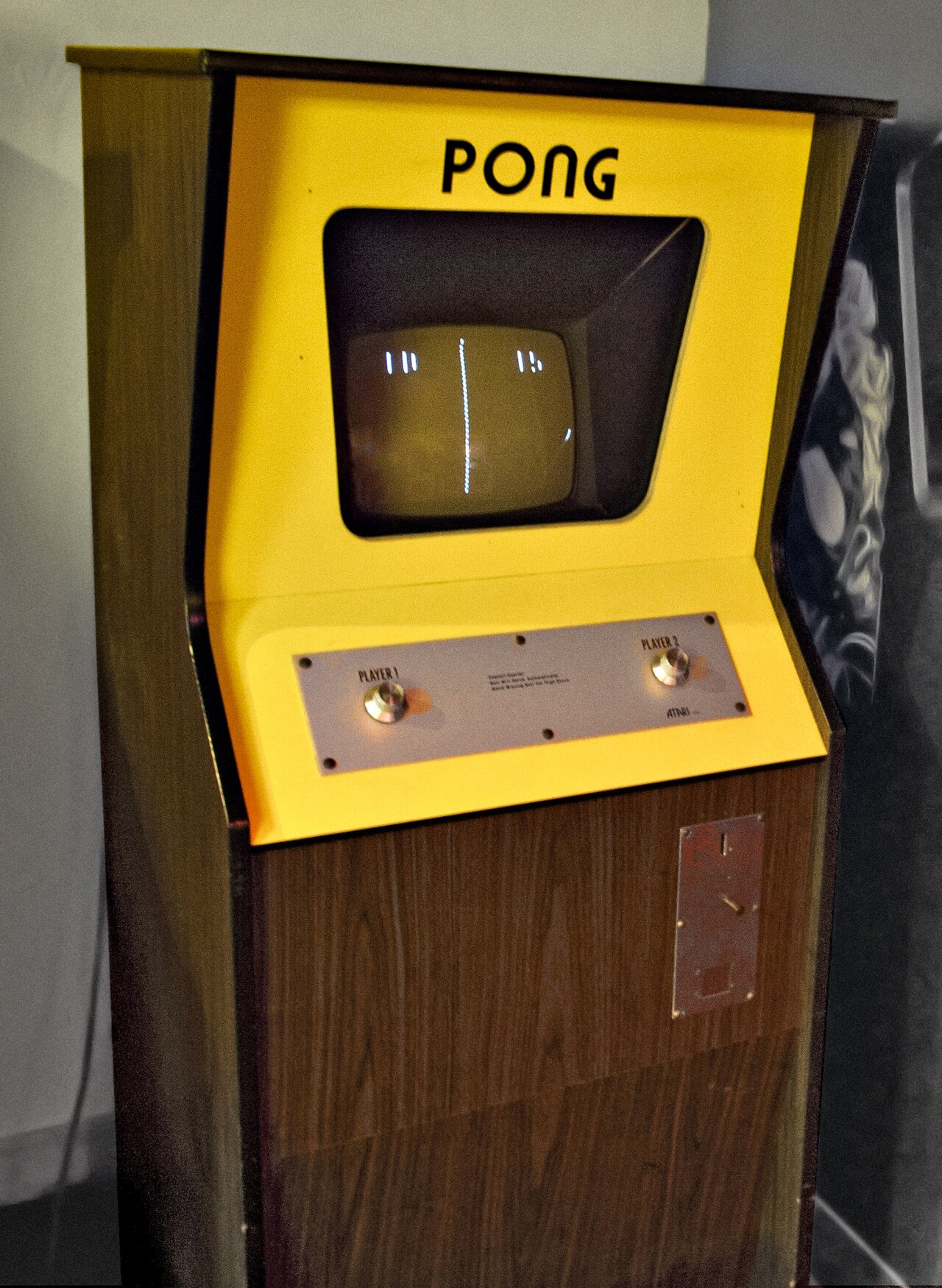
Pong (1972) was designed not by Bushnell but by Allan Alcorn, a new hire whom Bushnell assigned the task as an engineering exercise, officially to learn game programming, actually as an informal audition. The result was brutally simple: two paddles, a ball, a score. When Bushnell installed the first prototype in Andy Capp’s Tavern in Sunnyvale, California, it collected so many quarters that it broke down within two days, the coin box was full. Atari, the company Bushnell and Ted Dabney had founded that year, went into production.
The Arcade Era and the First Boom
The arcade (a commercial space dedicated to coin-operated games) became the first major cultural institution of the video game industry. Space Invaders (Taito, 1978) created lines around city blocks and became a genuine cultural phenomenon in Japan. Pac-Man (Namco, 1980) was the first game to break out of the young male demographic: its non-violent premise and colorful characters attracted women and children who had avoided the space shooter genre. Donkey Kong (Nintendo, 1981) introduced Jumpman, later renamed Mario, a character who would become the most recognized video game character in history.
Myth: Space Invaders caused a national 100-yen coin shortage
The most-repeated Space Invaders story (that the game was so popular it drained Japan of 100-yen coins, forcing the Mint to ramp up production) is an urban legend. Japan did mint far more 100-yen coins in 1979 (+76%) and 1980 (+65%), but from an unusually low 1978 baseline, and numismatic research ties the increase to coin hoarding and melting after Japan switched the 100-yen coin from silver to cupronickel in 1967, not to arcades. Arcade operators emptied their cabinets regularly, keeping the coins in circulation, and residents reported nothing unusual in everyday cash supply at the time. See Myths and Misconceptions.
The economics of the arcade were straightforward: the operator owned the cabinet, the player paid per play, and the game developer received licensing fees. This model produced short, difficult games deliberately designed to consume quarters; player skill was valuable because it meant fewer coins spent per session, but the machine needed to generate revenue from average players, not masters.
Atari became, briefly, the fastest-growing company in American history. By 1982 it had revenues of $2 billion and employed 9,000 people. Time Magazine ran a cover story on the video game boom. Industry analysts projected continued exponential growth.
The Home Console: Atari 2600
The transition from arcade to home began with the Atari 2600 (1977), a console built around the removable cartridge, software separate from hardware, allowing the same machine to run different games. The Fairchild Channel F had introduced the ROM cartridge a year earlier, but it was the 2600 that turned the concept into a mass market; before the cartridge, home gaming devices had their games built in.
The Atari 2600 established the platform model that would define the industry for forty years: a hardware manufacturer creates a platform, sets technical standards, and controls (or fails to control) what software runs on it. Atari’s failure was the absence of quality control. When the console succeeded, third-party developers flooded the market: Activision (founded in 1979 by defecting Atari programmers) produced high-quality titles, but hundreds of other publishers produced games as quickly and cheaply as possible, relying on Atari’s brand to sell boxes to parents who could not evaluate game quality before purchase.
The market saturation problem was compounded by two high-profile failures. The Atari 2600 port of Pac-Man (1982) was technically degraded beyond recognition from the arcade original; Atari had licensed it as a system seller, produced 12 million cartridges for a console with 10 million owners, and shipped something that embarrassed the platform. E.T. the Extra-Terrestrial (1982) repeated the pattern at higher cost: Atari paid a reported $20–25 million for the film license in a deal closed in late July 1982, which left developer Howard Scott Warshaw just over five weeks to finish the game by a September 1 production deadline for the Christmas season. The result was nearly unplayable. In 1983 Atari dumped roughly 700,000 unsold cartridges of E.T. and other overproduced titles in a New Mexico landfill as a warehouse clear-out and tax write-off, a story that grew into the legend of “millions of buried E.T. cartridges” before a 2014 excavation confirmed the burial and its more mundane scale (see the myth callout in Nolan Bushnell and Atari).
The North American video game market collapsed from $3.2 billion in 1983 to $100 million in 1985. Retailers pulled gaming sections from stores. Industry analysts declared the home console a failed format.
Nintendo and the Rescue
Nintendo had been manufacturing playing cards since 1889 and had diversified into toys, light-gun shooting ranges, and arcade games by the late 1970s. Its Famicom (Family Computer), released in Japan in July 1983, was a technically superior platform with a feature Atari had lacked: a licensing system that required third-party developers to meet quality standards before Nintendo would manufacture their cartridges.
The American market required a different approach. The word “video game” was toxic after the crash. Nintendo rebranded the Famicom as the Nintendo Entertainment System (NES) and marketed it not as a game console but as an “entertainment system” bundled with a toy robot (R.O.B.) and presented in packaging that suggested an electronics appliance rather than a toy. Retailers who had refused to stock game consoles agreed to carry it.
The game that saved the industry was Super Mario Bros. (1985), designed by Shigeru Miyamoto. Miyamoto (an industrial design graduate who had come to Nintendo as an artist and been asked to design Donkey Kong) had developed a set of design principles that were almost entirely unprecedented: games should introduce mechanics gradually, through play rather than instruction; difficulty should increase at a rate calibrated to player skill development; every level should contain something new to discover. Super Mario Bros. sold 40 million copies and established platformers as the defining genre of the 8-bit era.
Miyamoto’s companion title The Legend of Zelda (1986 in Japan on the Famicom Disk System; its 1987 Western cartridge release popularized battery-backed saving) let players leave and return to a game in progress. Zelda was an open world: players could approach challenges in any order, and the map rewarded exploration rather than linear progression. The design philosophy Miyamoto articulated (reward curiosity, not speed) shaped game design for decades.
Info
Nintendo’s quality licensing system (the “Nintendo Seal of Quality”) was enforced not through technical means but through manufacturing control. Nintendo owned the chip fabrication for cartridge lock-out hardware and would not manufacture cartridges for titles that failed quality review. This gave Nintendo a quality gatekeeping power that Atari had lacked. The tradeoff was developer resentment: Nintendo’s licensing terms were strict, royalties were high, and developers were prohibited from releasing the same title on competing platforms. The tension between platform control and developer freedom that started with Nintendo in the 1980s continues with Apple’s App Store in the 2020s.
The Console Wars: Sega vs. Nintendo
The 1980s console market belonged entirely to Nintendo, in the United States, Nintendo controlled over 90% of the market. The competitive challenge came from Sega, a coin-operated game manufacturer that had been producing arcade titles (including the early hit Zaxxon) and had entered the home console market with the Master System.
The decisive confrontation came with the Sega Genesis (1988, called Mega Drive outside North America), a 16-bit console that outperformed the aging NES hardware. Sega’s marketing strategy was built on one word: attitude. Where Nintendo’s brand was family-friendly and carefully protected, Sega positioned itself as edgier, faster, and aimed at teenagers rather than children. The advertising slogan “Genesis Does What Nintendon’t” was a direct attack, unprecedented in the games industry, which had no precedent for companies attacking competitors by name.
The character embodying this positioning was Sonic the Hedgehog (1991), designed by Yuji Naka and Naoto Ohshima as a direct response to Mario: fast where Mario was methodical, cool where Mario was friendly, set in a world of loops and ramps where speed itself was the reward. Sonic sold 15 million copies and gave Sega the credibility to challenge Nintendo’s dominance.
The Super Nintendo Entertainment System (SNES, 1991) reestablished Nintendo’s technical lead with superior graphics capabilities, a better sound chip, and a launch lineup anchored by Super Mario World. The console war that followed (Genesis vs. SNES) was the first genuine platform competition in the history of the medium, complete with partisan allegiances, schoolyard arguments, and marketing so aggressive it eventually attracted Congressional hearings.
The hearings, in 1993, focused on violent game content, specifically Mortal Kombat, a fighting game that included graphic fatalities and had been released in versions for both consoles, with the SNES version sanitized and the Genesis version intact. The hearings produced the Entertainment Software Rating Board (ESRB), the industry’s self-regulatory ratings system, created in 1994 to forestall government-mandated censorship.
Sony Enters: The PlayStation Revolution
The most consequential decision in Nintendo’s history was a deal it did not make. In 1988, Nintendo signed an agreement with Sony to develop a CD-ROM add-on for the SNES, called the “Play Station.” In 1991, Nintendo announced it was abandoning the deal and partnering with Philips instead, a decision motivated by concerns about the contract terms, which gave Sony significant control over CD-ROM software. Sony president Norio Ohga was furious. He authorized the development of an independent Sony game console.
The PlayStation launched in Japan in December 1994 and in North America in September 1995, priced at $299 against Sega Saturn’s $399. The pricing was partly a calculated attack (Sony had reportedly learned Sega’s price before announcing its own) but the technical architecture was more important than the cost. The PlayStation used a CD-ROM format that reduced software manufacturing costs dramatically compared to cartridges and made developers’ storage constraints essentially irrelevant. Where a SNES cartridge held at most 4 to 6 megabytes, a PlayStation CD held 650 megabytes.
The storage capacity enabled a new kind of game. Final Fantasy VII (Square, 1997), three CDs, 40+ hours of play, pre-rendered cinematic cutscenes, a story explicitly aimed at adult emotional engagement, demonstrated that video games could be a narrative medium. It sold 10 million copies worldwide and attracted players who had never previously owned a console. The PlayStation became the first console to sell over 100 million units.
Sega’s response (the Saturn) was technically ambitious but architecturally complex: a dual-CPU design that was difficult to program and produced games that looked worse than PlayStation versions at the same price point. Sega’s internal structure, divided between Japanese and American divisions with conflicting visions of the platform’s direction, produced contradictory decisions: the Saturn launched in the US in May 1995 with a surprise announcement at the Electronic Entertainment Expo (E3), four months early, available only through three chosen retail chains (about 1,800 Toys “R” Us, Software Etc., and Electronics Boutique stores). Developers who had not received advance notice were unable to have software ready. The surprise launch damaged Sega’s third-party relationships beyond recovery.
The 3D Revolution and the N64
Nintendo’s response to the PlayStation was the Nintendo 64, developed from 1993 in partnership with the graphics-workstation maker Silicon Graphics under the codename Project Reality and launched in Japan on June 23, 1996 (North America followed that September). Built around a 64-bit MIPS processor and dedicated 3D graphics hardware, it was Nintendo’s bet that it could out-engineer the “modern, cool” PlayStation at the one thing that now mattered: convincing 3D. The cartridge format was retained (Nintendo argued that load times from CD-ROM were unacceptable for fast-action games) but the decision had costs: cartridges were expensive to manufacture, limiting production runs, and their capacity constraints put Japanese RPG developers at a disadvantage. Square moved Final Fantasy VII to PlayStation rather than N64 specifically because of storage requirements. The loss of Square was a signal moment; it demonstrated that platform holder decisions could redirect the loyalties of major developers.
The N64’s critical contribution was Super Mario 64 (1996), Miyamoto’s translation of his design principles into three dimensions. Mario 64 established the conventions of 3D platformers (the camera as a design problem, the third dimension as a navigational space, the hub world connecting discrete levels) that still define the genre. The Legend of Zelda: Ocarina of Time (1998) translated Zelda’s open-world exploration into 3D with a combat system, a time-manipulation mechanic, and a musical instrument as an interaction device. Both games appear on virtually every “greatest games of all time” list; both represented the first time a game designer had successfully solved the fundamental problem of adapting 2D design intuitions to a 3D space.
The hardware shaped that design language. Early 3D games were awkward (characters steered like tanks, cameras swung unpredictably) and the N64 attacked both problems directly. Its controller’s analog stick brought pressure-sensitive, nuanced movement to a market whose controllers had been purely digital since the mid-1980s (analog joysticks on the Atari 5200 and the Vectrex had died with the early-80s market): Mario could creep, walk, or sprint depending on how far the stick was tilted, and every subsequent console controller adopted the idea. On the graphics side, hardware-based bilinear texture filtering and anti-aliasing gave N64 games a smooth, soft-edged look that contrasted sharply with the PlayStation’s raw, pixelated and wobbling textures, and the much-criticized cartridges repaid their cost with practically zero loading times.
The N64’s other lasting contribution was social: four controller ports as a standard feature. Four-player hardware had existed before, the Bally Astrocade (1977) and the Atari 5200 (1982) offered four ports, but the idea had lain dormant through the NES, Mega Drive, and SNES generations. The N64 built its identity on the couch: Mario Kart 64 (1996), GoldenEye 007 (Rare, 1997), the game that established the first-person shooter as a console genre with its four-player split-screen deathmatches, Mario Party (1998), and Super Smash Bros. (1999) made local multiplayer the console’s defining ritual and a template every later party game inherited.
Commercially, none of this was enough. The N64 sold over 30 million units (fewer than the SNES’s nearly 50 million, and less than a third of the PlayStation’s 100-million-plus) as the cartridge decision drove developers and, with them, entire genres to Sony. The N64 lost the generation decisively while contributing more per-unit design vocabulary (analog control, 3D camera conventions, console multiplayer, the console shooter) than almost any machine before or since.
Info
The 3D rendering challenge was not merely aesthetic but computational. Transforming 3D geometry into 2D pixels in real time required matrix multiplication at a rate that overwhelmed general-purpose processors. The solution was dedicated graphics hardware, first 3Dfx’s Voodoo cards for PC, then the integrated graphics processors in Sony’s PlayStation 2 and NVIDIA’s GeForce series. The game industry’s demand for faster 3D rendering drove the GPU industry’s development; by the 2000s, GPUs were the most powerful processors in consumer hardware. When researchers needed to train neural networks in 2012, they turned to the same parallel processing architecture that game players had been buying for two decades. The link from Carmack’s Doom to AlexNet to ChatGPT is direct. See The GPU Revolution.
id Software and PC Gaming
While the console wars defined home gaming for casual players, the PC was developing a separate and increasingly sophisticated gaming culture. The key figure was John Carmack at id Software.
Carmack’s technical innovations were concentrated in the early 1990s. Commander Keen (1990) demonstrated smooth scrolling on IBM-compatible PCs, previously thought impossible without dedicated hardware. Wolfenstein 3D (1992) introduced the first-person perspective at playable framerates. Doom (December 10, 1993) combined first-person shooting with network multiplayer, shareware distribution (the first episode was free; the remainder cost $40 by mail order), and a modifiable data format (WAD files) that made it the first game with an active player-created content community.
Doom was installed on an estimated 10 million computers in its first two years, more than Windows 95. It was banned from corporate networks after IT departments found that employees were using LANs for four-player deathmatch instead of work. It triggered Congressional concern about violent video game content (alongside Mortal Kombat) and shaped the political discourse around media violence that continued for decades.
Quake (1996) moved to true 3D polygonal rendering and introduced internet multiplayer, not just LAN play, but games with strangers over dial-up connections. The culture around Quake spawned the first professional competitive gaming scene: id’s own Red Annihilation tournament (June 1997), whose winner Dennis “Thresh” Fong drove home John Carmack’s Ferrari (see The First Esports Champion Won John Carmack’s Ferrari), was followed days later by the founding of the Cyberathlete Professional League (CPL, June 26, 1997), which offered cash prizes for Quake tournaments. The direct line from Quake tournaments in 1997 to esports stadiums in 2024 is continuous.
Quake’s cultural reach went beyond competition. Its soundtrack and sound effects were composed by Trent Reznor and Nine Inch Nails (the game’s nailgun ammunition crates carry the NIN logo as a nod) and it remains the only complete game soundtrack Reznor ever produced. And because Quake recorded gameplay demos as compact game-state data that the engine replayed, rather than as video, players could stage scenes inside the game itself: Diary of a Camper (October 1996), a one-and-a-half-minute clip by the Quake clan the Rangers (credited as “United Ranger Films”), is considered the first work of machinima, filmmaking inside a game engine, an art form that later produced series like Red vs. Blue and fed into today’s game-engine-based film production.
Valve entered gaming in 1996 when Gabe Newell and Mike Harrington left Microsoft (see Valve and Steam). Their first game, Half-Life (1998), used the Quake engine to tell a narrative story through first-person gameplay, no cutscenes, no interruptions, just a continuous experience in which the player inhabited the protagonist Gordon Freeman. The design philosophy (never take control from the player) was influential enough that game designers still cite it as the template for narrative-driven shooters.
Half-Life’s modding community produced Counter-Strike (1999), a team-based tactical shooter created by players Minh Le and Jess Cliffe and acquired by Valve in 2000. Counter-Strike became the most-played online game in the world and remained in the top five most-played PC games for twenty years, a feat no designed game came close to matching. The lesson was significant: the players, given tools, could produce games more durable than the developers.
Online Gaming and the MMO Era
The earliest online games were text-based Multi-User Dungeons (MUDs), running on university servers since the late 1970s (see MMORPGs and Virtual Worlds). The transition to graphical online worlds began with Ultima Online (Origin Systems, 1997) and EverQuest (Sony Online Entertainment, 1999), persistent worlds where thousands of players coexisted simultaneously, where in-game economies produced real scarcity, and where player communities developed their own social structures, guilds, and conflicts.
World of Warcraft (Blizzard Entertainment, November 2004) was the moment online gaming became a mass phenomenon. WoW reached 12 million subscribers at its peak, a number that meant it was larger than most capital cities’ populations, generating over a billion dollars annually in subscription revenue. It refined the “raid” mechanic (coordinated groups of up to 40 players working through synchronized encounters) into a social institution. Guilds scheduled raid nights like sports teams scheduled practices. Players planned real-world schedules around virtual commitments.
The MMO market it created also created its first crisis: addiction. Researchers documented cases of players neglecting jobs, relationships, and physical health in favor of WoW progression. China implemented real-name registration requirements and time limits for minors. The phenomenon of virtual world escapism, which Second Life (see Dead End: Second Life) had explored with different mechanics, found its mass-market expression in WoW.
The Handheld Revolution: Game Boy
Nintendo’s dominance of the handheld market is among the most complete monopolies in consumer electronics history. The Game Boy (1989), designed by Gunpei Yokoi using a philosophy he called “lateral thinking with withered technology” (using cheap, proven components rather than cutting-edge hardware) dominated the handheld category for a decade. The Game Boy’s monochrome screen and inferior graphics compared to Sega’s competing Game Gear were irrelevant; its battery life (up to 30 hours to the Game Gear’s three to five) made it the device you could actually take anywhere.
Tetris, bundled with the Game Boy, was the decisive factor. The Soviet-designed puzzle game required no dexterity advantage from color screens or fast processors. It was perfectly matched to handheld play, sessions that could end at any moment without losing meaningful progress. Tetris on Game Boy sold 35 million copies and demonstrated that perfect game-hardware matching was more important than technical superiority.
Pokémon Red and Green (1996) became the Game Boy’s second defining franchise, designed by Satoshi Tajiri around the link cable as a social mechanic, requiring players to trade with others to complete the game. Pokémon was not just a game but a demonstration that digital connectivity could recreate childhood social rituals. It became the highest-grossing media franchise in history (though Mario remains the best-selling franchise by game units). The cultural dimensions of Pokémon and Tamagotchi (and their place in Japan’s broader digital culture) are covered in Japan’s Digital Culture.
The Game Boy Advance (2001), Nintendo DS (2004), with its dual screens and touchscreen bottom panel, and Nintendo 3DS (2011) continued the lineage. Each represented Yokoi’s principle applied to new constraints. The DS’s two screens enabled game designs impossible on any other platform; the touchscreen bottom was years before smartphones made touchscreens mainstream.
The PlayStation 2 and the DVD Trojan Horse
The PlayStation 2 (2000) sold 155 million units (more than any other game console in history) and its success was partly attributable to a feature that had nothing to do with games: it was also an affordable DVD player. At launch, standalone DVD players cost $300-500; the PS2 cost $299 and played games as well.
Sony’s strategy of using the PlayStation platform to drive adoption of Sony’s media formats (MiniDisc, UMD, Blu-ray) was not always successful, the PSP’s UMD format failed; Blu-ray won the format war against HD-DVD partly because of PS3 adoption. But the PS2 DVD case demonstrated the power of the platform as a trojan horse for adjacent technology adoption.
The PS2 library became the deepest in console history: over 4,000 titles, including Grand Theft Auto III (Rockstar, 2001), which introduced fully realized open-world gameplay to a mass audience for the first time; Shadow of the Colossus (Team Ico, 2005), which explored the formal possibility of a game built entirely around boss fights with no enemies in between; and God of War (Sony Santa Monica, 2005), which demonstrated that console games could match cinematic production values.
Microsoft and the Xbox
Microsoft entered the console market in 2001 with the Xbox, a decision driven by concern that Sony’s PlayStation platform (a living-room computer running a custom OS) posed a threat to Microsoft’s PC dominance. The Xbox was a PC inside a console shell: an Intel processor, a hard drive, ethernet networking, and an architecture that made porting PC games straightforward.
The launch title Halo: Combat Evolved (Bungie, 2001) demonstrated that the first-person shooter genre (previously considered unsuitable for controllers) could work on consoles with the right control scheme. Halo’s dual-analog stick shooter mechanics, the rechargeable health system replacing the era’s inventory-based medkits, and the AI behavior of the Covenant enemies set the template for console shooters that still holds twenty years later.
The Xbox 360 (2005) pioneered the modern online console gaming ecosystem: Xbox Live matchmaking, downloadable content, achievements, and a unified identity across games. The achievement system (small rewards for in-game accomplishments) turned out to be psychologically powerful beyond anyone’s prediction; players pursued achievements in games they had already completed, extended playtime in titles they would otherwise have finished, and developed an additional layer of social competition through gamerscore comparisons.
The 360 also suffered from the most expensive hardware failure in consumer electronics history: the “Red Ring of Death,” a GPU failure caused by thermal stress in the solder joints, affected an estimated 23-55% of all units shipped. Microsoft’s total repair and replacement cost exceeded $1 billion. The failure damaged the Xbox brand’s reputation in Japan irrecoverably and in Europe significantly; the 360 succeeded primarily in the United States and UK.
The Wii and Casual Gaming
Nintendo’s response to the Xbox 360 and PlayStation 3 was to abandon the competition entirely. The Wii (2006) used hardware far less powerful than its competitors (roughly comparable to a GameCube, the console it replaced) and centered its proposition not on graphics but on a motion controller that made games physically intuitive.
Wii Sports, bundled with every console in Western markets, was the proof of concept: tennis, bowling, boxing, golf, and baseball controlled by swinging the remote. It required no prior gaming experience. It attracted players who had never owned a game console, middle-aged parents, grandparents, children too young for complex controls. The Wii sold 100 million units, outselling both the Xbox 360 and PlayStation 3.
The Wii’s success validated a principle that Nintendo had been testing since the DS: there is a larger market for accessible play than for technically advanced play, and technical advancement does not win that market. The “Blue Ocean Strategy” (competing in uncontested market space rather than fighting for the existing hardcore gaming audience) was articulated by business school professors who cited Nintendo’s strategy as a case study.
The Wii’s limitation was third-party support: games designed for the 360 and PS3’s hardware did not translate well to the Wii’s capabilities. The casual audience Nintendo had attracted was also fickle (many Wii owners played Wii Sports extensively and bought few other titles. The Wii had the highest rate of “shelf queens”) consoles purchased and seldom used, in hardware history.
The Mobile Revolution and the Destruction of the Dedicated Handheld
The iPhone (2007) and the App Store (2008) created a gaming platform that no dedicated gaming hardware company had anticipated. The smartphone was always with the user, always connected, and carried a touch interface that made certain categories of game (puzzle games, card games, casual games) more immediately accessible than any dedicated device.
Angry Birds (Rovio, 2009) was the first mobile game to achieve genuine mass cultural penetration: simple physics puzzles, free or near-free pricing, and addictive feedback loops that worked perfectly on a touch screen. It reached 300 million downloads within two years of launch. Candy Crush Saga (King, 2012) refined the free-to-play model that would define mobile gaming: the core game was free, but waiting times could be skipped with small payments, and lives could be replenished for a fee. Candy Crush generated about $1.3 billion in 2014, its peak year, from players who had never paid for a game in their lives.
The monetization model that mobile gaming developed (free to play, with optional in-app purchases for cosmetics, progression advantages, or time skips) spread from mobile back into console and PC gaming, where it became the most controversial business practice in industry history.
Mobile gaming effectively destroyed the dedicated handheld market. The Nintendo 3DS, the last traditional handheld, sold 76 million units over its lifetime, respectable by historical standards but a fraction of what Game Boy and DS had achieved. Sony discontinued its Vita handheld after poor sales. The market for a device dedicated to gaming that could not also make phone calls had essentially disappeared.
Minecraft and the Indie Revolution
Minecraft (Mojang, 2009) is the best-selling video game in history, with over 300 million copies sold across all platforms as of 2023. It was created by Markus “Notch” Persson, a Swedish developer who built the first version in six days and released it as a paid alpha, unfinished, priced at €10, distributed entirely without publisher, retailer, or physical media.
Minecraft’s central innovation was procedural generation of an effectively infinite world made of breakable, placeable blocks. The game had no defined objective, no story, no explicit win condition; it was a space for play rather than a game in the traditional sense. Players built structures of arbitrary complexity, from simple houses to faithful recreations of entire cities, from working calculators to computers within computers. The game became an educational tool, a creative medium, and a social platform simultaneously.
Minecraft’s success validated a business model that the industry had not taken seriously: direct digital distribution, player-funded development before completion, and community building as a marketing strategy. Steam (Valve, 2003), initially a platform for distributing Valve’s own games, became the dominant PC gaming distribution platform partly because it provided infrastructure for this model. The Steam Greenlight and later Steam Direct programs allowed independent developers to publish directly; by 2018, over 9,000 games were being released on Steam annually.
The indie game movement that Minecraft embodied produced Braid (Jonathan Blow, 2008), Super Meat Boy (Team Meat, 2010), Spelunky (Derek Yu, 2012), Papers Please (Lucas Pope, 2013), and Stardew Valley (Eric Barone, 2016), games made by one to five people that achieved both critical acclaim and commercial success measured in millions of copies. The cost of game development had not decreased, but the barrier to distribution had effectively dropped to zero, and the audience for games had expanded to include players whose tastes were not served by the blockbuster-oriented major publisher system.
The AAA Blockbuster Era and Its Tensions
The major publishers (EA, Activision, Ubisoft, Take-Two, Square Enix) responded to the expanding market by concentrating resources on fewer, larger titles. The “AAA” (triple-A) designation became shorthand for games with budgets of $50-200 million, development teams of hundreds, and marketing spends that sometimes exceeded development costs. Grand Theft Auto V (Rockstar, 2013) reportedly cost $265 million to develop and market; it generated $800 million in its first 24 hours.
The economics of AAA development produced structural problems. Development costs had risen faster than prices: a AAA game cost $60 at retail in 2005 and still cost $60 (or $70 from 2020) fifteen years later, while development budgets had multiplied tenfold. Publishers’ response was the “games as service” model: supplementing or replacing the one-time purchase with ongoing monetization through downloadable content (DLC), season passes, cosmetic microtransactions, and battle passes.
The loot box controversy crystallized the tension. Star Wars Battlefront II (EA, 2017) launched with a progression system that either required hundreds of hours of play or real-money purchases to unlock characters, including characters from the franchise whose players had paid full price for the game. The backlash was immediate and disproportionate: EA’s Reddit response explaining the system became the most downvoted comment in Reddit history. Belgium and the Netherlands regulated loot boxes as gambling. EA rolled back the system within days.
The controversy exposed a fundamental conflict: publisher incentives pointed toward maximizing per-player revenue through psychological mechanisms borrowed from casino design, while player expectations (shaped by decades of complete games purchased once) assumed that paying $60 entitled them to a complete experience.
The Battle Royale Phenomenon and Fortnite
PlayerUnknown’s Battlegrounds (Bluehole, 2017) codified a genre that had been developing in Minecraft mods and Arma 2 custom modes: 100 players dropped onto an island, gather equipment, fight until one remains, in a play area that shrinks to force encounters. PUBG sold 75 million copies but was surpassed within a year by a free-to-play version of the same concept.
Fortnite Battle Royale (Epic Games, 2017) was initially a half-finished add-on mode to a failing cooperative tower defense game, developed in two months by a small team responding to PUBG’s success. Its free-to-play model with cosmetic-only purchases (no gameplay advantages buyable) combined with a relentlessly updated seasonal content model (new weapons, map changes, limited-time events, celebrity crossovers) produced a cultural phenomenon. At its peak, Fortnite had 350 million registered accounts and hosted virtual concerts by Travis Scott (a peak of 12.3 million concurrent players, 27.7 million across all showings) and Ariana Grande.
Fortnite’s model demonstrated the viability of the “live service” game: not a product shipped and completed but a continuously evolving service that sold cosmetics to players who never paid for the core game. Epic’s revenues exceeded $5 billion annually. The model was imitated across the industry; the era of the single-player game sold once at a fixed price was not over, but it was no longer the dominant model.
Streaming and Esports
The audience watching video games became as significant as the audience playing them. Twitch, founded in 2011 as a gaming-focused spinoff of Justin.tv, was acquired by Amazon in 2014 for $970 million. By 2020 it served over 1 billion hours of watched content monthly. The economics were new: streamers built audiences through personality and skill, earning income from subscriptions, advertising, and donations from viewers who were not playing but watching others play, a behavioral pattern that confused observers who assumed games were played rather than watched, and which turned out to describe the behavior of hundreds of millions of people.
Esports (competitive gaming at professional or semi-professional level with prize pools, structured leagues, and media coverage) grew from the Quake CPL tournaments of the 1990s into a $1 billion industry. League of Legends (Riot Games, 2009) attracted 100 million players and built a structured global league system; the World Championship annually filled sports stadiums. Dota 2 (Valve, 2013) offered prize pools funded by player contributions: The International’s prize pool reached $40 million in 2021, several times the purse of the US Open golf major.
Whether esports would develop into a durable media institution comparable to traditional sports remained uncertain. Franchised league investments by traditional sports team owners (NBA, NFL, and Premier League clubs all made esports investments) were followed by contraction when viewership growth slowed and profitability proved elusive. The cultural significance of competitive gaming was not in doubt; the institutional form it would settle into was.
The PlayStation–Xbox Generation: Services and Subscriptions
Sony’s PlayStation 4 (2013) and PlayStation 5 (2020) maintained market leadership by concentrating investment in cinematic single-player exclusives: The Last of Us, God of War, Horizon Zero Dawn, Spider-Man. These were games designed to demonstrate what the hardware could do, games with Hollywood production values and the emotional ambition of prestige television. They sold Sony hardware and established PlayStation as the platform of choice for players who wanted narrative games with state-of-the-art visuals.
Microsoft, having lost the PS4 generation comprehensively, responded under CEO Satya Nadella and Xbox chief Phil Spencer with a strategic pivot: rather than winning on exclusive titles, Microsoft would win on subscription. Xbox Game Pass (2017), expanded to PC and rebranded as Game Pass Ultimate, offered access to hundreds of games for a monthly fee: Netflix for games. Microsoft acquired Bethesda (Fallout, Elder Scrolls) for $7.5 billion in 2020 and Activision Blizzard (Call of Duty, World of Warcraft) for $68.7 billion (announced in 2022, closed in October 2023 after nearly two years of regulatory review), the largest acquisition in the history of the games industry, to populate Game Pass with content.
The acquisition strategy raised regulatory concerns worldwide. The UK’s Competition and Markets Authority blocked the Activision deal before approving it on revised terms; the FTC challenged it in US federal court. The argument (that control of major game franchises by a platform holder was a competition concern) was new territory for antitrust regulators who had developed their frameworks around different industries.
Nintendo’s Hybrid: The Switch
The Nintendo Switch (2017) resolved the contradiction between home console and handheld that had plagued Nintendo since the Wii U’s failure. A tablet that docked to a television, it was simultaneously a home console and a portable device, the same hardware, the same games, in either context. The concept was technically simple; executing it within a $299 price point at adequate battery life and performance required significant engineering.
The Switch became the third-best-selling game console in history (after PS2 and DS), with over 140 million units sold as of 2024. Its success was driven by a combination of The Legend of Zelda: Breath of the Wild (2017), which reinvented the open-world formula by making every surface climbable, every problem solvable through improvisation, and every part of the map worth exploring; Animal Crossing: New Horizons (2020), which launched during COVID-19 lockdowns and became a social space for millions of people isolated from physical community; and a steady output of Nintendo franchise titles whose quality remained consistently high.
The Industry at Scale
The video game industry of the 2020s is characterized by:
Scale unimaginable at its origin. Minecraft has sold over 300 million copies, making it the best-selling video game ever, and the global gaming audience exceeds 3 billion people. Annual revenues exceed those of the film and music industries combined.
Platform fragmentation and consolidation. Platforms (PlayStation, Xbox, Nintendo, iOS, Android, Steam, Epic Games Store) compete for developer attention and player time. Simultaneously, the major publishers and platform holders are consolidating through acquisition at rates that have attracted antitrust scrutiny.
A bifurcated development economics. AAA games cost hundreds of millions of dollars and require years of development. Indie games made by individuals reach millions of players through digital distribution. The middle (mid-budget games from teams of 20-100) has largely disappeared, squeezed between blockbusters and bedroom projects.
The artificial intelligence frontier. Generative AI is beginning to affect game development in ways whose full implications are unclear. AI-generated art, dialogue, and level design reduce production costs but raise questions about creative authorship, labor displacement, and the role of human craft in games.
The narrative maturity question. Games like Disco Elysium (ZA/UM, 2019), Outer Wilds (Mobius Digital, 2019), and Hades (Supergiant Games, 2020) demonstrate that the medium can achieve literary, philosophical, and emotional complexity that the early industry’s critics considered impossible. Whether this represents the maturation of a medium or the niche success of a specific genre within a larger market dominated by action and sports games is a question the industry debates continually.
What is not debatable is the distance traveled from Andy Capp’s Tavern in 1972 to stadiums full of esports spectators fifty years later, from a coin box jammed with quarters to a $180 billion global industry that has become the dominant entertainment medium of the twenty-first century.
Dead End: The Hardware Failures
Not every major company navigated the transitions successfully.
Sega exited hardware after the Dreamcast (1998-2001). The Dreamcast was genuinely innovative (the first console with a built-in modem and internet gaming capability, a year before PlayStation 2) but Sega’s balance sheet could not sustain the fight against Sony’s marketing power and PlayStation 2’s DVD capability. Sega discontinued the hardware in 2001 and became a software publisher, releasing Sonic games on Nintendo and Sony platforms.
Google Stadia (2019-2023) attempted to replace hardware with streaming: games running on Google’s servers, delivered over the internet to any screen. The technical execution was impressive (latency was lower than expected) but the business model failed. Google launched without a compelling exclusive library, charged full price for games the player would lose access to if the service shut down, and earned a reputation as an unreliable platform partner after years of Google abandoning products. Stadia shut down in January 2023, a little over three years after launch.
The Virtual Reality cycle. Oculus (acquired by Facebook for $2 billion in 2014) and PlayStation VR demonstrated that VR gaming was technically viable. The commercial market remained small: headsets were expensive, the physical requirements (cleared space, powerful hardware) were significant, and the game library was thin. Meta’s Quest 2 (2020) achieved the largest VR adoption yet, selling approximately 20 million units, significant for a gaming peripheral, negligible compared to mainstream platforms. Apple’s Vision Pro (2024), at $3,499, demonstrated AR/VR hardware quality at a price point that confirmed the technology’s status as a premium niche rather than a mass market.
📚 Sources
- Steven L. Kent: The Ultimate History of Video Games (2001) — Three Rivers Press
- Blake J. Harris: Console Wars (2014) — HarperCollins
- Masters of Doom — David Kushner (2003)
- Atari video game burial — Wikipedia
- E.T. the Extra-Terrestrial (video game) — Wikipedia, license cost ($20–25 million), late-July 1982 deal, five-week development, September 1 deadline
- Astronomical (Fortnite event) — Wikipedia
- Mark Fox: “Insert Coin to Play: Space Invaders and the 100 Yen Myth”, numismatic analysis debunking the coin-shortage legend
- The Golden Age Arcade Historian: “Video Game Myth Busters — The Space Invaders Yen Shortage”, mint production figures and the hoarding explanation
- Star Wars Battlefront II Reddit Thread — r/StarWarsBattlefront (2017)
- Acquisition of Activision Blizzard by Microsoft — Wikipedia
- Nintendo Switch Sales Data — Nintendo IR (2024)
- Global Games Market Report — Newzoo (2023)
- The History of Minecraft — Daniel Goldberg & Linus Larsson (2013)
- Esports Revenues — Newzoo Esports Report (2023)
- Kautz, Paul: “Missing Link: 30 Jahre N64 – Nintendos 3D-Wunderkiste” — heise online (June 28, 2026) · Project Reality, analog stick, texture filtering, four-player legacy, sales comparison
- Nintendo 64 — Wikipedia, launch dates and hardware details
- 30 Fakten zu 30 Jahren Quake — heise online · Red Annihilation, NIN soundtrack, Diary of a Camper
- Machinima — Wikipedia
- Fairchild Channel F — Wikipedia, first ROM-cartridge console (1976)
- How Sega’s surprise Saturn launch backfired — Fast Company (2025), the May 1995 rollout through 1,800 stores of three chains
- Candy Crush Revenue and Usage Statistics — Business of Apps, peak revenue around $1.3 billion in 2014
- Google Stadia — Wikipedia, November 2019 launch, January 2023 shutdown
- Image: Atari Pong arcade game cabinet.jpg by Rob Boudon (crop by Ubcule) (CC BY 2.0), via Wikimedia Commons