Spain's Computing Industry: From the Ajedrecista to the Golden Age of the Spectrum
Abstract
Spain had a computing pioneer before it had a computer: Leonardo Torres Quevedo’s chess automaton of 1912 and his 1914 essay on floating-point arithmetic are covered in their own article. The country’s modern computing began late and on the railways, with an IBM 650 that RENFE bought in 1959 to run its payroll, and it produced exactly one domestic computer maker, Telesincro of Barcelona, whose Factor-P of 1967 was the first computer designed and built in Spain and whose successors held 16 percent of the Spanish market in 1972 before the company was folded into a state venture. The country’s largest contribution to computing culture came from teenagers with ZX Spectrums: between 1983 and 1992 Spain was the second-largest producer of 8-bit games in Europe. Its largest technology company, Amadeus, runs the world’s airline bookings from Madrid. This article follows the thread from the Complutense laboratory of 1952 to the Barcelona startups, with the Spectrum years as its centre.
Santesmases and the First Machines
Spanish computing research started in a physics department. José García Santesmases (1907–1989), a Barcelona-born physicist at the Universidad Complutense in Madrid, founded the Instituto de Electricidad y Automática of the CSIC in 1952 and between 1953 and 1954 built the first electronic analogue calculator made in Spain, which he presented at the international analogue-computing congress in Brussels in 1954. In 1956 his group built a digital arithmetic unit that added two eight-digit numbers in under a millisecond, in 1958 he organised an international automation congress in Madrid, and in 1967 he founded the Spanish association for computing and automation. He taught the first generation of Spanish computer scientists, and the faculty’s museum, the Museo de Informática García Santesmases opened in November 2013 along its corridors, shows the machines built at the university between 1950 and 1975 (see Computer Science Locations).
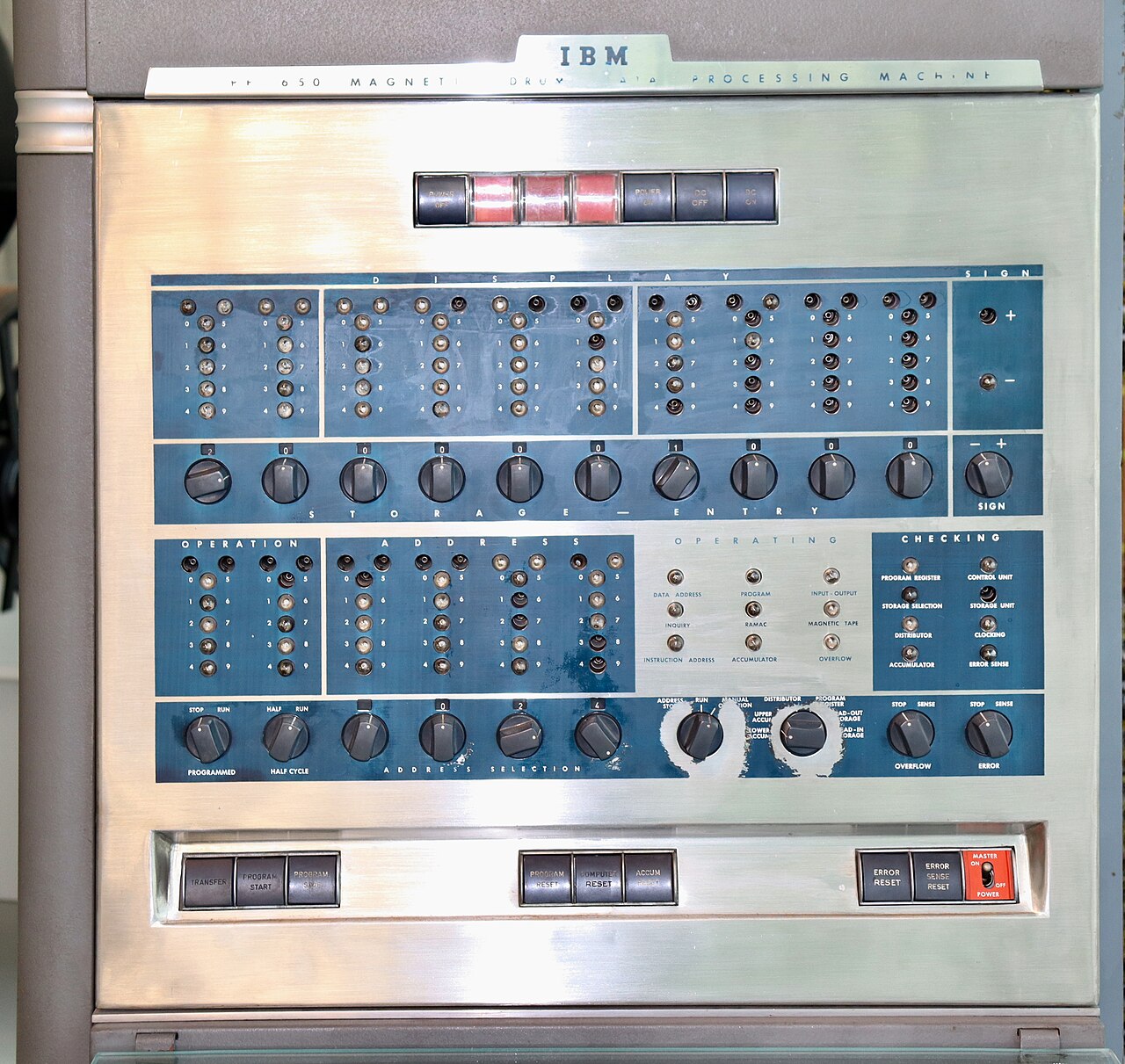
The first working computer in the country was bought, not built. RENFE, the state railway, acquired an IBM 650 in 1959 for more than $250,000, about €1.9 million in today’s money, and had it running in 1960 to calculate the payroll of its employees: 900 kilograms of machine and 1,350 kilograms of power supply, with about 1 KB of drum memory. It is preserved at the Museo Nacional de Ciencia y Tecnología in A Coruña.
Telesincro
The one Spanish attempt at a computer industry came from Catalonia. Joan Majó founded Telesincro in 1963 at Sardañola del Vallès outside Barcelona, and with Jordi Vidal designed the Factor-P, presented in 1967 as the first computer made in Spain with its own architecture and software. The Factor-Q of 1968, with a ferrite-core memory of 32 registers of 16 digits, won the Petit Herrera prize that year, and the Factor-S minicomputer of 1971 had 2 KB of processor memory and 16 to 32 KB of fast storage. By 1972 Telesincro’s machines were the third best-selling computer line in Spain, with 16 percent of the market, and the company was the country’s only significant domestic manufacturer.
It did not stay independent. In 1976 Telesincro was merged into Secoinsa, the state’s computing venture; Telefónica took over its operations in 1986, the French group Bull acquired 67 percent in 1989, and Ingenico bought what remained in 1999 for its payment-terminal business. The pattern was the Italian one on a smaller scale: a competent domestic firm absorbed into a state vehicle and then sold to a foreign one, leaving no Spanish computer architecture behind.
The Golden Age of Spanish Software
What Spain did produce, in quantity, was games. Between 1983 and 1992 the country became the second-largest producer of 8-bit entertainment software in Europe after Britain, a period Spanish writers call the edad de oro del software español. The platforms were the Sinclair ZX Spectrum and the Amstrad CPC, with MSX and the Commodore 64 behind them; the publishers were Dinamic Software, Topo Soft, Opera Soft, Made in Spain and Zigurat, with Erbe Software as the main distributor. Bugaboo (1983) was the first Spanish game with mass international distribution; Opera Soft’s La Abadía del Crimen (1987), an adaptation of Umberto Eco’s The Name of the Rose, is the era’s acknowledged classic; Dinamic’s Army Moves and Navy Moves and Zigurat’s Sir Fred were its commercial peaks.
The age ended as abruptly as it began. The market moved to 16-bit machines, the Spanish studios did not move with it, piracy hollowed out what remained, and by 1992 the industry had stopped. A second wave, with studios such as MercurySteam, came in the 2010s. The ZX Spectrum’s own story is in The UK Computing Industry.
Amadeus and the Modern Sector
Spain’s largest technology company is one most people have used without knowing it. Amadeus was founded in 1987 by Air France, Iberia, Lufthansa and SAS as a computer reservations system to rival the American ones, put its headquarters in Madrid and its data centre at Erding outside Munich, and became a travel-technology company under the name Amadeus IT Group in 2006. It listed on the Spanish exchanges on 29 April 2010; in 2024 it had €6.14 billion in revenue, €1.34 billion in net income and about 21,500 employees, with development centres in Sophia Antipolis, London, Breda and Bangalore. Around it, the sector is dominated by Telefónica, the incumbent operator that was itself the vehicle for Secoinsa and Telesincro, and by the Barcelona and Madrid startups of the 2010s, Glovo and Cabify among them, whose story belongs to the platform economy rather than to computing.
Dead End: An Industry of One Company
Spain’s computing history has a beginning that most countries would envy and a middle that almost nothing fills. Torres Quevedo’s work of 1912 to 1920 led nowhere in Spain because there was no institution to carry it; Santesmases built the institution in 1952 and it produced teachers rather than products; Telesincro built the products and was absorbed by the state before it could build a second generation. What the country did build, twice, was software for other people’s hardware: the Spectrum games of the 1980s and the reservation systems of the 1990s. The first collapsed when the hardware changed, and the second survives because it does not depend on any hardware at all. The lesson is not flattering but it is consistent with the rest of southern Europe: the countries that lost or never had a computer industry kept the parts of computing that were made of people.
📚 Sources
- José García Santesmases — Wikipedia (Spanish)
- “Este es el primer ordenador que llegó a España: un IBM 650” — Xataka
- Telesincro — Wikipedia (Spanish)
- Golden era of Spanish software — Wikipedia
- Amadeus IT Group — Wikipedia
- Image: IBM 650.002 - MUNCYT.jpg by Fernando Losada Rodríguez (CC BY-SA 4.0), via Wikimedia Commons