The Fax Machine
Abstract
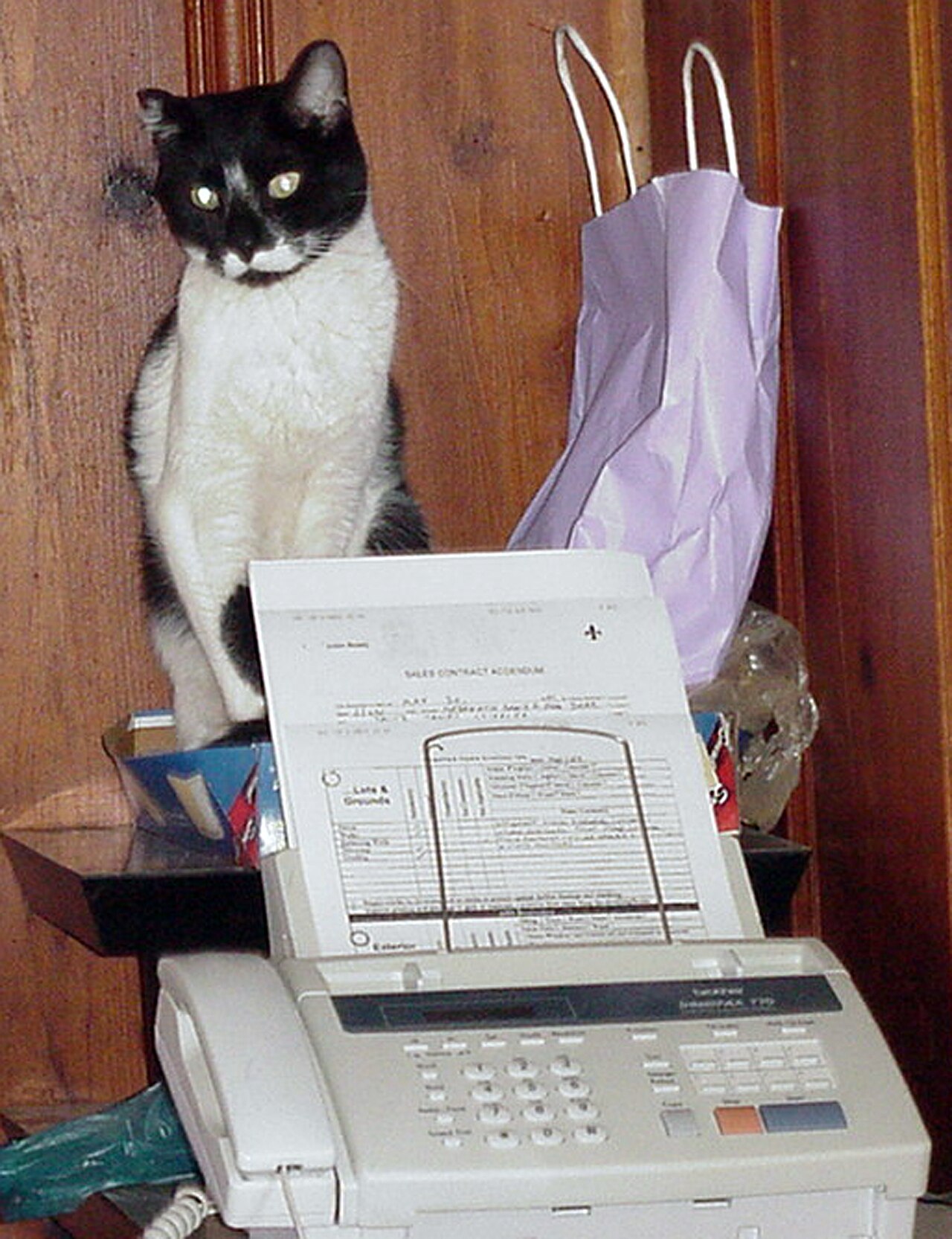
The fax machine was patented in 1843, before the telephone, and did not become an ordinary office machine until the 1980s. In between it had a commercial service in Napoleon III’s France, carried news photographs for wire agencies, and ran as a teleprinter for German field units and press agencies in the form of Rudolf Hell’s Hellschreiber. What finally made it universal was a standard: Group 3, agreed at the international telecommunications body in 1980, largely on Japanese work and with Japanese patents given away, which let any machine talk to any other over an ordinary phone line in about a minute a page. American offices went from 500,000 machines in 1985 to five million in 1990, nearly all made in Japan. Email took most of the traffic within a decade, but faxes still move prescriptions, court papers, and government forms, most visibly in Japan, where a 2021 plan to end their use in the ministries was withdrawn after officials called it impossible.
Bain’s Pendulums
Alexander Bain, a Scottish clockmaker, received a British patent on 27 May 1843 for an electric printing telegraph that copied an image line by line. Two pendulums, one at each end, swung in step. At the sending end a probe passed over raised metal type and made or broke a circuit; at the receiving end a stylus drew the pulses onto paper soaked in a chemical that changed color when current passed through it. Scanning a picture into a sequence of lines and rebuilding it by synchronized sweeps is how every later fax machine worked. Bain’s own apparatus never worked well: the images were poor and the two pendulums drifted out of step.
Frederick Bakewell patented an improved “image telegraph” in 1848 and showed it at the Great Exhibition in London in 1851. Bain had made money from his inventions, lost it in bad investments, and lived his last years on a Civil List pension of 80 pounds a year granted in 1873. He died in 1877.
The Pantelegraph
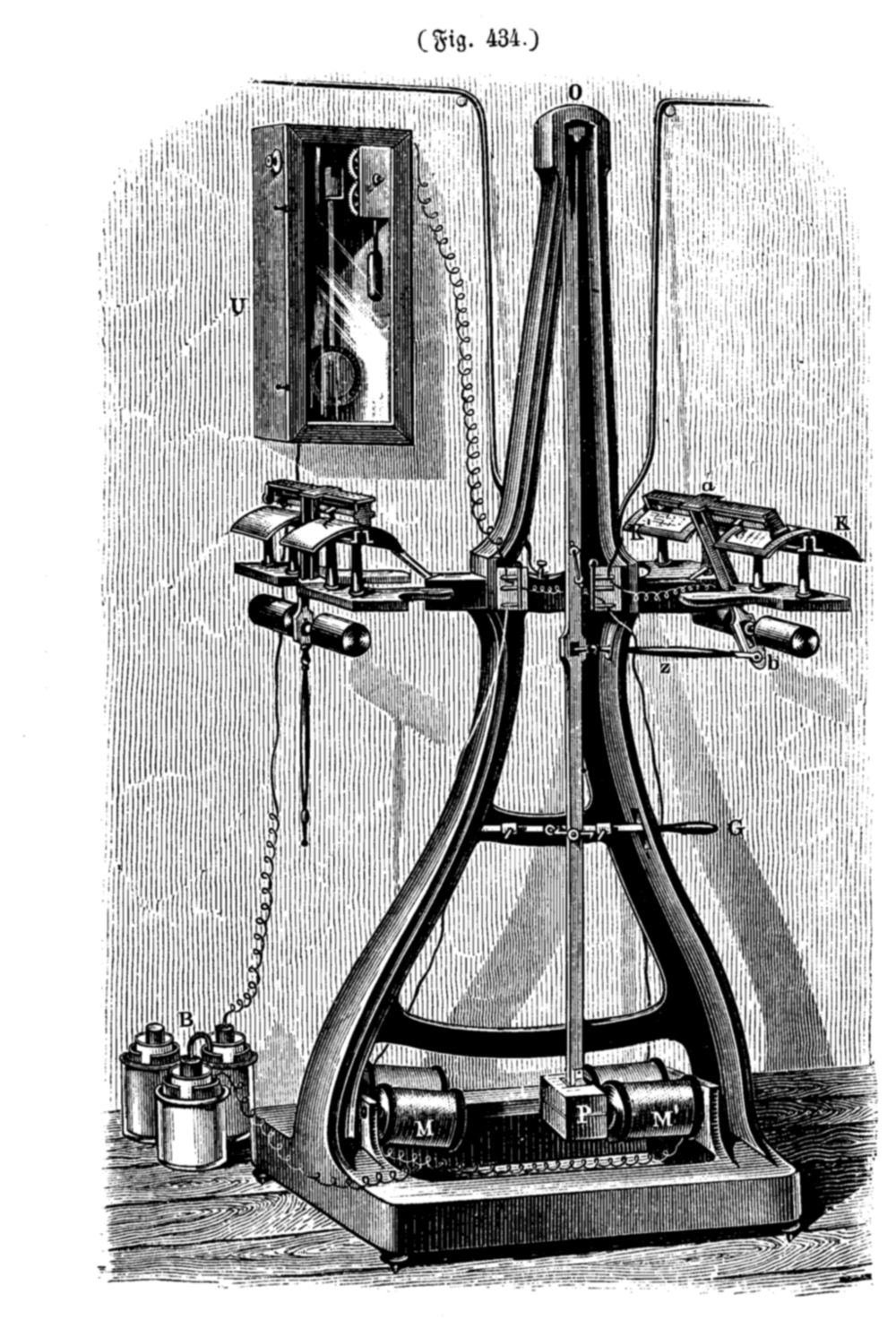
Giovanni Caselli, an Italian priest teaching at the University of Florence, solved the synchronization problem well enough to sell a service. He went to Paris in 1857 and built his pantelegraph with the instrument maker Paul-Gustave Froment. The sender wrote or drew in insulating ink on a metal plate; a pendulum governed by a regulating clock kept the scanning styluses at both ends in step, and the receiver used paper impregnated with potassium ferricyanide, which darkened where current flowed. Napoleon III visited Froment’s workshop on 10 May 1860 and gave Caselli use of the state telegraph lines.
The first transmission between Paris and Lyon was made on 10 February 1862, and a public service on that line opened in 1865, the first commercial facsimile service in the world. A message of about 25 handwritten words took 108 seconds. Marseille was added in 1867. The service ran until 1870.
Pictures by Wire
The next step was to scan photographs, which needed a sensor for light and dark. Arthur Korn, a physicist at the University of Munich, used selenium cells, whose resistance falls in light, and on 17 October 1906 sent a photograph of the German Crown Prince over a distance of 1,800 kilometers. In 1908 his “Bildtelegraph” drew attention by transmitting a wanted man’s photograph from Paris to London. Korn was dismissed from his professorship in Berlin in 1935 because of his Jewish descent and emigrated to the United States in 1939.
In France Édouard Belin built the Belinograph in 1913, which scanned with a photocell and sent over ordinary telephone lines. On 19 May 1924 AT&T sent fifteen photographs by telephone line from Cleveland to New York. The Associated Press opened its Wirephoto network in 1935; its first picture was of a small plane that had crashed in the Adirondack Mountains in December 1934. From the 1930s newspapers used such systems to get photographs of distant events into the next edition.
The Hellschreiber
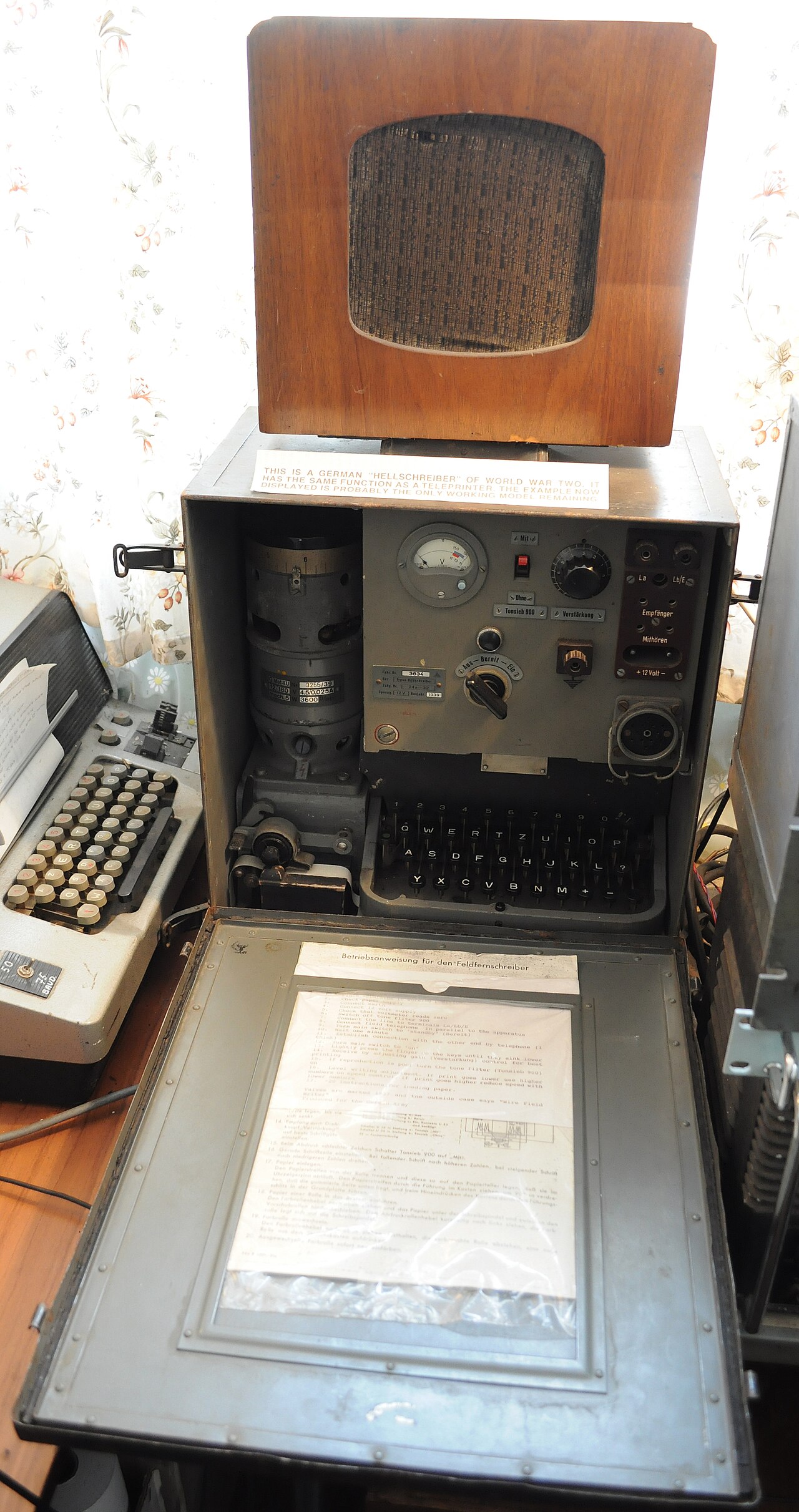
Rudolf Hell (1901–2002) studied electrical engineering in Munich and worked from 1923 to 1929 as assistant to Max Dieckmann, with whom he ran a television demonstration at the Munich transport exhibition of 1925. In 1929 he patented the Hellschreiber and founded his own company in Babelsberg near Berlin.
The Hellschreiber was a teleprinter that sent letters as pictures. Each character was a pattern on a grid of 7 by 7 points, transmitted as on-off pulses at 112.5 baud. At the receiver a magnet pressed an inked cylinder against a moving paper tape wherever a pulse arrived, hammering out the pattern dot by dot, and each line was printed twice, one above the other, so that a small timing error shifted one copy but left the other readable. A conventional teleprinter decodes each character from a code and prints a wrong letter if one bit is lost; on the Hellschreiber a lost pulse left a gap in a letter that a human reader could still recognize. That made it usable over noisy radio links where other teledata failed. The German military used it in the Second World War, sometimes to carry Enigma-encrypted traffic, and news agencies used it to distribute press copy until the 1980s. Radio amateurs revived it in the 1990s with software versions that run on a personal computer’s sound card.
Hell re-established his company in Kiel after the war and turned it toward printing: electronic engravers for printing plates and the Digiset typesetter. Siemens took it over in 1981, and in 1990 it merged with Linotype into Linotype-Hell (see The History of Printing).
Six Minutes a Page
Xerox took facsimile into the office in the 1960s. Its LDX (Long Distance Xerography) of 1964 was leased for 800 dollars a month. In 1966 Xerox introduced the Magnafax Telecopier, a 46-pound machine that sent a letter-sized page over a telephone line in about six minutes. Machines from different makers could not talk to each other. The international telecommunications standards body, the CCITT, published a Group 1 standard in 1968 at six minutes a page and Group 2 in 1976 at three minutes. The United States had about 25,000 fax machines in 1970 and 250,000 in 1980.
Group 3 and Japan
Japan needed fax more than anyone. Japanese writing uses thousands of kanji, and typewriters that could hold them were complex machines. A fax sent handwriting as easily as print. The two Japanese carriers, NTT and KDD, led the work on the next standard.
Group 3, adopted as CCITT Recommendation T.4 in 1980, was digital. It scanned a page into black and white dots, compressed each line with Modified Huffman coding, which replaces long runs of white or black with short codewords (see Data Compression), and sent the result through a modem over an ordinary telephone line. NTT and KDD contributed a two-dimensional method, Modified READ, which codes each line by its differences from the line above and roughly doubled the compression. To get it adopted internationally, the Japanese delegates declared that their patents on it would be offered free of charge if it became the standard. A page now took about a minute, and any Group 3 machine could send to any other.
Japanese manufacturers built nearly all the machines that followed. In the United States the installed base went from 500,000 machines in 1985 to five million in 1990 (see Japan’s Computing Industry). A Group 4 standard for digital ISDN lines followed in 1985. Fax use in the United States peaked in 1997 and in Japan in 2000, as email took over much of its traffic (see Email).
The Holdouts
Fax survived where its properties mattered more than its speed: the sender gets a confirmation of receipt, the machine needs no internet connection, and in Japan a faxed form can carry a personal seal.
In Japan a government survey found fax machines in 33.6 percent of households in 2020. In the first months of the COVID-19 pandemic, Japanese health centers reported new cases to the authorities by fax, until the health ministry introduced an online system, HER-SYS, in May 2020. Taro Kono, appointed minister for administrative reform in September 2020, campaigned against both the fax and the personal seal. In June 2021 a cabinet body announced that the ministries in Tokyo’s Kasumigaseki district would stop using fax “as a rule” by the end of the month, so that officials would not have to come into the office to send and receive them. Hundreds of offices replied that this would be impossible, citing the security of confidential material such as court and police documents and “anxiety over the communication environment,” and the plan was dropped.
In England the health secretary Matt Hancock banned NHS trusts from buying fax machines from January 2019 and ordered existing ones out of use by 31 March 2020; the Royal College of Surgeons had counted about 8,000 still in use. In the United States, doctors and hospitals kept faxing records and prescriptions, often because they regarded fax as the safe way to comply with the HIPAA privacy rules.
⚠️ Dead End: Speed Mail
In 1960 the US Post Office tried to turn the letter itself into a fax. Under Speed Mail, a customer handed in a sealed letter at a post office; a machine opened it without any employee reading it, scanned it, and transmitted the image to the destination post office, where it was printed, sealed in a new envelope, and delivered. Postmaster General Arthur Summerfield sent the first Speed Mail letter on 9 November 1960 and planned a network of 71 stations, each handling up to 15 letters an hour. Congress never funded the expansion. President Kennedy’s new Postmaster General, J. Edward Day, put his effort into ZIP codes instead, and the Kennedy administration cancelled Speed Mail in August 1961. Businesses got fast delivery of documents twenty years later by buying their own fax machines.
📚 Sources
- Fax — Wikipedia (Bain’s British patent 9745; Korn’s 1908 Paris–London transmission; AT&T 19 May 1924; Magnafax Telecopier weight and six minutes; Group 1–4 speeds; NHS and US healthcare use)
- Fax Machines — Engineering and Technology History Wiki (IEEE) (Bain patent 27 May 1843; Bakewell 1848 and 1851; Caselli service 1865; LDX 1964 leased at $800 a month; G1 1968, G2 1976, G3 1980, G4 1985; US installed base 1970–1990 “nearly all made in Japan”; peaks 1997 and 2000)
- Milestones: International Standardization of G3 Facsimile, 1980 — Engineering and Technology History Wiki (IEEE) (NTT and KDD; Modified READ with twice the compression of MH; patents offered free of charge)
- Alexander Bain (inventor) — Wikipedia (pendulums, electrochemical paper, poor results, Civil List pension, death 1877)
- Pantelegraph — Wikipedia (Froment, Napoleon III’s visit of 10 May 1860, first Paris–Lyon transmission 10 February 1862, 25 words in 108 seconds, Marseille 1867, service until 1870)
- Coopersmith, Jonathan: “A Florentine in Paris: The Caselli pantelegraph and its successors, 1859–1871,” IEEE HISTory of ELectro-technology CONference (2012) (first commercial facsimile service, Paris–Lyon, 1865)
- Arthur Korn — Wikipedia (selenium cells; 17 October 1906 transmission over 1,800 km; dismissal 1935; emigration 1939)
- Wirephoto — Wikipedia (Belinograph 1913; AP Wirephoto 1935 and its first photograph)
- Hellschreiber — Wikipedia (7 by 7 grid, 112.5 baud, double printing, noise tolerance, military and press-agency use, amateur revival)
- Rudolf Hell — Wikipedia (life dates, Dieckmann, 1929 patent and Babelsberg company, Kiel, Siemens 1981, Linotype-Hell 1990)
- Coopersmith, Jonathan: Faxed: The Rise and Fall of the Fax Machine (Johns Hopkins University Press, 2015)
- “The history of the fax machine (and why it’s not dead yet),” ABC News (Australia) (28 March 2019) (kanji and Japan as the leading market; G3 standard in 1980)
- “Faxed: The Rise and Fall of the Fax Machine” (review), IEEE Technology and Society (Speed Mail cancelled August 1961; analog machines “two decades out of date” in 1965)
- “When a Giant Mylar Balloon Was the Coolest Thing in Space,” IEEE Spectrum (Speed Mail procedure, 9 November 1960, 71 stations, 15 letters an hour, Day and ZIP codes)
- “Why Japan’s Love for Fax Machines Just Won’t Die,” Unseen Japan (33.6 percent of households, 2020 ministry survey)
- “Japan’s fax-loving health ministry plans online reporting system for virus,” The Japan Times (1 May 2020)
- “Tokyo test centers trade fax machines for computers with new coronavirus reporting system,” The Japan Times (4 August 2020) (HER-SYS in use from May)
- “Can Japan end its reliance on ‘boomer-era’ tech? One minister is waging war on the fax machine,” South China Morning Post (2020) (Kono appointed 16 September 2020)
- “Japanese Officials Resist Ban On Fax Machines,” Silicon UK (July 2021) (June 2021 decision, “as a rule,” remote work, withdrawal)
- “Japanese Fax Fans Rally To Defence of Much-Maligned Machine,” Slashdot (9 July 2021) (“impossible”; security and “anxiety over the communication environment”)
- “Health and Social Care Secretary bans fax machines in NHS,” GOV.UK (December 2018)
- “NHS banned from buying new fax machines as Hancock orders phase-out,” Digital Health (December 2018) (about 8,000 machines, Royal College of Surgeons)
- Image: Fax machine printing.jpg by RikkisRefuge Other (CC BY 2.0), via Wikimedia Commons