Japan's Computing Industry
Abstract
In the 1980s, Japan appeared to be winning the technology war. Its semiconductor companies controlled over half the global DRAM market. Its consumer electronics dominated living rooms worldwide. Its government had launched the most ambitious artificial intelligence program in history. American politicians declared an emergency. Then, within a decade, Japan’s technology industry fell from near-dominance to sustained decline, a collapse so thorough that it became a case study in how industrial policy can simultaneously build and constrain an industry.
The MITI Model
Japan’s technology industry was not built by markets alone. The Ministry of International Trade and Industry (MITI) coordinated industrial strategy with an intensity that had no equivalent in the United States or Europe. After World War II, MITI directed capital, licensed foreign technology, protected domestic markets from imports, and organized “research consortia” that allowed competing companies to share the costs of basic research.
The results were formidable. Japan licensed semiconductor technology from Western Electric (Bell Labs’ parent) in 1953, then systematically improved on it. Companies like NEC, Fujitsu, Hitachi, Toshiba, and Mitsubishi Electric developed parallel capabilities across computing, telecommunications, and consumer electronics, a breadth that American companies, focused on shareholder returns and quarterly earnings, could not easily match.
By the early 1970s, NEC had built a complete computing stack: mainframes, minicomputers, networking equipment, and semiconductor fabrication. Fujitsu’s mainframes were largely compatible with IBM’s architecture, a deliberate strategy to sell into the IBM-installed base while avoiding the cost of software incompatibility. Hitachi went further, reverse-engineering IBM systems so precisely that it became the target of a famous FBI sting operation in 1982: Hitachi engineers were caught purchasing IBM trade secrets.
The DRAM Wars
The most visible confrontation between American and Japanese technology occurred in dynamic random-access memory (DRAM) chips. Memory chips are a commodity; the company that can manufacture them at lowest cost and highest yield wins. Japanese manufacturers, subsidized by MITI’s Very Large Scale Integration (VLSI) project from 1976 to 1980, invested aggressively in manufacturing process improvements and drove production costs below what American firms could sustain.
By 1986, Japanese companies (led by NEC, Toshiba, and Hitachi) controlled 80% of the global DRAM market. American manufacturers Intel (which had shipped the first commercial DRAM, the 1103, in 1970, though the device itself was invented by IBM’s Robert Dennard in 1968), Mostek, and National Semiconductor largely exited the market, unable to compete on cost. Intel’s survival was only possible because Gordon Moore and Andy Grove made the strategic decision to abandon memory and focus entirely on microprocessors, a bet that required eliminating roughly 7,200 jobs and which was vindicated when IBM chose Intel’s x86 architecture for the IBM PC in 1981.
The American response was political and commercial. In 1986, the US and Japan signed the Semiconductor Trade Agreement (STA), which guaranteed American manufacturers a 20% share of the Japanese market and set minimum prices for Japanese chips exported to the US. The agreement was controversial (it raised prices for American computer manufacturers) but it gave American chipmakers breathing room to recover. Reagan placed 100% tariffs on selected Japanese electronics goods in 1987 when Japan was judged non-compliant with the agreement. The pressure reached even system software: in April 1989 the US Trade Representative flagged Japan’s plan to standardize the domestic TRON operating system in schools as a potential trade barrier, and Japan abandoned the plan within months (see Ken Sakamura and TRON).
Info
The VLSI project (1976–1980) is often cited as MITI’s greatest success in technology policy. Five competing companies (NEC, Fujitsu, Hitachi, Mitsubishi, Toshiba) collaborated on pre-competitive research under MITI coordination, jointly filing over 1,000 patents and collectively bridging the manufacturing gap with IBM. It served as a template that South Korea would follow (more aggressively) with Samsung and SK Hynix in the 1990s.
The PC-98: A National Standard That Became a Prison
The machine’s own history, the clones, DOS/V and the Compaq shock are covered in NEC PC-98 and Japan’s Domestic PC.
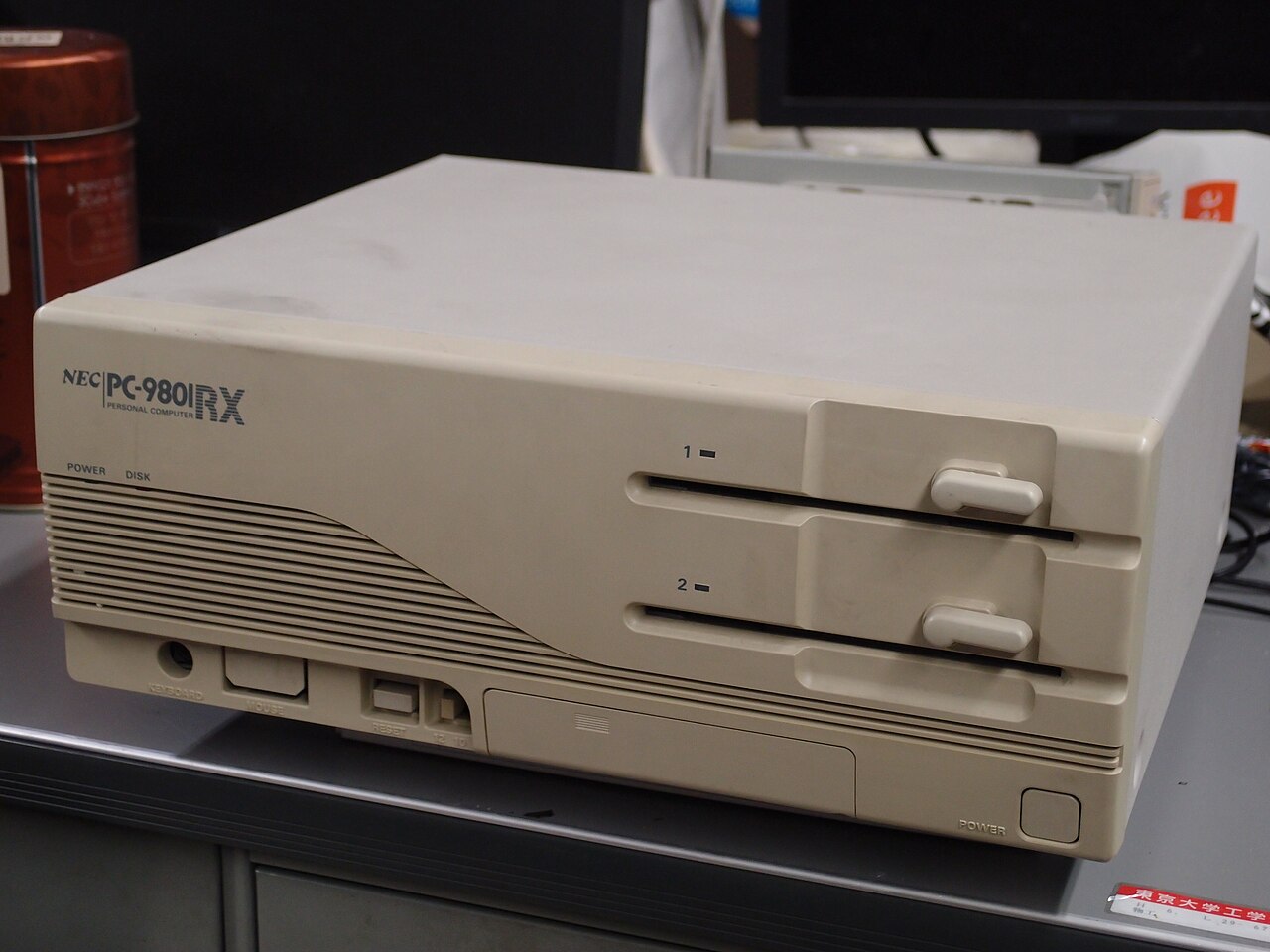
While the global PC industry standardized around IBM’s architecture and Intel’s x86 processor, Japan developed its own: the NEC PC-98, introduced in 1982. The PC-98 used an Intel 8086-compatible processor but defined its own hardware architecture, expansion bus, and character display system, the latter essential for rendering the thousands of kanji characters in the Japanese writing system, which required more graphical sophistication than the ASCII-focused IBM PC could handle.
The PC-98 was enormously successful domestically. By the late 1980s, it commanded over 80% of Japan’s personal computer market. A vast software ecosystem developed around it, business applications, games, and productivity tools written exclusively for PC-98 hardware. Japan’s technology industry viewed this as a success: a domestically controlled standard insulated from American dominance.
It was also a trap. While the global PC industry moved from 8086 to 286 to 386 to Pentium in rapid succession, each transition driven by fierce competition among hundreds of companies competing on an open standard, the PC-98 ecosystem moved more slowly. NEC had less competitive pressure to advance the platform. The software ecosystem, having invested in PC-98-specific code, resisted migration. When Windows 95 and the global x86 PC finally entered Japan in force in the mid-1990s, Japanese businesses faced a painful choice: invest in re-training and re-tooling, or stay on an aging platform. Most stayed too long.
The PC-98’s decline was not just the replacement of one hardware standard with another. It represented the end of Japan’s ability to maintain a separate domestic PC ecosystem, and, with it, the domestic software industry that had grown around it. Japanese software developers, trained on PC-98 architecture, found themselves less competitive in the global Windows market. The installed base that had been a moat became a millstone.
The Fifth Generation: Hubris and the AI Race
In 1982, MITI announced the Fifth Generation Computer Project (compared with the Western programmes it provoked in Dead End: Buying a Computer Industry), a ten-year program (which ultimately spent roughly ¥57 billion, about $320–400 million) to build computers that could reason, understand natural language, and draw logical inferences. The goal was to leapfrog American and European computing by building a new computational paradigm based on logic programming rather than the Von Neumann architecture.
The announcement caused panic in the United States. A DARPA-funded response program, the Strategic Computing Initiative, was launched in 1983. Britain established the Alvey Programme. Europe created ESPRIT. The Fifth Generation project had, almost accidentally, triggered a global AI race.
The project failed to meet its objectives. Logic programming in Prolog (the core technology chosen) proved insufficient for the tasks the project hoped to accomplish: natural language understanding, knowledge representation at scale, and real-time inference. By 1992, when the project concluded, it had produced research contributions in parallel logic programming but nothing approaching the goals MITI had set. Crucially, the paradigm it had bet on (symbolic AI) was already being challenged by neural network approaches that would eventually dominate the field.
The Fifth Generation project was not simply a technical failure. It was a symptom of a deeper problem: MITI’s industrial policy was excellent at directing resources toward known technological targets, reducing manufacturing costs, improving process yields, catching up to American standards. It was poor at identifying the right targets when the technology frontier was genuinely uncertain.
Warning
The Fifth Generation project’s failure has a direct parallel to the “AI winters” that followed the first wave of AI enthusiasm in the 1960s and 1970s. Japan bet on symbolic AI at precisely the moment when connectionist approaches were gaining traction. The lesson (that government coordination of technology bets is more valuable for catch-up than for frontier research) was learned painfully and late.
Why Japan Lost
Japan’s technology decline in the 1990s had multiple causes that reinforced each other:
The asset bubble and its aftermath. The collapse of Japan’s real estate and stock market bubble in 1989–1991 destroyed the balance sheets of the banks that funded technology investment. Japanese companies that had borrowed aggressively to invest in capacity were left with enormous debts and assets worth a fraction of their book value. The “Lost Decade” was really two lost decades of constrained investment and deflation.
The software gap. Japanese hardware manufacturing was world-class. Japanese software was not. The cultural and educational systems that produced excellent process engineers (precision, conformity, systematic improvement) were less suited to producing the creative, rule-breaking approaches that characterized successful software companies. Japan had no equivalent of Microsoft, Oracle, or Apple. Software had been treated as an appendage of hardware rather than as a standalone industry.
Keiretsu and the cost of coordination. Japanese companies operated within keiretsu, networks of cross-shareholding between companies, suppliers, and banks. These networks provided stability and patient capital but were slow to adapt to rapid market change. The American model of fast-moving, independent startups funded by venture capital was structurally foreign to the keiretsu system.
Korean and Taiwanese competition. South Korean companies (Samsung, SK Hynix, LG) followed the MITI model but with more aggressive capital investment and lower labor costs. By the mid-1990s, they had done to Japanese DRAM manufacturers what Japan had done to American ones in the 1980s: competed on cost until the Japanese firms retreated or exited. Taiwanese companies, clustered around TSMC’s foundry model, built the world’s most advanced semiconductor manufacturing, without the overhead of integrated device manufacturing.
The internet. Japan built excellent infrastructure: broadband penetration, mobile internet on NTT DoCoMo’s i-mode platform (1999) was years ahead of Western equivalents. But the major internet platforms (search, social, e-commerce) emerged as American companies that defined global standards. Japanese internet companies (Rakuten, Mixi, Line) achieved domestic dominance but did not export their models. The cultural dimension of Japan’s digital technology (Walkman, Tamagotchi, Pokémon, 2channel, Hatsune Miku, and the Galapagos phone phenomenon) is covered in Japan’s Digital Culture.
The Legacy
Japan remains a significant technology power. Sony dominates image sensors; nearly every smartphone camera contains a Sony sensor. Murata, TDK, and Kyocera manufacture electronic components with no Western equivalents. Renesas controls the automotive microcontroller market. Nintendo survives as one of the last independent consumer gaming hardware companies.
But Japan never recovered its position at the semiconductor frontier. The decisions of the 1980s (the PC-98 moat, the Fifth Generation bet, the underinvestment in software) compounded across two decades of economic stagnation into a structural weakness that neither MITI nor its successor METI has been able to reverse. The most revealing indicator: Japan’s most strategically significant semiconductor company in the 2020s is not NEC or Fujitsu but TSMC’s Japanese subsidiary, JASM, a Taiwanese company the Japanese government paid billions to attract.
📚 Sources
- MITI and the Japanese Miracle — Chalmers Johnson (1982), Stanford University Press
- The Japanese Challenge to U.S. Industry — National Academy of Engineering (1992)
- NEC PC-9800 series — Wikipedia
- Fifth Generation Computer Systems — Wikipedia
- Semiconductor industry in South Korea — Wikipedia
- Japan’s Lost Decade and the Technology Industry — McKinsey Global Institute (2000)
- The Semiconductor Trade Agreement 1986 — Office of Technology Assessment, US Congress
- Image: NEC PC-9801 RX Personal Computer.jpg by Flickr user: htomari (CC BY 2.0), via Wikimedia Commons