Vera Molnár
Abstract
Vera Molnár (1924–2023) was making computer art before she had a computer. From 1959 in Paris she produced series of geometric pictures by following written rules and throwing dice, a method she called the machine imaginaire, and when she was given access to a real machine in 1968 she simply handed it the rules. For the next fifty-five years she made drawings in which a square, a line or a letter was repeated under a small, controlled amount of disorder, “1% de désordre”, and she watched what the disorder did. She was one of the very few women among the plotter pioneers of the 1960s and the last of them working; she showed at the Venice Biennale at 98, died in Paris on December 7, 2023, a month short of 100, and got her Centre Pompidou retrospective two months after that.
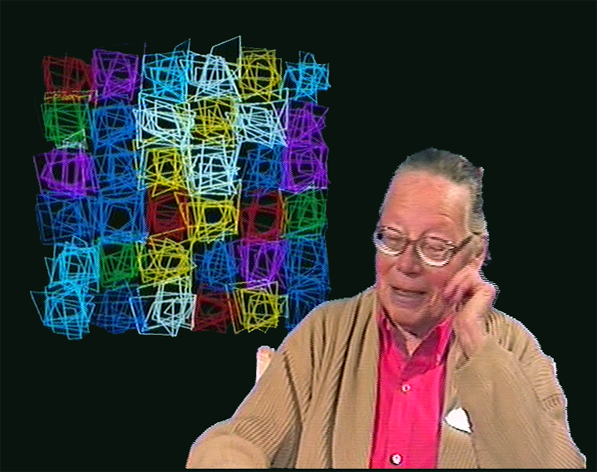
Budapest to Paris
Vera Gács was born in Budapest on January 5, 1924, and studied at the Hungarian Academy of Fine Arts from 1942 to 1947, painting figuratively and then, from about 1946, in the geometric abstraction that she never left. She met François Molnár there; they went to Paris on a scholarship in 1947, married in 1948, and stayed. François became a scientist of perception, working on how the eye scans a picture, and the two of them treated painting as an experiment on the viewer for the rest of his life. In 1960 they were among the founders of the Groupe de Recherche d’Art Visuel, GRAV, with François Morellet, Julio Le Parc and others, a collective committed to art made from systems, optics and movement rather than expression, and the commitment outlasted the group.
The Imaginary Machine
By 1959 she was working by procedure. A picture began as a rule, a grid of squares to be rotated, say, or a set of lines to be displaced, and the rule was executed by hand, step by step, with dice or tables of random numbers deciding what the rule left open, across a whole series of sheets. She called the method the machine imaginaire: she was the computer, and a slow and fallible one. The point was to remove the artist’s taste from the individual decisions and to see what the rule produced, which she could then judge, adjust, and run again.
In 1968 she got time on a real computer, at a research centre in Paris, with a Benson plotter attached, and learned Fortran and then BASIC to drive it. The pictures that followed were the rules she had been running by hand, now executed without fatigue: Interruptions (1968–69), fields of short lines in which the orientation varies slightly and a few are missing, and the long series in which a form is repeated with a small random perturbation, “1% disorder”, growing across the sheet. With François she wrote Molnart (1974–76), a program that let her vary the parameters of a drawing interactively and see the results at once, which is what she had wanted the machine for: the ability to make a thousand versions in an afternoon and keep the few that surprised her. Her lines through the 1980s and 1990s reworked Dürer’s magic square, the letters of her mother’s handwriting (Lettres de ma mère), and, again and again, the square, which she said was the one form she had never exhausted.
Ninety-Nine
Recognition came in the order it usually comes to women in the history of technology: late. From 1990 her work was shown in the major European surveys of non-representational art; she received the DAM Digital Art Award in 2005, was made a Chevalier of Arts and Letters in 2007, and in the 2010s, as museums began to assemble the history of computer art, found her work being bought by the Museum of Modern Art, the Tate and the Pompidou. In 2022, at 98, she was shown at the 59th Venice Biennale. In July 2023 a series of her algorithms, Themes and Variations, was issued as generative NFTs through Sotheby’s and sold for about $1.2 million; she was 99 and treated the blockchain as one more plotter. She died in Paris on December 7, 2023, and the Centre Pompidou’s retrospective Parler à l’œil, planned for her centenary, opened on February 28, 2024. She had said that she had no regrets: her life was squares, triangles and lines. The tradition she belonged to, and the Stuttgart contemporaries who reached the machine before she did, are in Computer Art and Generative Art and Georg Nees and Frieder Nake.
📚 Sources
- Vera Molnár — Wikipedia
- Vera Molnár — compArt database of digital art, University of Bremen (the machine imaginaire from 1959, the 1968 computer access, Interruptions, Molnart)
- Vera Molnar — DAM Museum artist page
- Vera Molnár, Now Heralded as Godmother of Generative Art, Has Died — Artnet News, December 2023
- Vera Molnár: Parler à l’œil, Centre Pompidou — The Mayor Gallery news page
- Vera Molnár — Parler à l’œil, Centre Pompidou, February 28 – August 26, 2024
- “Vera Molnár NFT Auction at Sotheby’s Generates $1.2 M. Total”, ARTnews, July 2023
- Image: Vera Molnár (1996).png by Pantalaskas (CC BY-SA 3.0), via Wikimedia Commons