Computer Art and Generative Art
Abstract
In February 1965 a Siemens mathematician named Georg Nees hung plotter drawings on a gallery wall in Stuttgart, and a philosopher’s students argued about whether a machine could make art. Within a year the same idea surfaced independently at Bell Labs in New Jersey. The people who started it were mathematicians and engineers, not painters, and the first works were made by writing programs that fed a drawing machine. Sixty years later the descendants of that idea sold at Christie’s and generated images from text. This is the story of art made by writing rules for a computer to follow, from the plotter to the neural network.
The Stuttgart School
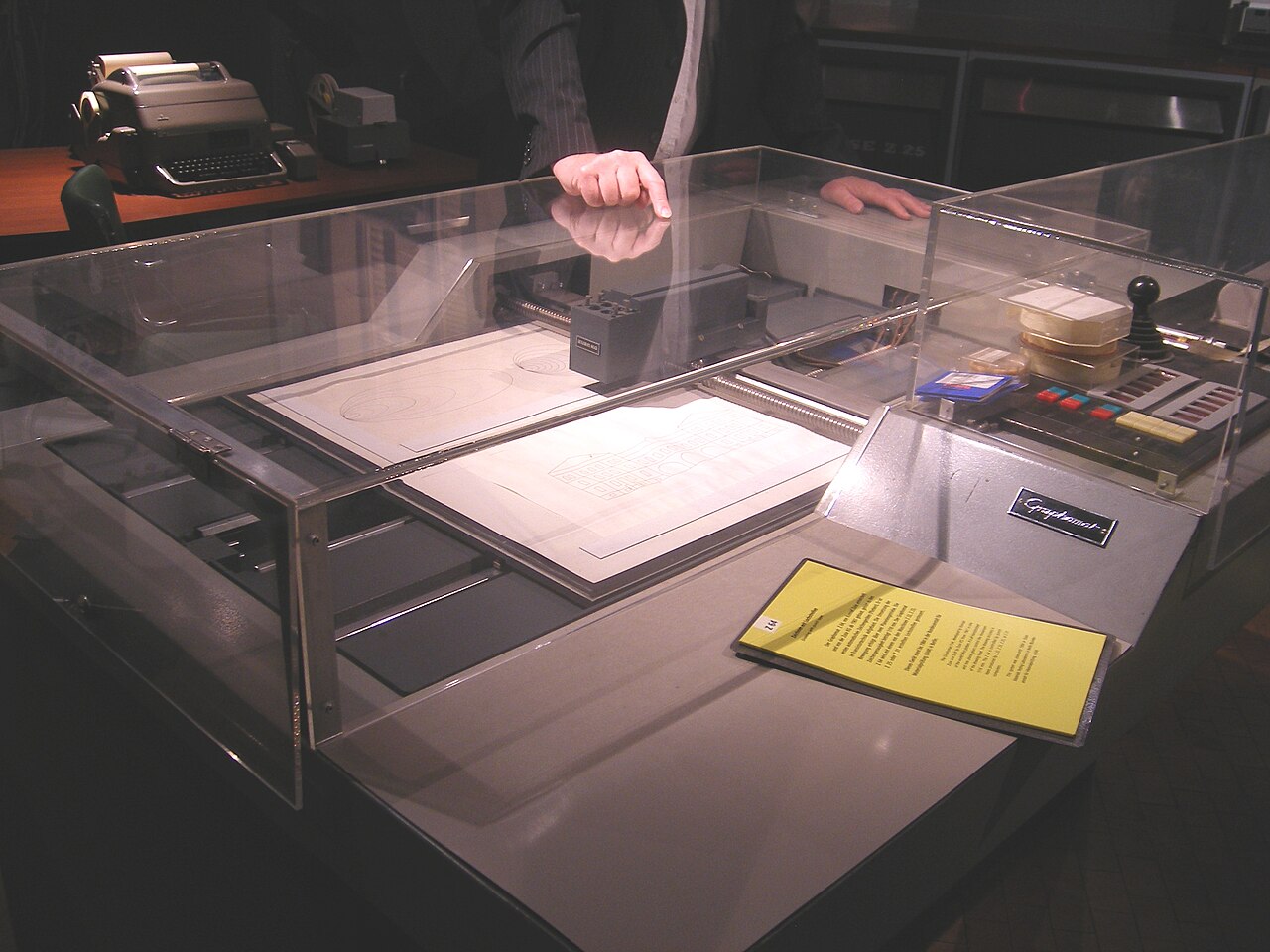
The theory came before the pictures. Max Bense, a philosopher at the Technische Hochschule Stuttgart, spent the 1950s and 1960s building what he called information aesthetics: an attempt to describe beauty in measurable, mathematical terms, treating a work of art as a signal with calculable order and complexity. If aesthetics could be quantified, Bense reasoned, it could be generated. He called the idea generative aesthetics, and he had students willing to test it.
One was Georg Nees, an industrial mathematician who had worked at Siemens in Erlangen since 1951 and started programming in 1959. Nees studied philosophy under Bense from 1964 and wrote programs that produced abstract line drawings, output on a Zuse Graphomat Z64, a high-precision flatbed plotter. In February 1965 his work went on display at the Study Gallery of the Stuttgart college, the first public exhibition of pictures made with a digital computer. The reception was hostile. Painters in the audience objected that a machine following instructions could not be an artist, and Bense answered with the term he coined for the occasion: this was künstliche Kunst, artificial art. Nees finished his doctorate, “Generative Computergraphik,” under Bense in 1969.
A second Bense student, the mathematician Frieder Nake, exhibited at the Galerie Wendelin Niedlich in Stuttgart in November 1965, alongside Nees. Nake also drove the Graphomat Z64, and produced a few hundred works with it before 1970, among them a plotter homage to Paul Klee. Nake later grew uneasy about art becoming a commodity and mostly stopped exhibiting, turning to teaching and to writing the history of the field he had helped begin.
Bell Labs, Independently
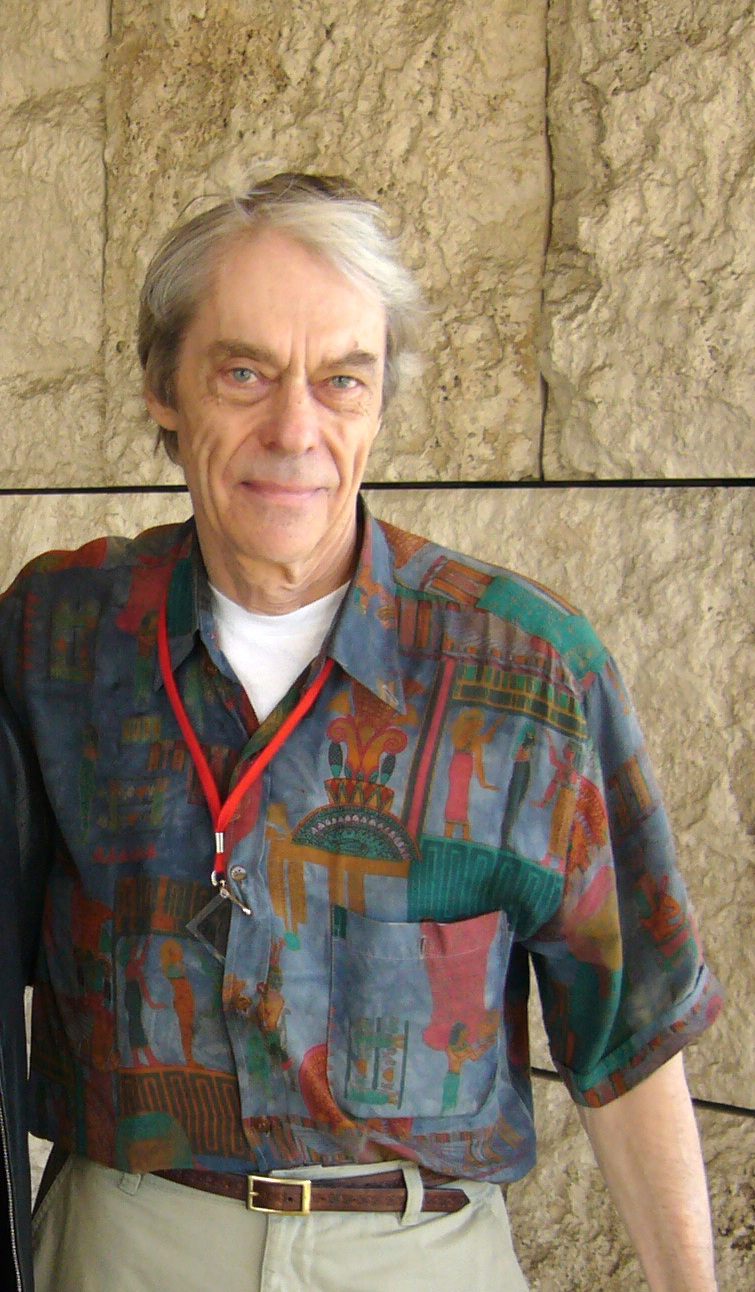
The idea did not stay in Germany, and it did not travel; it reappeared on its own. At Bell Telephone Laboratories in Murray Hill, New Jersey, the engineer A. Michael Noll programmed his first computer-generated pictures in the summer of 1962, plotting them on microfilm. In April 1965, two months after Nees, the Howard Wise Gallery in New York showed Noll’s work next to the random-dot patterns of the vision researcher Béla Julesz. Noll ran experiments that read like science as much as art: he generated a picture in the manner of a Mondrian, showed it to viewers next to the real thing, and found that most preferred the computer’s version and misidentified which was which.
The two debuts shared a method and a social fact. The tools, mainframes and plotters, lived in corporate and university labs, so the first computer artists were the people with access to those rooms: mathematicians, physicists, and engineers who had to write their own software before they could draw a line.
The Rule Becomes the Work
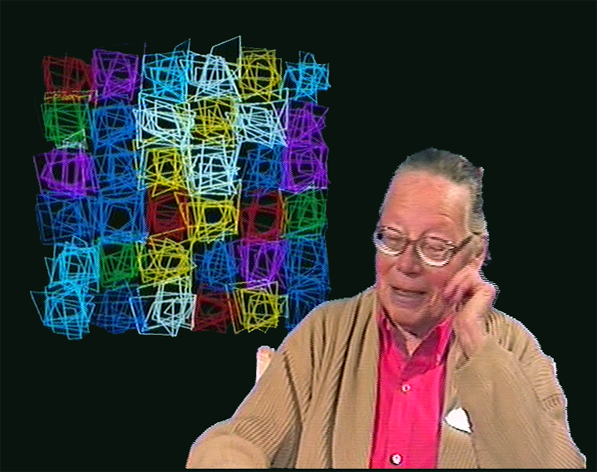
What separated this from earlier art was where the decisions lived. The artist did not draw the image; the artist wrote a procedure, often seeded with controlled randomness, and the procedure drew the image. Change a parameter and the program produced a different but related work, a whole family from one set of rules. This is the core of what came to be called generative art: the artwork is the system, and the output is one run of it.
Vera Molnár pushed the idea further than anyone of her generation. Born in Budapest in 1924 and settled in Paris from 1947, she had made systematic, combinatorial geometric works by hand since 1959, running the algorithm in her head, a method she called her machine imaginaire. In 1968 she got access to a computer at a Paris research lab, learned Fortran and BASIC, and began producing plotter drawings that varied simple geometric rules across long series. She kept working in the mode for the rest of a long life, exhibited at the 2022 Venice Biennale, and died in 2023 at 99, by then recognized as a founder of the form.
The German artist Manfred Mohr, working in Paris, turned to the computer in 1969 and spent decades on a single subject, the cube and its higher-dimensional relatives, mapping their rotations and slices into flat black-and-white drawings. The generative artists tended to work this way: pick a narrow formal problem, then let the machine exhaust its variations.
AARON and the Autonomy Question
The most ambitious project asked whether the computer could do without the parameter-tweaking artist entirely. Harold Cohen was an established British painter, shown at the Venice Biennale, when he moved to the University of California, San Diego and, from 1972, began writing AARON. His question was foundational rather than decorative: what are the minimum conditions under which a set of marks reads as an image? AARON was a program that drew on its own, first abstract closed forms, then over the years rocks, plants, human figures, and interior scenes, later adding color and driving a physical painting machine.
Cohen worked on AARON for more than forty years, until his death in 2016, and the Whitney later called it the earliest artificial-intelligence program for making art. AARON produced an endless supply of images in a recognizable style, and it never learned. Every new thing it could draw, a new kind of plant, the human body, the use of color, Cohen had to hand-code as explicit rules. The knowledge of how to make a picture lived in Cohen’s programming, not in the machine. AARON is the high-water mark of symbolic, rule-based art and the clearest illustration of its ceiling: a system that could only ever know what its author had already worked out how to say.
From the Lab to the Laptop
For thirty years generative art stayed close to the machines and the mathematicians. Two shifts opened it up. Cheap personal computers put a plotter’s worth of capability on a desk, and the demoscene of the 1980s and 1990s, programmers competing to generate graphics and music in real time from tiny amounts of code, built a parallel culture of algorithmic image-making outside the art world entirely. Then in 2001 Casey Reas and Ben Fry, at the MIT Media Lab, released Processing, a free programming environment aimed at artists and designers. Writing a generative sketch stopped requiring a research account and a Fortran manual. A generation of artists learned to code specifically to make images, and the plotter tradition of Nees and Molnár became a living practice again, now feeding gallery walls, album covers, and blockchain art markets.
The Machine Learns to Draw
The break with the whole rule-writing tradition came from a different direction. Instead of an artist specifying how to draw, neural networks trained on millions of existing images learned a statistical model of what pictures look like and generated new ones. In 2018 a print from a generative adversarial network, the Portrait of Edmond de Belamy, sold at Christie’s for $432,500, the first such work at a major auction house. See the Belamy portrait. By the early 2020s, diffusion models turned a line of text into a finished image, and the question Bense’s Stuttgart audience had shouted about in 1965 returned at scale, now attached to arguments over training data, authorship, and the labor the models had learned from.
The lineage is real but the mechanism inverted. Nees and Cohen wrote down every rule by hand and owned every decision; the neural models absorbed their rules from other people’s pictures and can explain none of them. AARON could tell you exactly why it drew what it drew. A diffusion model cannot. The visual-art story runs parallel to the one told in Computing and Music Creation: in both, the machine moved from executing an artist’s explicit procedure to inferring one from data, and in both the argument about whether the result is authorship or theft is still open.
📚 Sources
- Georg Nees (Wikipedia): Siemens, February 1965 Stuttgart exhibition, Graphomat Z64, Bense doctorate 1969
- Frieder Nake (Wikipedia): November 1965 Galerie Wendelin Niedlich exhibition, Graphomat Z64, Klee homage
- A. Michael Noll (Wikipedia): Bell Labs 1962 first programs, April 1965 Howard Wise Gallery show with Béla Julesz
- Vera Molnár (Wikipedia): 1924–2023, machine imaginaire, computer plotter drawings from 1968, Venice Biennale 2022
- AARON (Wikipedia): Harold Cohen, started 1972, hand-coded autonomy, worked on until his death in 2016
- Max Bense (Wikipedia): information aesthetics, generative aesthetics, the Stuttgart school
- Processing (programming language) (Wikipedia): Casey Reas and Ben Fry, 2001, MIT Media Lab
- Image: Zuse Z64 Graphomat.jpg by Steve Parker from Ash Vale, UK (CC BY 2.0), via Wikimedia Commons
- Image: Vera Molnár (1996).png by Pantalaskas (CC BY-SA 3.0), via Wikimedia Commons