Videotex: Prestel, Minitel and the Viewdata Era
Abstract
Videotex was the first attempt to put a public computer network into ordinary homes. A central database sent pages of text and block graphics over the telephone line to a television set or a small terminal, and the user answered with a numeric keypad. Britain’s Post Office invented it in the early 1970s as Viewdata and opened it to the public as Prestel in September 1979, forecasting a million sets by 1984; it never passed about 95,000. Canada, the United States and West Germany built their own versions and lost tens of millions each. France alone made it a mass medium, because its telephone administration gave the Minitel terminal away and let private companies sell services on the telephone bill: nearly nine million terminals, more than 20,000 services, and a shutdown only in 2012. Prestel’s other legacy was legal. In 1984 two journalists read the Duke of Edinburgh’s Prestel mailbox, the courts found that no law covered what they had done, and Parliament passed the Computer Misuse Act 1990.
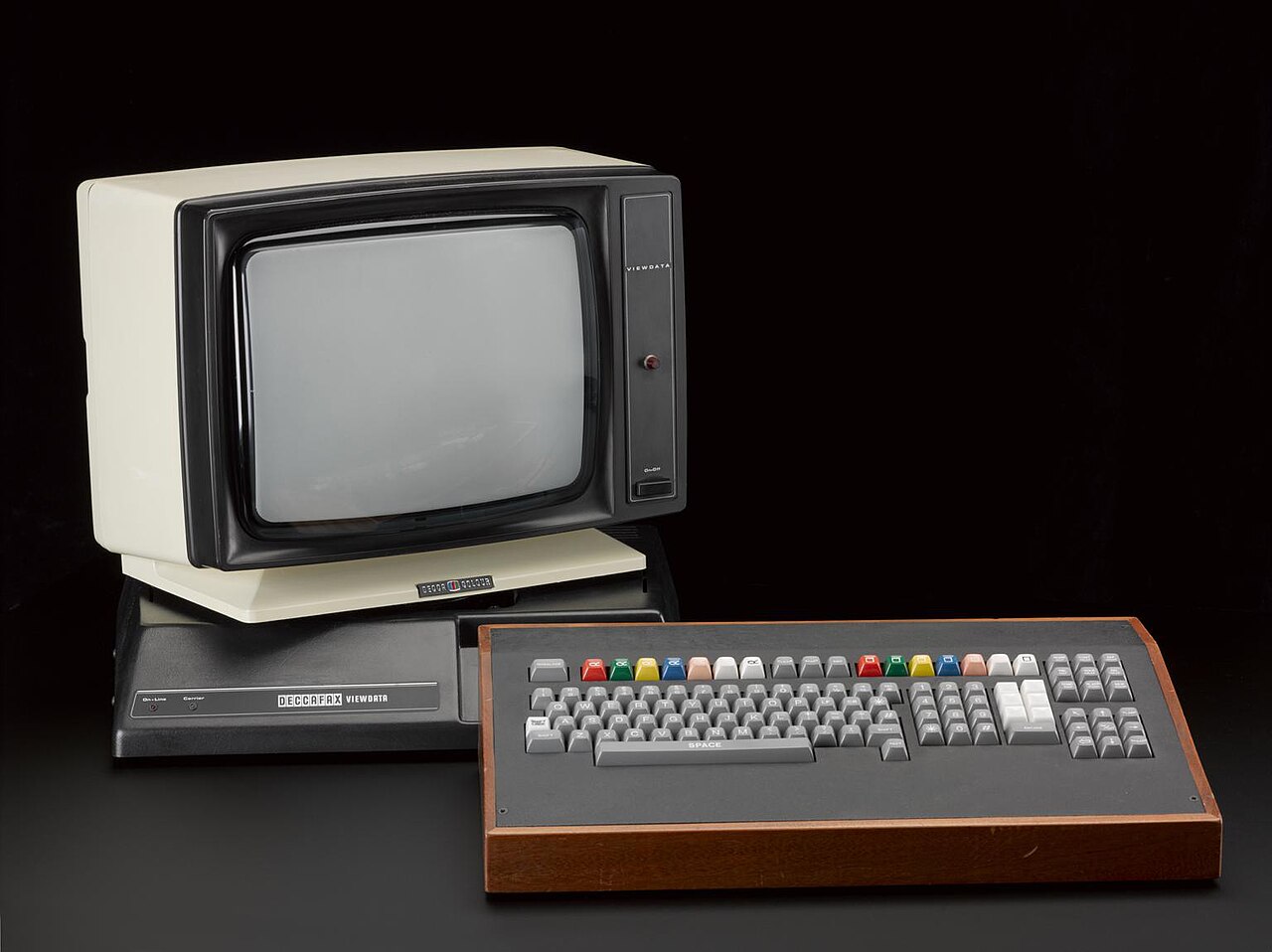
Viewdata
Samuel Fedida, a research engineer who had worked at English Electric and an American consultancy, joined the British Post Office in 1970 as head of its Computer Applications Research division. The Post Office ran the national telephone network and had been trying to sell the public a video telephone, the “viewphone”, which nobody wanted. Fedida turned the idea around: instead of pictures of people, send pages of information from a computer, and instead of a new screen, use the television set that almost every British household already owned. The phone line carried data to the home at 1,200 bits per second and keypresses back at 75. A page was 24 rows of 40 characters, with coloured letters and simple mosaic graphics built from blocks.
The first public demonstration was at the Eurocomp conference in London in 1975. A pilot with information providers ran from 1976 to 1978, and the service opened commercially in September 1979 under the brand name Prestel, chosen to suggest “press” and “presentation.” At launch the database held more than 130,000 pages, supplied by newspapers, travel firms, government departments and anyone else willing to rent space, served from GEC 4000 minicomputers in regional centres.
A Million Sets by 1984
The forecasts were those of a national monopoly that expected its customers to follow. A 1978 Post Office forecast put 500,000 sets in place by the end of 1981; the planning figure for 1984 was a million. The actual count was about 7,000 at the end of 1979 and 24,000 in 1984, of which some 20,000 were business terminals. The peak was about 95,000 at the end of 1988.
The prices explain most of it. In 1981 a television with a built-in Prestel decoder cost between £450 and £1,500, or £200 for an external adaptor, and a household might need a new telephone line at £80. On top came a quarterly subscription, the cost of the local telephone call for every minute online, a Prestel time charge, and a price per page set by the provider, from nothing to 50 pence. The Post Office did not make terminals; it waited for television manufacturers, who waited for customers, who waited for cheaper sets and more content. Residential users accounted for 13 percent of usage. The services that made residential sense came late: the Nottingham Building Society’s Homelink home banking in 1983, with subsidised terminals, and Micronet 800, a club for home-computer owners that let them download software over Prestel and peaked at about 20,000 members.
The Post Office did sell the software. PTTs in West Germany, the Netherlands, Austria, Switzerland, Italy, Hong Kong, Singapore, Malaysia and Australia bought Prestel systems, and GTE bought the rights for the United States. Germany’s version became Bildschirmtext, launched in 1983 with a forecast of a million subscribers by 1986 and a result of 60,000.
North America
Canada’s Communications Research Centre announced its own system, Telidon, on 15 August 1978. Telidon drew pictures from geometric instructions rather than mosaic blocks, which gave it better graphics, and in 1983 it became, with additions from AT&T, the North American standard NAPLPS. The Globe and Mail wrote in 1981 that it “may become as commonly used as the telephone.” Its terminals cost $1,800 to $2,500. The government stopped funding the programme on 31 March 1985, after spending $69 million.
In the United States the newspaper chain Knight-Ridder and AT&T launched Viewtron in South Florida on 30 October 1983, modelled on Prestel. The required AT&T Sceptre terminal cost $600, later rented at $39.95 a month. Knight-Ridder had built Viewtron as an electronic newspaper, and news was where most of its operating money went. The subscribers wanted to send messages to each other, and most of them cancelled after six months. Knight-Ridder spent more than $50 million and closed the service on 31 March 1986.
Minitel
France started later and planned differently. In 1978 the Nora–Minc report to President Giscard d’Estaing coined the word télématique for the merger of computing and telecommunications, and the Direction générale des Télécommunications under Gérard Théry needed a use for it. France had fewer than seven million telephone lines for 47 million people and was installing new ones fast; every new subscriber meant more printed directories and more directory-assistance operators. The DGT’s argument was that an electronic directory on a cheap terminal in every home would pay for the terminal by abolishing the paper phone book, and the traffic would pay for the network.
The trial began in Saint-Malo on 15 July 1980 with 55 households; in 1983 the free distribution of the terminal, the Minitel, began in Ille-et-Vilaine in Brittany and then spread across the country (the history of that rollout and its consequences for French industry is in France’s Tech Industry). The terminal, costing the DGT about 1,000 francs to make, was a small integrated screen, keyboard and modem, not an add-on to the family television. It connected through the Transpac packet network, the X.25 network the PTT had chosen over Louis Pouzin’s datagrams.
The decisive invention was the billing. From 1984 the Kiosque system let any company run a service on its own computer, connected to Transpac, while the PTT charged the user by the minute on the ordinary telephone bill and passed most of the money on; on the popular 3615 tariff, of 60 francs an hour about 40 went to the service provider. Nobody had to register a credit card or sign up with each service. There were 120,000 terminals at the end of 1983, three million in 1987 and 5.6 million in 1990, and more than 20,000 services by the mid-1990s, from the SNCF’s train reservations to bank accounts, horoscopes and the messageries roses, the erotic chat lines whose billboards covered French cities (see The History of Online Dating). Minitel first made an annual profit in 1989. Attempts to export it to Belgium, Ireland and the United States failed, because none of those countries gave away the terminals.
Dead End: The Television as a Terminal
Every videotex system of the 1970s assumed a single operator, a central database, and a screen that the household already owned or that the operator chose. The first two assumptions made it easy to bill and hard to innovate; the third tied the systems to the television trade and to 40-column block graphics that were fixed in international standards before the personal computer arrived. When home computers could show better pictures for less money, the Prestel standard could not follow.
The one lesson that carried over came from the users. In Florida, in Britain and in France, operators built electronic publishing systems and customers used them to talk to each other: Viewtron’s subscribers preferred messages to news, Prestel’s added a mailbox in 1981, and much of Minitel’s early traffic was chat. Prestel closed as a consumer service in early 1994, when British Telecom sold it to a consortium that kept it for financial data. France Télécom switched Minitel off on 30 June 2012.
The Duke’s Mailbox
Prestel’s most lasting effect on computing was in law. Robert Schifreen and Stephen Gold, two technology journalists, explored Prestel from their home computers between October 1984 and January 1985. Schifreen had stumbled on an internal test ID, found the telephone numbers of the development machines, and then found system-manager credentials that worked on the live system as well. Among the accounts they could open was the Prestel mailbox of Prince Philip, Duke of Edinburgh, which according to Schifreen held mostly birthday greetings to Princess Diana from members of the public. The police arrested them in March 1985.
No law made unauthorised access to a computer a crime, so the prosecution charged them under the Forgery and Counterfeiting Act 1981, arguing that typing someone else’s password created a false instrument that deceived a machine. They were convicted at Southwark Crown Court in 1986 and fined. The Court of Appeal quashed the convictions in July 1987, and in April 1988 the House of Lords agreed: the “forgery” had existed for a moment inside the computer’s memory and was not the kind of thing the Act described. Parliament closed the gap with the Computer Misuse Act 1990, the United Kingdom’s first computer-crime statute, under which unauthorised access became an offence in itself. Schifreen went on to work in computer security.
📚 Sources
- Prestel, Wikipedia (Fedida’s career, Eurocomp 1975, the 1976–1978 pilot, September 1979 launch with over 130,000 pages, GEC 4000 machines, 1200/75 bit/s, the brand name, mailbox 1981, Micronet 800, Homelink 1983, licensing abroad, peak of about 95,000 at end of 1988, sale in 1994)
- Davenport, Lucinda D., “The Viability of Viewdata as a Mass Medium: A Case Study of Prestel”, TMG Journal for Media History, 2023 (the viewphone, the forecasts, subscriber counts by year, 1981 prices, residential share, the terminal problem)
- Maynes, E. Scott, “Prestel’s Lessons for Americans”, Advances in Consumer Research 11, 1984 (the 1978 Post Office forecast of 500,000 sets by the end of 1981)
- Telidon, Wikipedia (15 August 1978, NAPLPS, the Globe and Mail quotation, terminal prices, $69 million, end of funding 31 March 1985)
- Viewtron, Wikipedia (30 October 1983, the Sceptre terminal, $600 and $39.95, six-month churn, over $50 million, closure 31 March 1986)
- Minitel, Wikipedia (Nora–Minc, the directory rationale, seven million lines for 47 million people, Saint-Malo on 15 July 1980, 20,000 services, shutdown 30 June 2012)
- “Gérard Théry, l’un des créateurs du Minitel, est décédé”, L’Usine Nouvelle, July 2021 (director general of telecommunications 1974–1981)
- “The Era of Fragmentation, Part 3: The Statists”, Creatures of Thought (terminal cost about 1,000 francs, the 60-franc hour and its 40/20 split, 1987 and 1990 terminal counts, first annual profit in 1989, failed exports)
- Mailland, Julien and Kevin Driscoll, Minitel: Welcome to the Internet, MIT Press, 2017
- “How a hack on Prince Philip’s Prestel account led to UK computer law”, The Register, 26 March 2015 (October 1984 to January 1985, Schifreen’s account of the test ID and the sysman credentials, the mailbox contents, the March 1985 arrests)
- Robert Schifreen, Wikipedia (Forgery and Counterfeiting Act 1981, April 1986 trial, Court of Appeal July 1987, House of Lords April 1988, Computer Misuse Act 1990) and “Computer hacking archive at TNMOC”, The National Museum of Computing, 18 May 2016
- Image: Prestel Deccafax-viewdata-terminal +-Cherry-Editing-Keyboard.jpg by Science Museum Group (CC BY-SA 4.0), via Wikimedia Commons