The History of Online Dating
Abstract
Computer matchmaking is older than the internet: Stanford students paired 49 couples with an IBM 650 in 1959, Joan Ball ran a commercial computer dating service in London in 1964, and Harvard’s Operation Match turned punch-card romance into a national fad in 1965. The idea then migrated through video dating studios, BBSs, and France’s Minitel before Match.com (1995) moved it to the web and Tinder (2012) reduced it to a swipe. Along the way, dating services pioneered subscription e-commerce, recommendation algorithms, and geolocation apps, and by 2013 meeting online had displaced friends as the most common way American couples meet. The industry’s dark side kept pace: fake profiles at industrial scale, a catastrophic data breach, and a billion dollars a year in romance scams.
Punch Cards and Questionnaires
The first computer matchmaking experiment on record was a class project. In 1959, Stanford students Jim Harvey and Phil Fialer, enrolled in Math 139 (“Theory and Operation of Computing Machines”), built the “Happy Families Planning Service”: a punch-card questionnaire and an IBM 650 that matched 49 men with 49 women. Their allotted machine time ran out after ten couples, so they picked the lab’s lock one evening and ran the rest. The couples met at a party at the students’ rented house on Los Trancos Woods Road in Portola Valley. None of the 49 pairings turned into a lasting relationship, and nobody tried to sell it.
The first person to sell it was Joan Ball, a British businesswoman who had left school at fifteen. She founded the Eros Friendship Bureau in London in 1962, renamed it the St. James Computer Dating Service, and ran her first computer matches in 1964, a year before the famous American services. In 1965 the company became Com-Pat (Computer Dating Services Ltd.). Ball’s operation was profitable and, unlike the campus experiments, matched paying adults from the general public.
In 1965, Harvard undergraduates Jeff Tarr and Vaughan Morrill, wondering after an evening of drinking whether a computer could get them dates, launched Operation Match. Customers mailed in a 75-question form (musical tastes, religion, willingness to kiss on a first date) with a $3 fee; answers were punched onto cards and processed on a rented IBM 1401, and each client received the names, addresses, and phone numbers of their five most compatible matches. Questionnaires flooded in from campuses across the country, the founders incorporated as Compatibility Research, Inc., and the press treated punch-card romance as the story of the season.
Myth: Operation Match (1965) was the world’s first computer dating service.
It was the first to become famous, which is different. Stanford’s Happy Families Planning Service matched couples on an IBM 650 in 1959, and Joan Ball’s St. James Computer Dating Service in London ran commercial computer matches in 1964, a year before the Harvard students mailed their first questionnaire. Operation Match was the first computer dating service to reach mass-market scale in the US. See Myths and Misconceptions.
Video Dating, BBSs, and the Minitel
The 1970s and 80s moved matchmaking onto new media without networks. Great Expectations, founded in Los Angeles in 1976, built a chain of video dating studios: members recorded interviews on videotape and browsed a library of other members’ tapes. It was expensive, awkward, and for two decades it was the respectable face of the industry.
The first genuinely online dating happened where people were already online. Bulletin board systems in the BBS era hosted dating boards, including the Matchmaker Electronic Pen-Pal Network (1986), and romance was a constant, unplanned byproduct of CompuServe chat and later AOL chat rooms.
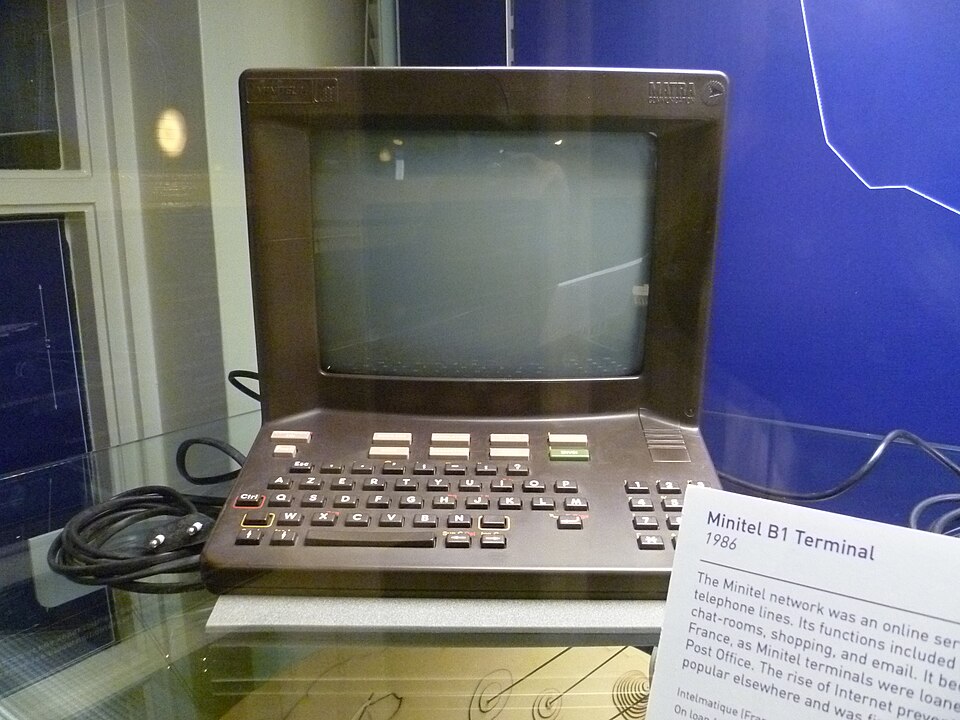
France industrialized it. The Minitel network (see France’s Tech Industry) carried the messageries roses, pay-per-minute flirtation and chat services advertised on billboards across the country. A 1986 study found that messageries accounted for the large majority of 1.7 million measured connection hours in May and June of that year, an industry estimated at hundreds of millions of francs annually. Xavier Niel, later founder of the ISP Free and one of France’s richest men, made his first fortune in Minitel rose services. The most famous service, 3615 ULLA, ran until Minitel itself was switched off in 2012. The messageries demonstrated, a decade before the web, that ordinary people would pay by the minute to flirt through a screen.
Match.com and the Web
Gary Kremen, a Stanford MBA who had founded Electric Classifieds, Inc. in 1993 to put classified ads online, launched Match.com on April 21, 1995. Membership cost $9.95 a month at a time when most of the web was free, and it worked: 100,000 registrations by October 1996. Match.com became one of the web’s first proofs that subscription e-commerce could sustain a business, and the personal ad, a newspaper staple for three centuries, began migrating to a database with photographs. Kiss.com, registered in 1994, had arrived slightly earlier; Match.com was the one that scaled. Kremen left in 1996 with little to show for it and spent the following years in a landmark lawsuit recovering the stolen domain sex.com.
The 2000s split the market by philosophy. eHarmony (2000), founded by clinical psychologist Neil Clark Warren and initially promoted with help from the evangelical organization Focus on the Family, sold scientific marriage-making: a long questionnaire feeding a proprietary compatibility model, marketed as “29 dimensions of compatibility.” Its refusal to match same-sex couples drew a New Jersey discrimination complaint in 2005; the 2008 settlement obliged it to launch a same-sex service, Compatible Partners, in 2009.
The free sites attacked from below. Plenty of Fish (2003) was written and run by a single person, Markus Frind in Vancouver, funded by ads instead of subscriptions; he sold it to Match Group in 2015 for $575 million in cash. OkCupid (2004), built by the founders of the study-guide site SparkNotes, was also free and treated matching as a public statistics project: user answers to thousands of crowd-sourced questions fed openly explained match percentages, and the company’s OkTrends blog turned its dataset into widely cited essays on race, age, and attractiveness in dating. Matching had become a species of recommendation system, with the same opaque-algorithm debates that followed recommenders everywhere else.
Location, Swipe, and the App Era
Grindr, launched by Joel Simkhai on March 25, 2009, was the first dating app built on smartphone geolocation: it showed gay men a grid of other users sorted by physical distance, collapsing the search radius from “your city” to “this block.” The design predated and shaped everything after it (see The Rise of the App Store for the platform that made it possible).
Tinder came out of Hatch Labs, an incubator backed by the media conglomerate IAC, in 2012. Built by Sean Rad, Jonathan Badeen, Justin Mateen, Joe Munoz, and Whitney Wolfe and seeded on the University of Southern California campus, it stripped dating to photos and a binary choice. Badeen’s swipe gesture, right for yes and left for no, with messaging unlocked only on mutual interest, removed both the essay-writing of profiles and the sting of visible rejection. The swipe became the defining interface metaphor of 2010s consumer apps and “swipe right” entered the language.
Tinder’s founding also produced its most consequential lawsuit. Wolfe sued the company for sexual harassment and discrimination in June 2014, alleging among other things that her co-founder title was stripped because of her gender; the case settled for a reported sum of just over $1 million. Months later she founded Bumble with backing from Badoo founder Andrey Andreev, keeping the swipe but requiring women to send the first message in heterosexual matches. Wolfe Herd took Bumble public in February 2021.
One Company, Most of the Market
Consolidation followed. Match Group, spun fully out of IAC in July 2020, came to own Match.com, Tinder, OkCupid, Plenty of Fish, Hinge, Europe’s Meetic, and dozens of smaller brands, giving one company most of the major Western dating platforms and prompting antitrust complaints from rivals such as Bumble. The business model converged on freemium: free swiping, paid visibility.
The social result is measurable. Stanford sociologist Michael Rosenfeld and colleagues, tracking how American couples meet, found that meeting online surpassed meeting through friends around 2013, the first change of leader since World War II; by the 2017 survey about 39% of heterosexual couples had met online, and among same-sex couples meeting online had long been the majority route, since apps served exactly the populations for whom the pool of offline candidates was thinnest. The personal introduction, brokered for centuries by family, church, and friends, is now brokered mostly by software.
German-Speaking Europe
The German-language market took the eHarmony route rather than the Tinder one. Parship, built in Hamburg and online from Valentine’s Day 2001, sold algorithmic matchmaking for the long term: a personality questionnaire designed by University of Hamburg psychologist Hugo Schmale, a hidden compatibility score, and a paywall. It became the leading serious-dating brand across Germany, Austria, and Switzerland, three markets that share a language and largely the same platforms. ElitePartner (Hamburg, 2004) chased the same educated, marriage-minded audience. FriendScout24 (2000, later renamed LoveScout24) and Munich’s Neu.de (2002) served the broader market before the consolidation caught up here too: Neu.de went to France’s Meetic in 2007, and the Parship and Elite brands ended up in one group under the broadcaster ProSiebenSat.1. Where American dating drifted toward free apps and casual swiping, the German-speaking market stayed anchored to paid, questionnaire-driven services that promised a Lebenspartner rather than a date.
Beyond the West
Outside the Euro-American axis, online dating grew on different assumptions. In China, where family pressure to marry runs high, the early sites sold matrimony, not flirtation. Jiayuan was started in 2003 by Gong Haiyan from her dorm room at Fudan University, after her own bad experience with a rival service; it and Baihe (2005) grew into marriage-focused databases with tens of millions of registered users and, eventually, offline matchmaking storefronts. The mobile era brought the opposite mood. Momo, launched in 2011 by Tang Yan and built on geolocation like Grindr, and Tantan (2014), a close copy of Tinder’s swipe, both aimed at casual meeting. Momo bought Tantan in 2018 for about $735 million, concentrating the Chinese app market much as Match Group concentrated the Western one.
Japan built mobile dating before the smartphone. Deai-kei (“encounter-type”) sites ran on i-mode, NTT DoCoMo’s 1999 mobile-internet service, letting people flirt from feature phones years ahead of the app stores. The trade drew minors and paid-sex solicitation, and in 2003 Japan passed a law regulating internet dating services and requiring operators to confirm that users were adults. Later apps such as Pairs and Omiai leaned on identity verification and a cleaner image in reaction to that history.
India kept the arranger and moved it online. Shaadi.com, launched in the late 1990s as Sagaai.com by Anupam Mittal and renamed in 1999, was a matrimonial service: built for families arranging marriages by caste, religion, language, and horoscope rather than for individuals arranging dates. The category it defined, the online matrimonial, stayed distinct from Western dating apps well into the smartphone era.
Dead End: Ashley Madison and the Fake-Profile Economy
The structural weakness of every dating platform is that its inventory is people, and inventory can be faked. Ashley Madison, a Canadian site founded in 2002 with the slogan “Life is short. Have an affair,” is the definitive case. In July 2015 a group calling itself the Impact Team breached the site and in August published its entire database, roughly 37 million accounts with names, addresses, and credit-card transactions. The breach was a privacy catastrophe for users. It was also an audit: journalists at Gizmodo, digging through the leaked source code, found the company had operated more than 70,000 “fembot” accounts that sent millions of automated come-ons to male users, who then paid credits to reply. A report by Ernst & Young, commissioned by the parent company, confirmed the bot program, and the operators settled with the US Federal Trade Commission in 2016. Of the millions of accounts marked female, a large share had never belonged to a woman at all.
Ashley Madison only concentrated what the whole industry manages daily: fake profiles, bots, and the “catfish” (a persona built to deceive, named by the 2010 documentary of the same name). At the far end sit romance scams run by organized fraud rings; the FTC counted nearly 70,000 US reports and $1.3 billion in reported losses in 2022 alone, with a median loss of $4,400. Trust, the product dating services actually sell, remains the hardest thing to engineer.
📚 Sources
- Stanford Magazine: Punch-Card Love · the 1959 Happy Families Planning Service, Harvey and Fialer, IBM 650, 49 couples
- IEEE Annals: Stanford, the IBM 650, and the First Trials of Computer Date Matching · academic account of the 1959 project
- Joan Ball — Wikipedia · Eros Friendship Bureau (1962), St. James Computer Dating Service (1964), Com-Pat (1965)
- Operation Match — Wikipedia · founding, IBM 1401, precedence of Joan Ball’s service
- CNN: Operation Match, the dating service that changed our love lives · Jeff Tarr, the 75-question form, $3 fee, five matches
- Radio Diaries: Operation Match · oral history of the 1965 launch
- Timeline of online dating — Wikipedia · Great Expectations (1976), Matchmaker Electronic Pen-Pal Network (1986), kiss.com (1994)
- IEEE Spectrum: Minitel, the Online World France Built Before the Web · messageries roses, 1986 usage figures, Xavier Niel
- Match.com — Wikipedia · April 21, 1995 launch, Electric Classifieds, pricing, early growth
- Gary Kremen — EBSCO Research Starters · Electric Classifieds (1993) and the founding of Match.com
- Fox News: eHarmony to provide gay dating service after lawsuit · the McKinley complaint and 2008 settlement; Compatible Partners
- Neil Clark Warren — Wikipedia · eHarmony’s 2000 founding and Focus on the Family connection
- CBC: PlentyOfFish sold to Match Group for US$575 million · Markus Frind, 2003 founding, 2015 sale
- OkCupid — Wikipedia · 2004 founding by the SparkNotes team, free model, OkTrends
- Grindr — Wikipedia · March 25, 2009 launch, Joel Simkhai, first geolocation dating app
- TechCrunch: The Story of Whitney Wolfe vs. Tinder · Hatch Labs origins and the 2014 lawsuit
- NBC News: Tinder executive Whitney Wolfe settles sexual harassment lawsuit · settlement of just over $1 million
- Match Group — Wikipedia · brand portfolio and the July 2020 separation from IAC
- Parship — Wikipedia · 2000 founding, Valentine’s Day 2001 launch, Hugo Schmale of the University of Hamburg, Germany/Austria/Switzerland reach
- Global Dating Insights: German dating company Parship · ElitePartner (2004), FriendScout24, Neu.de and the ProSiebenSat.1 consolidation
- Jiayuan.com — Wikipedia · 2003 founding by Gong Haiyan from a Fudan University dorm
- Baihe.com — Wikipedia · 2005 founding, marriage-focused Chinese dating service
- Momo (software) — Wikipedia · 2011 launch by Tang Yan, geolocation-based social/dating app
- TechNode: Dating app Momo buys Tantan · Tantan (2014), Tinder-style swipe, ~$735M acquisition by Momo in 2018
- Deai-kei — Wikipedia · encounter-type sites, i-mode (NTT DoCoMo, 1999), the 2003 internet-dating regulation law
- Shaadi.com — Wikipedia · founding as Sagaai.com by Anupam Mittal, 1999 rename, online matrimonial model
- Rosenfeld, Thomas & Hausen: Disintermediating your friends (PNAS, 2019) · online meeting surpassing friends around 2013; 39% figure from the 2017 survey
- Tripwire: The Ashley Madison Hack, a timeline · Impact Team, July–August 2015, 37 million accounts
- Gizmodo: How Ashley Madison Hid Its Fembot Con From Users and Investigators · the 70,000+ bot accounts in the leaked source code
- FTC Data Spotlight: Romance scammers’ favorite lies exposed · $1.3 billion reported losses, ~70,000 reports, $4,400 median (2022)
- Image: Minitel B1 terminal 1986 02.JPG by Philafrenzy (CC BY-SA 4.0), via Wikimedia Commons