Dead End: Bildschirmtext
Abstract
Bildschirmtext (Btx) was West Germany’s national online service: interactive pages on the television screen, delivered over the telephone line, operated by the Deutsche Bundespost. Launched in 1983 with a forecast of one million subscribers by 1986, it reached 60,000. The Bundespost charged for the connection, for the monthly subscription, for the decoder hardware, and per page viewed, while France gave away Minitel terminals for free and built a mass medium. Btx is remembered today mostly for two things: it brought home banking to Germany a decade before the web, and in 1984 it handed the Chaos Computer Club the most famous demonstration hack in German history.
The Idea
In the late 1970s, European post and telecom monopolies converged on the same vision: use the existing telephone network and the television set in every living room to deliver interactive text services. Britain built Prestel, France built Minitel, and the Deutsche Bundespost built Bildschirmtext. Field trials ran in Düsseldorf and West Berlin from 1980; the national service launched on 1 September 1983 at the IFA radio and television exhibition in Berlin.
Technically, Btx was a videotex system following the CEPT standard agreed by European telecom administrations in 1981. A page held 24 rows of 40 characters, drawn in block mosaic graphics with up to 32 colors from a palette of 4,096. Data arrived over an ordinary phone line through a V.23 modem at 1,200 bit/s downstream, with a 75 bit/s return channel for keypresses. Companies and institutions ran pages as Anbieter (providers); users navigated by typing page numbers like *20000#.
The service could do things that nothing else in a German household could do in 1983: send electronic messages, book travel, order from mail-order catalogs, and check bank accounts. German home banking started on Btx, and banks remained the service’s most loyal providers for its entire life.
The Price List
The Bundespost designed Btx the way a monopolist designs anything: everyone pays, for everything.
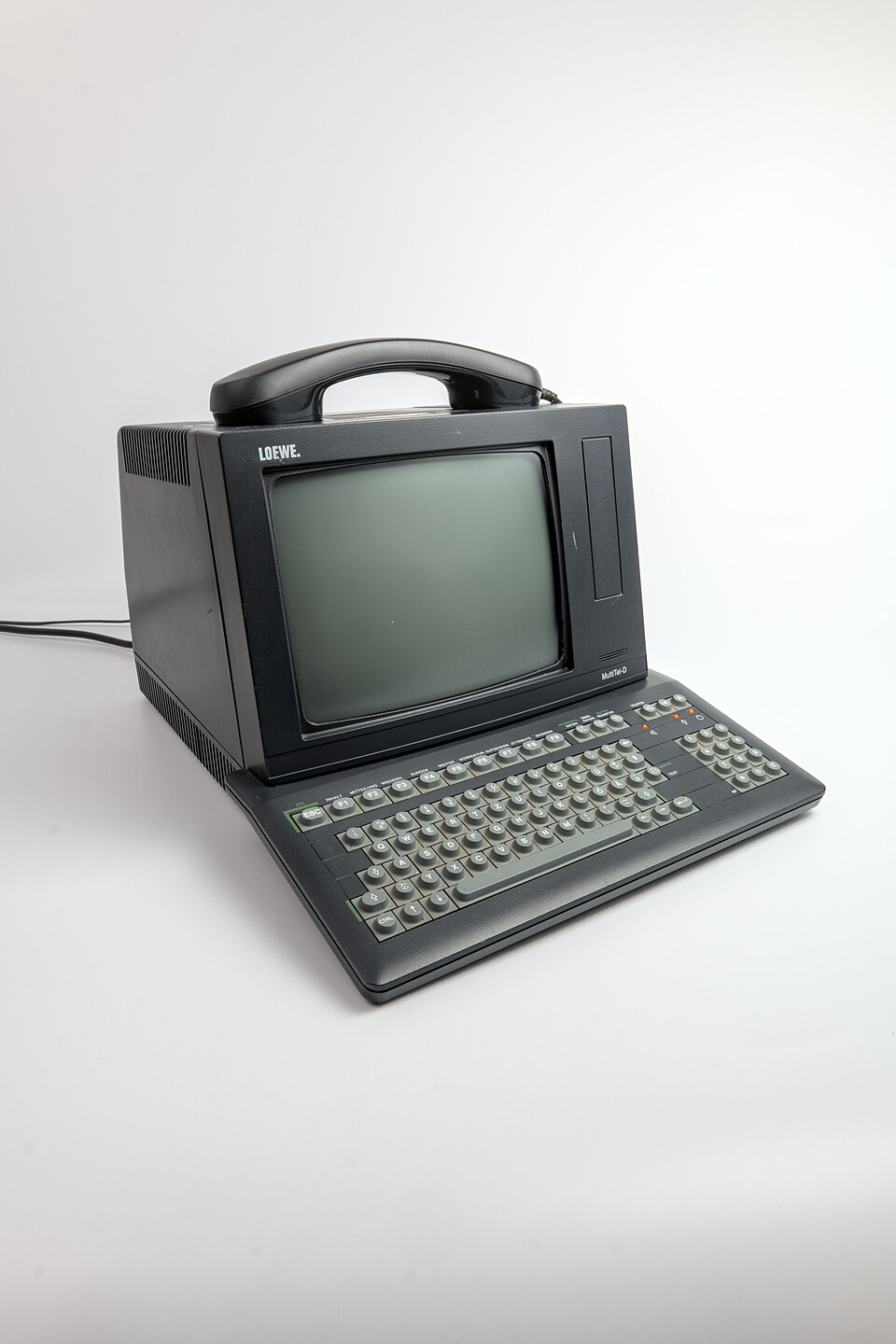
A subscriber paid a one-time connection fee of 55 DM and a monthly base fee of 8 DM, on top of normal telephone charges for every minute online. The decoder was extra: either a set-top unit for the television or the Bundespost’s own MultiTel terminal, rented or purchased. Providers then charged per page, anywhere from 0.01 to 9.99 DM per view, with the Bundespost handling billing and taking its cut. Sending a message cost 30 Pfennig. Only in 1986 did cheap adapter modules for home computers such as the Commodore 64 open the service to people unwilling to buy dedicated hardware.
The result was a service where the meter was always running and the entry ticket cost real money. The Bundespost had projected one million subscribers by 1986. The actual number was about 60,000. The million mark was reached roughly a decade later, and only after Btx had been folded into a general online service with internet access.
The Haspa Hack
The Bundespost marketed Btx as secure and dismissed critics who said otherwise. In November 1984, the Chaos Computer Club settled the argument.
The 134,634.88 DM demonstration
A flaw in the Btx system could leak the contents of memory into a displayed page, and one such leak exposed the access password of the Hamburger Sparkasse (Haspa). On the night of 16–17 November 1984, Wau Holland and Steffen Wernéry used the bank’s credentials to call up a CCC page billed at 9.97 DM per view, over and over, by script. By morning the bank owed the club 134,634.88 DM. The CCC returned the money, informed the data protection authorities, and held a press conference. See Wau Holland for the full story, including the myth that the money came from the Bundespost itself.
The hack made the CCC a national institution and made Btx a punchline. For the Bundespost, the damage was less the flaw itself than the memory of its own assurances.
Minitel Next Door
The comparison that condemned Btx was running in parallel across the Rhine. France Télécom gave the Minitel terminal away, or rented it for a token fee, on the theory that the money would come from usage. Millions of French households took one, an ecosystem of services bloomed (directories, ticket sales, chat, the notorious messageries roses), and Minitel became a genuine mass medium that survived until 2012.
The Bundespost made the opposite bet: recover the hardware cost from the subscriber up front. Fewer subscribers meant fewer providers, which meant less content, which meant fewer subscribers. Btx spent the 1980s on the wrong side of that loop.
Absorption into T-Online
In 1993 the Bundespost folded Btx into Datex-J (“Datenexchange für Jedermann”), dropping the separate brand. In 1995 the successor Deutsche Telekom relaunched the whole thing as T-Online, bundling the old Btx pages with e-mail and internet access. The classic Btx service was switched off on 31 December 2001; a remnant, kept alive mainly because German banks still used its interface for home banking, ran as “T-Online Classic” until 10 May 2007.
Dead End
Btx failed for reasons that had little to do with its technology, which was competent for its era, and everything to do with its economics. It charged consumers for hardware, connection, subscription, connect time, and content in a market that had never seen any of these services and had no idea whether they were worth paying for. Minitel proved in the same years that the same idea, priced for adoption instead of cost recovery, could reach the mass market. And when the open internet arrived in the mid-1990s, a closed national system with a state monopoly at its center had no answer; its user base and its banking services were carried over into T-Online, and the medium itself was quietly retired.
Two things outlived it. German online banking, born on Btx, moved to the web without missing a step. And the Haspa hack fixed the public image of the German hacker as a watchdog rather than a thief, an image the hacker culture in Germany benefits from to this day. See also Germany’s IT Industry for the pattern of German strength in infrastructure and weakness in consumer platforms, and Dead End: WAP for a later system that repeated the per-page toll booth on the mobile phone.
📚 Sources
- Bildschirmtext — Wikipedia
- Bildschirmtext — Wikipedia (German), launch, tariffs, subscriber numbers, shutdown dates
- heise online: “Zahlen, bitte! CCC: Virtueller Bankraub für 134.634,88 DM”
- Wau Holland Stiftung: “BTX-Hack — 30th Anniversary”
- Minitel — Wikipedia
- Image: MultiTel-D P1110266.jpg by -stk (CC BY-SA 4.0), via Wikimedia Commons