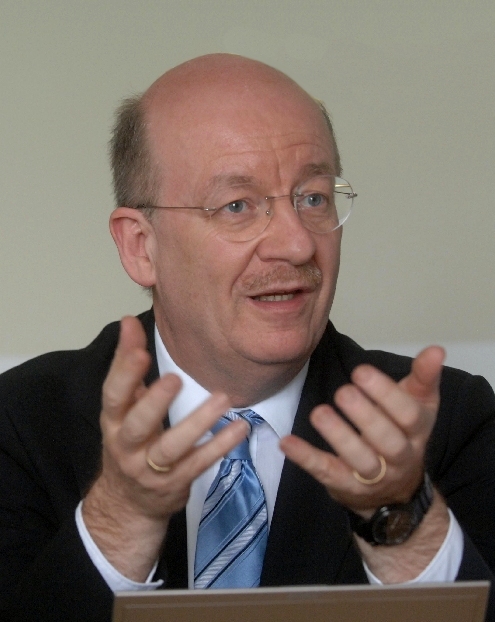
Wolfgang Wahlster
Abstract
Wolfgang Wahlster (born 1953) became a full professor at 29, co-founded the German Research Center for Artificial Intelligence in 1988 and ran it for 22 years, and led Verbmobil (1993–2000), the 116-million-mark project to translate spontaneous German, English and Japanese speech in real time, the largest AI project Germany had attempted and one that shipped no product and trained a generation. In April 2011 he, Henning Kagermann and Wolf-Dieter Lukas published a short article in VDI Nachrichten proposing that the networking of factories by software be called the fourth industrial revolution. The phrase, Industrie 4.0, became German industrial policy within two years and was adopted around the world. He is the person through whom German AI kept a public face during the winters, and the one who gave its manufacturing sector its slogan.
Hamburg to Saarbrücken
Wahlster was born in Saarbrücken on February 2, 1953, and studied computer science and theoretical linguistics at the University of Hamburg from 1972, taking his diploma in 1977 and his doctorate in 1981 with a dialogue system, HAM-RPM, that could discuss a scene in German and explain its own reasoning. Saarland University appointed him to a chair in computer science in 1982, at 29, one of the youngest full professors in the country, and he never left Saarbrücken, which under him and Hans Uszkoreit became the German centre of language technology (see Hans Uszkoreit and German Language Technology).
DFKI
In 1988, at the end of the expert-systems boom and the start of the winter that followed it, the federal research ministry and a group of companies founded the Deutsches Forschungszentrum für Künstliche Intelligenz, DFKI, in Kaiserslautern and Saarbrücken, as a non-profit research company owned jointly by industry and the state. Wahlster was one of its founding scientific directors and its chief executive from 1997 to 2019. The model was deliberate: a laboratory with professors and doctoral students on one side and Siemens, SAP, Deutsche Telekom, BMW and the rest as shareholders on the other, funded by projects rather than endowment, so that research had to find an industrial partner to exist. It grew to about a thousand staff on five sites and a stream of spin-off companies, and it survived a period in which AI institutes elsewhere were closed or renamed by keeping the letters in its name. The larger national picture is in Germany’s IT Industry.
Verbmobil
Verbmobil was the ministry’s lead project from 1993 to 2000, with 116 million Deutsche Mark and around a hundred researchers from universities and industry, coordinated from DFKI with Wahlster as scientific director. The task was to translate spontaneous spoken dialogue, German, English and Japanese, between two people arranging a meeting or planning a trip, with a delay short enough for conversation. Spontaneous speech was the point: hesitations, restarts, half-sentences and the noise of a real conversation, which the hand-written grammars of the 1980s could not survive. The final system combined deep linguistic analysis with statistical components, produced translations about 80 percent of which were judged approximately correct on its test dialogues, and demonstrated on a laptop in 2000. It was never sold. What it left was the trained people, the annotated corpora of all three languages that the statistical era needed, eight spin-off companies in car voice control, e-mail reading and speech search, and a prototype in the Deutsches Museum. Wahlster and the project received the German Future Prize, the president’s technology award, in 2001. The project in detail, including the final evaluation, is in Dead End: Verbmobil; the paradigm that overtook it is in Machine Translation.
Its successors, SmartKom (1999–2003) and SmartWeb (2004–2007), added gesture, gaze and the mobile web to speech, and Wahlster’s own research through those years was on multimodal dialogue: how a system should combine what a user says, points at and looks at into one meaning.
Industrie 4.0
The phrase for which he is known outside the field came from a working group. In 2011 the federal government’s research union asked whether German manufacturing could be given a strategic theme, and Wahlster, Henning Kagermann of SAP and Wolf-Dieter Lukas of the research ministry wrote an article for VDI Nachrichten, published on April 1, 2011, and presented at the Hannover Messe that month, arguing that the embedding of networked software in every machine, product and process amounted to a fourth industrial revolution after steam, electricity and the computer, and that Germany, which built the machines, should lead it. Industrie 4.0 became a government platform in 2013, a line in the coalition agreement, a standard at trade fairs, and, translated, a policy in China, Japan and the United States. Wahlster’s contribution was the concept behind the slogan: the cyber-physical production system, in which the workpiece carries its own data and negotiates with the machines that will process it, which DFKI had been building in a demonstration factory in Kaiserslautern since 2005.
He was elected to the Royal Swedish Academy of Sciences in 2003, the Leopoldina in 2004 and the German engineering academy acatech, received the Federal Cross of Merit in 2006 and its Grand Cross in 2019, holds five honorary doctorates, and initiated the Hermes Award for industrial technology given at Hannover since 2004. He retired from his chair at the end of 2018 and handed DFKI to Jana Koehler, once his doctoral student, on February 1, 2019, staying on as its chief scientific advisor.
📚 Sources
- Wolfgang Wahlster — Wikipedia
- Wolfgang Wahlster — Wikipedia (German) (the 1982 chair at 29, DFKI CEO 1997–2019, the April 1, 2011 VDI Nachrichten article with Kagermann and Lukas, the academies and honours, the 2019 succession)
- Verbmobil — Wikipedia (German) (1993–2000, 116 million DM, the partners, the three languages, the 2001 Zukunftspreis)
- “Prof. Wahlster erhält den Deutschen Zukunftspreis 2001” — idw (about 100 researchers, eight spin-offs)
- Wahlster, Wolfgang (ed.) — Verbmobil: Foundations of Speech-to-Speech Translation, Springer, 2000
- Kagermann, Henning, Wolf-Dieter Lukas and Wolfgang Wahlster — “Industrie 4.0: Mit dem Internet der Dinge auf dem Weg zur 4. industriellen Revolution”, VDI Nachrichten 13, April 1, 2011 (DFKI mirror; 403 to scripts, loads in a browser)
- Wahlster, Wolfgang — “Ten Years of Industrie 4.0”, interview, DFKI, 2021 (the Kaiserslautern demonstration factory, the cyber-physical production system, the 2013 platform)
- Image: Wolfgang Wahlster Portrait.jpg by Renatoorsini (CC BY-SA 3.0), via Wikimedia Commons