A. Michael Noll and Ken Knowlton
Abstract
In the summer of 1962 a Bell Labs plotter drew garbage because of a program bug, and a 23-year-old engineer named A. Michael Noll (born 1939) decided the garbage was interesting. Three years later his pictures hung in a New York gallery, two months after Georg Nees’s in Stuttgart, and he had shown that most people preferred a computer’s imitation of Mondrian to the Mondrian. Down the corridor Ken Knowlton (1931–2022) wrote BEFLIX, the first language for making animated films by computer, and with Leon Harmon produced the twelve-foot nude of a dancer built from tiny symbols that The New York Times printed in 1967. Between them they established that computer art could be made in a telephone company’s research laboratory as a by-product of the work, and that nobody there would mind, provided the pictures went out under the laboratory’s name.
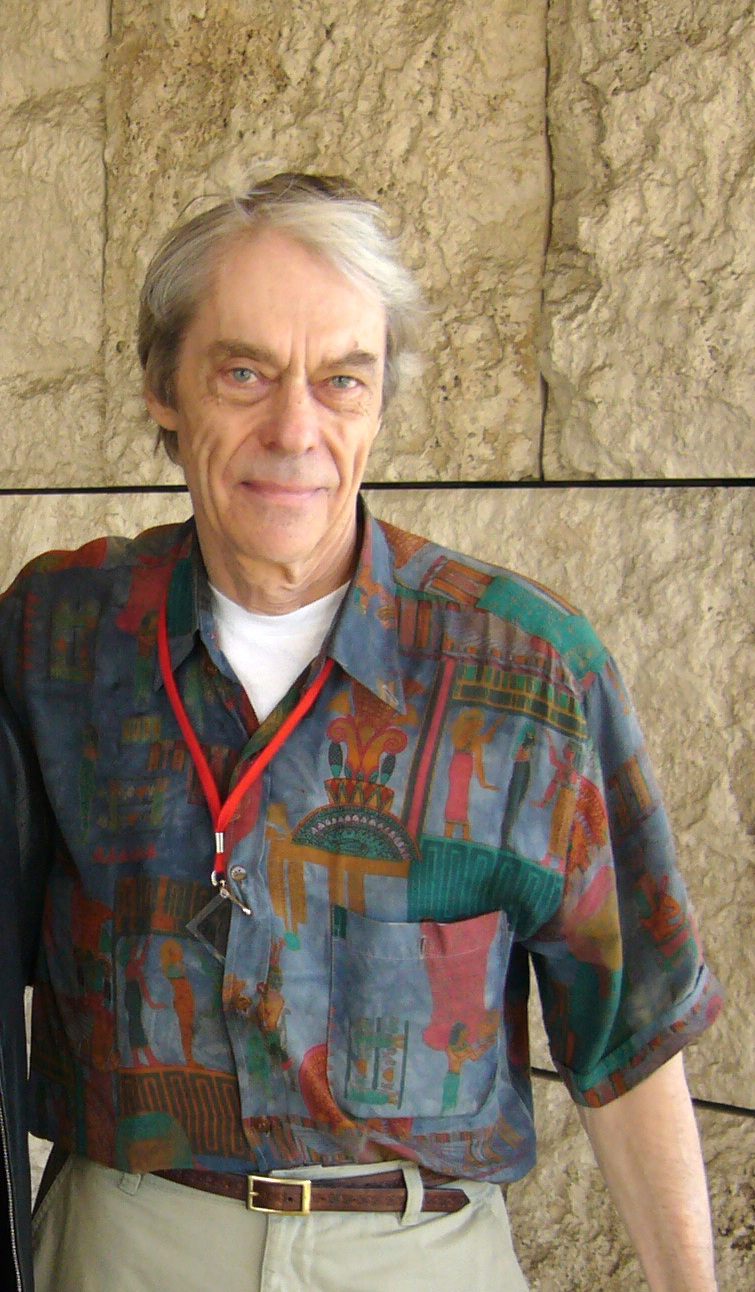
Murray Hill
Bell Telephone Laboratories in Murray Hill, New Jersey, had in the early 1960s an IBM 7090 and a Stromberg-Carlson 4020 microfilm recorder, a machine that drew lines and characters on a cathode-ray tube and photographed them frame by frame. It existed to plot the output of simulations. The engineers who used it worked out that it could draw anything, and Bell Labs, which was run on the principle that people hired for their curiosity should be allowed to indulge it (see Bell Labs: The Idea Factory), let them.
Noll
Albert Michael Noll was born in Newark in 1939, took an electrical-engineering degree at Newark College of Engineering in 1961, and joined Bell Labs that year, working on speech and, in his own time, on the 4020. In the summer of 1962 a colleague’s program went wrong and the plotter drew a tangle; Noll, who had been reading about the new field of information aesthetics, wrote programs on purpose to do the same, with a random-number generator choosing the coordinates. Gaussian-Quadratic (1963), lines whose horizontal positions were Gaussian and vertical positions quadratic, is the earliest surviving example of American digital art. He made stereoscopic pairs and short films, including a computer-generated ballet, and in 1965 became one of the first people to register a copyright on a computer-generated picture; the Copyright Office first refused, on the grounds that a machine had made it, and relented when Noll explained that the randomness was his and so was the program.
In April 1965 the Howard Wise Gallery on 57th Street showed Computer-Generated Pictures, Noll’s work alongside the random-dot stereograms of his Bell Labs colleague Béla Julesz. It was the first computer-art exhibition in the United States; Nees’s in Stuttgart had opened in February (see Georg Nees and Frieder Nake), and neither knew of the other. The critics were unimpressed and nothing sold. Noll’s most quoted work was an experiment rather than a picture: he programmed the 4020 to produce a pattern of short bars distributed like those in Piet Mondrian’s Composition with Lines (1917), showed both to a hundred Bell Labs staff, and found that most could not tell which was the painting and that a majority preferred the computer’s. He published it in 1966 in The Psychological Record.
His later career was in the machinery of communications rather than its art. He built a three-dimensional input device with force feedback in 1971, a precursor of haptic interfaces that he patented in 1975; he took a doctorate at Brooklyn Polytechnic in 1971 and left Bell Labs the same day to spend two years, 1971 to 1973, on the staff of the President’s Science Advisor, Edward David, in the White House Office of Science and Technology; he went back to AT&T on the business side, and became a professor and, from 1992 to 1994, interim dean of the Annenberg School for Communication at the University of Southern California. He has written ten books and spent much of his retirement writing the history of what happened at Murray Hill in the 1960s.
Knowlton
Kenneth Charles Knowlton was born in Springville, New York, on June 6, 1931, took degrees in engineering physics at Cornell, and finished a doctorate at MIT in 1962 on parsing sentences with a self-organising program. Bell Labs hired him that year. In 1963 he wrote BEFLIX (Bell Flicks), the first programming language for making films: a program described a grid of cells and how their contents changed from frame to frame, the 7094 computed each frame, and the 4020 photographed it. His own demonstration film, A Computer Technique for the Production of Animated Movies (1964), was made in it, and the experimental filmmaker Stan VanDerBeek came to Murray Hill to make the Poem Field series (1966–69) with him, abstract films of dancing text that toured the art-house circuit.
In 1966 he and the perception researcher Leon Harmon scanned a photograph of the dancer Deborah Hay lying nude, divided it into a coarse grid, and replaced each cell with a small electronic symbol, a transistor, a resistor, a diode, whose density matched the grey level, so that the picture resolved into a body only from across the room. Studies in Perception I was twelve feet wide. It was shown at a 1967 press conference on art and technology and reproduced in The New York Times on October 11, 1967, reportedly the first full-frontal nude the paper had printed; Bell Labs, embarrassed, asked that its name be left off, and then, when the picture was a success, asked that it be put back. The image became the standard illustration of the idea that a computer could make a picture out of a picture, and Knowlton spent the rest of his life making mosaics: portraits assembled from dominoes, seashells, dice, and keyboard keys, each one also an image of something else.
He wrote a second language, EXPLOR, in 1970, for pictures built from explicit patterns, local operations and randomness, left Bell Labs in 1982, and later worked at Wang Laboratories. In 2011, with Mark Setteducati, he designed the puzzle Ji Ga Zo, in which three hundred pieces can be assembled into any face. Ken Knowlton died in Sarasota, Florida, on June 16, 2022, at 91.
The Laboratory as Studio
Neither man called himself an artist for long, and both were clear that the pictures were experiments on perception, on randomness, on what a viewer would accept as intentional. What they demonstrated was institutional as much as aesthetic: the first American computer art came out of a monopoly telephone company’s research budget because the machine was there, the engineers were curious, and the management could afford not to ask. The German pioneers had a philosopher; the Americans had a microfilm recorder. The two traditions and what came after them are in Computer Art and Generative Art.
📚 Sources
- A. Michael Noll — Wikipedia
- Ken Knowlton — Wikipedia
- A. Michael Noll — compArt database of digital art, University of Bremen (the summer 1962 start, Gaussian-Quadratic, the April 1965 Howard Wise show, the copyright registration, the Mondrian experiment)
- Noll, A. Michael — “Human or Machine: A Subjective Comparison of Piet Mondrian’s ‘Composition with Lines’ and a Computer-Generated Picture”, The Psychological Record 16(1), 1966, pp. 1–10
- Noll, A. Michael — “The Beginnings of Computer Art in the United States: A Memoir”, Leonardo 27(1), 1994, pp. 39–44
- Knowlton, Kenneth C. — “A Computer Technique for Producing Animated Movies”, AFIPS Spring Joint Computer Conference, 1964
- Ken Knowlton, a father of computer art and animation, dies at 91 — The New York Times obituary via The Seattle Times, June 2022
- First-Hand: Two Years in Washington — A. Michael Noll, Engineering and Technology History Wiki (the 1971 doctorate and the Office of Science and Technology, 1971–73)
- Ken Knowlton — DAM Museum artist page