Georg and Edvard Scheutz: The Printing Difference Engine
Abstract
Georg Scheutz (1785–1873), a Stockholm printer, publisher and translator of Shakespeare, read a magazine article about Charles Babbage’s unfinished difference engine in 1834 and decided to build one. His son Edvard Scheutz (1821–1881) made the first metal model at sixteen, in his school holidays. Father and son completed the first difference engine that both calculated and printed its results: a small model by 1843, and with a Swedish parliamentary grant a full machine in 1853 that handled 15-digit numbers and four orders of differences and pressed its tables into moulds for stereotype printing. Babbage, who had spent large sums of the British government’s money without finishing his own, became their most energetic promoter. The machine won a gold medal at the Paris Exposition of 1855 and was bought for the Dudley Observatory in Albany, New York; a copy built in London computed the English Life Table of 1864. Neither paid off, and both survive in museums.
The Publisher
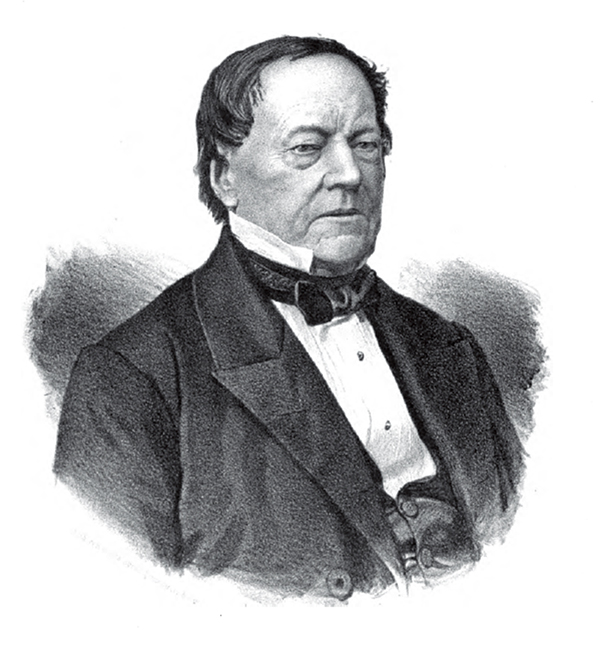
Pehr Georg Scheutz was born on 23 September 1785 in Jönköping, a wooden town of about 2,000 people at the southern tip of Lake Vättern, where his father, the son of a German cook in the Danish royal service, kept the best inn in town. He studied law at Lund, passed the legal examinations in 1805, and served for some years at the Göta Supreme Court and then in Stockholm as an unpaid auditor with the Swedish artillery.
His real career was print. In 1816 he published the first Swedish translation of Shakespeare’s Julius Caesar, and the next year, with a small inheritance, he went into partnership with the novelist and journalist Fredrik Cederborgh, whose weekly Anmärkaren started Swedish opposition journalism. In 1819 their paper exposed false murder confessions extracted by torture from a servant’s innocent family, and the guilty official was dismissed and imprisoned. For a while, their contract specified that Cederborgh wrote the odd-numbered issues and Scheutz the even ones. In 1820 Scheutz took over the printing house under his own name, and until 1836 he printed Argus, the leading opposition journal of the 1820s. Under the press laws of the time, the censor repeatedly withdrew its licence, and each time a friend obtained a new one for a journal with a “new” name; there were seven Arguses in all, the last licensed in 1834 to a printer’s apprentice.
Scheutz also translated, with Bishop Johan Henrik Thomander, the first Swedish edition of Shakespeare’s collected works, and published technical handbooks and journals on mechanics, dyeing, brewing, surveying and algebra for a country that was beginning to industrialize. He invented a cylinder printing press of his own in 1823 that was never developed.
A Magazine Article
In July 1834 the Edinburgh Review published a long article by Dionysius Lardner on Charles Babbage’s difference engine. Babbage had designed the machine in the 1820s to compute mathematical tables by the method of differences, which reduces the computation of any polynomial to repeated addition, and to print them, eliminating both the human computers’ and the typesetters’ errors. The British government had paid for its construction, and the work had stopped after a dispute with Babbage’s engineer, Joseph Clement (see Charles Babbage: The Visionary Architect). Lardner’s article explained the principle and the general outline of the mechanism and ended with a plea not to let the investment go to waste.
Scheutz read it and concluded that such a machine was feasible, and simpler than Babbage’s. He built a small model out of wood, wire and cardboard. It would have joined his other inventions in a drawer, Uta Merzbach wrote in her history of the machine, if it had not been for his son.
Edvard
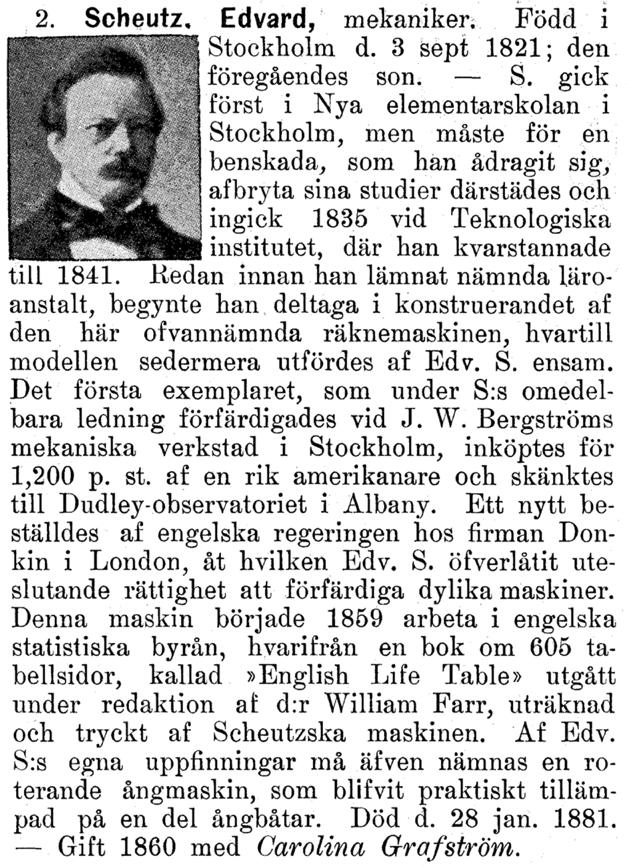
Edvard Scheutz was born in Stockholm on 3 September 1821. A leg injury interrupted his schooling, and in 1835 he entered the new Technological Institute in Stockholm, where he studied until 1841; at fifteen he also wrote a comedy that his father’s firm published. In the summer holidays of 1837, aged sixteen, he asked his father’s permission to turn the cardboard model into a metal one. His father installed a workshop at home for him, and the son agreed to work on the machine in return.
That autumn Georg asked the Royal Swedish Academy of Sciences to support an application for government money to build a full-size engine. The Academy, perhaps influenced by what it had heard of Babbage’s expensive failure, refused. In December 1838 the Paris Academy of Sciences recorded a note from Scheutz about a calculating machine “announced as being simpler and hence less costly than that of Mr. Babbage.” Edvard kept working. By 1840 he had a five-digit machine that computed one order of differences; by 1842 it handled three orders; and early in 1843 the printing mechanism was finished. That February, in Edvard’s first year of legal majority, his father handed the printing business over to him.
A commission of the Academy, led by the chemist Jöns Jacob Berzelius, tested the model and confirmed that it worked. It consisted of a calculating machine for series of up to the third degree and five figures, a printing machine that pressed each result into a soft material from which stereotype or electrotype printing plates could be made, and a numbering machine that printed the argument in front of each value, all driven by turning a single crank. There was nothing in the mechanism, the commissioners wrote, to prevent extending it to any degree and any number of figures.
Money was another matter. In 1844 Georg Scheutz asked the crown for 10,000 riksdaler to build a full-size machine; the Academy would not say that the benefit to the nation justified the cost, and the request was refused. An offer to sell a 17-digit, seven-difference machine to Britain, transmitted by the Swedish ambassador, met only references to Babbage’s money-consuming project. The model lay unused for seven years.
The Grant
By 1850 the political ground had shifted in Scheutz’s favour. The press freedom and free-trade causes he had fought for were winning, and old friends from the Argus years sat in the liberal chamber of burghers of the Riksdag. In January 1851 he asked again, this time for 3,333 riksdaler and 16 skilling, a third of his earlier request. The Academy now supported him, noting that he sought “a donation that does not come to 1 % of that which England paid for the Babbage machine.” The crown again declined for lack of funds, but a Stockholm merchant in the burghers’ chamber, A. M. Brinck, took up the motion, and in August 1851 the four estates of the Riksdag voted the money, payable only if the finished machine was found to work. The nobles had argued that the Academy had merely said it “had reason to suspect that it is useful.”
The full machine was built in the Stockholm workshop of the engineer J. W. Bergström and finished in October 1853. It was about the size of a piano. It worked with numbers of 15 digits and four orders of differences, printed eight digits of each result, and pressed the figures into strips of papier-mâché, usually coated with black lead, from which stereotype plates for a printing press could be cast.
Babbage, London and Paris
In the autumn of 1854 the Scheutzes brought the machine to London, to the works of Bryan Donkin and Company in Bermondsey, a firm that had made parts for Babbage’s engine. The engineer William Gravatt took charge of demonstrating it, and the Scheutzes obtained a British patent in 1854. In 1855 the machine stood for a time at the Royal Society in Somerset House, whose committee reported that it could “calculate and print more quickly than a good compositor could set the type, and that without risk of error.” Prince Albert came to see it.
Many had expected Babbage, known for his temper, to treat the Swedes as rivals. The Scheutzes themselves came to England with some trepidation. Instead he became their most active supporter. He wrote to the press and to scientific societies, and his son Henry Prevost Babbage drew the machine in Babbage’s mechanical notation. When the machine went to the Exposition Universelle in Paris in August 1855, Babbage followed it in October, presented it to the French Academy of Sciences and distributed its literature at his own expense. He also published a pamphlet attacking the Royal Society for not awarding Scheutz a medal. “It was prognosticated even to us, that we should meet an adversary in you,” the Scheutzes wrote to him in 1856; “and we have found a protector!”
At the Exposition the machine won a gold medal, which the Scheutzes received from Prince Charles at the royal palace in Stockholm on 21 April 1856. Georg Scheutz was elected to the Royal Swedish Academy of Sciences that February and made a knight of the Order of Vasa. The French were more cautious. After the exhibition the machine went to the Paris Observatory for trials, and its usefulness was debated at the Academy of Sciences; Charles Dupin, while acknowledging the superior merits of the observatory’s human computers, argued that the inventors should be encouraged.
Albany
The buyer came from America. The astronomer Benjamin Apthorp Gould had met Babbage in 1845 and had discussed mechanical computation with him again in 1851. In 1855 he was helping to equip a new observatory in Albany, New York, the Dudley Observatory, and on a buying trip to Europe that autumn Babbage showed him the Scheutz machine in Paris. In 1856 an Albany manufacturer, John F. Rathbone, subscribed $5,000 for it, and the observatory paid the Scheutzes £1,000 through George Peabody and Company in London. “In securing the calculating engine,” Gould told the trustees on 7 November 1856, “I see the inauguration of a new era.” It was the first printing calculator ever sold.
Gould and his assistants used it to compute a table of the true anomaly of Mars, and found its quirks: it lacked the security mechanisms Babbage had designed against jammed or slipped wheels, and they recorded an accidental error in its output. A bitter dispute between Gould and the observatory’s trustees ended his time at Albany, and the machine was used only occasionally afterwards. In the 1920s it passed to Felt and Tarrant of Chicago, makers of the Comptometer; their successor, the Victor Comptometer Corporation, gave it to the Smithsonian Institution in 1963, and it went on display in the National Museum of History and Technology in 1966.
The English Life Table
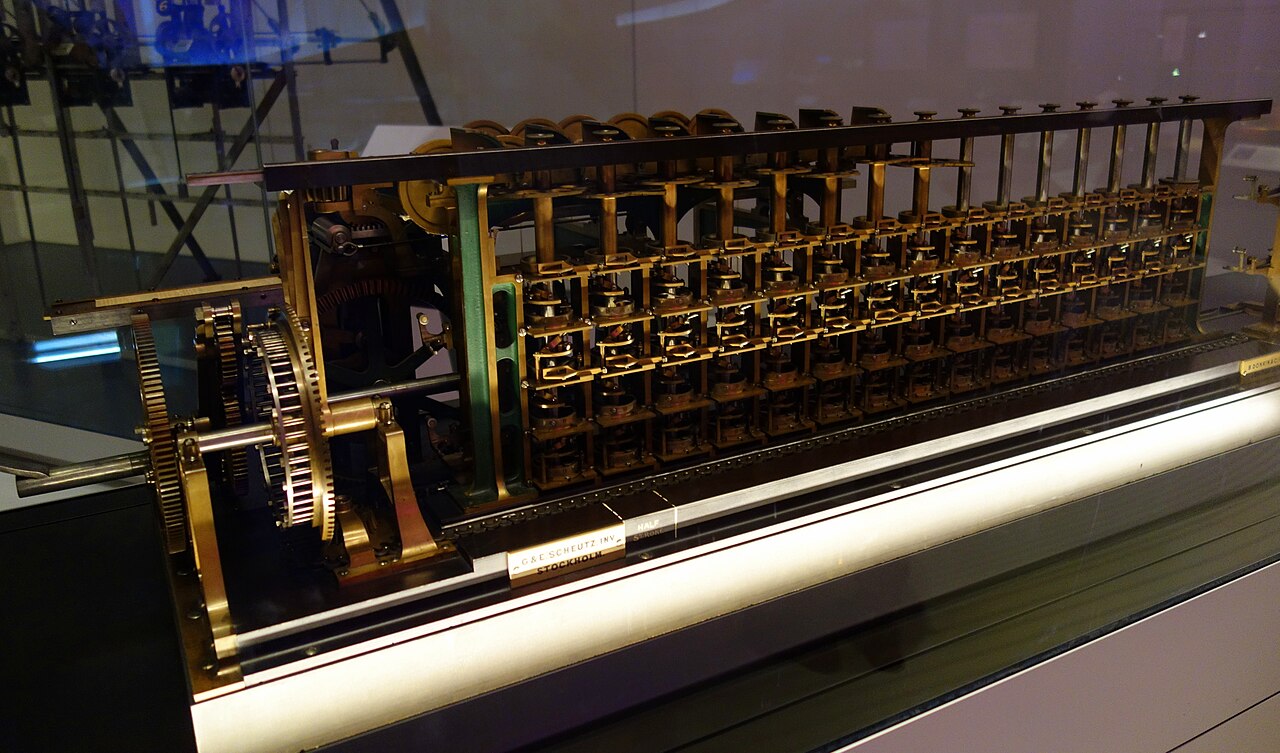
Before the machine left for America, Edvard Scheutz and Bryan Donkin looked for a British buyer for a second one and found William Farr, the statistician of the General Register Office, who needed life tables for insurance and public health. In 1857 the British government ordered a copy, which Scheutz and Donkin offered to build for £1,200. Donkin’s firm built it, from about 4,320 parts, of which 2,054 were screws, delivered it in 1859 several weeks late, and lost money on the contract. The same year Farr published the first tables produced by the machine.
Farr used it for the English Life Table of 1864, a volume of life expectancies, annuities and insurance premiums whose printed pages came directly from the machine’s moulds. His verdict was mixed. The machine needed constant attention, it had to be checked against hand computation, and the hoped-for saving in clerks did not materialize. Donkin and Scheutz offered further machines at £2,000 each and found no customers. The engine stayed at the General Register Office until 1914, when it went to the Science Museum in London.
Afterwards
Georg Scheutz returned to publishing. In 1856 the printer Per Ambjörn Sparre handed him the production of Sweden’s first postage stamps, and until he retired in 1870, at 84, Scheutz was responsible for designing and printing the country’s stamp issues; in 1860 the Riksdag voted him a lifelong pension of 1,200 riksdaler, and in December 1872, less than five months before his death, the Academy of Sciences awarded him its Carl Johan Prize for his literary work, especially for “clothing Shakespeare in Swedish dress.” He died on 22 May 1873, aged 87. Edvard, who had not inherited his father’s constitution, died in January 1881, aged 59.
Others carried the idea on. The Swedish inventor Martin Wiberg built a compact difference engine, desk-sized, with its number wheels arranged along one axis, and published interest tables computed with it in 1860 and logarithm tables in 1875. In the United States George B. Grant, encouraged by the same circle of Harvard scientists who had backed Gould, built difference engines in the 1870s and showed a large one at the Centennial Exhibition of 1876. None of these machines found a market. The future of mechanical calculation lay with desk machines for multiplication and division (see Before the Computer: Mechanical Calculation), and later with punched-card tabulators, which the British Nautical Almanac Office and other institutions adopted for differencing.
The Scheutzes’ place in the story is that they finished what Babbage had designed, on a fraction of his budget, and that it worked. Their machine also showed why the idea had less of a future than its promoters hoped: a mechanical computer that lacked Babbage’s interlocks could err without warning, and a table-making machine was only worth its cost to an institution that printed a great many tables. Babbage had answered the first problem on paper in his design for Difference Engine No. 2, whose calculating section the Science Museum finally built in 1991, followed by its printer in 2002.
📚 Sources
- Merzbach, Uta C.: Georg Scheutz and the First Printing Calculator, Smithsonian Studies in History and Technology No. 36, Smithsonian Institution Press, 1977 (biography, Lardner, Edvard’s models, Academy reports, 1844 and 1851 grant requests, Riksdag vote, 15 digits and 4 orders, London, Babbage, Paris medal, Gould, Rathbone, £1,000, Albany, Donkin and Farr, £1,200, parts count, Science Museum 1914, pension, deaths, Wiberg, Grant, Smithsonian 1963)
- Merzbach, Uta C.: Georg Scheutz and the First Printing Calculator, Smithsonian Research Online record
- Per Georg Scheutz, Wikipedia (birth, Lund, 1843 model, 1851 grant, 1853 machine, Paris, Dudley, British copy, death)
- Difference engine, Wikipedia (Scheutz section, Wiberg, Grant)
- “Scheutz Difference Engine,” Smithsonian National Museum of American History, object 323659 (1853, first printing calculator sold, gift of Victor Comptometer Corporation)
- “Georg & Edvard Scheutz,” Computer History Museum, The Babbage Engine (London engine used for the 1864 English Life Table, lack of security devices, Science Museum)
- “No Longer in the Collection: Scheutz Difference Engine,” Dudley Observatory, May 2023
- “Death by numbers: the mathematics of mortality,” Science Museum blog (Farr and the Scheutz engine)
- “William Farr Publishes the First Instances of a Printing Calculator Used to Do Original Work,” HistoryofInformation.com
- Scheutz, Georg & Scheutz, Edvard: Specimens of Tables, Calculated, Stereomoulded, and Printed by Machinery, London, 1857 (Internet Archive)
- Image: Edvard Scheutz SPA3.jpg from Svenskt Porträttarkiv (portrattarkiv.se) (CC BY-SA 4.0), via Wikimedia Commons