Czechoslovakia's Computing Industry: Svoboda, SAPO, and the Institute That Lost Its Founder
Abstract
Czechoslovakia’s computing began with a man who had already built computers for the United States Navy. Antonín Svoboda came home to Prague in 1946 from the MIT Radiation Laboratory, founded the country’s computer laboratory in 1950, and built SAPO, the first fault-tolerant computer anywhere: three arithmetic units voting on every result, on 7,000 relays, running from 1957 until a spark set the relay oil alight in 1960. The state took his institute away from him in 1958 and he left the country for good in 1964, through Yugoslavia and Greece to UCLA. What stayed behind built the EPOS machines, the Comecon clone EC 1021, and the Tesla school computers of the 1980s, and after 1989 became the improbable home of two of the world’s antivirus companies. The article is a case of an industry losing its founder rather than its market.
Svoboda’s War
Antonín Svoboda was born in Prague on 14 October 1907, graduated from the Czech Technical University in 1931 and took his doctorate in 1935 on models of electrical transmission. In 1936 he joined the Ministry of National Defence, where he improved anti-aircraft gun sights, and when Germany invaded in 1939 he fled to France, then, in 1941, to the United States. At the MIT Radiation Laboratory he designed an automatic aiming scope for naval guns and the linkage computer at the heart of the Mark 56 gun fire-control system, for which the Navy gave him its Ordnance Development Award. He was, by 1945, one of the few people in the world who had designed a working computing machine that had been fired in anger.
He went home in 1946, took a department at the Technical University, and in 1950 set up a laboratory for mathematical machines inside the Central Mathematical Institute; it moved under the Academy of Sciences in 1952 and became the Academy’s Institute of Mathematical Machines in 1955. There he designed SAPO (SAmočinný POčítač, “automatic computer”) between 1950 and 1956. SAPO was electromechanical, 7,000 relays and 400 valves, with a magnetic drum of 1,024 words of 32 bits and binary floating point, and it had a feature no other computer had: three arithmetic units working in parallel, with a vote deciding the result. It was the first fault-tolerant computer, triple modular redundancy before the idea had a name. It ran from 1957 to 1960, by which time it was already obsolete, and in 1960 a spark from a relay ignited the lubricating oil and the relay unit burned; nobody thought it worth repairing.
The Institute Without Its Founder
In 1958 the institute was taken from the Academy and given to the Ministry of Industry as the Research Institute of Mathematical Machines (VÚMS), and Svoboda lost the directorship. He kept designing. With Jan Oblonský he laid out EPOS 1 in 1958, a first-generation valve machine of medium performance that ran in 1963, and the transistorised EPOS 2 followed in 1964, along with the small MSP 2, of which eleven were built. By then he had decided to leave. In 1964 Svoboda emigrated with his family by way of Yugoslavia and Greece to the United States, where he taught computer science at UCLA until his retirement in 1977; he died in Portland, Oregon, on 18 May 1980, and in 1999 President Václav Havel awarded him the Medal of Merit posthumously.
The EPOS line outlived him in the country. EPOS 2 went into series production at the ZPA works in Čakovice from 1968 to 1973 as the ZPA 600 and ZPA 601, more than thirty machines in all, including mobile versions for the army mounted on three trucks. VÚMS also produced the DP 100 punched-card computer (200 units from 1967) and the ŘIP 1000 process-control machine, and its programmers spent much effort making EPOS 2 competitive with the Tesla 200 that the other state enterprise was selling. Then the Comecon decision of 1968 arrived (see Comecon Computing). Czechoslovakia’s assigned model in the ES EVM programme was the EC 1021, a clone of the IBM System/360 Model 20, developed at VÚMS from 1968; the institute’s last large machine, the EC 1027, ended production in 1989, and with it large-scale computer manufacturing in the country. VÚMS was dissolved in 1991 and the name passed to a small software firm.
The Home Computers
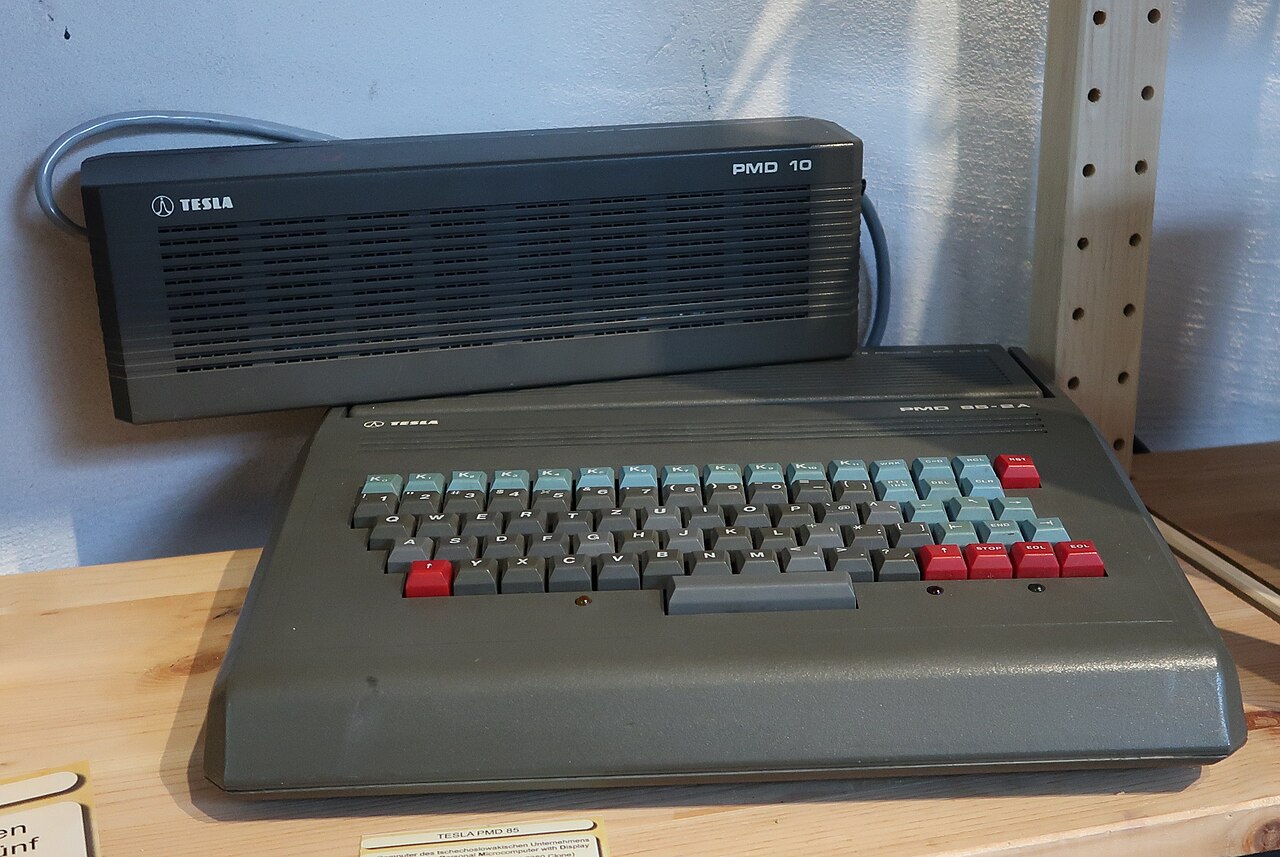
The 1980s produced the machines most Czechs and Slovaks actually touched. Tesla Piešťany and Tesla Bratislava built the PMD 85 from 1985, an 8-bit computer on the MHB 8080A, the domestic clone of the Intel 8080, at 2.048 MHz with 48 KB of RAM, designed from Roman Kišš’s PMD 85-0 prototype; the PMD 85-2 followed in 1986, the 2A in 1987 and the 85-3 in 1988. They were installed in bulk in Slovak schools, while the IQ 151 from ZPA did the same job in the Czech lands. Production stopped after the Velvet Revolution of 1989, when the machines could not compete with the Western computers that were suddenly legal to import.
After 1989
The country’s post-communist computing reputation rests on a product category nobody planned. Pavel Baudiš and Eduard Kučera founded Avast in Prague in 1988, while Baudiš was a researcher at the Academy of Sciences, and Miroslav Trnka and Peter Paško, who had been writing antivirus software since 1987 under the name NOD, founded ESET in Bratislava in 1992; the two companies and the conditions that produced them are covered in Estonia and Eastern Europe’s Tech Industry. Czechoslovakia itself split on 1 January 1993, and the two successor states went on as software exporters and nearshore development centres rather than hardware makers.
Dead End: The Fault-Tolerant Machine and the Man Who Left
SAPO is the kind of machine that should have founded a school. Its designer had built fire-control computers for the US Navy, its architecture anticipated the redundancy that spaceflight and telephone exchanges later depended on, and it worked. What the state did with it was take the institute from its founder in 1958, let the machine burn in 1960, and make his working conditions such that he walked out in 1964. The institute he left behind was competent, built more than thirty EPOS machines and a Comecon clone, and never again produced an original architecture; its last computer was a copy of an IBM model that was itself twenty years old. The Czechoslovak case adds one item to the list of ways a small country can lose a computer industry: not by selling it, as Italy did, and not by cancelling its best design, as Poland did, but by losing the one person who could have designed the next one. Svoboda’s students at UCLA got what Prague had.
📚 Sources
- Antonín Svoboda (computer scientist) — Wikipedia
- SAPO (computer) — Wikipedia
- Výzkumný ústav matematických strojů — Wikipedia (Czech)
- EPOS 1 — Wikipedia (Czech)
- EPOS 2 — Wikipedia (Czech)
- “Střední tranzistorový počítač EPOS 2” — Historie počítačů v Československu (ZPA 600/601 production 1968–1973, over thirty units, mobile army versions)
- PMD 85 — Wikipedia