Danny Hillis and the Connection Machine
Abstract
Danny Hillis wanted to build a computer with a million processors, wired like a brain, because he thought AI needed hardware shaped like the problem. His MIT thesis became Thinking Machines Corporation (1983), whose Connection Machine put 65,536 one-bit processors in a black cube of blinking red lights, employed Richard Feynman as a router analyst, and topped the first TOP500 list in 1993. A year later the company was bankrupt, undone when its main customer, DARPA, stopped playing favorite, and commodity clusters finished the job. GPUs later made massive parallelism the default. Hillis moved on to Disney rides, Google’s Knowledge Graph, and a clock in a Texas mountain designed to tick for 10,000 years.
Tinkertoys
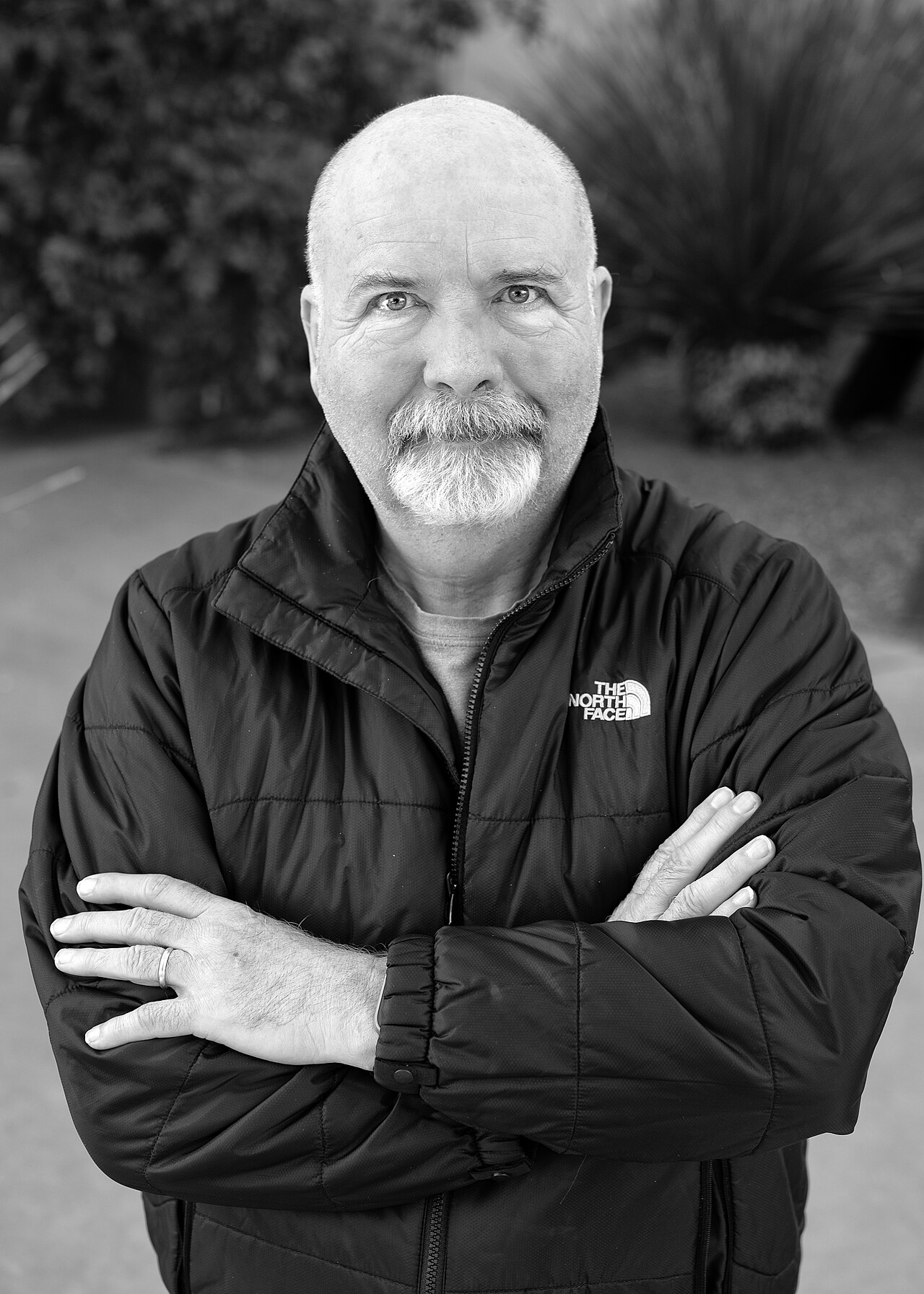
W. Daniel “Danny” Hillis was born on September 25, 1956, in Baltimore and spent much of his childhood abroad, in Europe, Africa, and Asia. At MIT (mathematics BS, 1978) he worked in the Logo Laboratory under Seymour Papert building hardware and software for children, and was part of the student team that built a computer out of Tinkertoys that plays perfect tic-tac-toe. It now sits in the Computer History Museum.
A Million Processors
As a graduate student under Marvin Minsky (with Claude Shannon and Gerald Sussman on the committee), Hillis attacked what he saw as AI’s hardware problem: a conventional computer fetched one word at a time through the bottleneck between processor and memory, while the brain ran billions of slow components in parallel. His 1981 proposal was a machine of a million simple processors, each with its own sliver of memory, passing messages through a routing network, hardware shaped like the semantic networks AI programs were trying to traverse. The design he actually built for his dissertation had 65,536 processors. The thesis won the 1985 ACM Doctoral Dissertation Award and was published as The Connection Machine; the PhD followed in 1988, the machine having somewhat preceded the paperwork.
Thinking Machines
To build it, Hillis and Sheryl Handler founded Thinking Machines Corporation in May 1983 near Boston. Richard Feynman showed up the day after incorporation (his son Carl was on the project) and demanded a real assignment. He got the message router, and analyzed its circuits the way he analyzed nature: where the engineers’ discrete analysis said each chip needed seven message buffers, Feynman’s partial differential equations said five. When chip area constraints later forced the count down to five, the network worked. The first program the machine ran, in April 1985, was Conway’s Game of Life. Hillis’s essay about those summers, “Richard Feynman and the Connection Machine”, became a classic of physics-meets-engineering literature.
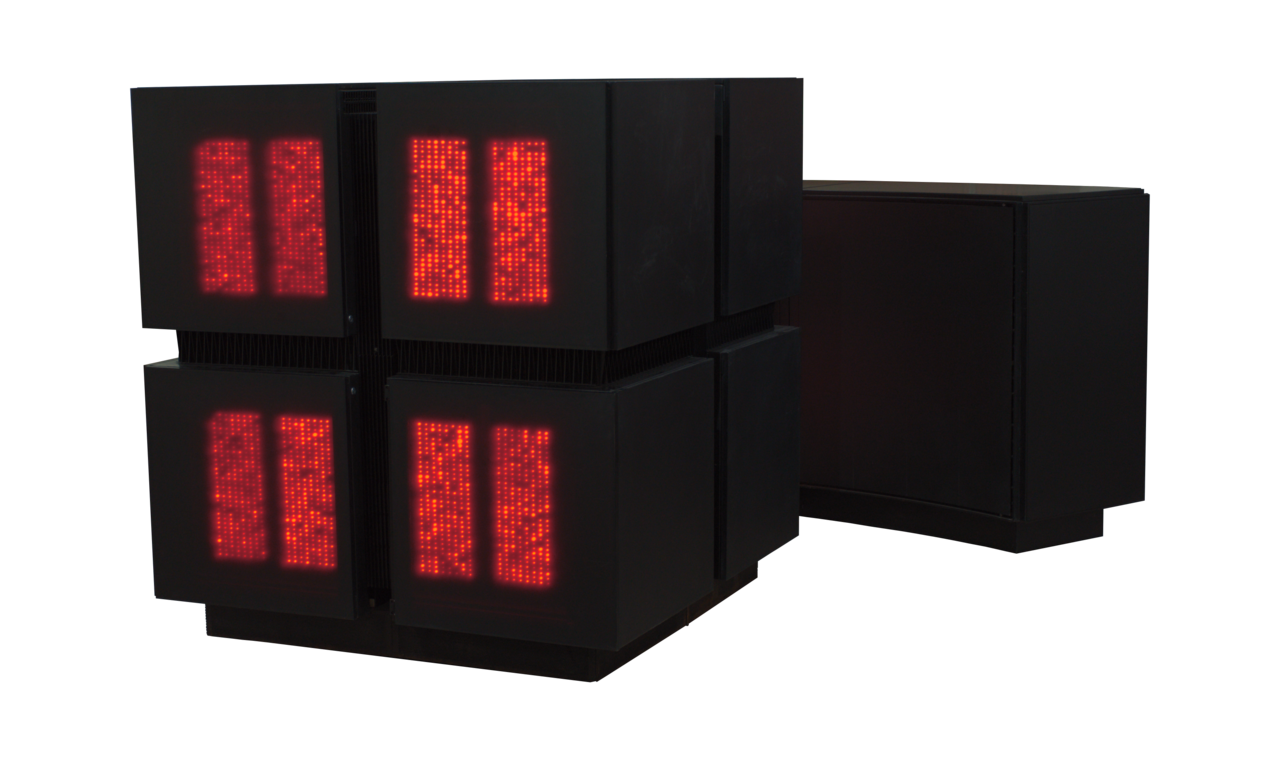
The CM-1 (1986) packed up to 65,536 one-bit processors with 4 kilobits of RAM each into a hypercube network, all executing the same instruction at once (SIMD). Industrial designer Tamiko Thiel gave it the form that made it famous: a black cube of cubes, a wall of red LEDs blinking with processor activity, the most photogenic computer ever shipped. One admirer was Steve Jobs: according to Thiel and to Jobs’s marketing chief Joanna Hoffman, Jobs asked Hoffman in 1986 to recruit the machine’s designer for his new NeXT computer, but Thiel had already left for Germany to become an artist. The NeXT Cube (1988) shipped as a black cube anyway. The CM-2 (1987) added Weitek floating-point coprocessors and the DataVault disk array, and turned an AI machine into a scientific instrument: oil-reservoir simulation, molecular modeling, all programmed in data-parallel language dialects like StarLisp (written *Lisp) and C*. One early employee, Brewster Kahle, left his work on parallel text search convinced that indexing everything was feasible; WAIS and the Internet Archive followed.
Fastest Computer in the World
The CM-5 (1991) abandoned the pure SIMD hypercube for a MIMD design of standard SPARC processors on a fat-tree network, with a staircase silhouette and LED panels contributed by the sculptor Maya Lin. In June 1993 a 1,024-processor CM-5 at Los Alamos stood at number one on the first TOP500 list, at 59.7 GFLOPS on the LINPACK benchmark; CM-5s held the top four spots and five of the top ten. Commercial customers arrived too: American Express mined its credit-card data on Thinking Machines hardware with the company’s Darwin software. The same year, a CM-5 played the control-room computer of Jurassic Park, blinking over the raptor crisis. Being the fastest and most famous computer in the world coincided almost exactly with the company running out of money.
Dead End: Massive Parallelism, Version One
Thinking Machines had grown up as DARPA’s favorite: profitable in 1989, $65 million revenue in 1990, much of it from government contracts steered its way. In 1991 DARPA and the Department of Energy, criticized for favoritism toward one vendor, spread their purchases across competitors like Cray and nCUBE, and export controls fenced off foreign sales. Losses began in 1992, Handler was pushed out, and in August 1994 the company filed for Chapter 11. Sun Microsystems took the hardware and parallel-software groups; the Darwin data-mining unit went to Oracle in 1999, and when Oracle bought Sun in 2010 the estate was accidentally reunited. The deeper cause sat in the machine room: purpose-built parallel hardware was being undercut by clusters of commodity parts, the shift The Supercomputer Era traces from the 1994 Beowulf cluster onward. The bet on massive parallelism was early rather than wrong. Every GPU now on the TOP500 is a descendant of the argument, thousands of simple processors beating one fast one, that Hillis lost commercially in 1994.
After Thinking Machines
Hillis’s second career treated computing as one material among many. As Disney’s first Fellow and Imagineering R&D vice president (1996) he built theme-park technology, including a free-walking dinosaur. Applied Minds (2000, with Bran Ferren) produced work from a containerized data center for Sun to a pinch-to-zoom patent that later surfaced in the Apple v. Samsung litigation. Metaweb (2005) built Freebase, the open structured database of the world’s entities; Google acquired it in 2010 and grew it into the Knowledge Graph. With Stewart Brand and Brian Eno he co-founded the Long Now Foundation (1996), whose 10,000 Year Clock, Hillis’s design, has a prototype in London’s Science Museum and a full-scale version under construction inside a West Texas mountain. His 1998 book The Pattern on the Stone explains computer science without mathematics; his patent count passed 300; at USC he held professorships in both research medicine (Keck School) and engineering (Viterbi School), working on proteomic cancer detection. The million-processor machine for AI arrived on schedule, a few decades late and sold by NVIDIA.
📚 Sources
- Danny Hillis — Wikipedia
- Connection Machine — Wikipedia
- Thinking Machines Corporation — Wikipedia
- Hillis, W. D.: “Richard Feynman and the Connection Machine” — Physics Today (1989), via Long Now Foundation
- Thiel, Tamiko: “The Connection Machine CM-1/CM-2” · Jobs’s 1986 request via Joanna Hoffman and the NeXT Cube connection; also told in Geoffrey Cain, Steve Jobs in Exile (2026)
- TOP500 List — June 1993 · CM-5/1024 at Los Alamos at number one (59.7 GFLOPS); CM-5s in ranks 1–4 and 7
- Oracle Acquires Thinking Machines for Parallel Data Mining — Tech Monitor (1999) · Darwin data-mining business; American Express as customer
- First prototype of the “Clock of the Long Now”, 1999 — Science Museum Group Collection · prototype on display in the Making the Modern World gallery
- US patent office rejects claims of Apple ‘pinch to zoom’ patent — Computerworld (2013) · Hillis/Ferren patent 7,724,242 as prior art in Apple v. Samsung
- Image: Danny Hillis in 2022.jpg by Christopher Michel (CC BY-SA 4.0), via Wikimedia Commons
- Image: Connection Machine CM-2 and DataVault at Computer Museum of America.png by Logg Tandy (CC BY-SA 4.0), via Wikimedia Commons