Larry Ellison and Oracle
Abstract
Larry Ellison built Oracle on a foundation of two things: Edgar Codd’s 1970 paper on relational databases, which nobody at IBM had commercialized, and a sales culture so aggressive that it nearly destroyed the company in an accounting scandal before it had finished disrupting its industry. He was not a computer scientist; he was a street fighter from Chicago who had dropped out of two universities and had read one important paper more carefully than anyone else. He turned that paper into a $300 billion company, made himself one of the wealthiest people on Earth, and spent the profits on racing sailboats and an island in Hawaii.
Chicago and the Dropout
Lawrence Joseph Ellison was born on August 17, 1944, in New York City, the illegitimate son of a nineteen-year-old woman and (he later claimed) an Italian-American U.S. Air Force officer. His mother, who could not support him, gave him to her aunt and uncle in Chicago, Lillian and Louis Ellison. Louis, a Russian immigrant who had changed his name on arrival, adopted the boy.
Louis Ellison was critical and distant. His relationship with Larry was characterized by his son as uniformly discouraging: Louis told the young man repeatedly that he would never amount to anything. Ellison later said that his entire career was powered by a desire to prove his adoptive father wrong.
He enrolled at the University of Illinois at Urbana-Champaign in 1962 and left after his second year when his adoptive mother died. He enrolled briefly at the University of Chicago. He left without a degree. He spent the 1960s drifting through California (Berkeley, then south) working as a programmer at various technology companies.
The Paper Nobody Commercialized
In 1970, Edgar Codd, an IBM researcher, published “A Relational Model of Data for Large Shared Data Banks” in the Communications of the ACM. Codd described a mathematical framework for organizing data into tables related by keys, and proposed a query language based on relational algebra. The paper was one of the most important in the history of software. Its full impact on database theory and the industry it spawned is explored in The Database Revolution.
IBM’s response was institutional inertia. IBM had already built IMS, a hierarchical database system, and a large business around it. Commercializing a relational database would have cannibalized IBM’s existing product, a classic innovator’s dilemma. IBM funded research into relational databases but was in no hurry to ship one.
Ellison was working at Ampex Corporation in the early 1970s, where he encountered the paper and recognized what it meant: a massive commercial opportunity. The relational model was elegant, queryable with something approaching plain language, and (crucially) IBM had not built it.
Oracle and the Lie That Worked
In 1977, Ellison co-founded Software Development Laboratories with Bob Miner and Ed Oates. Their initial contract was a CIA database project that Oracle named “Oracle.” When they incorporated their product as a commercial offering in 1979, they called it Oracle Database Version 2; there was no Version 1. They wanted customers to believe the product was mature and tested.
Oracle V2 was the first commercially available implementation of SQL, IBM’s query language for relational databases. IBM had published the SQL specification; Ellison built it. Oracle was on the market before IBM’s own relational database, DB2, shipped in 1983.
The sales model was essential. Ellison hired aggressive salespeople on commission-heavy structures and told them to close deals. When a deal required promising features that did not yet exist, the salesperson promised them anyway. When a feature was promised for version N and not delivered, it was promised again for version N+1. This created a culture of optimistic delivery timelines that the engineering team spent the next decade actually catching up to.
Oracle grew from roughly $2.5 million in revenue in 1982 to $131 million in 1987. Ellison took it public on March 12, 1986, at $15 per share.
The Accounting Crisis and Near-Death
In 1990, Oracle nearly failed. The company had been booking revenue at the time of signing contracts rather than at delivery, an aggressive accounting practice that inflated reported revenues. When customers complained about products not working as promised and demanded refunds or delayed payment, the discrepancy between reported and actual revenue became a crisis.
Oracle’s stock fell 80% in six months. The company restated its earnings for fiscal year 1990, which had shown a profit, as a loss. Ellison laid off 10% of the workforce and brought in a chief financial officer with a mandate to impose financial discipline. Oracle survived, but the near-death experience imposed on Ellison a respect for financial controls that the company had previously lacked.
The crisis also produced Oracle’s first honest reckoning with product quality. Oracle 7, released in 1992, was the product that established Oracle as technically credible: it was faster, more stable, and more feature-complete than anything the company had shipped before.
Database Wars: Beating IBM and Sidelining Microsoft
Oracle’s primary competition in enterprise databases through the 1980s and 1990s came from IBM’s DB2 and, later, from Microsoft SQL Server and IBM’s Informix and Sybase. Ellison’s strategy was to maintain Oracle Database’s technical lead at the high end of the market (the largest databases, the most demanding transaction loads) while fighting on price at the low end.
The competition with Microsoft was intense and personal. Ellison regarded Gates as his primary rival for both market position and public stature; in various interviews over the years, he declared Microsoft’s various database efforts dead on arrival. Microsoft’s SQL Server, which ran only on Windows, was a credible competitor for mid-market applications, but Oracle maintained its dominance in the enterprise tier where companies ran their most critical systems.
Ellison used Oracle’s database dominance to expand into applications: ERP, CRM, human resources, financial software. The expansion was largely through acquisition. Between 2005 and 2008, Oracle spent more than $24 billion acquiring PeopleSoft, Siebel Systems, and BEA Systems, the major independent enterprise software vendors. The PeopleSoft acquisition was particularly contentious: Oracle launched a hostile takeover bid, PeopleSoft’s board resisted for eighteen months, and the final deal closed only after Ellison raised his offer multiple times.
The Sun Acquisition and Java
In 2010, Oracle acquired Sun Microsystems for $7.4 billion. The acquisition gave Oracle hardware (SPARC servers and the Solaris operating system), MySQL (the open-source database), and Java.
Java, the programming language and runtime environment that Sun had developed in the 1990s, was running on an estimated 3 billion devices. Most enterprise applications ran on the Java Virtual Machine. Owning Java meant owning a piece of infrastructure that every major technology company depended on.
Oracle immediately sued Google, which had built Android on a subset of the Java APIs. The lawsuit alleged that Google had violated Oracle’s copyright in the Java API specifications. The case ran for eleven years, through the district court, the Federal Circuit twice, and the Supreme Court. In April 2021, the Supreme Court ruled 6-2 in Google’s favor, holding that Google’s use of the Java APIs constituted fair use. The decision was widely interpreted as protecting the fundamental practice of reimplementing software interfaces, one of the building blocks of the technology industry.
The Java acquisition also alarmed the open-source community. Oracle’s relationship with MySQL, the free relational database that competed with Oracle’s own products, was a source of constant concern. MariaDB, a MySQL fork, was created immediately after the Sun acquisition, on the assumption that Oracle might kill or commercialize MySQL aggressively. Oracle maintained MySQL, but the fork persisted.
The Oracle Ecosystem
Oracle built its business on high-switching-cost enterprise software: databases so deeply embedded in corporate operations that changing vendors was comparable to changing the plumbing in a skyscraper. Customers complained consistently about Oracle’s licensing costs, which were structured around CPU counts and user numbers in ways that made scaling expensive and auditing hazardous. Enterprise CIOs routinely described Oracle licensing as the most stressful single item in their technology budget.
Yachts, Islands, and the Race for Second
Ellison funded the Oracle Team USA entry in the America’s Cup, the oldest international yacht race. The 2013 America’s Cup, held in San Francisco Bay, featured Oracle Team USA’s AC72 catamarans, enormous machines capable of foiling at fifty knots. Oracle won in one of the greatest sporting comebacks in the race’s history, trailing 8–1 and winning 9–8.
In 2012, Ellison purchased 98% of Lana’i, Hawaii’s sixth-largest island, for a reported $300 million. He described his plans as making the island a “model for sustainable communities.”
He has been publicly ranked among the five wealthiest people in the world multiple times. He stepped down as Oracle CEO in September 2014, becoming executive chairman and CTO, with Safra Catz and Mark Hurd as co-CEOs.
For the relational database theory Ellison commercialized, see Edgar Codd and the Relational Model. For the competitive database landscape Oracle shaped, see The Database Wars.
📚 Sources
- Wilson, Mike: The Difference Between God and Larry Ellison: God Doesn’t Think He’s Larry Ellison (1997), Morrow
- Symonds, Matthew: Softwar: An Intimate Portrait of Larry Ellison and Oracle (2003), Simon & Schuster
- Codd, Edgar F.: “A Relational Model of Data for Large Shared Data Banks” — Communications of the ACM, vol. 13, no. 6, 1970
- Google LLC v. Oracle America, Inc., 593 U.S. ___ (2021) — Supreme Court Opinion
- Oracle Corporation — Wikipedia
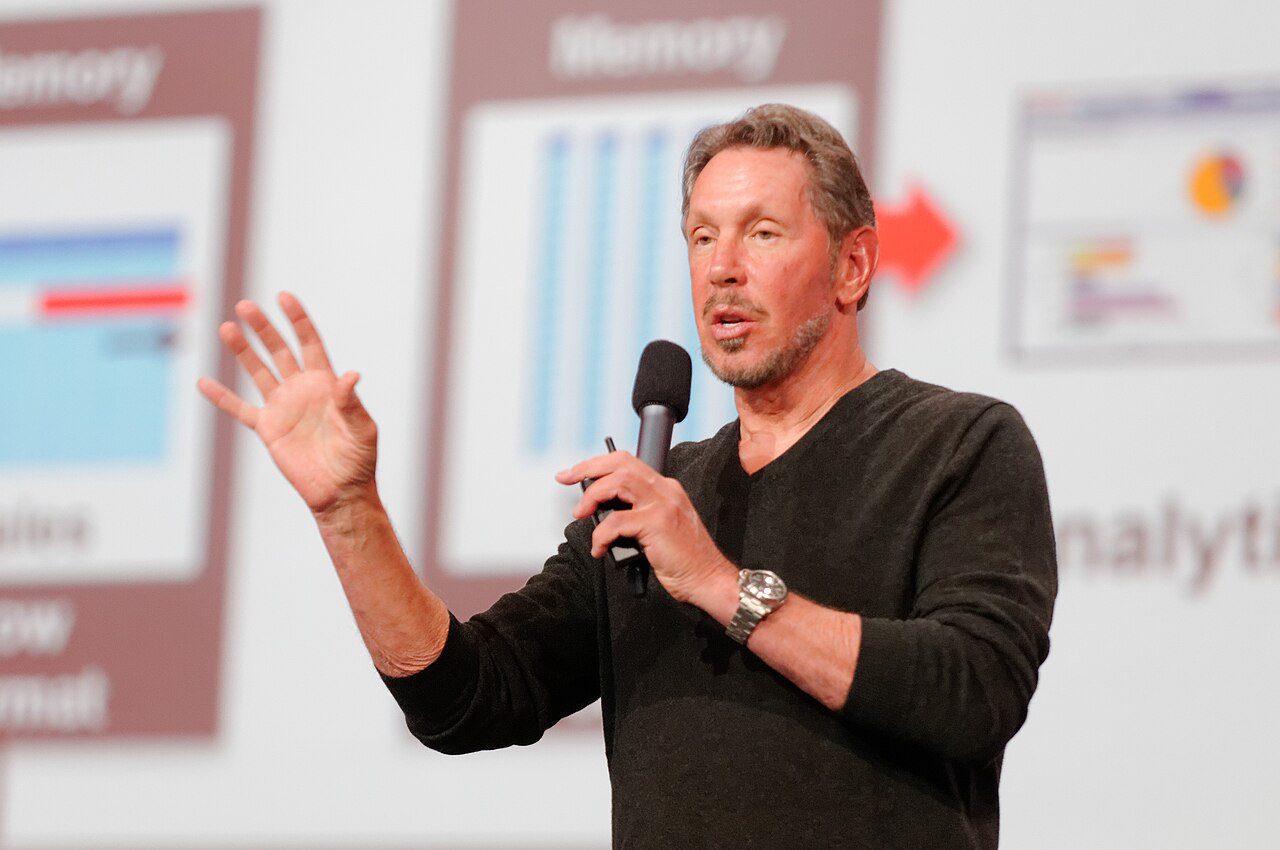
- Image: Larry Ellison 2013 (9887589546).jpg by Oracle PR (CC BY 2.0), via Wikimedia Commons