The Modem and the Carterfone Decision
Abstract
A modem (modulator-demodulator) turns bits into tones a telephone line can carry and back again. The first were built in 1949 at the Air Force Cambridge Research Center to send radar data, and AT&T mass-produced them for the SAGE air-defence network from 1958. For two decades afterwards, though, only the Bell System was allowed to connect anything to its lines. A Texas radio dealer, Tom Carter, broke that rule with a device that linked two-way radios to telephones; on 26 June 1968 the Federal Communications Commission ruled that AT&T could not forbid harmless attachments. The Carterfone decision opened the American phone network to independent modems, answering machines and fax machines. In 1981 the Hayes Smartmodem gave personal computers a modem they could control by software, and dial-up connections carried bulletin boards, online services and the first public internet until broadband replaced them.
Radar over Telephone Lines
In 1949 a group led by Jack Harrington at the Air Force Cambridge Research Center near Boston built a device that modulated digital data into audible tones and demodulated received tones back into data. Its purpose was to relay radar observations over ordinary telephone circuits to a central computer. The idea scaled up in SAGE, the air-defence system whose computers took data from radar stations across North America (see Whirlwind, SAGE, and Core Memory); for it, AT&T began mass production of telephone-line modems in 1958.
The same year AT&T offered the Bell 101 dataset at 110 bits per second. The Bell 103, introduced in 1962 or 1963 (sources differ), sent 300 bits per second in both directions at once by frequency-shift keying: the calling modem used 1,070 and 1,270 Hz for its zeros and ones, the answering modem 2,025 and 2,225 Hz. Bell 103 tones were still being exchanged by hobbyists’ modems twenty years later.
The Foreign Attachment Rule
All of these modems belonged to the Bell System. AT&T’s tariffs forbade customers to connect any “foreign attachment” to the network; it owned the telephones, rented them out, and argued that outside equipment could harm the system and that it alone was responsible for service end to end. In 1956 a federal appeals court had allowed one exception in the Hush-A-Phone case: a cup that clipped onto the mouthpiece for privacy, connected to nothing electrical, could not be banned.
Thomas Carter, born in 1924 in Mabank, Texas, had been a radio technician during the Second World War and afterwards leased two-way radios to businesses from Dallas. From 1959 he sold the Carterfone, which he assembled on wooden tables in a small building: a cradle that coupled a telephone handset acoustically and inductively to a radio base station, so that a worker in the field, typically in the oil industry, could talk by radio to anyone on the phone network. By 1966 he had sold about 3,500. AT&T and General Telephone told customers that using it could cost them their phone service.
Carter sued AT&T on 29 November 1965 in the federal court for the Northern District of Texas. In 1966 the court referred the question to the FCC. On 26 June 1968 the Commission ruled unanimously that the tariff was “unreasonable, unlawful, and unreasonably discriminatory” (James Pelkey’s history dates the order to the 27th). Customers could attach equipment of their own as long as it did no harm to the network.
Protective Couplers and Part 68
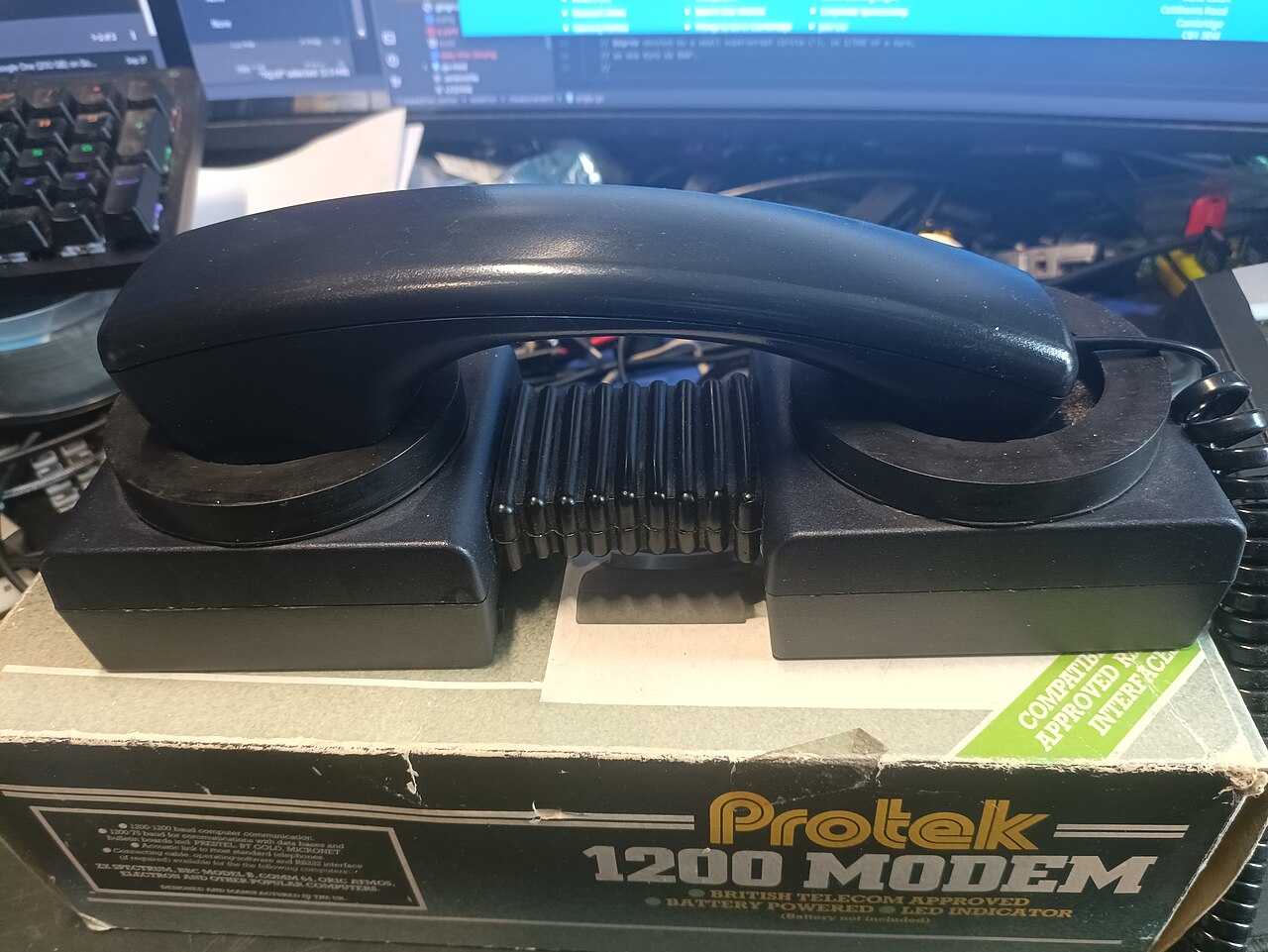
AT&T answered with new tariffs that required independent equipment to be connected through a protective connecting arrangement rented from the phone company, later called a data access arrangement, at about $10 to install and $2 to $4 a month. Bell’s own modems needed none, and the independent modem makers’ association called the requirement “manifestly anti-competitive”. The cheap way around it was the acoustic coupler: a box with rubber cups into which the user pressed an ordinary handset, so that nothing touched the line electrically. John van Geen at the Stanford Research Institute improved its receiver in the late 1960s so it could pick bits out of the hiss of a long-distance call. Acoustic couplers connected the terminals of time-sharing users and, in 1976, Lee Felsenstein’s Pennywhistle kit to early microcomputers (see Lee Felsenstein).
The FCC finished what Carterfone began with Part 68 of its rules in 1975, which allowed direct electrical connection of any equipment that met published technical standards. Registration of telephones, modems and other devices under Part 68 began in 1977. Answering machines, fax machines and cheap telephones followed, and the separation of network and terminal that the rules created is one of the threads leading to the 1982 consent decree and the break-up of AT&T in 1984 (see The Fax Machine).
The Smartmodem
Early modems for personal computers had to be dialled by hand or driven through hardware peculiar to one machine. Dennis Hayes and Dale Heatherington, who founded D.C. Hayes Associates in January 1978 and sold modem boards for S-100 and Apple II computers, announced the Hayes Smartmodem in April 1981: a separate box that connected to any computer’s RS-232 serial port and directly to the phone line, ran at 300 bits per second and cost $299. Its innovation was a command language. Commands began with the letters AT (“attention”), so software could dial (ATDT), answer and hang up; Heatherington’s escape sequence, three plus signs surrounded by a one-second pause, switched from data back to commands without confusing the two. The Hayes command set became the standard every competitor copied.
The Smartmodem 1200 followed in 1982 and the 2400 in 1985. Bulletin board systems ran on such modems (see The BBS Era), as did CompuServe, AOL and the early internet service providers (see The AOL Era). International standards took over the race for speed: V.34 reached 28.8 kbit/s in 1994 and was later extended to 33.6 kbit/s, and V.90, approved in September 1998, 56 kbit/s, near the limit of an analog voice line. Hayes itself entered bankruptcy in November 1994, again in October 1998, and was liquidated in 1999. AOL switched off its last dial-up access on 30 September 2025 (see Data Communication Prehistory).
Carter received no money from the decision that bears his device’s name. He died on 26 February 1991; a Carterfone is in the Smithsonian’s National Museum of American History.
📚 Sources
- Computer History Museum: Timeline of Computer History, 1949 (Birth of the modem)
- Computer History Museum: Internet History, 1960s (acoustic couplers, van Geen)
- James Pelkey, “Computer Inquiry I and the Carterfone, 1965–1973”, A History of Computer Communications
- Wireless History Foundation: Thomas Carter
- Wikipedia: Carterfone
- Wikipedia: Modem
- Wikipedia: Bell 103 modem
- Wikipedia: Hayes Microcomputer Products
- Carter v. American Telephone & Telegraph Co. (CourtListener)
- FCC: Part 68
- ACTA, “ACTA and Part 68: Past, Present, and Future”
- Image: Protek 1200 Acoustic Coupler Modem with handset from 1984.jpg by PeterTMount (CC BY-SA 4.0), via Wikimedia Commons