Dead End: Teledesic, Globalstar and the First Satellite Internet
Abstract
In the mid-1990s five companies set out to surround the Earth with low-orbit communications satellites. Motorola’s Iridium and the Loral–Qualcomm venture Globalstar sold telephone calls; Orbcomm sold short data messages; ICO, spun off from Inmarsat, planned a medium-orbit phone system; and Teledesic, founded by the cellular pioneer Craig McCaw with backing from Bill Gates, promised an “Internet-in-the-Sky” of 840 satellites. Between August 1999 and February 2002 Iridium, ICO, Orbcomm and Globalstar all filed for bankruptcy, and Teledesic stopped work on 1 October 2002 with one test satellite built. The forecasts had assumed millions of customers who would pay dollars a minute; ground-based mobile networks reached 480 million GSM users by 2000 and took the market first. Twenty years later the same idea worked. SpaceX’s Starlink had 12 million subscribers in June 2026, and Globalstar, bought out of bankruptcy for $43 million in 2004, was carrying emergency messages for every recent iPhone and had agreed in April 2026 to be sold to Amazon for $11.57 billion.
Five Constellations
A satellite in geostationary orbit, 36,000 kilometres up, stays over one spot and can see a third of the Earth, but a signal takes about a quarter of a second to go up and down, and a hand-held phone cannot reach it. A satellite a thousand kilometres up is close enough for a phone and fast enough for conversation; it also crosses the sky in minutes, so covering the planet takes dozens or hundreds of them, handing calls from one to the next. By the early 1990s the spread of mobile phones made that trade look worth it.
Iridium, designed at Motorola from 1987 and switched on in November 1998, was the most complex: 66 satellites that routed calls among themselves by radio links. Loral Space & Communications and Qualcomm founded Globalstar in 1991 and formed the operating partnership in March 1994 with Alcatel, AirTouch, DASA, Hyundai and Vodafone. Orbcomm, from Orbital Sciences and Teleglobe, launched its first small satellites in 1995 to carry pager-like data messages. Inmarsat, the maritime satellite organisation, set up ICO Global Communications in January 1995 with twelve spacecraft ordered from Hughes (later Boeing) for medium orbit.
Internet in the Sky
Craig McCaw and his brothers had built McCaw Cellular into the largest American mobile operator and sold it to AT&T in 1994 for $11.5 billion. The same year McCaw and Bill Gates announced Teledesic, which aimed higher than telephones. Its 1994 filing described 840 satellites, plus spares, at 700 kilometres, each a node in a packet-switched network using the Ka band, offering links “like fiber” of up to 100 megabits per second up and 720 down, for an estimated $9 billion. In 1997 the design was scaled back to 288 larger satellites at 1,400 kilometres. Saudi Prince Alwaleed bin Talal and Boeing invested. In May 1998 Motorola dropped its own broadband constellation, Celestri, and put $750 million into Teledesic for a 26 percent stake.
Teledesic launched one satellite. The 120-kilogram BATSAT, renamed Teledesic 1, went up on 26 February 1998 as the first commercially owned Ka-band satellite in orbit, and decayed out of orbit in October 2000. No production satellite was ever launched.
The Bent Pipe
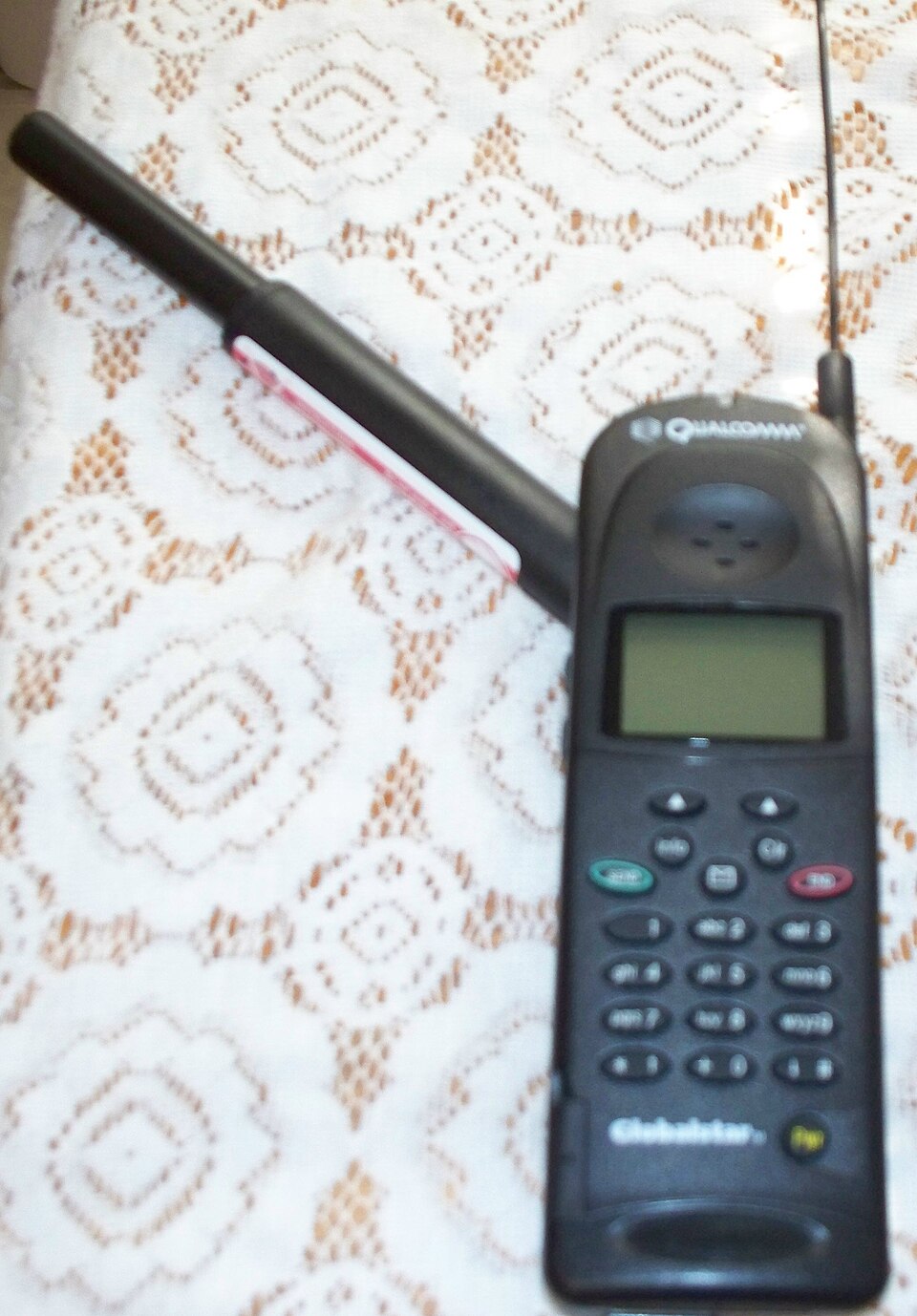
Globalstar made the opposite engineering choice from Iridium. Its satellites were “bent pipes”: analogue repeaters that bounced a phone’s signal down to the nearest ground gateway, which connected it to the ordinary telephone network, with no links between satellites and no switching in orbit. That kept the spacecraft simple and let the gateways use Qualcomm’s CDMA technology. It also meant that a call worked only where a satellite could see both the phone and a gateway, so mid-ocean coverage depended on where gateways were built.
The launches went badly at first. In September 1998 a Ukrainian Zenit rocket failed and destroyed twelve Globalstar satellites at once. The system of 48 satellites at 1,414 kilometres, with four spares, was complete by February 2000, and commercial service began in the United States, Europe and Brazil at $1.79 a minute, on handsets costing $1,000 to $1,500.
Where the Customers Went
The business plans were written around the telephone and the business traveller. Iridium’s own projections in 1990 and 1991 spoke of three to six million subscribers by 2001; Globalstar in 1999 expected 500,000 subscribers by the end of 2000 and 7.5 million eventually. What they got was 10,000 Iridium subscribers in March 1999 and 50,000 a year later, against 500,000 to 600,000 needed to break even; Globalstar had shipped 40,000 handsets to distributors by the end of 1999 and had about 66,000 subscribers at the end of 2001.
The customers they had counted on were on the ground. GSM, standardised in Europe, served 480 million users in 110 countries by January 2000, and roaming agreements let a traveller use one phone in most of the places where business travellers went. A cellular handset cost under $100 and worked indoors; satellite phones were larger, cost more than ten times as much, and needed a clear view of the sky. A 2003 MIT study of the two systems concluded that the predictions of 1991 had been too pessimistic about terrestrial cellular.
Bankruptcies
Iridium filed for Chapter 11 on 13 August 1999, nine months after opening. ICO followed later the same month, before launching a working satellite; McCaw bought it out of bankruptcy in May 2000 as New ICO. Orbcomm filed in September 2000. Globalstar filed on 15 February 2002 with $3.3 billion in liabilities against $570 million in assets, after about $4.3 billion of debt and equity had gone into it. Capital for satellite projects disappeared with the telecom and dot-com crash. Teledesic suspended its satellite contracts on 1 October 2002 and sold its spectrum licences in 2003.
The Afterlife
The satellites that had been built outlived their owners. Private investors bought Orbcomm in 2001, and it became a provider of machine-to-machine tracking for fleets and farm equipment. Thermo Capital Partners bought Globalstar’s assets in 2004 for $43 million, about one percent of what had been invested. Globalstar survived on satellite messengers and industrial customers until September 2022, when Apple announced Emergency SOS via satellite for the iPhone 14 and chose Globalstar to carry it. In 2024 Apple took a 20 percent stake as part of a $1.5 billion commitment to Globalstar’s next satellites. On 14 April 2026 Amazon agreed to buy Globalstar for $90 a share, about $11.57 billion in cash, for its spectrum and its direct-to-phone service, keeping the Apple arrangement.
Starlink
SpaceX announced its constellation in January 2015 with the opening of a satellite-development facility in Redmond, Washington, and launched the first sixty operational Starlink satellites on 24 May 2019. Its design was Teledesic’s: thousands of satellites in low orbit forming a broadband network. What differed was who paid for the rockets and what the customer wanted. SpaceX launched its own satellites on its own reusable boosters and built them on a production line, and it sold internet access, not phone calls, to households and ships and aircraft beyond the reach of fibre at a time when the demand for bandwidth had no ceiling in sight. By June 2026 Starlink had about 10,400 satellites in orbit and 12 million subscribers.
📚 Sources
- Teledesic, Wikipedia (1994 plan of 840 satellites at 700 km, $9 billion, 100 and 720 Mbit/s, 1997 reduction to 288 at 1,400 km, Alwaleed, BATSAT launched 26 February 1998 and decayed October 2000, suspension 1 October 2002)
- “Motorola drops Celestri for Teledesic project”, Flight International, 27 May 1998 ($750 million, 26 percent)
- Craig McCaw, Wikipedia (the $11.5 billion AT&T sale in 1994, Teledesic with Gates, New ICO in 2000, licences sold in 2003)
- Globalstar, Wikipedia (1991 founding, March 1994 partnership, $4.3 billion invested, bent pipe, 48 satellites at 1,414 km, the September 1998 Zenit failure, service and $1.79 a minute, bankruptcy of 15 February 2002 with $3.3 billion against $570 million, Thermo’s $43 million in 2004, Apple’s 2022 service and 2024 stake)
- de Weck, Olivier, Richard de Neufville, Darren Chang and Mathieu Chaize, “Technical Success and Economic Failure”, MIT Engineering Systems Learning Center, October 2003 (subscriber forecasts and actuals, break-even, handset and airtime prices, GSM’s 480 million users in 110 countries)
- Globalstar makes USD 184 mil loss in 4th-qtr 2002, Telecompaper (66,000 subscribers at the end of 2001)
- ICO Global Communications (Pendrell), Wikipedia (January 1995, twelve Hughes/Boeing spacecraft, Chapter 11 in August 1999, New ICO in May 2000)
- Orbcomm, Wikipedia (1995 launches, September 2000 Chapter 11, 2001 purchase, industrial IoT)
- “Amazon to buy Globalstar for $11.57B in bid to flesh out its satellite biz”, TechCrunch, 14 April 2026, and “Amazon to buy Globalstar to bolster Leo satellite business”, CNBC, 14 April 2026 ($90 a share, the Apple agreement, Apple’s 20 percent stake as part of $1.5 billion)
- Starlink, Wikipedia (January 2015 announcement in Redmond, first 60 satellites on 24 May 2019, about 10,400 satellites and 12 million subscribers in June 2026, Teledesic as precursor)