Jeff Bezos and Amazon
Abstract
Jeff Bezos left a well-paying job at a hedge fund in 1994 to sell books on the internet. Within a decade, he had built the world’s largest e-commerce company; within two decades, a cloud computing business that became the infrastructure layer for a significant portion of the internet. The governing principle was patience to a degree unusual even in technology: a relentless willingness to invest in the future at the expense of current profits, to lose money in one business if doing so built infrastructure that would compound over decades. Amazon’s competitors consistently underestimated this patience, and consistently paid for the misunderstanding.
New Mexico and Princeton
Jeffrey Preston Jorgensen was born on January 12, 1964, in Albuquerque, New Mexico. His father, Ted Jorgensen, was a teenager who left when Jeffrey was very young. His mother, Jacklyn, remarried Miguel Bezos, a Cuban immigrant who had arrived in the United States at sixteen as part of Operation Peter Pan, graduated from the University of Albuquerque, and become a petroleum engineer at Exxon. Miguel adopted the boy, who became Jeffrey Preston Bezos.
His maternal grandparents, Preston and Mattie Gise, had a cattle ranch in Cotulla, Texas, where Bezos spent summers. Preston Gise had been a regional director at the U.S. Atomic Energy Commission; he was a self-reliant, technically minded man who taught his grandson to fix machinery and solve problems without asking for help. Bezos has cited his grandfather as a formative influence.
He was an exceptional student, the valedictorian of Miami Palmetto Senior High School, a National Merit Scholar, a space enthusiast who gave a speech at his high school graduation about colonizing space to save Earth. He enrolled at Princeton in 1982 and graduated summa cum laude in electrical engineering and computer science in 1986.
Wall Street and the Decision
After Princeton, Bezos worked in finance, eventually joining the hedge fund D.E. Shaw in 1990, where he became one of the youngest senior vice presidents in the firm’s history. D.E. Shaw was a quantitative trading firm; Bezos was part of a team that looked for early opportunities in internet commerce.
By 1994, the internet was growing at 2,300% annually. Bezos made a list of products that could be sold online, ranked by the degree to which the internet’s advantages (infinite inventory, searchability, distribution) would outweigh physical retail’s advantages. Books were at the top of the list: there were more titles than any physical store could stock, and a database could catalog them all.
He told his boss at D.E. Shaw about his idea. His boss said it sounded like a good idea for someone who didn’t have a good job. Bezos applied what he later called the “regret minimization framework”: imagining himself at eighty, asking whether he would regret not having tried. He would. He quit in July 1994.
He and his wife MacKenzie drove from New York to Seattle. MacKenzie drove; Bezos wrote the business plan in the passenger seat.
Garage to Globe
They moved into a rental house in Bellevue, Washington. Bezos set up desks made from doors on sawhorses (cheaper than furniture and larger) and hired the first engineers. The company was initially named “Cadabra,” then renamed Amazon after the world’s largest river, on the logic that Amazon would be the world’s largest bookstore.
Amazon.com launched on July 16, 1995, riding the first wave of the commercial internet that was simultaneously producing Netscape, Yahoo, and dozens of competitors who would not survive the decade. (The collapse of most of those competitors is chronicled in The Dot-com Bubble.) In the first month, Amazon shipped books to all fifty states and forty-five countries. In its first partial year (July–December 1995), it took in $511,000 in sales. Bezos worked out of the garage himself, packing book orders.
The initial pitch to investors was a detailed argument for why internet retail would win, lower prices through lower overhead, infinite selection, and the ability to learn from every transaction. Most investors passed. The company raised $8 million in a 1995–1996 seed round from sixty angel investors before going public on May 15, 1997, at $18 per share.
The IPO raised $54 million. Amazon was not profitable. Bezos argued to shareholders that this was intentional: the company was investing its gross margins in infrastructure and growth rather than returning them as profit. This argument (that the correct metric was not current profitability but long-term customer value) became the template for Amazon’s investor communications for the next decade.
Expansion and the “Everything Store”
The initial strategy was focused: sell books online better than anyone else. The expansion strategy that followed was aggressive: become the store where anyone could buy anything.
Amazon launched music and DVD sales in 1998. It launched electronics, toys, and home improvement in 1999, a year of massive capital investment that nearly bankrupted the company and contributed to its stock falling 90% from peak during the dot-com crash. The company survived because its logistics infrastructure, which looked like overinvestment in 1999, turned out to be the competitive moat that mattered.
The third-party seller platform (allowing other merchants to sell through Amazon’s website) launched in 2000. Amazon took a percentage of each sale and provided the logistics infrastructure. By 2023, third-party sellers accounted for over 60% of Amazon’s unit sales.
The Customer Obsession Principle
Amazon’s internal culture was organized around fourteen “Leadership Principles,” the most important of which was Customer Obsession: “Leaders start with the customer and work backwards to the technology.” Bezos enforced this principle by bringing an empty chair into executive meetings and declaring it occupied by the customer, whose interests would be considered in every decision. The principle produced practices unusual for a retailer: Amazon consistently priced below cost to gain market share, invested in systems that made it easy to return purchases and receive refunds, and published negative customer reviews of products it sold, a practice suppliers found infuriating and customers trusted.
AWS: The Accidental Empire
The most consequential business Amazon built was the one it stumbled into. By 2002, Amazon’s engineering teams had concluded that they needed to rebuild their infrastructure around standardized, web-based services: APIs that different teams could call without knowing the implementation details of each other’s systems. The discipline of building modular, service-oriented infrastructure improved Amazon’s own software development velocity dramatically.
Andy Jassy, a senior manager, began working on an external version of this infrastructure in 2003: a set of services that any company could use to build scalable web applications without owning physical servers. Amazon Web Services launched publicly in 2006 with S3 (Simple Storage Service) in March and EC2 (Elastic Compute Cloud) in August.
The idea was straightforward (rent computing capacity and storage the way utilities rent electricity) but the execution required building a global network of data centers, managing reliability at scale, and pricing aggressively enough to make the economics work for customers. AWS launched years before Microsoft Azure (2010) and Google Cloud (2008’s App Engine, more directly comparable service in 2013), and the head start compounded. By 2023, AWS had over 30% of the cloud market, generated $90 billion in annual revenue, and contributed the majority of Amazon’s operating profit.
Why Amazon Could Do This
Amazon’s advantage in cloud computing was not technical genius; Microsoft and Google had comparable engineering talent. It was operational experience. Running amazon.com at scale had required Amazon to solve problems (distributed storage, fault-tolerant compute, large-scale networking) that most technology companies had not yet faced. AWS productized those solutions.
Kindle, Washington Post, and Blue Origin
The Kindle, launched November 19, 2007, applied Amazon’s book experience to digital reading: a device with wireless connectivity, a month-long battery life, and (crucially) access to the Amazon bookstore in sixty seconds. It sold out in five and a half hours and was out of stock for months. By 2010, Kindle e-books outsold hardcover books on Amazon.
In 2013, Bezos purchased The Washington Post for $250 million in cash, a personal transaction separate from Amazon. He financed a significant editorial and technical investment in the paper, which had been in decline. The Post’s digital readership grew substantially under his ownership.
Blue Origin, founded in 2000, was Bezos’s aerospace company, pursuing reusable rocket technology for commercial space access. Blue Origin’s New Shepard vehicle flew its first crewed flight in July 2021, with Bezos aboard. He described the experience as the best day of his life and was mocked for the shape of the rocket.
The Succession
Bezos announced in February 2021 that he would step down as Amazon’s CEO, handing the role to Andy Jassy, who had built and run AWS. Bezos became executive chairman. He cited a desire to spend more time on other projects: Blue Origin and his philanthropic initiatives, including the Bezos Earth Fund.
He divorced MacKenzie in 2019; she took 25% of their Amazon shares and almost immediately became one of the most prolific philanthropists in the United States, committing billions to racial equity, housing, and education before Bezos had organized his own giving.
Bezos married Lauren Sánchez in Venice in June 2025.
For Amazon’s cloud infrastructure business, see The Cloud Wars. For the e-commerce revolution Amazon drove, see The E-Commerce Revolution. For the dot-com context in which Amazon was founded and survived, see The Dot-com Bubble.
📚 Sources
- Stone, Brad: The Everything Store: Jeff Bezos and the Age of Amazon (2013), Little, Brown and Company
- Stone, Brad: Amazon Unbound: Jeff Bezos and the Invention of a Global Empire (2021), Simon & Schuster
- Bezos, Jeff: Invent and Wander: The Collected Writings of Jeff Bezos (2021), Harvard Business Review Press
- Bezos, Jeff: Annual letters to Amazon shareholders (1997–2020), Amazon.com Investor Relations
- Galloway, Scott: The Four: The Hidden DNA of Amazon, Apple, Facebook and Google (2017), Portfolio/Penguin
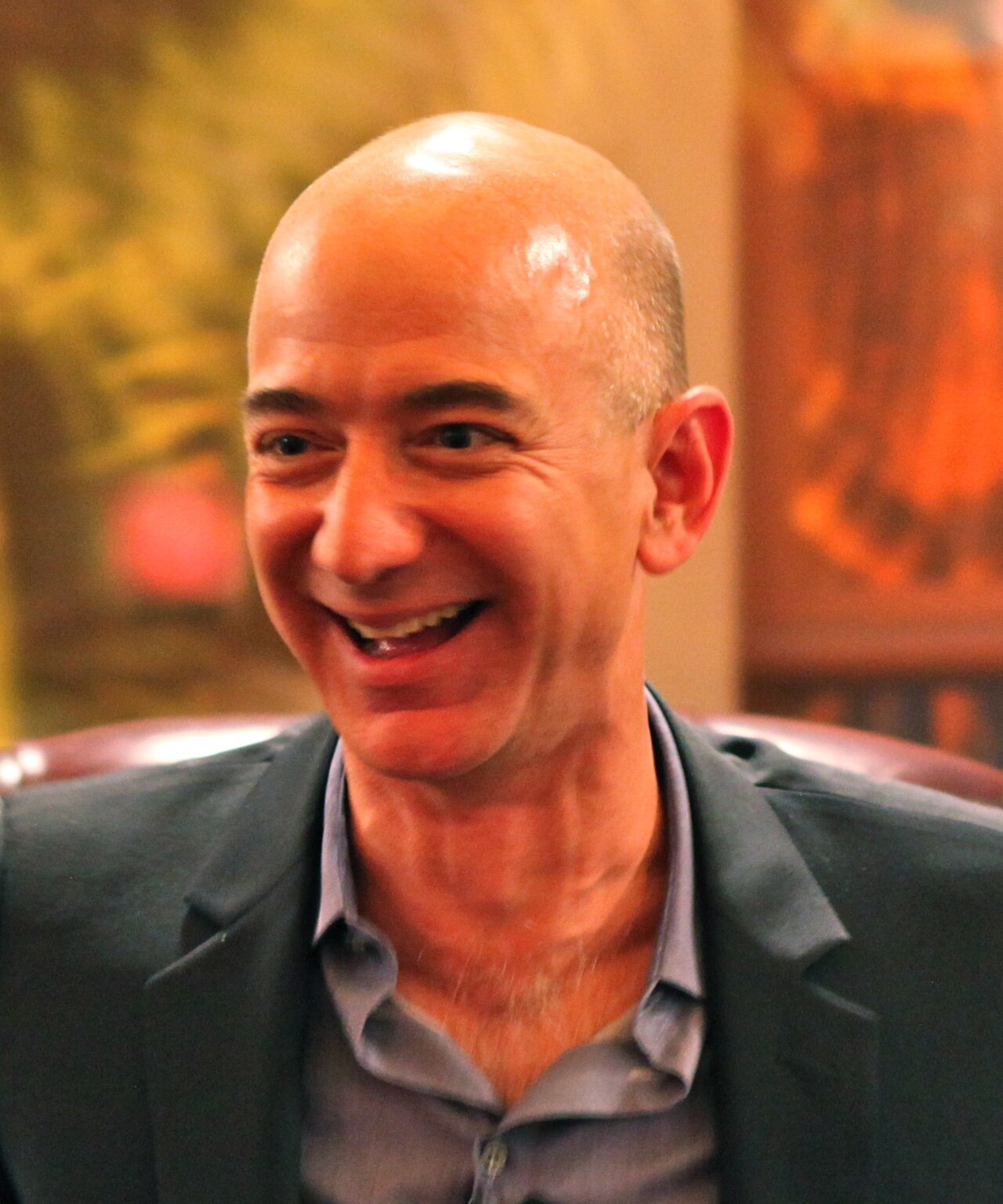
- Image: Jeff Bezos’ iconic laugh crop.jpg by Steve Jurvetson (crop by King of Hearts) (CC BY 2.0), via Wikimedia Commons