Qualcomm: The Invisible Tax on Every Phone
Abstract
Qualcomm makes the radio that connects your phone to the cellular network, and, just as importantly, owns the patents that make any modern phone possible. For decades it ran two businesses at once: selling chips, and collecting a royalty on the wholesale price of nearly every smartphone on Earth, whether or not it contained a Qualcomm part. That dual model made Qualcomm one of the most profitable and most litigated companies in technology, fighting Apple, the FTC, the EU, and even an attempted $117 billion hostile takeover. The cellular standards and devices it enabled are covered in The Mobile Computing Revolution; this article is about the company that taxed them.
Engineers Betting on a Discredited Idea
Qualcomm (from “Quality Communications”) was founded in San Diego on July 1, 1985, by a group of engineers led by Irwin Jacobs and Andrew Viterbi, with Franklin Antonio and four others. Jacobs and Viterbi were not businessmen first; they were communications theorists. Jacobs co-wrote a standard textbook on digital communication; Viterbi invented the Viterbi algorithm, a method for decoding noisy signals that is still used everywhere from cell phones to DNA sequencing.
Qualcomm’s first product was OmniTRACS, a satellite messaging and tracking system for trucking fleets, a real business that, crucially, funded the company’s gamble on a radio technology the industry had written off: CDMA (Code Division Multiple Access).
Spread Spectrum and the Bet on CDMA
Where rival standards split the airwaves by time or frequency, CDMA let many phones transmit over the same frequencies at once, each tagged with a unique code that the receiver could pick out of the noise, a spread-spectrum technique whose lineage runs back to Hedy Lamarr’s frequency hopping. When Qualcomm demonstrated CDMA in 1989, established carriers and rivals insisted it could not work at scale. It did. CDMA became the basis of 3G worldwide (CDMA2000 and WCDMA), and Qualcomm (holding the foundational patents) was positioned at the center of every 3G, 4G, and 5G network that followed.
Two Businesses: The Chip and the Toll
Qualcomm’s genius was structural. It split into two engines that reinforced each other:
- QCT (Qualcomm CDMA Technologies) designs and sells chips, most famously the Snapdragon system-on-chip (brand launched 2007), which combines an ARM-based processor, graphics, and a cellular modem on one die. Qualcomm is fabless, designing chips that foundries like TSMC manufacture. Its modems became so dominant that for years even Apple’s iPhones depended on them.
- QTL (Qualcomm Technology Licensing) collects royalties on patents essential to cellular standards. Because those patents are unavoidable, Qualcomm charges a percentage of the wholesale price of the entire phone (not the chip) so a more expensive handset pays more for the same radio patents.
That royalty model is the “Qualcomm tax”: a cut of nearly every smartphone sold, regardless of whose chips are inside. QTL is a fraction of revenue but historically the bulk of profit. It also made Qualcomm a permanent defendant, the structure that printed money was, opponents argued, an abuse of standard-essential patents.
The Wars
Qualcomm’s licensing model triggered some of the largest legal and corporate fights in tech.
Apple (2017–2019). Apple and its manufacturers stopped paying Qualcomm royalties, alleging the percentage-of-phone model was illegal “double-dipping.” The two-year global litigation ended abruptly in April 2019 with a settlement: Apple paid Qualcomm a lump sum reported at $4.5 billion, signed a six-year license, and committed to a multi-year chip-supply deal. Qualcomm’s model survived intact.
The FTC (2017–2021). The U.S. Federal Trade Commission sued, calling Qualcomm’s “no license, no chips” policy anticompetitive. A district court ruled against Qualcomm in May 2019, but the Ninth Circuit unanimously reversed in 2020, holding the practices were not proven anticompetitive, and the FTC dropped the case in 2021. Qualcomm won.
The Broadcom takeover (2018). Rival Broadcom launched a $117 billion hostile bid, what would have been the largest tech acquisition ever. On March 12, 2018, President Trump blocked it by executive order on CFIUS national-security grounds: regulators feared Broadcom would gut Qualcomm’s R&D and cede 5G leadership to China’s Huawei. The U.S. government effectively designated Qualcomm a strategic asset.
Beyond the Phone: The NUVIA Bet
By the 2020s Qualcomm faced a ceiling: smartphone growth had stalled, and it wanted into PCs and data centers. In 2021 it acquired the chip-design startup NUVIA for $1.4 billion, founded by ex-Apple silicon engineers, to build high-performance CPU cores in-house. Those Oryon cores powered the Snapdragon X Elite laptop chips (2024), Qualcomm’s serious push to bring ARM-based, long-battery-life PCs to Windows against Intel and Apple.
ARM itself sued, arguing NUVIA’s license terms could not simply transfer to Qualcomm. After a December 2024 jury trial, Qualcomm largely won (the jury found it had not breached its ARM architecture license) though ARM signaled an appeal. The fight underscored how much of modern chip power rests on tangled licensing, the very game Qualcomm itself had mastered against everyone else.
⚠️ Dead End: The Mirasol Display
Qualcomm’s clearest failure came when it strayed from radios into screens. Mirasol was a reflective display technology (interferometric modulator, “IMOD”) built from microscopic mirrors that produced color by light interference, like a butterfly’s wing. The pitch was compelling: a screen readable in direct sunlight that sipped almost no power, ideal for e-readers and smartwatches.
It never worked well enough. After roughly eight years of development and nearly $1 billion spent (including a dedicated Taiwan fabrication plant) the displays came out with washed-out, unsaturated colors that engineers could not fix, and early production lines reportedly suffered failure rates near 50%. Qualcomm ceased Mirasol e-reader production in summer 2012, took further write-downs, and ultimately handed the Taiwan facility over (Apple later took over the lab). Mirasol is the counter-lesson to CDMA: Qualcomm’s contrarian bet on a doubted radio technology made the company, but the same instinct applied to a doubted display technology cost it a billion dollars. Being right about CDMA did not make Qualcomm right about everything, and outside its core of signals and patents, its judgment was ordinary.
Legacy
Qualcomm is the rare company whose most important product is invisible: not a phone, not even mainly a chip, but the legal and technical right to connect to a cellular network. It turned communications theory into an empire built as much on patents as on silicon, survived every challenge to that model, and is now spending its CDMA fortune trying to matter beyond the phone. Whether the Snapdragon X laptops succeed or not, the toll Qualcomm built into the global standards system means it will keep collecting a slice of the wireless world for as long as that world runs on the standards it helped write.
📚 Sources
- Wikipedia: Qualcomm · FTC v. Qualcomm · Interferometric modulator display
- National Inventors Hall of Fame: Andrew Viterbi
- CNBC: Trump blocks Broadcom-Qualcomm deal, citing national security concerns (2018)
- MacRumors: FTC Abandons Antitrust Lawsuit Against Qualcomm (2021)
- Data Center Dynamics: Delaware judge rules for Qualcomm and Nuvia in ARM dispute
- Good e-Reader: The Rise and Fall of Qualcomm Mirasol
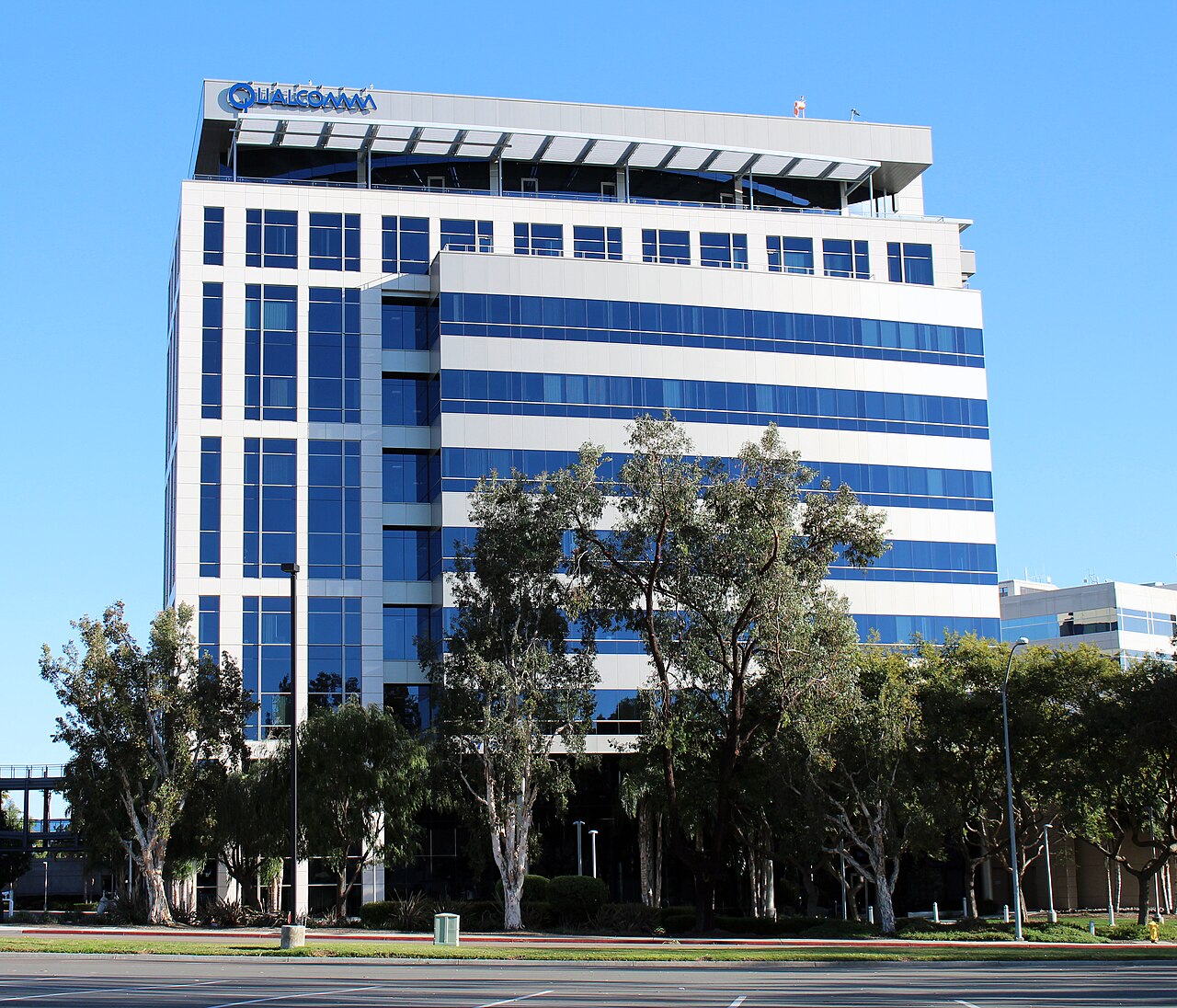
- Image: Qualcomm Headquarters La Jolla.jpg by Coolcaesar (CC BY-SA 4.0), via Wikimedia Commons