Ken and Roberta Williams and Sierra On-Line
Abstract
In 1980, a 25-year-old programmer and his wife packaged a game in Ziploc bags on their kitchen table and sold it by mail order. Mystery House, designed by Roberta Williams and programmed by Ken Williams, was the first adventure game with graphics, and the company they built around it, Sierra On-Line, invented the graphic adventure genre: King’s Quest, Space Quest, Leisure Suit Larry, Gabriel Knight. Roberta Williams became the most prominent female game designer of her era while raising two sons upstairs from the office. In 1996 the couple sold the company for roughly $1.5 billion in stock to CUC International, whose earnings turned out to be fabricated in one of the largest accounting frauds before Enron. Sierra was dismantled within three years. In 2023, aged 68 and 69, the two shipped a new game together.
A Teletype in the Kitchen
Ken Williams, born in 1954, grew up in a working-class family in Southern California, married Roberta Heuer (born 1953) in 1972, and taught himself programming into a well-paid career as a mainframe consultant in Los Angeles. In 1979 he brought home a teletype terminal connected to a client’s mainframe. On it Roberta found Colossal Cave Adventure, the text-only cave exploration game written by Will Crowther and expanded by Don Woods. She played it obsessively, mapping the cave on butcher paper across the kitchen, and when she ran out of game she wanted to make her own.
Ken’s plan at the time was business software for microcomputers. Roberta talked him out of it. Her design idea was concrete: an adventure game in the style of Agatha Christie’s And Then There Were None, a mansion, seven guests, a murderer among them, and, her real innovation, pictures. Every text adventure on the market described rooms in words. Roberta wanted the player to see them.
Mystery House
Ken worked out how to store and draw roughly seventy line drawings on an Apple II, using a VersaWriter drawing tablet to trace Roberta’s sketches and storing the images as coordinate instructions rather than memory-hungry bitmaps. Mystery House shipped in May 1980: hand-drawn rooms, stick-figure corpses, a two-word text parser underneath. The couple placed a small ad in MICRO magazine, priced the game at $24.95, and packed disks in Ziploc bags themselves.
It sold over ten thousand copies, at a time when a thousand copies made a hit. The revenue exceeded Ken’s annual salary, and the two concluded that the software business did not require staying in Los Angeles. They moved to Oakhurst, California, a small town in the Sierra Nevada foothills near Yosemite, and ran the company (founded in 1979 as On-Line Systems in Simi Valley, renamed Sierra On-Line in 1982) from there for the next decade and a half. Their follow-up, The Wizard and the Princess (1980), added color and outsold Mystery House several times over.
One early Sierra product acquired a life of its own. Softporn Adventure (1981), a bawdy text adventure written by outside author Chuck Benton, was packaged with a cover photograph of three naked women in a hot tub attended by a waiter. The hot tub was Ken and Roberta’s own, and one of the three women was Roberta. Six years later Sierra designer Al Lowe rebuilt the aging game with graphics and a lounge-lizard protagonist as Leisure Suit Larry in the Land of the Lounge Lizards (1987), which became one of the company’s most durable franchises.
King’s Quest and the Adventure Decade
The company’s defining break came from IBM, which in 1983 commissioned a showcase game for its upcoming PCjr home computer. Sierra’s answer was King’s Quest (1984), designed by Roberta: the first adventure game with an animated walking character that could move behind and in front of objects in a pseudo-3D scene, built on a reusable engine (AGI, later succeeded by SCI). The PCjr failed in the market, and the flop nearly took Sierra with it, but King’s Quest found its audience on other machines and grew into an eight-part series spanning fourteen years.
On that engine Sierra built the genre through the late 1980s: Space Quest (1986), Police Quest (1987), Leisure Suit Larry (1987), Quest for Glory (1989), later Gabriel Knight (1993) by designer Jane Jensen. Sierra’s adventures competed through the decade with LucasArts’ more forgiving designs; Sierra games famously let the player die, and Sierra sold hint books alongside the games. Roberta designed or co-designed the King’s Quest series throughout, working from home while raising the couple’s two sons, and was for years the most visible woman in an industry that had very few.
Ken ran the business side and pushed infrastructure ahead of the market. The Sierra Network (1991) offered graphical online multiplayer games, card rooms, and chat over dial-up modems, years before mainstream online gaming; it was sold to AT&T in 1994. Roberta’s Phantasmagoria (1995), a seven-CD horror game with filmed actors, a team of more than two hundred people, and a $4.5 million cost, was refused stocking by CompUSA and refused classification in Australia, and sold more than a million copies, Sierra’s first game to reach that mark.
⚠️ Dead End: The CUC Sale
In February 1996, Ken and Roberta agreed to sell Sierra On-Line to CUC International, a membership-shopping conglomerate, in a stock deal valued at roughly $1.5 billion at announcement (closed in July). The logic offered at the time was scale: CUC promised marketing muscle and capital for the CD-ROM era. Ken Williams stayed briefly as a division executive, found himself managing by conference call for a company whose culture he no longer controlled, and left in 1997.
In December 1997 CUC merged with HFS Incorporated to form Cendant. Four months later, Cendant disclosed that CUC’s books had been fabricated for years: roughly half a billion dollars of invented operating income across three years. Cendant’s market value dropped about $14 billion in a day, at the time the largest accounting scandal in US corporate history; CUC founder and CEO Walter Forbes was eventually convicted of fraud and sentenced in 2007 to more than twelve years in prison and $3.28 billion in restitution. The Williamses had been paid in the shares of a fraud.
Cendant dumped its software holdings on the French publisher Havas (soon part of Vivendi) in late 1998. On February 22, 1999, a date Oakhurst employees named “Chainsaw Monday,” the new owners cut roughly 250 jobs and shut down the historic studio’s development work; the Oakhurst operation was closed outright, and Roberta, whose King’s Quest: Mask of Eternity (1998) had just shipped, left the industry in 1999. The Sierra brand passed through Vivendi’s mergers into Activision Blizzard in 2008, where the label went dormant (a brief revival followed in 2014). There is an irony in the timing: in its final independent years Sierra had signed a small Seattle studio called Valve, and published Half-Life (1998), one of the most influential PC games ever made (see The PC Gaming Revolution), even as the company itself was being dismantled.
The dead end was not the adventure genre, which survived in indie and episodic form. It was the exit itself: a founder-run creative studio traded for paper written by con men. Ken Williams’ 2020 memoir about the company carries the verdict in its title: Not All Fairy Tales Have Happy Endings.
Colossal Cave, Again
The couple spent the following two decades mostly at sea, crossing oceans in their own boats and writing about it. During the COVID-19 lockdowns Ken, then in his mid-sixties, learned Unity and modern 3D programming; Roberta returned to design. Their new company, Cygnus Entertainment, released Colossal Cave in January 2023: a full 3D remake of the Crowther and Woods cave game that Roberta had played on the kitchen teletype in 1979. The first game and the latest game are the same game.
📚 Sources
- Ken Williams — Wikipedia
- Roberta Williams — Wikipedia
- Sierra Entertainment — Wikipedia (On-Line Systems, Oakhurst, CUC sale, Chainsaw Monday)
- Mystery House — Wikipedia
- King’s Quest — Wikipedia
- Softporn Adventure — Wikipedia (the hot-tub cover, Leisure Suit Larry lineage)
- Phantasmagoria — Wikipedia
- CUC International / Cendant accounting scandal — Wikipedia
- Williams, Ken: Not All Fairy Tales Have Happy Endings: The Rise and Fall of Sierra On-Line (2020)
- Colossal Cave (2023 video game) — Wikipedia
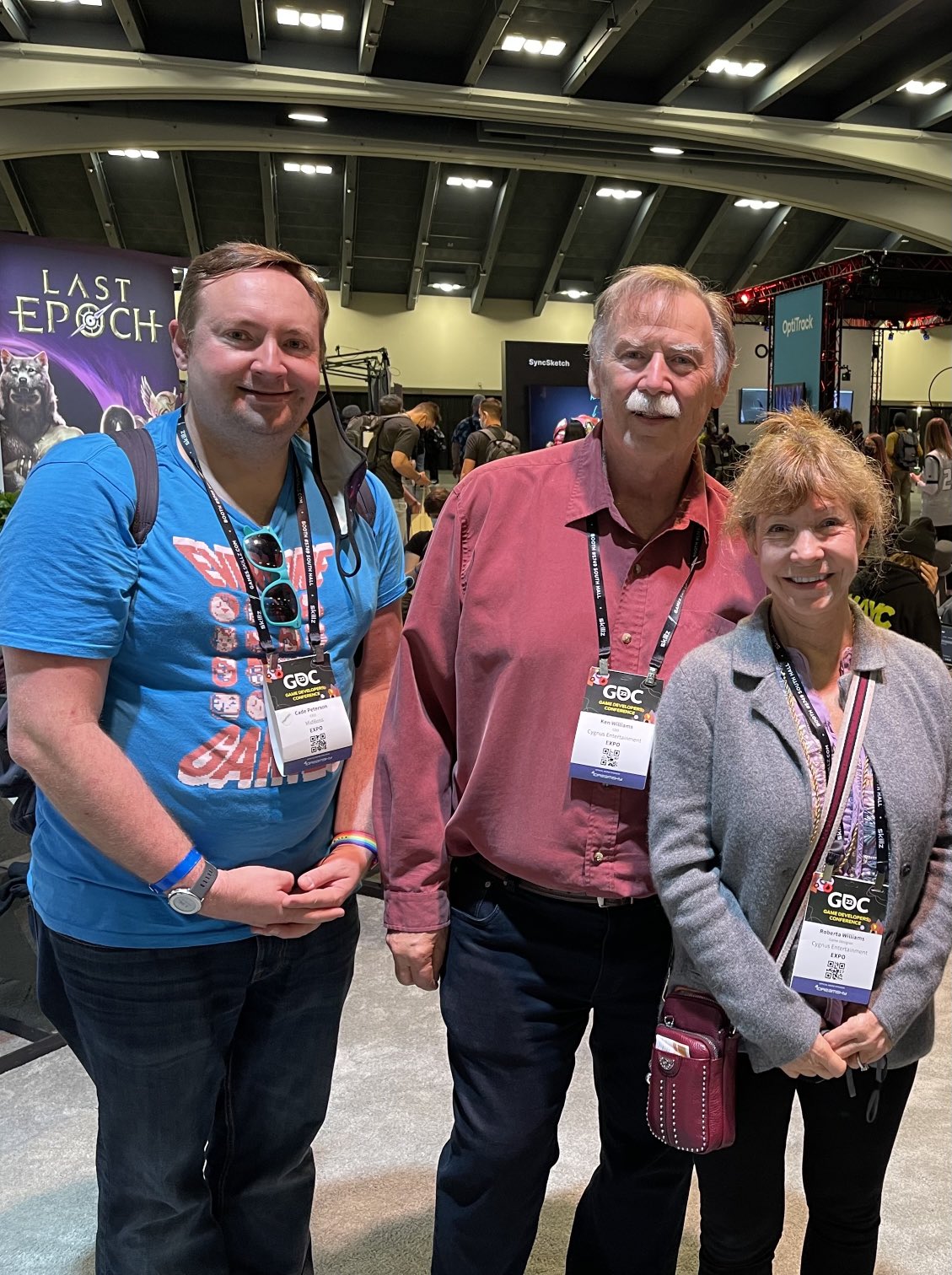
- Image: Ken and Roberta Williams, GDC 2022.jpg by Cade Peterson (CC BY-SA 4.0), via Wikimedia Commons