LucasArts and the Point-and-Click Adventure
Abstract
The point-and-click adventure replaced the typed commands of text adventures with a menu of verbs and a mouse pointer, and its form was set largely at Lucasfilm Games, the game division George Lucas founded in 1982. Ron Gilbert wrote the SCUMM engine in 1987 for Maniac Mansion so that designers could script scenes without writing assembly code; on it the studio built The Secret of Monkey Island (1990), Day of the Tentacle (1993) and a dozen other games. Gilbert also wrote down a design argument against the house style of the market leader, Sierra On-Line, whose games killed the player often and could leave a game unwinnable without saying so. LucasArts adventures mostly did neither. The genre peaked commercially in the early 1990s and declined after 1998, when LucasArts’ own Grim Fandango won awards and sold modestly; the company cancelled its last adventure sequels in 2003 and 2004. Former employees revived the form through episodic sales, an open-source interpreter called ScummVM, and a 2012 Kickstarter.

Lucasfilm Games
George Lucas set up a games group inside his company’s Computer Division in May 1982, the same division whose graphics group became Pixar. Its first releases, Ballblazer and Rescue on Fractalus! in 1984, were action games for Atari machines. In 1986 two of its programmers, Chip Morningstar and Randy Farmer, ran the beta of Habitat, a graphical online world with avatars on the Quantum Link service and the first attempt at a large-scale commercial virtual community in pictures.
Adventure games at the time meant Sierra On-Line. Sierra’s King’s Quest (1984) had put an animated character in a coloured scene, but the player still typed commands at a parser and guessed at the words it understood. Ron Gilbert, a young programmer at Lucasfilm Games, played King’s Quest and wanted to keep the pictures and drop the typing: the screen would show every verb the game understood, and the player would build a sentence by clicking a verb and then an object.
SCUMM and Maniac Mansion
Gilbert and the artist Gary Winnick designed Maniac Mansion, a parody of teenage horror films in which the player picked two companions for the hero from six students, each with different abilities, to rescue a girlfriend from a mad scientist’s house. The combinations produced several solutions and five endings. It came out for the Commodore 64 and Apple II in October 1987.
To build it Gilbert wrote the Script Creation Utility for Maniac Mansion, SCUMM, with help from Chip Morningstar; Aric Wilmunder, later known in the studio as “the SCUMM Lord,” and Brad Taylor extended it over the next decade. SCUMM was a scripting language and a runtime together. Designers wrote scenes, dialogue and object behaviour in scripts, and an interpreter ran them on each target machine, so a game could be ported by porting the interpreter. The studio later added iMUSE, a system by the composers Michael Land and Peter McConnell that changed the music smoothly as the player moved between scenes. Every LucasArts adventure from Maniac Mansion to The Curse of Monkey Island (1997) ran on SCUMM.
The Nintendo Entertainment System port met Nintendo’s content rules. Nintendo required the removal of profanity and of “nudity” that included a poster and a classical statue; a scene in which the player could put a hamster in a microwave survived the review and was taken out of later production runs.
Why Adventure Games Suck
While designing Monkey Island in 1989, Gilbert wrote an essay titled “Why Adventure Games Suck and What We Can Do About It.” It listed rules. The player should know the end goal and the first sub-goal. Puzzles should not be “backwards,” with the solution found before the problem is known. The game should reward the player’s intent. Solutions should not be arbitrary: “the best reaction after solving a tough puzzle should be, ‘Of course, why didn’t I think of that sooner!’” And: “Adventure games should be able to be played from beginning to end without ‘dying’ or saving the game if the player is very careful and very observant.”
The target, though the essay did not name it, was the Sierra style. Sierra’s games killed the character for walking off a path or touching the wrong object, often with a joke message, and some let the player lose an item or miss an event early on and go on for hours before discovering the game could no longer be finished. Players learned to save constantly. LucasArts made the opposite a house rule: its later adventures generally had no deaths and no unwinnable states, and the player could explore without fear.
The Secret of Monkey Island, released in October 1990 by Gilbert with two younger designers, Tim Schafer and Dave Grossman, applied the rules. Its hero, a would-be pirate named Guybrush Threepwood, can die in only one place: he drowns if the player leaves him underwater for ten minutes. Its sword fights were contests of insults and comebacks, learned from other pirates. It took nine months and $200,000 to make. Dave Grossman later put its first sales at “north of 100,000, far south of 1 million”; it sold especially well in Europe, and the sequel followed in 1991.
The Early 1990s
The studio, renamed LucasArts in 1990, produced about one adventure a year: Loom (1990), Monkey Island 2: LeChuck’s Revenge (1991), Indiana Jones and the Fate of Atlantis (1992), Day of the Tentacle (1993), Sam & Max Hit the Road (1993) and Full Throttle (1995). Day of the Tentacle, the sequel to Maniac Mansion directed by Schafer and Grossman, was LucasArts’ first adventure with full voice acting at release, added late when CD-ROM drives spread in 1992; players could find the complete original Maniac Mansion running on a computer in one of its rooms. Day of the Tentacle was the last to keep the verb list at the bottom of the screen: Sam & Max Hit the Road replaced it with icons cycled at the pointer, and Full Throttle with a small “verb coin”.
Grim Fandango
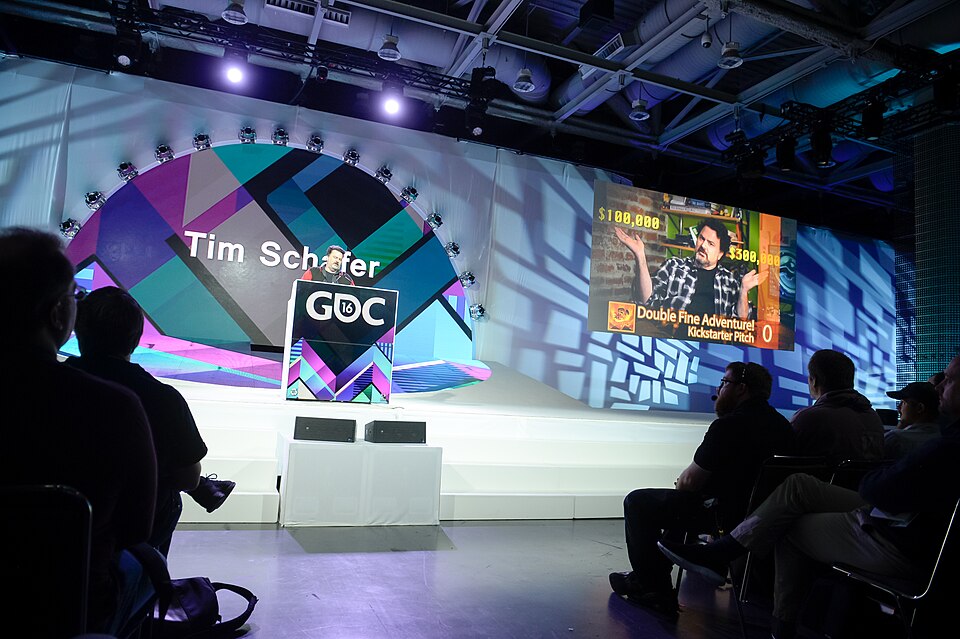
Schafer’s Grim Fandango, released on 30 October 1998, was a film-noir story set in the Aztec-inspired Land of the Dead, with 3D characters over pre-rendered backgrounds. It needed a new engine, GrimE, scripted in the Lua language, and abandoned the pointer for keyboard “tank” controls. Critics gave it a Metacritic score of 94 and GameSpot named it game of the year. It sold about half as many copies as Full Throttle; by 2012 its lifetime total was estimated at around 500,000. LucasArts said it had “met domestic expectations and exceeded them worldwide”, but the industry read it as proof that the adventure market had shrunk, and the company turned to Star Wars licences and action games. Schafer left in 2000 to found Double Fine. The Curse of Monkey Island (1997) had been the last SCUMM game; Escape from Monkey Island (2000) was the last new LucasArts adventure. The company cancelled Full Throttle: Hell on Wheels in 2003 and Sam & Max: Freelance Police in March 2004.
Dead End: The Moon-Logic Puzzle
By 2000 the question of who had killed the adventure game was a genre of its own. A GameCenter feature blamed audiences who wanted action and the influence of the slow, puzzle-box Myst (1993). On 11 September 2000 Erik Wolpaw, writing on the satirical site Old Man Murray, blamed the designers instead, with one puzzle from Sierra’s Gabriel Knight 3 (1999) as evidence. To borrow a motorcycle the hero had to impersonate a man named Mosely; to do that he made a moustache by using tape to collect hair from a cat and fixing it to his face with syrup, although Mosely had no moustache. Wolpaw’s point was Gilbert’s rule about arbitrary solutions, ten years on: puzzles that could only be solved by trying everything on everything drove away anyone without a walkthrough. Wolpaw later wrote for Valve’s Portal games.
Neither explanation killed the genre outright. It survived among smaller studios and later through the people LucasArts let go. Three former LucasArts staff, Kevin Bruner, Dan Connors and Troy Molander, founded Telltale Games in July 2004 after the Sam & Max cancellation; its episodic Sam & Max season of 2006 was sold by download a chapter at a time, and its The Walking Dead (2012) sold a million copies in twenty days. In September 2001 a computer-science student, Ludvig Strigeus, released ScummVM, an open-source reimplementation of the SCUMM interpreter that let the original game files run on new systems; LucasArts first sent a cease-and-desist letter, then after years of talks reached an agreement that let it continue, and Disney later used ScummVM to sell Maniac Mansion on Steam. In February 2012 Schafer asked Kickstarter backers for $400,000 for a new point-and-click adventure and got more than $3.3 million (see Crowdfunding and Kickstarter).
The Walt Disney Company completed its purchase of Lucasfilm on 21 December 2012 and on 3 April 2013 closed LucasArts’ internal game development, laying off about 150 people and keeping the name for licensing. Gilbert and Grossman, working under a Disney licence at Gilbert’s small studio Terrible Toybox, released Return to Monkey Island on 19 September 2022, thirty-one years after Monkey Island 2.
📚 Sources
- LucasArts, Wikipedia (May 1982 founding, Ballblazer and Rescue on Fractalus! 1984, Habitat 1986, the 1990 rename, cancellations of 2003 and 2004, Disney purchase completed 21 December 2012, closure of development 3 April 2013, about 150 layoffs)
- Habitat (video game), Wikipedia (Morningstar and Farmer, Quantum Link beta 1986)
- Maniac Mansion, Wikipedia (Gilbert and Winnick, October 1987, the King’s Quest inspiration, six characters, five endings, the NES censorship and the hamster)
- SCUMM, Wikipedia (Gilbert, Morningstar, Wilmunder “the SCUMM Lord”, Taylor, iMUSE, the verb coin, The Curse of Monkey Island as the last LucasArts SCUMM game, GrimE and Lua)
- Gilbert, Ron, “Why Adventure Games Suck and What We Can Do About It”, 1989, republished on Grumpy Gamer
- The Secret of Monkey Island, Wikipedia (October 1990, Gilbert, Schafer and Grossman, nine months and $200,000, the drowning, insult sword fighting, Grossman’s sales estimate)
- Day of the Tentacle, Wikipedia (25 June 1993, first LucasArts adventure with voices at release, Maniac Mansion inside, last game with the original verb interface)
- Grim Fandango, Wikipedia (30 October 1998, GrimE and tank controls, Metacritic 94, GameSpot game of the year, about 500,000 copies, “met domestic expectations and exceeded them worldwide”, Schafer’s departure in 2000)
- Wolpaw, Erik, “Death of Adventure Games”, Old Man Murray, 11 September 2000, and Old Man Murray, Wikipedia (the Gabriel Knight 3 moustache puzzle; the GameCenter article it answered)
- Telltale Games, Wikipedia (July 2004 founders, Sam & Max 2006, The Walking Dead a million copies in twenty days)
- ScummVM, Wikipedia (Strigeus, September and October 2001, the cease-and-desist and later agreement, Maniac Mansion on Steam)
- Return to Monkey Island, Wikipedia (19 September 2022, Terrible Toybox, Disney licence)
- Image: Ron Gilbert 2011.jpg by The Photo Group for Official GDC (CC BY 2.0), via Wikimedia Commons
- Image: GDC 2016 TXT8877 Tim Schafer (25851585235).jpg by Official GDC (CC BY 2.0), via Wikimedia Commons