Lee Felsenstein
Abstract
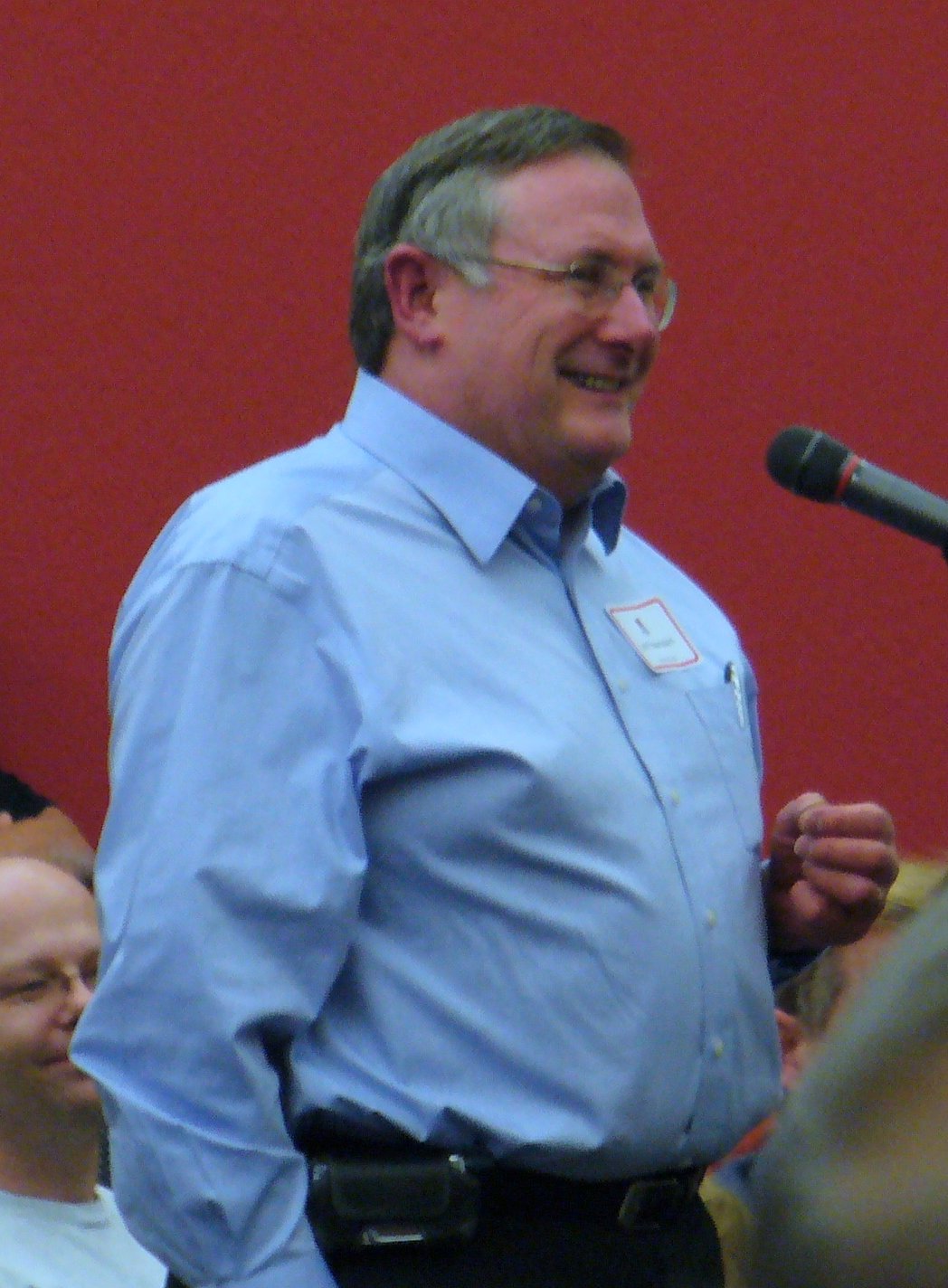
Lee Felsenstein (born 1945) was arrested in Sproul Hall in 1964 with the Free Speech Movement, put a public computer terminal in a Berkeley record shop in 1973, moderated the Homebrew Computer Club with a yardstick, and designed two of the machines that defined the hobbyist era: the Sol-20 (1976), one of the first microcomputers that came with a keyboard and video output in the box, and the Osborne 1 (1981), the first portable computer sold in volume. He came to hardware through politics rather than the other way round. His argument, taken from Ivan Illich’s Tools for Conviviality, was that a machine only survives in public if it grows a community around itself, and he built the machines to prove it.
Philadelphia
Lee Felsenstein was born in Philadelphia on April 27, 1945. His older brother Joseph became an evolutionary biologist whose PHYLIP phylogeny software was first developed on a Sol-20 and an Osborne 1, the two machines Lee designed. Lee went to Central High School and, in 1963, to the University of California, Berkeley, to study electrical engineering.
Berkeley in 1964 was the Free Speech Movement, and Felsenstein was in it. On the night of December 2–3, 1964, he was one of the 768 people arrested in the Sproul Hall sit-in. He wrote for the Berkeley Barb, the underground paper, and moved between engineering and activism for the rest of the decade: a co-op work-study job, dropping out at the end of 1967, three years as a junior engineer at Ampex from 1968 to 1971, and finally the degree in electrical engineering and computer science in 1972.
Leopold’s Records
In 1973 Felsenstein was part of a group at Resource One, a computer centre in a San Francisco warehouse called Project One that had inherited an SDS 940 timesharing computer. With Efrem Lipkin, Ken Colstad, Jude Milhon and Mark Szpakowski, he built Community Memory: a Teletype Model 33 in a cardboard box with a plastic window, connected by a 110-baud telephone line to the 940 in San Francisco, and placed at the top of the stairs in Leopold’s Records on Durant Avenue in Berkeley in the late summer of 1973. Felsenstein did the hardware, Lipkin the software, Szpakowski the interface. Anyone could walk up, type ADD and a message with keywords, or FIND and a keyword, and read what strangers had left. No registration, no names required. People used it to find musicians, rides, apartments and restaurants; a regular who signed as “Dr. Benway” became, by the project’s own reckoning, the first online personality.
It was the first public-access computer bulletin board, six years before the dial-up boards of The BBS Era. The 940 was too big, too slow and too expensive to keep running, and the terminal came down in January 1975. Felsenstein’s conclusion was that the next version needed a cheap terminal that a community could own and repair, which turned him into a hardware designer. He had read Ivan Illich’s Tools for Conviviality (1973), and his phrasing of its lesson became his working rule: “In order to survive in a public-access environment, a computer must grow a computer club around itself.” A revived Community Memory, with networked terminals in several Berkeley locations, free reading and a coin slot for posting, ran in two further versions from 1984 to 1992.
The Yardstick
The Altair 8800 arrived on the January 1975 cover of Popular Electronics, and on March 5, 1975, Gordon French and Fred Moore convened the first meeting of the Homebrew Computer Club in French’s garage in Menlo Park. Felsenstein was there and, once the meetings moved to the auditorium at the Stanford Linear Accelerator Center and the attendance grew into the hundreds, he ran them. His method was a “mapping” period in which anyone could announce what they were building or needed, followed by a “random access” period in which people found each other in the aisles. He kept order with a yardstick, pointed it at whoever had the floor, and described the job as being less a chair than a keeper of chaos. The club is where Steve Wozniak showed the Apple I, and Felsenstein’s format is the reason a room of three hundred hobbyists could function as a market for ideas. The larger story is in The Personal Computing Explosion.
The Sol-20
Felsenstein’s first products were for the Altair’s ecosystem. The Pennywhistle modem, a 300-baud acoustic coupler published as a construction project in Popular Electronics in March 1976, was the low-cost link Community Memory had needed. The VDM-1, designed for Bob Marsh’s Processor Technology, was a video display board that put 16 lines of 64 characters on an ordinary television from the computer’s own memory; its memory-mapped design was widely copied and became the standard way a personal computer drove a screen.
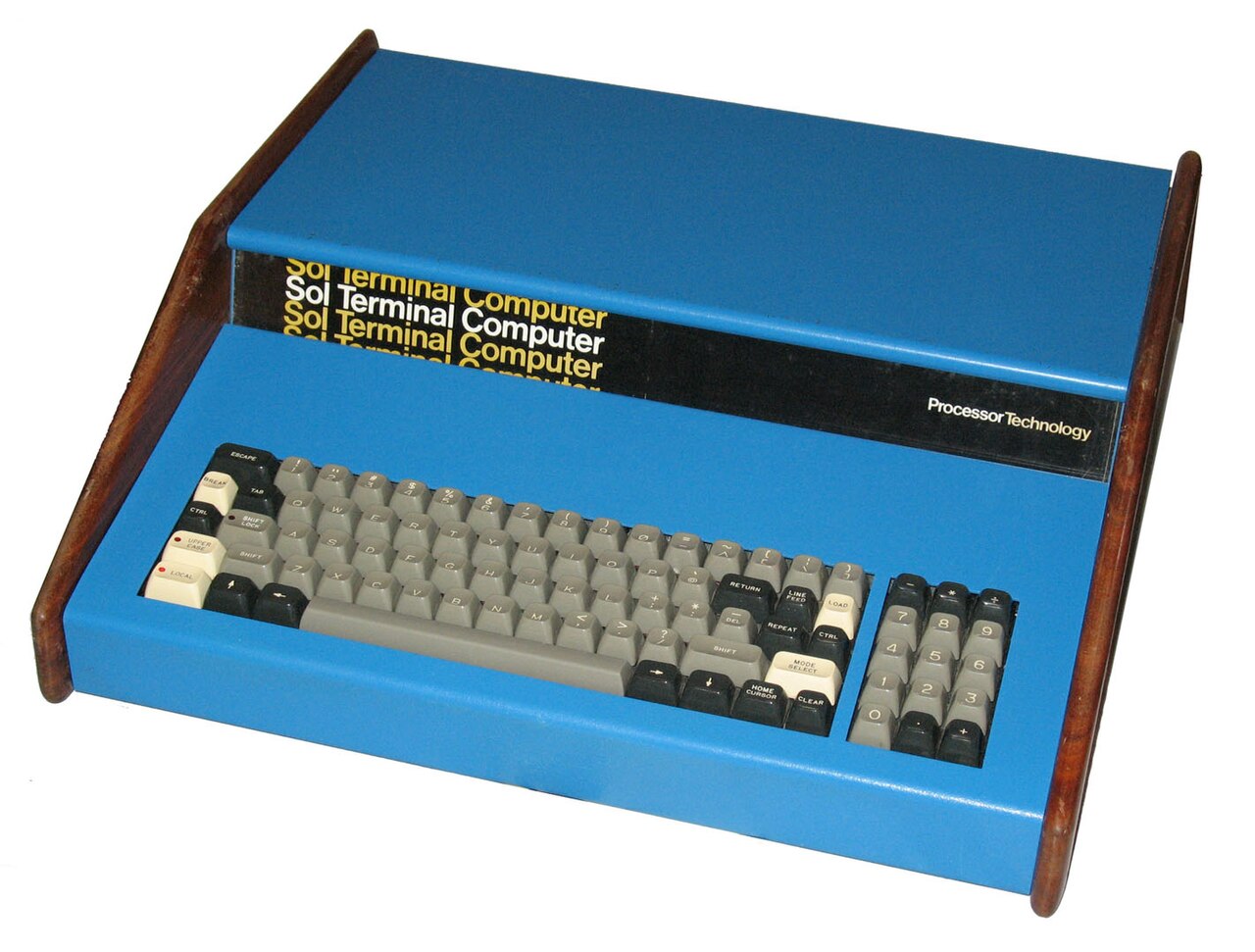
Then Les Solomon at Popular Electronics asked Marsh for an “intelligent terminal” for the magazine, and Marsh asked Felsenstein for the design. What came back was a whole computer. The Sol-20, on the cover of the July 1976 issue, packed an Intel 8080, a VDM-1, a keyboard and S-100 expansion slots into one steel case with walnut sides. It sold for $995 as a kit and $1,495 assembled. It was among the first microcomputers a buyer could take out of the box, connect to a television, and type on, a year before the Apple II, the Commodore PET and the TRS-80 did the same for a mass market. The name honoured Solomon; the editor’s own gloss was that if it worked people would say Sol meant “sun” in Spanish, and if it did not they would blame the Jewish guys. About 12,000 were sold. Processor Technology could not match the 1977 machines on price or distribution and was liquidated on May 14, 1979.
The Osborne 1
Adam Osborne, a technical publisher who had sold his book company to McGraw-Hill in 1979, hired him to design a computer to a specification that was mostly constraints: it had to fit under an airline seat, survive being carried, and sell for the price of the software bundled with it. The Osborne 1, announced at the West Coast Computer Faire in April 1981 and shipping from July at $1,795, weighed 24.5 pounds, ran CP/M on a Z80 with 64 KB of memory and two floppy drives, and had a five-inch screen. It sold 11,000 units in its first eight months on sale. The company grew from two people to about 3,000 and collapsed into bankruptcy in September 1983; the machine, the growth, and the myth of the “Osborne effect” are examined in Dead End: Osborne.
After Osborne
He spent 1992 to 2000 at Interval Research, Paul Allen’s laboratory in Palo Alto, and then five years as a consultant at Pemstar Pacific. In 2003, working with the Jhai Foundation, he designed a rugged, low-power computer and wireless relay for villages in Laos, powered by a bicycle generator; The New York Times Magazine called it the pedal-powered Internet, and the Tech Museum of Innovation made him a laureate for it that year. He founded the Free Speech Movement Archives online in 1998 and was a founding “sensei” of Hacker Dojo, the Mountain View hackerspace, in 2009. The Electronic Frontier Foundation gave him its Pioneer Award in 1994, and the Computer History Museum made him a Fellow on April 16, 2016, for his influence on the technical and social environment of the early personal computing era.
His three rules, repeated in talks for forty years, are the shortest statement of what the hobbyist era believed: to change the rules, change the tools; if work is to become play, tools must become toys; and a computer in public must grow a club around itself or die.
📚 Sources
- Lee Felsenstein — Wikipedia
- Community Memory — Wikipedia (the Leopold’s Records terminal, the SDS 940 at Resource One, the 110-baud link, ADD/FIND, Dr. Benway, the January 1975 shutdown)
- Sol-20 — Wikipedia (the July 1976 cover, $995 kit and $1,495 assembled, the walnut sides, the Solomon naming story, about 12,000 sold, Processor Technology’s May 14, 1979 liquidation)
- Community Memory: Precedents in Social Media and Movements — Computer History Museum (gives September 1973 for the first terminal; the 1992 end of the last version)
- Osborne 1 — Wikipedia (April 3, 1981 announcement, $1,795, 24.5 lb, Z80, 64 KB, five-inch screen)
- Oral History of Lee Felsenstein — Computer History Museum, May 7, 2008, interviewed by Kip Crosby
- Lee Felsenstein — 2016 Fellow, Computer History Museum
- Osborne Computer Corporation — Wikipedia (the 1981 founding, Felsenstein as designer, first-year sales and the 1983 bankruptcy)
- Illich, Ivan — Tools for Conviviality, Harper & Row, 1973
- Levy, Steven — Hackers: Heroes of the Computer Revolution, Doubleday, 1984 (the Community Memory and Homebrew chapters, the “mapping” and “random access” periods)
- Image: Lee Felsenstein.02.jpg by Marcin Wichary, cropped by Gorinin (CC BY 2.0), via Wikimedia Commons