Heinz Nixdorf
Abstract
Heinz Nixdorf, a railway worker’s son from Paderborn, dropped out of his physics degree in 1952 to build calculating machines in the basement of an Essen utility company, financed by a 30,000 DM advance from his first customer. His insight was that IBM’s mainframe model, a data center run by specialists, ignored the mid-sized firms that made up Germany’s Mittelstand; his “Mittlere Datentechnik” put small computers directly into their offices, bank branches, and shops. By 1985 Nixdorf Computer AG had 23,300 employees in 44 countries and was Europe’s fourth-largest computer maker. Nixdorf died of a heart attack on the dance floor of his own trade-fair party at the first CeBIT in 1986; the company survived him by only four years.
Paderborn
Heinz Nixdorf was born on April 9, 1925, in Paderborn, the eldest of five children of a railway worker who spent stretches of the Depression unemployed; the family knew real poverty. His father died on the Eastern Front in 1944. Nixdorf fought his way into the local Gymnasium by petition, took his Abitur in 1947, and began studying applied physics in Frankfurt on a stipend. In his ninth semester he quit. He had seen early electronic calculators in a student job and concluded that building them beat studying them.
A Basement at RWE
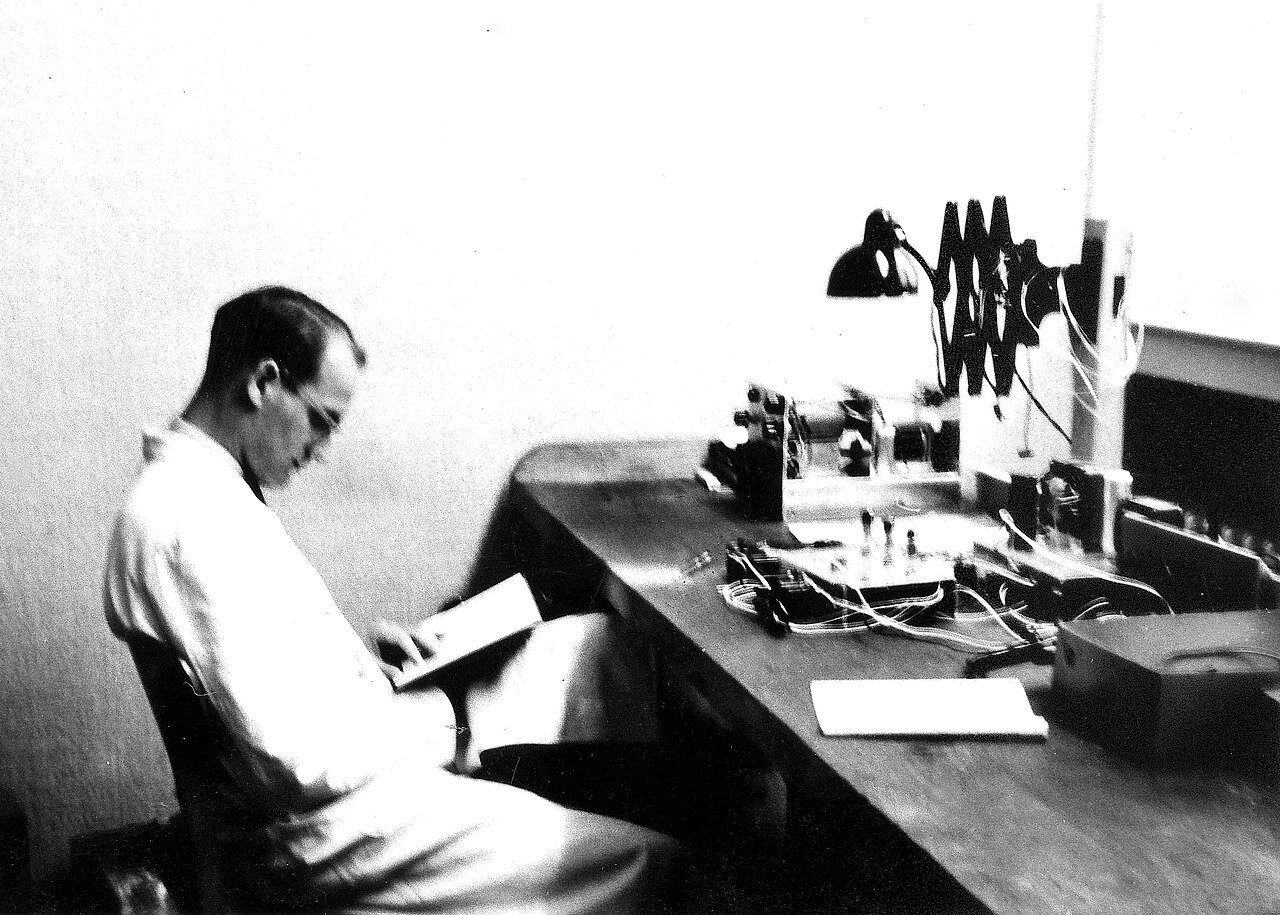
In July 1952, at 27, Nixdorf founded the Labor für Impulstechnik in Essen. The starting capital was a 30,000 DM advance from the electric utility RWE, which wanted a vacuum-tube calculating machine for its accounting department and let the one-man company work out of the basement of its administration building. The first employee started that September; the first machine went upstairs to RWE’s accountants in early 1954.
The business model of the first fifteen years was deliberately invisible: Nixdorf built calculating electronics that established office-machine companies sold under their own names, among them the Wanderer works, whose semiconductor-based Logatronic (1965) came out of his lab. The arrangement ended in a reverse takeover that became German industry folklore: in 1968 the supplier bought his customer, acquiring the majority of Wanderer-Werke for 8 million DM, and merged the firms on October 1, 1968, as Nixdorf Computer AG, headquartered in his home town of Paderborn. With Wanderer came what the lab had always lacked, a nationwide sales network.
Mittlere Datentechnik
Nixdorf’s product idea had a name that doubled as a market analysis: Mittlere Datentechnik, mid-range data technology. IBM sold mainframes to corporations rich enough to staff a data center; punch-card batch processing kept the computer far from the people whose work it processed. Nixdorf’s System 820 (from 1967), a desk-sized, programmable machine with magnetic-core memory and an integrated keyboard, sat in the office, the bank branch, or the back room of a shop, operated by clerks rather than specialists. Germany’s Mittelstand, too big for bookkeeping by hand and too small for an IBM 360, bought it in the thousands.
The formula scaled for two decades: German market leadership in mid-range systems by 1970, subsidiaries in 22 countries by 1972, the first billion DM of revenue in 1978, and a specialization in banking terminals and point-of-sale systems (the 88xx series, from 1975) that made Nixdorf machines part of the daily routine of European retail banking. The company went public on the Düsseldorf exchange in 1984. In 1985 it reported nearly 4 billion DM revenue, 172 million DM profit, and 23,300 employees in 44 countries, making it the fourth-largest computer manufacturer in Europe, and its founder was named Germany’s Manager of the Year.
The Patriarch
Nixdorf ran the company as a Paderborn patriarch, with a mixture of paternalism and calculation that predated the vocabulary of corporate culture. He opened an in-house vocational school in 1969, expanded in 1972 into a recognized training center for computing occupations, introduced profit-sharing the same year, and in 1977 handed 102,000 preference shares to employees for free, with annual share grants thereafter. After his first heart attack in 1978 he decided fitness was a company matter, hired the Olympic decathlete Kurt Bendlin, and in 1984 built the Ahorn-Sportpark next to the headquarters. For his region he extracted an autobahn connection and, by threatening to move the company to Frankfurt, a subsidized airport (Paderborn/Lippstadt, 1971), which was renamed after him in 2024, the first German airport named for an entrepreneur.
Death at CeBIT
In March 1986 the computer industry’s Hanover fair ran for the first time as a standalone event, CeBIT, and Nixdorf’s stand included the “Nixdorf-Saloon”, a western-themed party hall where staff, customers, and journalists mixed in the evenings. On the night of March 17, 1986, three weeks before his 61st birthday, Nixdorf collapsed on the dance floor of his own saloon and died of a heart attack.
Dead End: A Company Built Around One Man
The succession revealed how much of the company’s judgment had lived in its founder, and how much of its strategy had already expired. Nixdorf had deliberately ignored the personal computer, and the company under Klaus Luft kept expanding into a market that was turning: 5,000 new sales staff while proprietary mid-range systems were being squeezed between cheap networked PCs and standard servers. In 1989 Nixdorf Computer lost roughly a billion DM on five billion of revenue, and on October 1, 1990, it merged into Siemens Nixdorf Informationssysteme; the drawn-out dismantling that followed, down to the closing of Germany’s last large computer factory in 2020, is told in Germany’s IT Industry. Mittlere Datentechnik itself was the deeper casualty: the category Nixdorf invented disappeared with the hardware generation that had made it profitable. What endured is the banking-technology line, which as Wincor Nixdorf and later Diebold Nixdorf still builds the ATMs behind much of European retail banking, and the name itself: Nixdorf’s foundations, which held 74% of the company at his death, funded the Heinz Nixdorf MuseumsForum in the old Paderborn headquarters, since 1996 the world’s largest computer museum (Computer Science Locations).
See also: Barcodes and the UPC.
📚 Sources
- Heinz Nixdorf — Wikipedia (German)
- Heinz Nixdorf — Wikipedia (English)
- Vor 25 Jahren: Heinz Nixdorf stirbt auf der ersten CeBIT — heise online (2011)
- Es geschah auf der CeBIT — HNF Blog
- Heinz Nixdorf — Universität Paderborn
- Image: Heinz Nixdorf RWE Essen 1952.JPG by Heinz Nixdorf MuseumsForum, durch Norbert Ryska, Geschäftsführer des Heinz Nixdorf MuseumsForum (CC BY-SA 3.0 de), via Wikimedia Commons