The Altair 8800: The Spark That Started the Microcomputer Revolution
Abstract
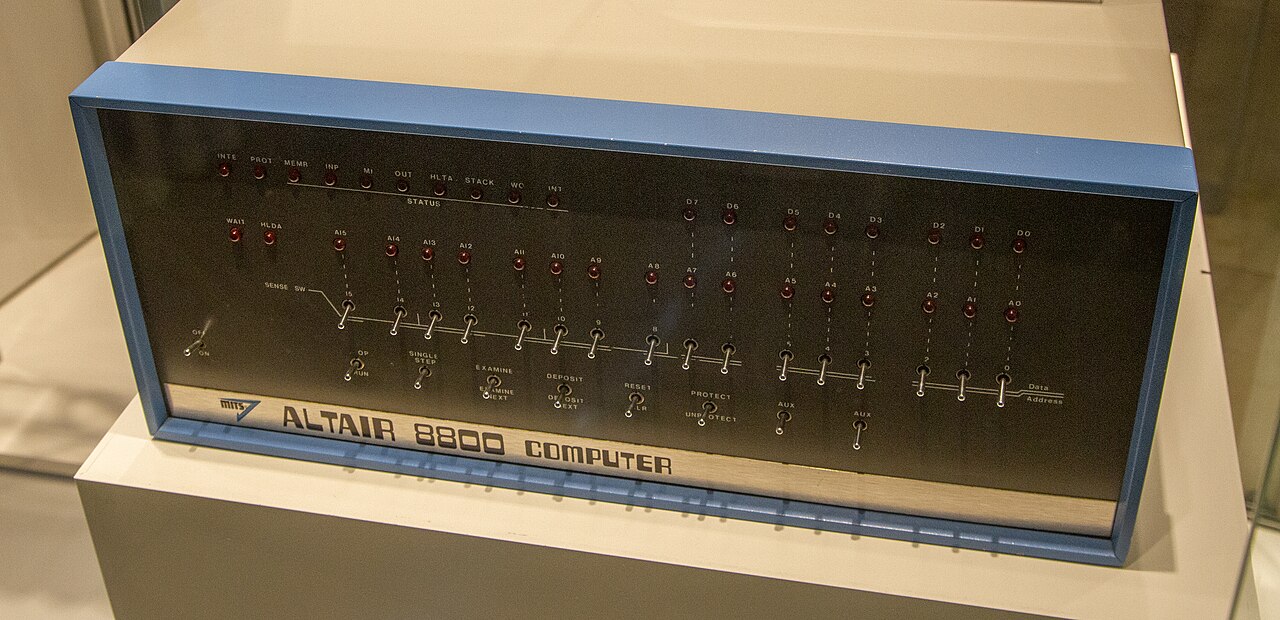
In January 1975, a photograph on the cover of Popular Electronics magazine showed a metal box with blinking lights and toggle switches (no keyboard, no screen, no software) and called it the “World’s First Minicomputer Kit to Rival Commercial Models.” The Altair 8800 cost $397 in kit form, did almost nothing useful out of the box, and triggered an avalanche. Within weeks, a Harvard student named Bill Gates had called his high school friend to say they had to write software for it immediately. Within months, the Homebrew Computer Club was meeting in a garage in Menlo Park, passing around cassette tapes of programs. Within two years, Apple Computer existed. The Altair didn’t start the digital revolution, but it was the specific spark, in the specific room, that lit it.
Ed Roberts and the Company on the Edge
Henry Edward Roberts was not a visionary entrepreneur in the romantic sense. He was a large, blunt engineer from Miami who had a gift for electronics, a weakness for ambitious projects, and a persistent ability to get himself into financial trouble.
Roberts had co-founded MITS (Micro Instrumentation and Telemetry Systems) in Albuquerque, New Mexico, in 1969, while working as an Air Force officer. The company started by selling rocket telemetry kits to model rocketry enthusiasts. Roberts bought out his partners, left the Air Force, and pivoted: by the early 1970s, MITS was selling electronic calculator kits by mail order.
The calculator business nearly killed him. Texas Instruments and other semiconductor manufacturers had entered the consumer calculator market and driven prices below what MITS could match. By late 1974, MITS carried roughly a quarter of a million dollars in debt and Roberts was negotiating with his bank to extend his credit line. The next product needed to succeed, or the company was done.
The product Roberts chose was a computer kit. This was, by the standards of 1974, an almost absurdly ambitious plan. Computers cost tens of thousands of dollars. They required trained operators. They served businesses and universities, not individuals. The idea that an ordinary person might want to own one (let alone build one from a kit) had no market validation whatsoever.
What Roberts had was a chip.
The Intel 8080 and the $75 Deal
In April 1974, Intel released the 8080 microprocessor, a significant step beyond the 8008, with a proper 8-bit architecture, a richer instruction set, and enough capability to run real software. The 8080 retailed for around $360 per chip, which placed it far outside any hobbyist budget.
Roberts called Intel and made an unusual offer: he would buy chips in bulk (enough volume to justify a quantity discount) if Intel would sell him the 8080 for $75 per chip. Intel agreed. Roberts didn’t have confirmed orders for the computers he hadn’t yet designed, but he was confident enough in his instincts to commit.
The machine Roberts designed around the 8080 was minimal by any measure. It had 256 bytes of RAM in the base configuration, not kilobytes, bytes. It had no keyboard, no display, no storage. The user communicated with it by setting toggle switches on the front panel to enter binary opcodes, one instruction at a time, and read results from a row of LED indicator lights. Programming it was painstaking in a way that made even assembly language seem like luxury.
The machine needed a name. It was originally going to be called the “PE-8”, Popular Electronics 8-bit computer, which the magazine’s editor Les Solomon thought dull. Two accounts of what replaced it survive. Solomon told the first Altair Computer Convention in March 1976 that his twelve-year-old daughter Lauren suggested it: “that’s where the Enterprise is going tonight”, a reference to the Star Trek episode “Amok Time”, in which the ship is bound for Altair VI. The other account, from the magazine’s own staff, is that Solomon, associate editor Alexander Burawa and technical editor John McVeigh decided to name it after a star, and McVeigh proposed Altair. Altair it was.
The Cover of Popular Electronics
Les Solomon was the technical editor of Popular Electronics, the magazine that had published circuit designs and kit projects for serious electronics hobbyists since 1954. By late 1974, Solomon was watching the hobbyist electronics market transform. Microprocessors existed. Minicomputers existed. What didn’t exist was a bridge between them and the people who read his magazine.
Roberts had approached Solomon with his computer kit concept. Solomon commissioned a cover story. In late 1974, with MITS nowhere near having working production hardware, Solomon had his art department photograph an empty metal box (just the chassis, no working electronics) for the cover photograph.
The January 1975 issue of Popular Electronics appeared on newsstands in late December 1974. The cover showed the Altair 8800 with the headline: “PROJECT BREAKTHROUGH! World’s First Minicomputer Kit to Rival Commercial Models.” The article, written with David Bunnell as MITS’s PR manager and communications point person, promised that the complete kit would be available for $397, or $498 assembled.
The response was unlike anything Roberts had prepared for. He had told his banker he might sell 800 machines and needed 200 in a year to break even; MITS took 1,000 orders in February 1975 alone, had shipped over 2,500 by the end of May and passed 5,000 by August. The checks arrived faster than MITS could process them. Roberts hired people as fast as he could, but delivery times stretched to months. Some customers waited a year. Most of them waited anyway.
Homebrew: The Community Assembles
On March 5, 1975, a group of electronics enthusiasts gathered in a garage in Menlo Park, California, for the first meeting of what would become the Homebrew Computer Club. The meeting had been organized by Gordon French and Fred Moore and announced through a flyer that read: “Are you building your own computer? Terminal? TV typewriter? I/O device? or some other digital black-magic box? If so, you might like to come to a gathering of people with like-minded interests.”
Thirty-two people showed up for that first meeting. A demonstration model of the Altair 8800 was present. People passed it around, examined it, asked questions, and argued about what it could become.
Among those 32 people was Steve Wozniak, a self-taught engineer working at Hewlett-Packard who had been designing computer circuits in his spare time for years. Wozniak had wanted to own a computer for as long as he could remember but had never been able to afford one. The Altair showed him that affordable hardware existed; it also showed him that the machine was harder to use than it needed to be. He went home and began designing something better.
The Homebrew Computer Club would meet every two weeks for years, growing from dozens to hundreds of members. It was the petri dish in which the personal computer industry cultured itself: a place where engineers, hobbyists, and entrepreneurs exchanged circuit designs, software listings, and ideas about what a personal computer could be. See The Personal Computing Explosion for what grew from these meetings.
The Clones: IMSAI and the Sol-20
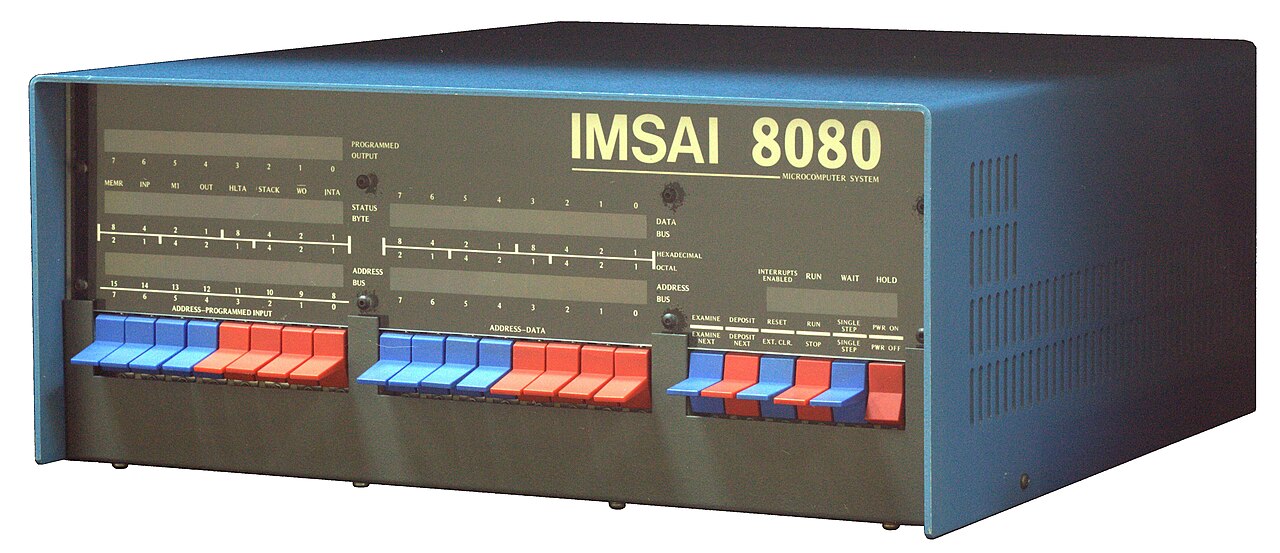
MITS could not keep up with its own orders, which left room for other people to build the same machine better. The IMSAI 8080 from IMS Associates shipped its first kits on 16 December 1975, advertised that October at $439 as a kit and $621 assembled. It used the Altair’s bus and ran the Altair’s cards, which makes it the first clone microcomputer, eight years before the same thing happened to the IBM PC. Between 17,000 and 20,000 were built from 1975 to 1978. Most people have seen one without knowing it: the IMSAI 8080 is the computer in the bedroom in WarGames (1983).
The Sol-20 went further and removed the terminal. Designed by Lee Felsenstein with Bob Marsh at Processor Technology and on the cover of Popular Electronics in July 1976, it put an Intel 8080, a keyboard, video output and cassette storage in one case at $995 as a kit and $1,495 assembled. It was among the first assembled microcomputers a buyer could plug into a television and type on, a year before the machines of 1977 did the same thing for a wider market (see The Home Computer Boom). About 12,000 were sold. Processor Technology could not survive the competition from the TRS-80 and Apple II and was liquidated on 14 May 1979; Felsenstein went on to design the Osborne 1.
The S-100 bus the Altair defined outlived all three companies and carried the CP/M business machines that ran small offices until MS-DOS replaced them.
Gates and Allen: “We Have to Do This Now”
Paul Allen was walking through Harvard Square in Cambridge, Massachusetts, in December 1974 when he spotted the January 1975 Popular Electronics on a newsstand. He bought it, read it, and called his friend Bill Gates, then a sophomore at Harvard.
Gates and Allen had been writing software together since high school in Seattle, where they had exploited a billing loophole to gain free time on a DEC PDP-10, taught themselves BASIC, and tried to start a small data analysis company called Traf-O-Data. Allen was 21 and working as a programmer in Boston. Gates was 19 and nominally studying at Harvard.
Allen’s call to Gates was urgent: someone had to write BASIC for the Altair, and if they didn’t do it immediately, someone else would. Gates agreed. He called Roberts at MITS in Albuquerque and told him that he and Allen had already written an Altair BASIC interpreter and wanted to demonstrate it. This was not true. They had not written a single line.
Gates and Allen wrote Altair BASIC in approximately eight weeks, working in Gates’s dormitory room at Harvard. They had no Altair to test on; they wrote an 8080 emulator first, then wrote BASIC to run on it. When Allen flew to Albuquerque to demonstrate the software to Roberts on a real Altair for the first time, neither he nor Gates had any certainty it would work. It worked. Roberts offered them a licensing deal.
Altair BASIC was their first product. They named their partnership Micro-Soft, the hyphen dropped later. Gates left Harvard that spring without finishing his degree. They moved the company to Albuquerque to be near their first and only customer.
The Piracy Problem and What It Meant
Altair BASIC was distributed on paper tape. MITS bundled it with purchased machines under a licensing agreement. But the Homebrew Computer Club had a different philosophy about software: information wanted to be free, programs were meant to be shared, and copying code to give to a friend was a natural extension of the hacker ethic. See The Hacker Culture for the values system that shaped this community.
Members began copying the Altair BASIC paper tape and distributing copies at club meetings. By some estimates, there were dozens of copied versions in circulation for every legitimate purchased license. Gates was furious. In February 1976, he wrote an "Open Letter to Hobbyists", published in the Homebrew Computer Club Newsletter and distributed to other hobbyist publications:
“As the majority of hobbyists must be aware, most of you steal your software. Hardware must be paid for, but software is something to share. Who cares if the people who worked on it get paid?”
The letter generated a massive response, mostly hostile. Hobbyists argued that software was different from hardware, that the community that made software valuable deserved to share in it, that Gates’s commercial framing missed the point of what they were building. The argument between open-source and proprietary software philosophies had begun, and it has never fully ended.
Gates’s position was also commercially motivated: he understood, with the clarity that would define his career, that software was where the leverage was. Hardware was a commodity that prices would erode; software was a standard that could accumulate monopoly power. See Bill Gates and Microsoft for how this insight shaped the company he built.
The Machine That Launched Two Companies
The Altair 8800 did not directly inspire only Microsoft. Steve Wozniak attended Homebrew meetings, saw what the Altair could and couldn’t do, and set out to design a better machine, one with a keyboard, video output, and software built in. His friend Steve Jobs understood that Wozniak’s design could be sold as a finished product. Wozniak demonstrated his design at a Homebrew meeting, Jobs saw that it could be sold as a product, and they founded Apple Computer on April 1, 1976.
Jobs had been watching Homebrew members share Gates and Allen’s BASIC for free and absorbing the lesson that software ecosystems drove hardware adoption. He wanted a machine that came with enough built-in software to be useful without requiring the owner to be an engineer. The Apple I was a step in that direction; the Apple II was the destination. See Steve Jobs and Apple for the full story.
The End of MITS
Ed Roberts sold MITS to Pertec Computer Corporation in May 1977 for approximately $6 million. It was a reasonable exit for a company that had nearly gone bankrupt three years earlier. But Roberts sold into a market that was rapidly moving past the Altair: the Apple II launched in June 1977; the TRS-80 and Commodore PET followed in the same year. The hobbyist kit computer market that MITS had created was being replaced by finished products that anyone could use.
Pertec managed MITS badly. The Altair line was discontinued. Within two years, MITS ceased to exist as a meaningful entity.
Roberts himself took the money and did something unexpected: he enrolled in medical school at Mercer University in Georgia. He took his M.D. in 1986, did a residency in internal medicine, and from 1988 practised in Cochran, Georgia, a small town where he delivered babies, treated farm injuries, and made house calls. He gave occasional interviews to technology journalists who found him, usually with a mixture of pride and bemusement about his place in history. He died on April 1, 2010 (coincidentally, the anniversary of Apple’s founding) of pneumonia at age 68.
Bill Gates flew to Georgia to visit Roberts in his final days.
A Box of Blinking Lights That Changed Everything
The Altair 8800 was, by any objective measure, nearly useless as a practical tool. Its 256 bytes of base memory could hold barely a handful of instructions. Programming it required setting binary switches one at a time and reading LED outputs. It had no software ecosystem, no peripherals worth speaking of, and a manufacturing operation that could barely meet its first wave of orders.
None of that mattered. What mattered was the idea (made concrete, purchasable, and real) that a person of ordinary means could own a computer. The Altair didn’t prove that such a computer would be useful. It proved that people desperately wanted one anyway, and that the desire itself was the market signal that launched Microsoft, seeded Apple, and convened the community that built the personal computer industry. Every machine in the explosion that followed owes a debt to the empty metal box that Les Solomon’s art department photographed for a magazine cover in the autumn of 1974.
📚 Sources
- History of personal computers — Wikipedia
- Levy, Steven — Hackers: Heroes of the Computer Revolution (1984)
- Popular Electronics, January 1975 — Altair 8800 Cover Story (archived)
- Gates, Bill — Open Letter to Hobbyists, February 3, 1976
- IMSAI 8080 — Wikipedia (first kits on 16 December 1975, the October 1975 advertisement at $439 as a kit and $621 assembled, IMS Associates, the first clone microcomputer, 17,000 to 20,000 units built from 1975 to 1978, and the WarGames appearance)
- Sol-20 — Wikipedia (July 1976 Popular Electronics cover, Lee Felsenstein with Bob Marsh at Processor Technology, $995 as a kit and $1,495 assembled, the built-in keyboard and video output, about 12,000 sold, and the liquidation of Processor Technology on 14 May 1979)
- Altair 8800 — Wikipedia
- Wallace, James & Erickson, Jim — Hard Drive: Bill Gates and the Making of the Microsoft Empire (1992)
- Isaacson, Walter — Steve Jobs (2011)
- New York Times — Ed Roberts Obituary, April 2, 2010
- Homebrew Computer Club — Wikipedia
- Image: 2019-08-04 Altair 8800 computer.jpg by Maksym Kozlenko (CC BY-SA 4.0), via Wikimedia Commons
- Image: IMSAI 8080, cropped.jpg by Morn (CC BY-SA 4.0), via Wikimedia Commons