NEC PC-98 and Japan's Domestic PC
Abstract
For most of the 1980s and half of the 1990s, the personal computer in Japan was not an IBM PC compatible. It was NEC’s PC-9801, launched in October 1982 at ¥298,000, which held around half the domestic market by 1983 and over 60% by 1991 and eventually shipped 18.3 million units. The reason was writing: Japanese text needs thousands of kanji, and the IBM PC’s text hardware could not draw them legibly, so Japan built its own architecture around a character ROM and a 640×400 display. The wall came down in software. IBM Japan’s DOS/V of 1990 put the fonts on the hard disk instead of in a chip, Compaq undercut the domestic price by half in October 1992, and Windows 95 made the question of which machine ran Japanese text obsolete. NEC’s own answer, in 1997, was to start selling PC compatibles.
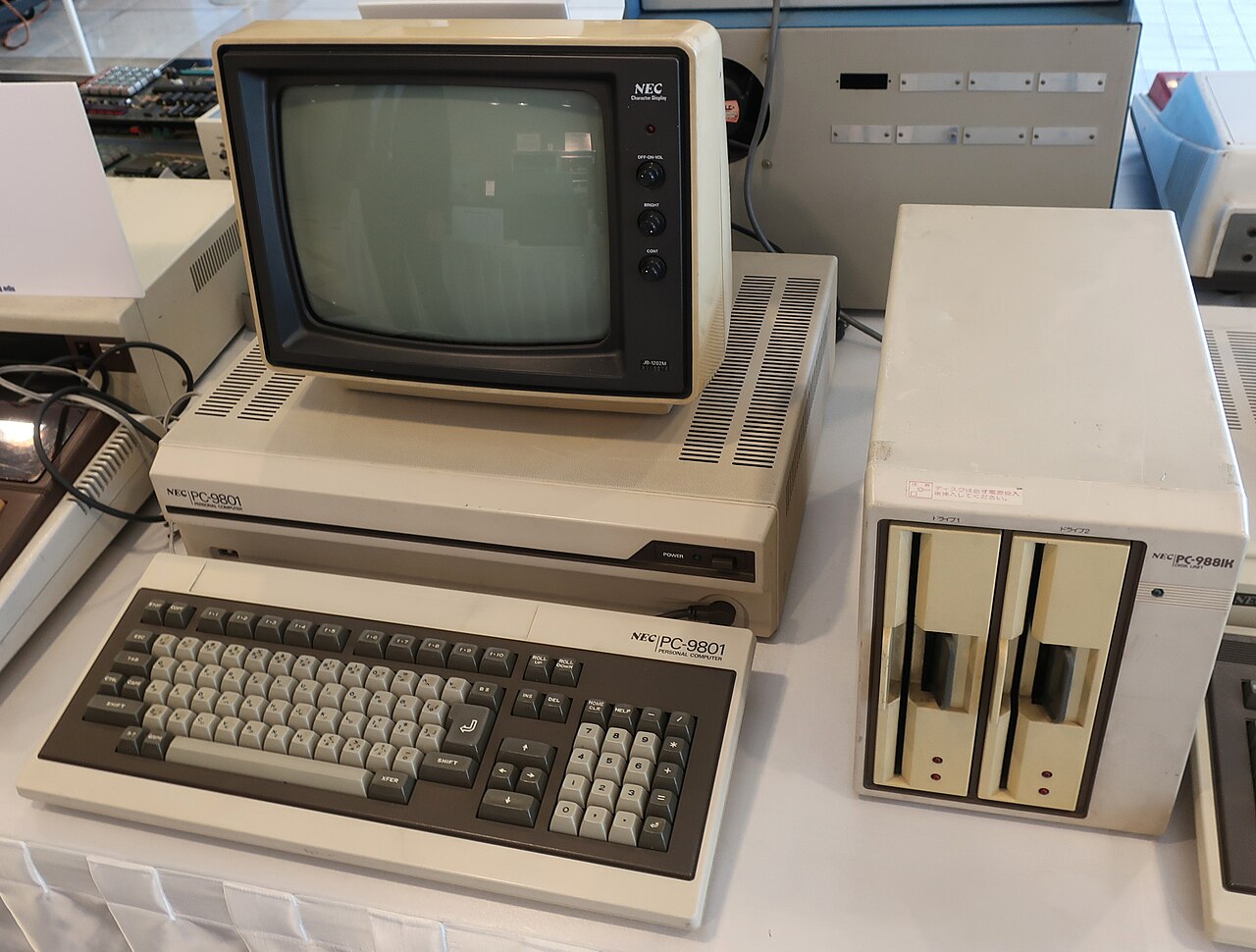
The Character Problem
An American personal computer in 1982 needed 96 printable characters. A Japanese one needed the two kana syllabaries, the Latin alphabet, punctuation, and several thousand kanji from the JIS standard, at a size a reader could distinguish. A kanji drawn in an 8×8 cell is a smudge; it takes at least 16×16 pixels to be legible, and a screen of forty such characters across needs a display and a font store that the IBM PC of the day did not have. IBM clones, as the standard histories put it, lacked the graphics capability to handle a writing system with thousands of characters.
The Japanese solution was hardware. Put the character shapes in a dedicated kanji ROM, give the machine a 640×400 display instead of the American 640×200, and let the video hardware compose text the way a Western machine composed ASCII. That decision produced a computer that did Japanese well and had nothing in common with the rest of the world’s PCs.
The PC-9801
NEC had already taken 40% of the Japanese market with the PC-8001 by 1981. The PC-9801, released in October 1982 at ¥298,000, ran an Intel 8086 at 5 MHz with 128 KB of RAM expandable to 640 KB and an eight-colour 640×400 display. The PC-9801F of 1983 added the kanji ROM and cost ¥398,000.
The platform grew the way a standard grows. By 1983 the PC-98 had about half the Japanese market. By 1987 a million machines had shipped and roughly 3,000 software titles existed for them, most of them written for PC-98 hardware directly rather than through an operating system, which made them fast and made them impossible to move. By 1991 NEC held more than 60% of the market. Japanese business software, Japanese word processing, and a large share of Japanese game development all lived on an architecture that was sold in one country.
Epson Builds a Clone
Japan produced its own version of the compatibility fight that Compaq had won in the United States. Epson announced a PC-98 compatible, the PC-286, in March 1987. NEC sued, claiming copyright in its BIOS. Epson produced a clean-room BIOS for a redesigned model and shipped the PC-286V and PC-286U in September 1987; NEC settled that November. In 1988 Epson sold 200,000 units a year of machines that were not NEC’s.
The clone made the platform cheaper without making it any less Japanese. The architecture still ended at the water’s edge.
The Other Domestic Machines
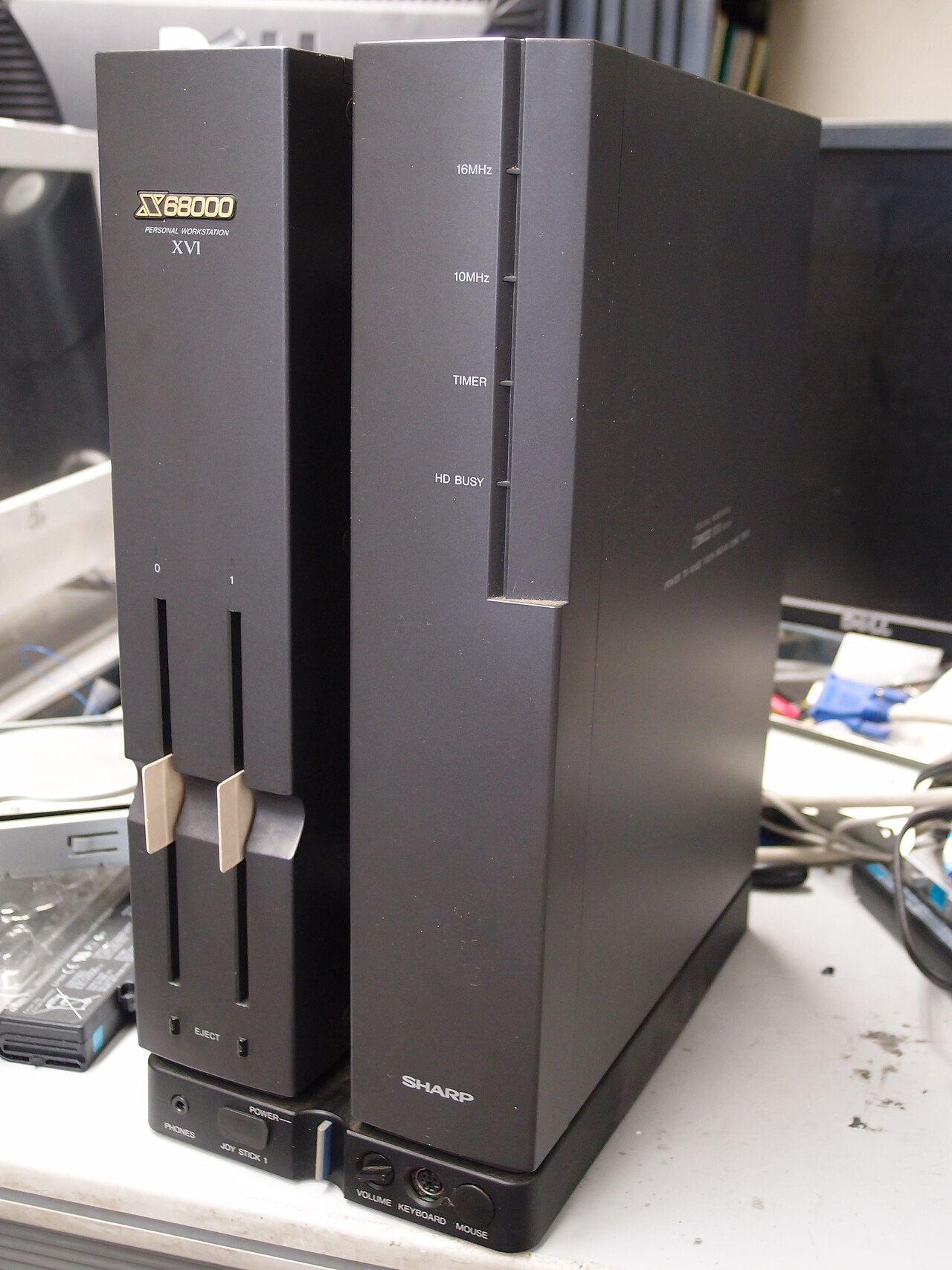
NEC’s dominance was in business computing. Around it sat machines built for other purposes and sold only in Japan.
The Sharp X68000 of 1987 paired a 10 MHz Motorola 68000 with sprite and scrolling hardware derived from Sharp’s arcade work, and it cost ¥369,000 at launch, which was roughly fifteen times the price of the PC Engine console released the same year. It became the machine that arcade conversions were developed on and a cult object afterwards, and it was discontinued around 1999 without ever being sold abroad.
Fujitsu’s FM Towns, released on 28 February 1989, shipped with a CD-ROM drive as standard equipment years before that was normal anywhere, and was aimed squarely at multimedia and games. It sold about 500,000 units and was discontinued in the summer of 1997.
The one Japanese platform that did travel was MSX, the standard Microsoft and ASCII published in 1983, which sold in Japan, South Korea, Brazil, Argentina and Spain and barely at all in the United States (see The Home Computer Boom).
DOS/V Breaks the Wall
The first attempt to bring IBM compatibles into Japan tried to copy NEC’s approach. The AX specification of 1987, backed by Microsoft and several manufacturers, added Japanese video chips and a Japanese keyboard to a PC clone. It failed: the hardware cost more and the software base was thinner.
The second attempt changed the assumption. IBM Japan announced DOS/V on 11 October 1990 and shipped it in November. Instead of a kanji ROM, it kept the fonts and locale data on the hard disk and drew the characters into a standard VGA framebuffer. Any PC compatible with VGA could now display Japanese, including machines IBM had not built, which IBM discovered when DOS/V turned up running on other manufacturers’ clones. The Japanese language stopped being a hardware feature and became a file.
The Compaq Shock
Price did the rest. In October 1992 Compaq entered Japan with a DOS/V machine at ¥128,000 against ¥248,000 for the cheapest PC-98. The Japanese press named the event the Compaq shock, and the price war it started ran through the domestic makers.
NEC’s share held at about 50% until 1996, which is a slow decline for a platform that had lost its technical reason to exist six years earlier. The installed software base was the reason: tens of thousands of programs written against PC-98 hardware kept offices on PC-98 machines long after new buyers had a cheaper option.
Windows 95 Ends the Argument
Windows 95 removed the last distinction. An application written for Windows did not care what video hardware drew the characters, so a PC-98 running Windows and a PC/AT clone running Windows were the same product with different prices, and one of them had the world’s component supply chain behind it.
NEC did the arithmetic and switched sides. In 1997 it introduced the PC98-NX series, which were IBM PC compatibles carrying the old brand name, and the original architecture went into maintenance. The last PC-98 model appeared in 2000, and NEC ended the line on 30 September 2003, with 18.3 million units shipped by March 2004.
Dead End: A Market of One
The PC-98 was not a bad machine and it was not a failure. It was the correct answer to a real constraint, and it worked for fifteen years, which is longer than most computer architectures last. What it could not survive was the constraint going away.
A platform that exists because of a local requirement has a defence only for as long as the requirement is expensive to satisfy any other way. DOS/V made it cheap, and at that point the PC-98’s advantages were a software library and a habit, while its disadvantage was that every part in it was made in one country for one market at one country’s volumes. The same shape appears again in Japanese mobile phones, where a domestic standard optimised for the domestic market found itself unable to sell anywhere else, a pattern local commentators named the Galapagos problem (see Japan’s Digital Culture and Japan’s Computing Industry).
📚 Sources
- PC-9800 series — Wikipedia (the PC-9801 in October 1982 at ¥298,000 with an 8086 at 5 MHz, 128 KB expandable to 640 KB and a 640×400 eight-colour display; the PC-9801F of 1983 with kanji ROM at ¥398,000; the PC-8001’s 40% share by 1981; half the market by 1983; one million units and about 3,000 titles by 1987; over 60% share by 1991; Epson’s PC-286 in March 1987, NEC’s BIOS lawsuit, the clean-room redesign, the November 1987 settlement and Epson’s 200,000 units a year in 1988; the AX specification of 1987 and why it failed; the October 1992 Compaq shock at ¥128,000 against ¥248,000; the PC98-NX switch in 1997; the end of the line on 30 September 2003 and 18.3 million units by March 2004)
- DOS/V — Wikipedia (IBM Japan’s announcement on 11 October 1990 and November 1990 shipment, fonts and locale data held on disk rather than in chips, VGA as the requirement, the unexpected compatibility with other manufacturers’ clones, and NEC holding about 50% share until 1996)
- Sharp X68000 — Wikipedia (1987 release with a 10 MHz 68000 and 1 MB of RAM, sold only in Japan, discontinued around 1999–2000)
- Sharp X68000 platform overview — Giant Bomb (the ¥369,000 launch price and the comparison with the PC Engine released the same year)
- FM Towns — Wikipedia (released 28 February 1989 with a CD-ROM drive as standard, aimed at multimedia and games, about 500,000 units sold, discontinued in the summer of 1997)
- MSX — Wikipedia (the 1983 standard from ASCII and Microsoft, its success in Japan and South Korea and its near-absence from the United States)
- Image: Sharp X68000 XVI.jpg by htomari (CC BY-SA 2.0), via Wikimedia Commons