The Home Computer Boom
Abstract
Between 1977 and 1984 the computer moved from the hobbyist’s workbench into the living room, and the thing that moved it was price. Three machines shipped in 1977 that a buyer could carry home and switch on: the Apple II at $1,298, the Commodore PET 2001 at $795, and the Radio Shack TRS-80 at $599. Five years later Commodore was selling the C64 for $300 in department stores, Sinclair was selling a computer in Britain for £69.95, and Texas Instruments was losing $111 million in a single quarter trying to keep up. The machines of the boom were shaped by two cheap components they did not have to build: the family television and the audio cassette. When the price war of 1983 ended, the category that had been invented in 1977 had about six years left.
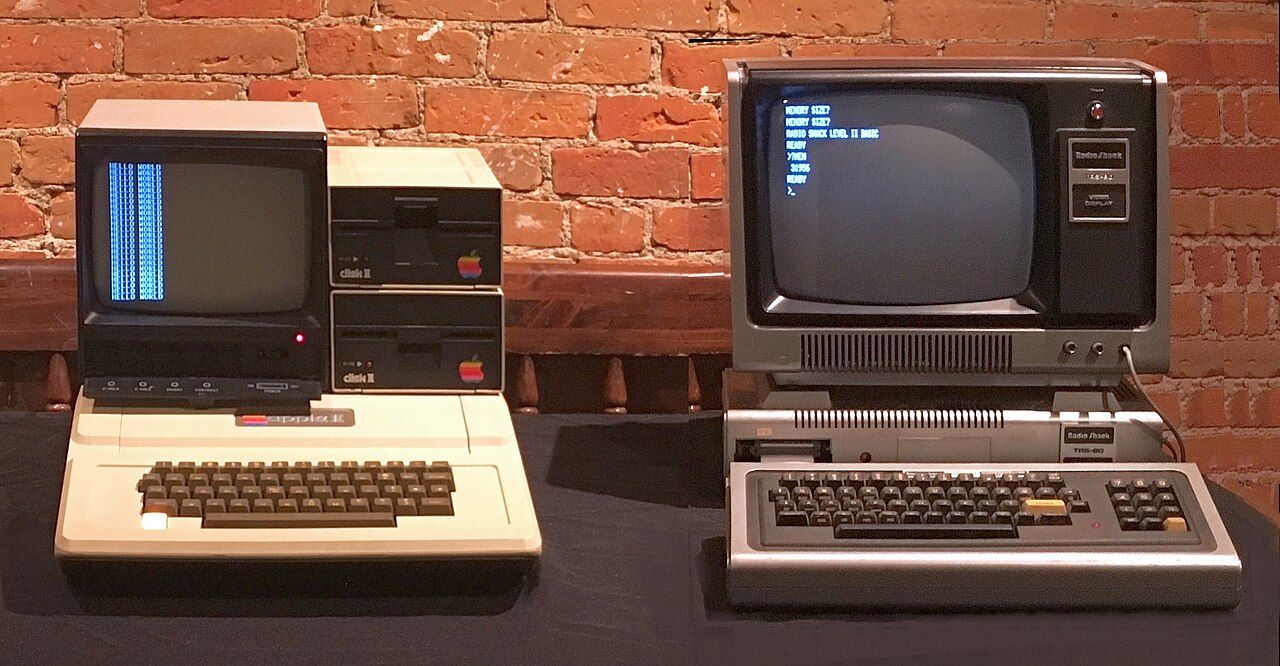
The 1977 Trinity
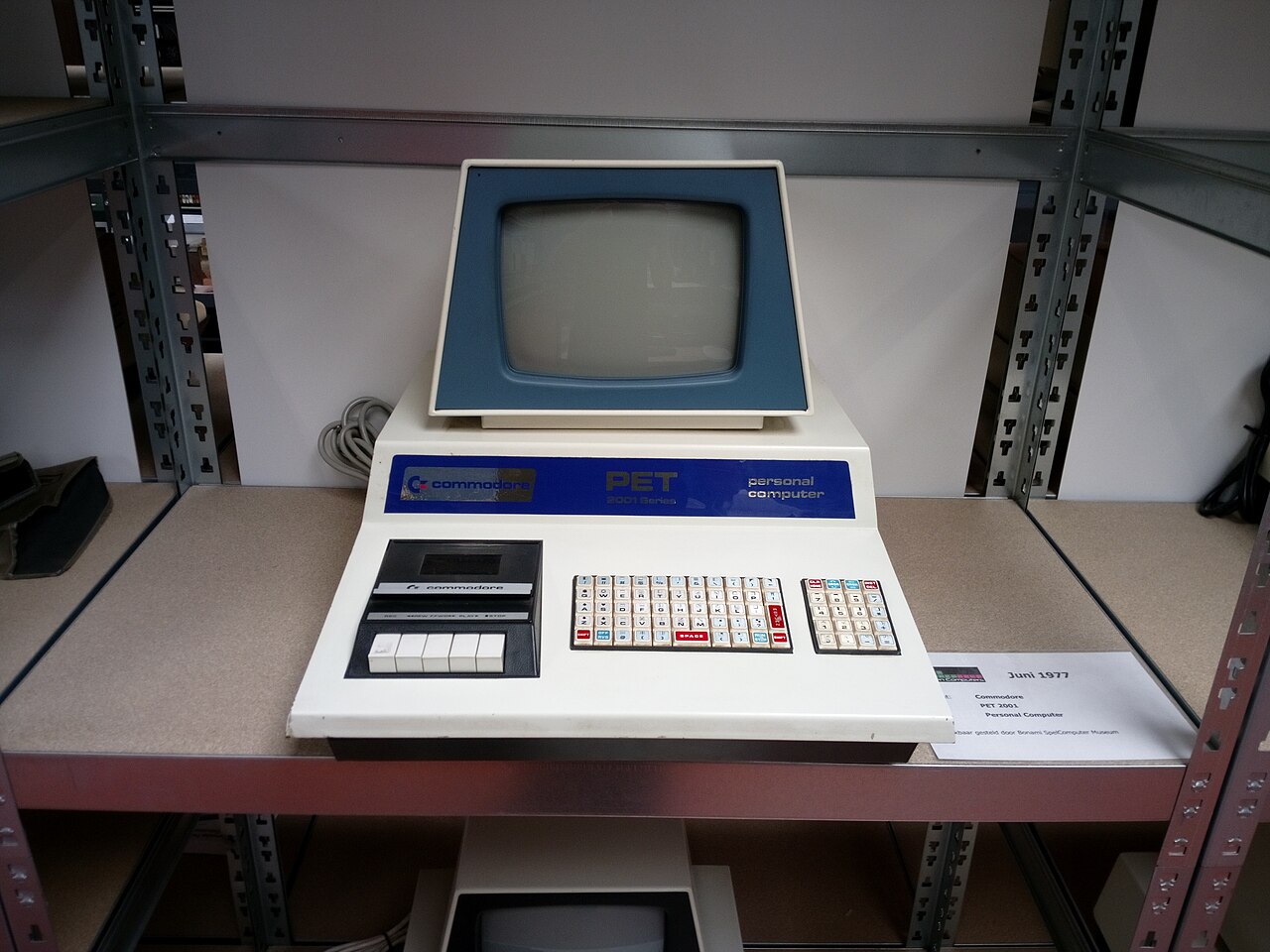
The Altair 8800 of 1975 sold to people who could solder. The machines of 1977 sold to people who could not, and that is the whole difference. A 1995 Byte retrospective named the Apple II, the Commodore PET and the TRS-80 the “1977 trinity”, and the label stuck because the three arrived within five months of each other with the same new property: assembled, cased, with a keyboard and a language already in ROM.
The Apple II went on sale on 10 June 1977 at $1,298 for the 4 KiB model, running a 6502 at 1.023 MHz. It was the expensive one, and the only one of the three with colour graphics out of the box. Its case and power supply were as carefully designed as its circuits, which is covered in Steve Wozniak: The Engineer’s Apple.
The Commodore PET 2001 was shown as a working prototype at the January 1977 Consumer Electronics Show after Jack Tramiel gave Chuck Peddle six months to build it. The first hundred units shipped in mid-October 1977 at $795, and the machine stayed back-ordered for months afterwards. The PET put keyboard, monitor and a Datasette tape drive in one sheet-metal case. The keyboard was the compromise: 69 small square keys that reviewers compared to chewing gum. Commodore sold about 219,000 before discontinuing it in 1982.
The TRS-80 Model I was announced at a New York press conference on 3 August 1977 and is the one that shows what distribution is worth. A Z80 at 1.774 MHz with 4 KB of RAM, a 12-inch monitor and a cassette recorder cost $599, and it was sold in more than 3,000 Radio Shack stores that already existed and already had customers walking through them. Tandy executives had forecast sales of 1,000 to 3,000 units a year. Over 15,000 people phoned in orders, the switchboard jammed, and the company sold more than 10,000 units in six weeks. The Model I passed 200,000 units in its lifetime; the TRS-80 line reached 2.4 million.
The Apple II Line
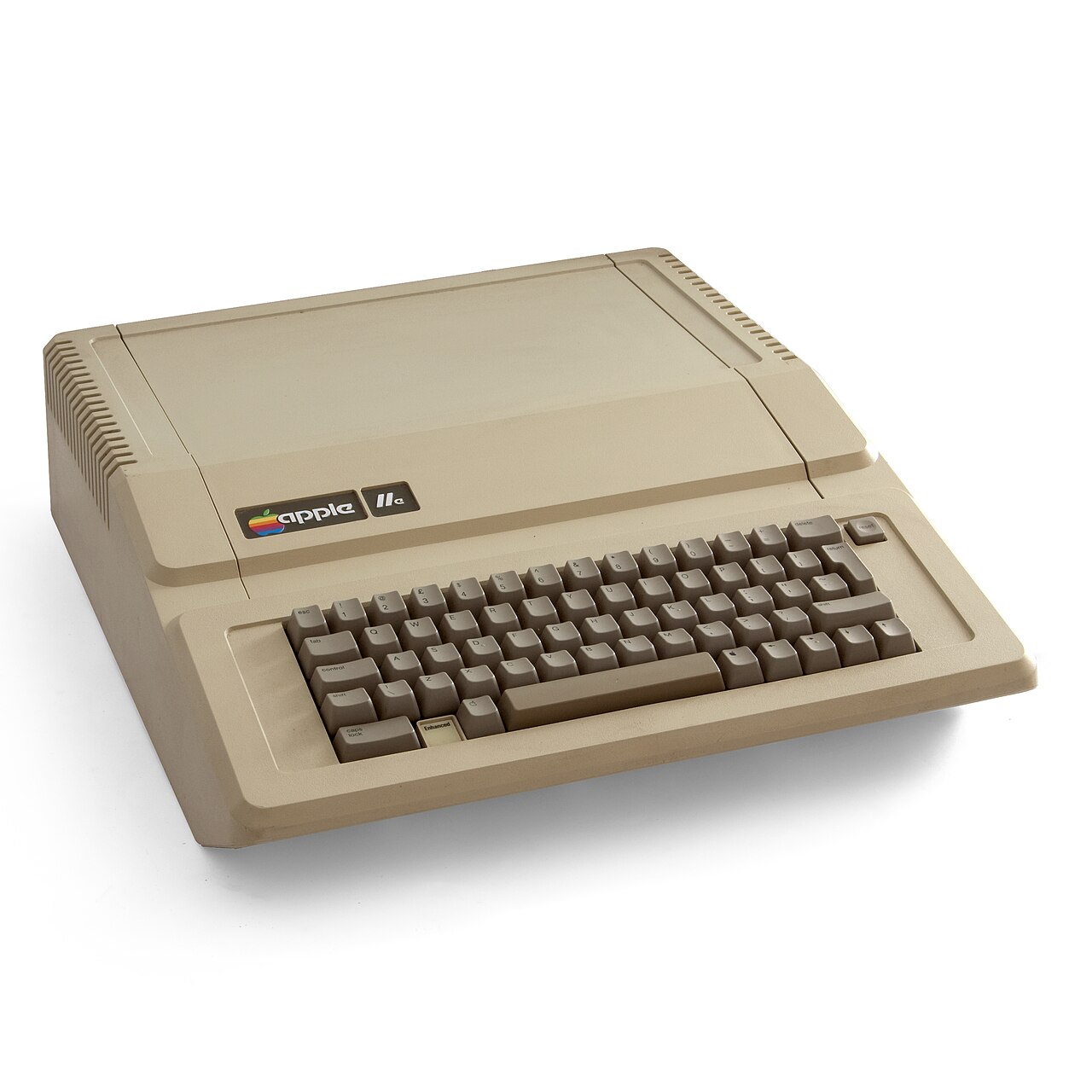
The Apple II was the expensive machine in the 1977 group and the one that kept selling longest, because Apple kept extending it. The Disk II of 1978, at $595, gave it a floppy drive built around a controller Wozniak designed with a fraction of the chips a conventional design used, which turned the machine from a cassette computer into one that could run a business program like VisiCalc. The Apple II Plus followed in June 1979, the IIe in 1983, the compact IIc in April 1984, and the 16-bit IIGS on 15 September 1986.
Apple went on selling the line alongside the Macintosh for nine years, mostly to schools. The IIGS was discontinued in December 1992 and the IIe in November 1993, and the last product in the family, a IIe emulation card for the Macintosh, was withdrawn on 15 October 1993. About six million Apple IIs were sold over sixteen years, 1.25 million of them IIGS models, with the peak in 1983 at a million machines in one year.
The Television Set as the Design Budget
A home computer could not include a display, because a display cost more than the computer was supposed to. The way out was the television already in the room. An RF modulator turned the machine’s video into a channel the TV could tune, which set the terms for everything above it: 40 columns of text at most, often 32 or 22, because broadcast resolution and domestic screens could not resolve the 80-column text that business machines used. Colour came free from the same signal path, which is one reason home machines had colour years before office machines did (see The History of Displays).
The compromise had a regulatory cost. A device radiating a TV signal had to pass FCC emission limits, and Atari’s answer, when it shipped the Atari 400 and 800 in November 1979 at $550 and $1,000, was to build the machines around cast aluminium shields forming a partial Faraday cage. That decision made them expensive to manufacture and forced Atari to replace internal expansion slots with the proprietary SIO serial bus. Jay Miner’s ANTIC and CTIA display chips gave the Atari machines the best graphics hardware of the 1979 generation, inside a case designed mainly to stop radio waves escaping. Two million were sold between late 1979 and mid-1985.
Price as a Specification
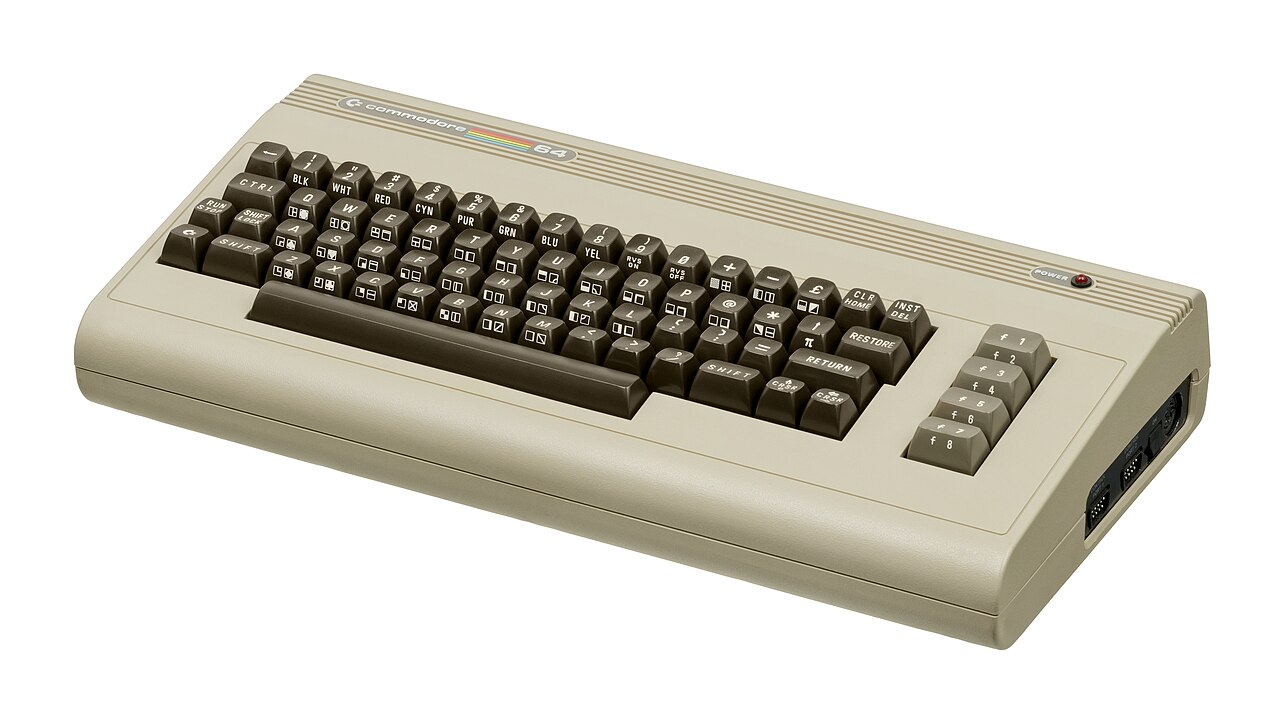
Commodore owned MOS Technology, which made the processors and the custom chips, so its cost floor was lower than anyone else’s. The VIC-20, announced in September 1980 and sold worldwide from 1981 at $299.95, became the first computer of any kind to sell a million units; it finished at 2.5 million. It had 5 KB of RAM and a 22-column display, and it was sold through toy shops and discount chains rather than computer dealers.
The Commodore 64 followed at the January 1982 CES and reached the market that August at $595. It had 64 KB of RAM, the VIC-II video chip with hardware sprites, and the SID sound chip, which had three oscillators and a filter and gave a generation of European bedroom programmers a synthesiser they could afford. Estimates of total sales run from 12.5 million (Commodore’s own shipment records) to 17 million. Either figure makes it the best-selling single computer model in history.
Cassettes and Printed Software
Storage was the other component borrowed from the consumer electronics aisle. The PET’s built-in Datasette ran at 1500 baud and wrote every block twice for safety, which left an effective rate of 750 baud. A 16 KB program therefore took about three minutes to load, if it loaded. Floppy drives existed and cost as much again as the computer; in Britain, where disk systems stayed unaffordable longer, cassettes survived into the late 1980s.
The bigger shortage was software, and the answer was to print it. Compute!, first published in November 1979, ran more type-in program listings per issue than any competitor and raised its circulation from 200,000 to 420,000 during 1983. A reader typed the listing in by hand, saved it to tape, and debugged the typing errors. Machine-language programs came as pages of decimal numbers entered through a checksummed utility called MLX. Every one of these machines had a BASIC interpreter in ROM and started at a command prompt (see BASIC: The Language That Democratized Programming), so the distinction between using the computer and programming it was not drawn for the buyer; it was simply how the machine came. Compute! dropped type-in listings with the May 1988 issue.
Britain and the Cheap End
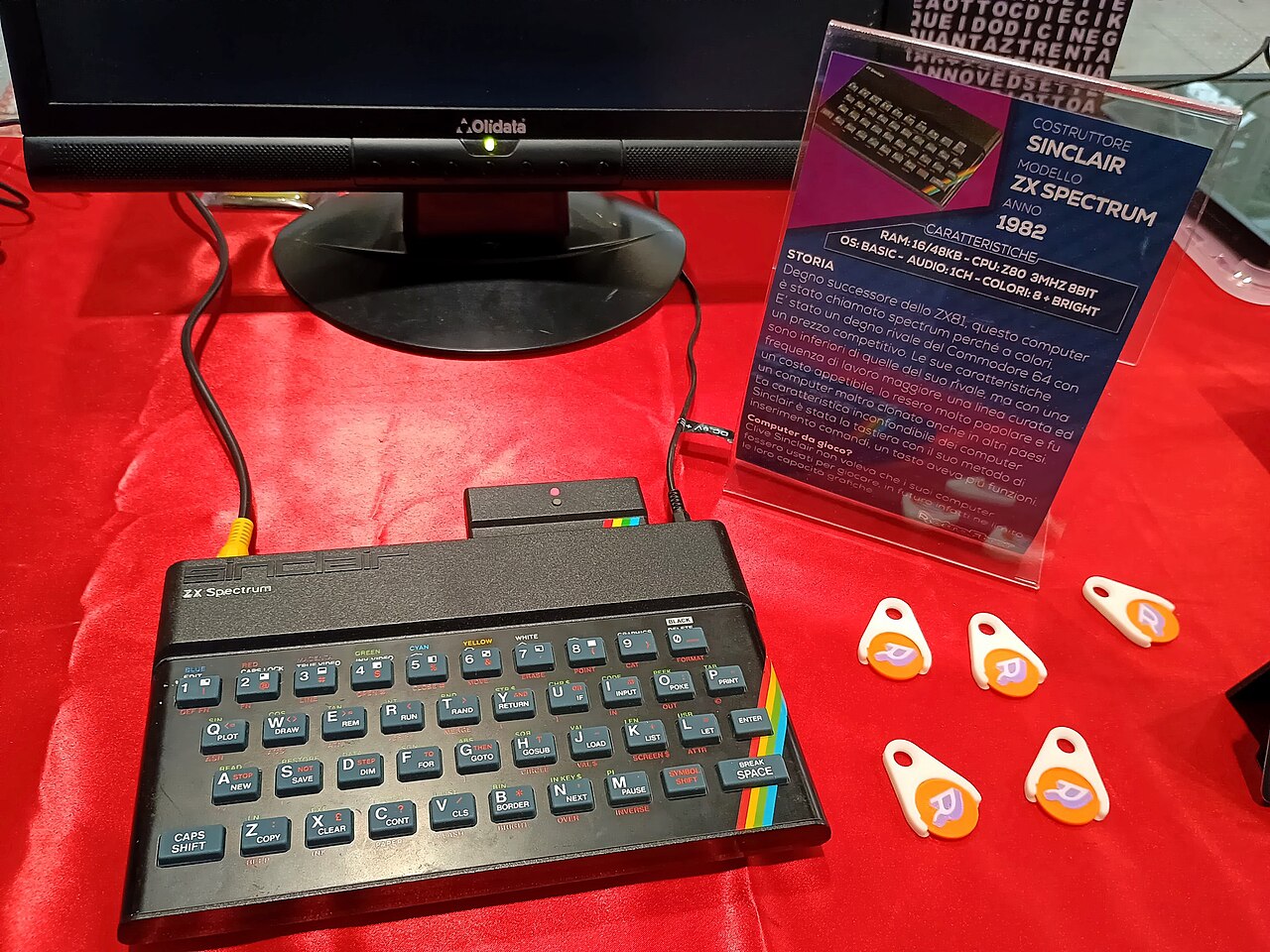
British machines were built to a lower price than anything sold in the United States, because the British market would not pay American prices. Sinclair’s ZX81 arrived on 5 March 1981 at £49.95 as a kit and £69.95 assembled, with 1 KB of RAM and a membrane keyboard, and sold more than 1.5 million units by July 1983. Its American cousin, the Timex Sinclair 1000, sold 550,000 machines in five months.
The ZX Spectrum followed on 23 April 1982 at £125 for 16 KB and £175 for 48 KB, with a Z80A at 3.5 MHz, 256×192 pixels, 15 colours and a rubber keyboard that is remembered with more affection than it earned. It sold over five million and carried the British games industry on its back.
Amstrad took the opposite view of what to bundle. The CPC 464 of June 1984 cost £249 with a green-screen monitor and £359 with a colour one, and the monitor was the point: Alan Sugar wanted a machine that looked like “a real computer, similar to what someone would see being used to check them in at the airport” rather than “a pregnant calculator” wired to the family TV. The cassette deck was built in, the power supply lived in the monitor, and the buyer took home one box that worked. The 464 sold over two million units. The British story continues in The UK Computing Industry and Clive Sinclair.
The Price War of 1983
Commodore’s pricing was aimed at a specific competitor. Texas Instruments had entered the market with the TI-99/4 in October 1979 at $1,150 and the improved 99/4A in June 1981 at $525, and TI, like Commodore, made its own chips. Tramiel cut the C64 from $595 to $425 in January 1983, added a $100 rebate in April that brought the street price to about $299, and reached $300 in June. TI followed each cut. By June 1983 the 99/4A was selling for as little as $99 in some shops, below what it cost to build.
Texas Instruments reported a loss of $100 million in the second calendar quarter of 1983 and $111 million after taxes in the third. In October 1983 it announced that it was leaving the home computer business, and production ended in March 1984. It had shipped 2.8 million machines. The same season took down most of the American video game industry (see The Video Game Industry), and the two collapses together convinced American retailers and investors that the home computer had been a fad.
Dead End: MSX, the Standard That Stayed Home
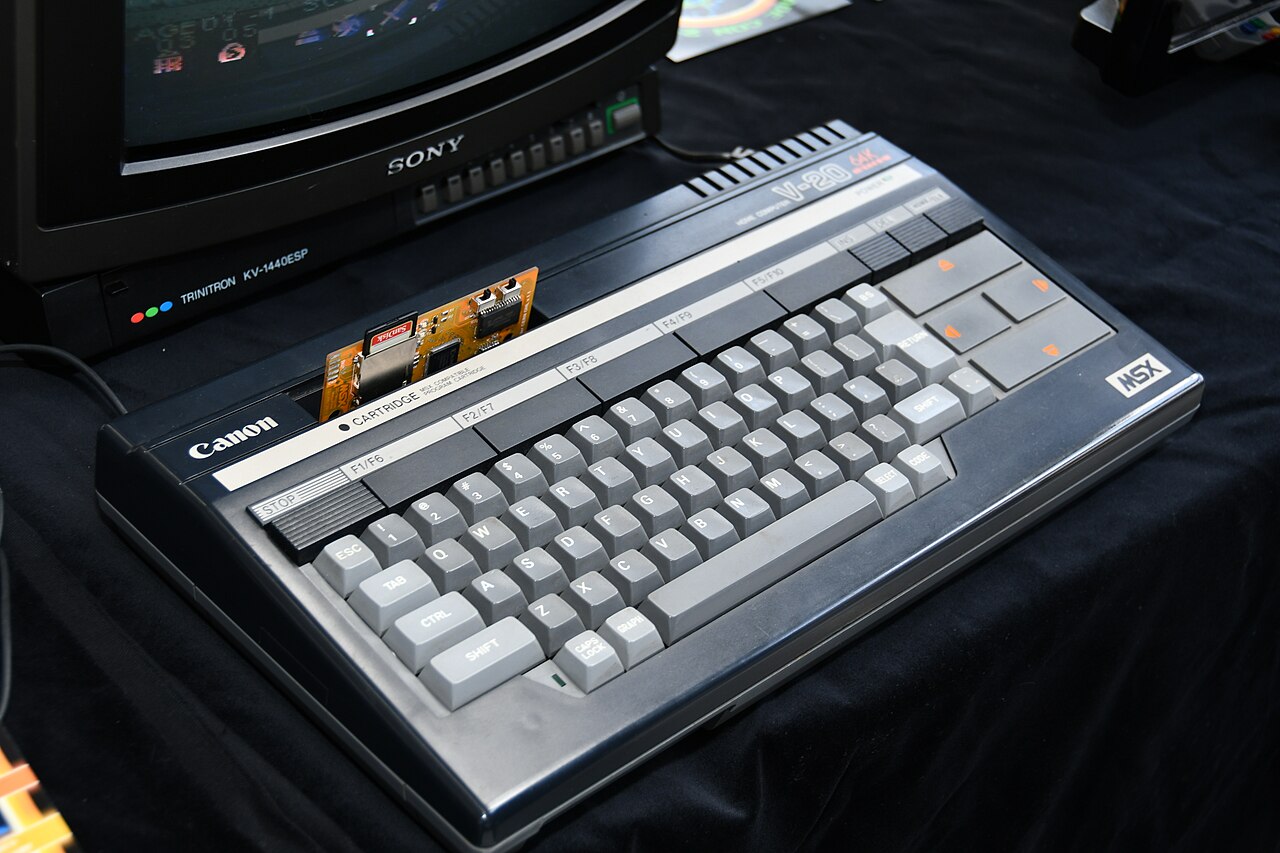
Every machine above was incompatible with every other one. MSX, announced by Kazuhiko Nishi’s ASCII Corporation on 16 June 1983 with Microsoft supplying the BASIC, was the attempt to fix that: a published hardware specification built from parts anyone could buy, a Z80A at 3.58 MHz, the Texas Instruments TMS9918 video chip and the General Instrument AY-3-8910 sound chip, so that software would run on any manufacturer’s box. Sony, Panasonic, Sharp, Philips, Yamaha, Toshiba, Canon, Casio, Mitsubishi and Fujitsu all built MSX machines.
In Japan it worked, and it worked in South Korea, Brazil and Argentina. Outside those markets it barely shipped: few MSX machines were sold in the United States at all. Sales figures are disputed by the people who were there, which is itself a measure of what happened. One account gives nine million units with seven million in Japan; Nishi himself says three million in Japan and one million abroad.
The standard failed abroad for a reason that had nothing to do with standardisation. MSX was specified in 1982 and launched in mid-1983, into the exact months when the C64 was being discounted toward $300. Its off-the-shelf video chip had no hardware sprites worth the name next to the VIC-II and its sound chip was behind the SID, so it arrived late, slower and no cheaper, holding out compatibility as its advantage to buyers who had already chosen a machine on price. A standard is worth something when the hardware underneath it is competitive, and this one was not. MSX is the counter-example usually forgotten when the incompatibility of 1980s home computers is described as an obvious mistake: somebody did try the obvious fix, with Microsoft’s help and a dozen large manufacturers behind it.
What Replaced the Category
The survivors of 1983 moved to 16-bit machines, the Atari ST in 1985 and the Amiga in the same year, both aimed at a market that still wanted a cheap computer with good graphics. Underneath them, IBM PC clones kept getting cheaper, and by the late 1980s a clone cost what a high-end home computer cost while running the software people used at work. Games moved to the fourth-generation consoles. By the early 1990s the home computer as a separate product category had disappeared in the United States, and what remained was a PC in the house.
The habits survived longer than the hardware. A generation that had typed listings out of magazines because there was no other way to get software went into the industry having written BASIC before they wrote anything else, and the European demo and games scenes were built by people whose first machine cost less than a bicycle.
📚 Sources
- Apple II (original) — Wikipedia (10 June 1977 on sale, $1,298 for 4 KiB, 6502 at 1.023 MHz, colour modes)
- Commodore PET — Wikipedia (January 1977 CES prototype, Peddle’s six months, first hundred units in mid-October 1977, $795, months of back orders, chiclet keyboard, Datasette at 1500 baud written twice, 219,000 sold, the Byte 1995 “1977 trinity” label)
- TRS-80 — Wikipedia (3 August 1977 announcement, $599 with monitor and recorder, Z80 at 1.774 MHz, 3,000 Radio Shack stores, the 1,000–3,000 forecast, 15,000 phone orders, 10,000 units in six weeks, 200,000 Model I, 2.4 million TRS-80s)
- Atari 8-bit computers — Wikipedia (December 1978 announcement, November 1979 shipping, $550 and $1,000, ANTIC/CTIA/POKEY, Jay Miner, the cast aluminium Faraday cage and the SIO bus, two million sold)
- VIC-20 — Wikipedia (September 1980 announcement, $299.95, 5 KB, first computer to sell one million units, 2.5 million total)
- Commodore 64 — Wikipedia (January 1982 CES, August 1982 launch at $595, VIC-II and SID, the 1983 cuts to $425, the $100 rebate, $300 by June, 12.5–17 million units, TI at $99)
- TI-99/4A — Wikipedia (99/4 October 1979 at $1,150, 99/4A June 1981 at $525, $99 street price by June 1983, $100 million loss in Q2 1983 and $111 million after taxes in Q3, October 1983 exit, production ending March 1984, 2.8 million shipped)
- ZX81 — Wikipedia (5 March 1981, £49.95 kit and £69.95 assembled, over 1.5 million by July 1983, Timex Sinclair 1000 at 550,000 units in five months)
- ZX Spectrum — Wikipedia (23 April 1982, £125 and £175, Z80A at 3.5 MHz, 256×192 and 15 colours, over five million sold)
- Amstrad CPC — Wikipedia (June 1984, £249 green screen and £359 colour, built-in cassette deck, Sugar’s “pregnant calculator” remark, over two million 464s)
- MSX — Wikipedia (ASCII announcement 16 June 1983, Nishi and Microsoft, Z80A/TMS9918/AY-3-8910 baseline, the manufacturer list, the disputed sales figures, near-absence from the United States)
- Apple II — Wikipedia (the Disk II in 1978 at $595, the II Plus in June 1979, the IIe in 1983, the IIc in April 1984, the IIGS on 15 September 1986, the IIGS discontinued in December 1992 and the IIe in November 1993, the IIe card withdrawn on 15 October 1993, and about six million units over sixteen years including 1.25 million IIGS machines with a peak of one million in 1983)
- Compute! — Wikipedia (first issue November 1979, circulation from 200,000 to 420,000 in 1983, type-in listings and MLX, listings dropped with the May 1988 issue)
- Home computer — Wikipedia (RF modulators and 40-column limits, cassette storage and its persistence in Britain, type-in listings, the clone price collapse and the category’s disappearance in the early 1990s)
- Image: Apple II, TRS-80 Model I (edited image).jpg by User:Pittigrilli, edited from a file by User:Springsgrace (CC BY 4.0), via Wikimedia Commons
- Image: Apple IIe.jpg by Bilby (CC BY 3.0), via Wikimedia Commons