Compaq and the BIOS Clean-Room
Abstract
IBM built the PC from parts anyone could buy, and left exactly one piece that could not be legally copied: the BIOS, the firmware that told software how to talk to the hardware. In 1982 three engineers who had quit Texas Instruments spent about a million dollars to copy that one piece without touching IBM’s code, using a “clean-room” method that separated the people who read IBM’s chip from the people who wrote the replacement. The result, Compaq, became the fastest company in American history to reach the Fortune 500 and a billion dollars in sales, took technical leadership of the PC away from IBM in 1986, fired its founder in 1991, spent the 1990s winning a price war it eventually lost to Dell, and was absorbed by Hewlett-Packard in 2002. The clean-room trick outlived the company: it turned IBM’s standard into everyone’s standard.
The Placemat
Compaq began in 1982 when three senior managers left Texas Instruments: Rod Canion, Jim Harris, and Bill Murto. The founding legend, repeated because the people involved confirm it, is that the first product was sketched on a placemat in a Houston pie restaurant, the House of Pies. The name was a compression of “Compatibility and Quality.” They took the plan to the venture capitalist Ben Rosen, whose firm backed it; Rosen became chairman and, nine years later, the man who fired Canion.
Their bet was specific. The IBM PC, launched in 1981, had been assembled from off-the-shelf parts and a published bus, which meant almost all of it was legal to reproduce. A machine that ran the same software as the IBM PC, without being made by IBM, would sell, because businesses were standardizing on IBM’s machine and its software library was growing fast. The only obstacle was one chip.
Copying the One Part They Couldn’t Buy
The BIOS (Basic Input/Output System) was a small piece of IBM firmware, and IBM held the copyright and had printed the source code in its technical manuals, daring anyone to copy it. Copying it directly was infringement. Compaq’s answer was clean-room design, sometimes called Chinese-wall engineering. One team studied the IBM BIOS and wrote a precise specification of everything it did, every input and output, without describing how. A second team of programmers, who had never seen IBM’s code or manuals, implemented a new BIOS from that specification alone. Because the writers had never read IBM’s code, nothing they produced could be a copy of it, however closely the two behaved. Compaq documented the separation to prove it in court if needed, and spent around $1 million and months of work on the effort.
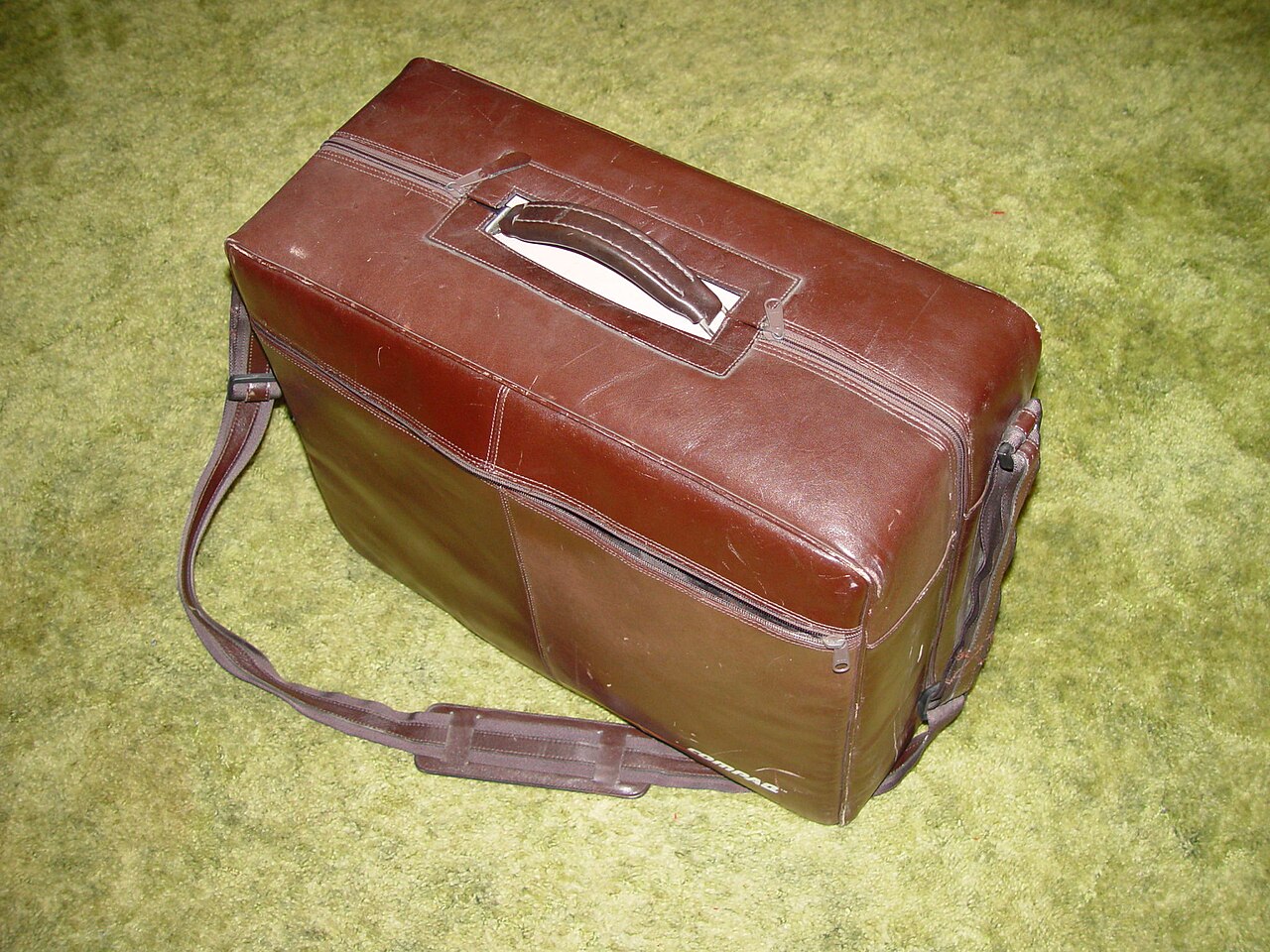
The first product shipped the compatibility as a feature IBM did not offer: portability. The Compaq Portable, announced in November 1982 and shipping in early 1983 at $2,995, was a 28-pound machine shaped like a sewing-machine case that ran the same MS-DOS software as a desk-bound IBM PC. It sold 53,000 units and $111 million in its first year of sales, the fastest any American startup had reached that figure. The clean-room BIOS held up. Compaq had proved that the IBM standard could be legally cloned by someone with money and lawyers.
Phoenix Sells the Key
Compaq had done its clean-room BIOS in-house, at in-house cost, and kept it. What turned one company’s advantage into an entire industry was a second company selling the same thing off the shelf. In May 1984 Phoenix Technologies released the first commercially available clean-room IBM-compatible ROM BIOS, produced by the same two-team method and sold to any manufacturer who wanted it. Now a maker in Taiwan or Texas did not need a million dollars and a legal department to build a PC clone; it could license a Phoenix BIOS, bolt it to standard parts and an Intel chip, and ship a machine that ran IBM software. Hewlett-Packard, Tandy, AT&T, and hundreds of smaller firms did exactly that. Phoenix (and rivals like Award and AMI) removed the last barrier, and the “IBM PC compatible” became a commodity standard that IBM controlled less and less each year. The clean-room method, blessed by the courts, is the legal foundation the entire PC industry was built on. Apple tried the licensed version of the same arrangement a decade later and cancelled it: see Dead End: Mac Clones.
Fastest to the Fortune 500
Compaq’s growth set records that still get cited. It became the youngest company ever to enter the Fortune 500, in 1986, four years after its founding. It passed $1 billion in annual revenue in 1987, faster than any company before it. Compaq did this by aiming at businesses rather than hobbyists, selling only through dealers, and building machines that were more reliable and often more capable than IBM’s own, at a time when “nobody ever got fired for buying IBM” was the buyer’s default. Compaq’s pitch was that its machines were more IBM-compatible than the alternatives and better engineered than IBM’s.
Beating IBM at Its Own Standard
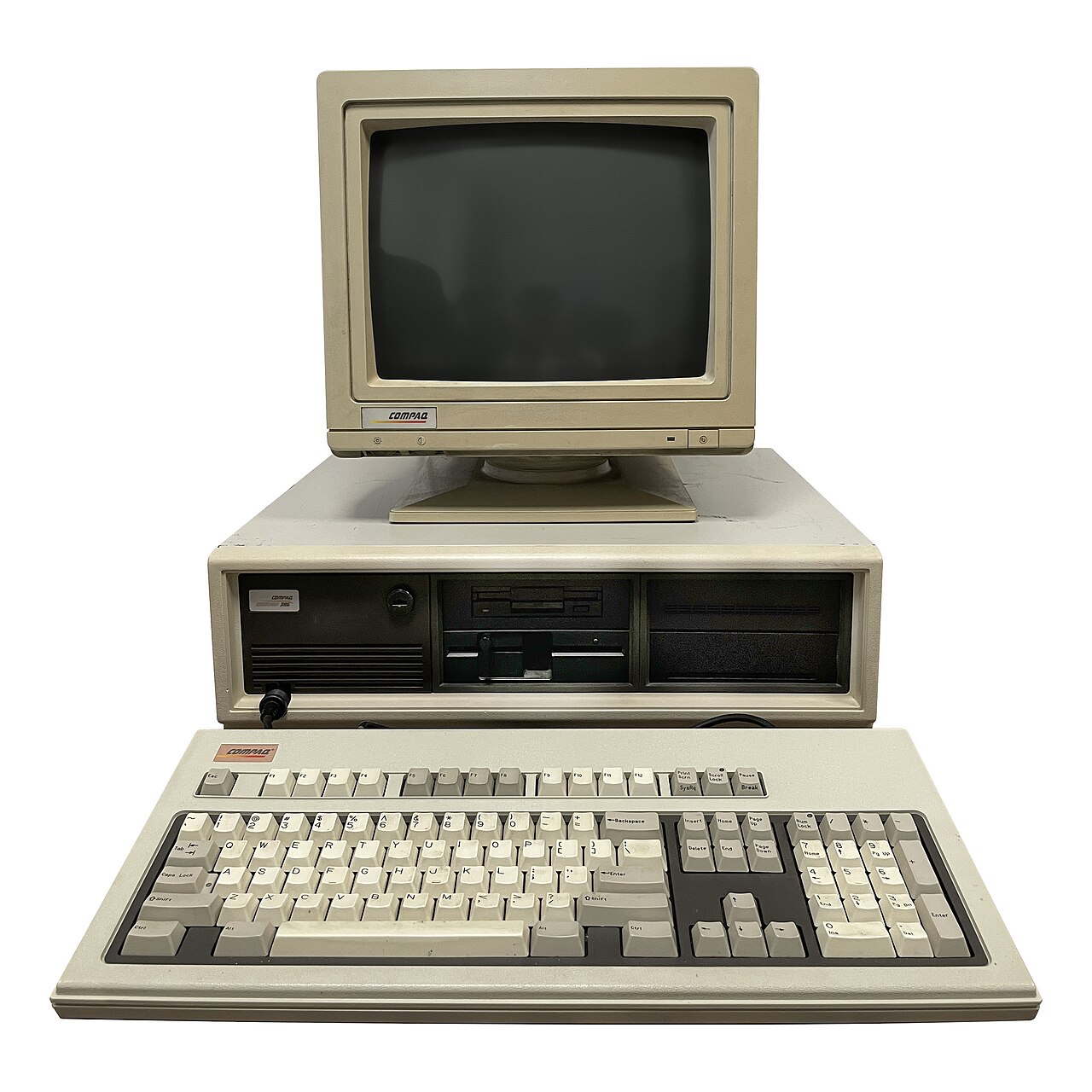
The turning point came in September 1986. Compaq shipped the Deskpro 386, the first personal computer built on Intel’s new 32-bit 80386 processor. It was the first time a major upgrade to the IBM PC standard was made by a company other than IBM. IBM, still trying to manage the transition on its own schedule, did not ship a 386 machine until the PS/2 Model 80 in July 1987, ten months later, and by then Compaq was the 386 supplier of choice, holding roughly 28% of the 386 market to IBM’s 16%. Technical leadership of the standard IBM had created passed to a five-year-old company in Houston.
IBM tried to take the standard back. In 1987 it launched the PS/2 line with a new proprietary bus, Micro Channel Architecture, that clone makers would have to license and pay royalties on. The clone industry refused. A group of nine manufacturers including Compaq and Hewlett-Packard, the Gang of Nine, jointly defined a rival open bus, EISA, and software makers declined to write for IBM’s proprietary features. Customers would not pay a premium for lock-in when compatible machines ran the same software for less. The PS/2 strategy failed, and by 1990 the clone makers, not IBM, defined the PC (see The IBM PC).
The Founder Is Removed
Winning the standard war did not make Compaq safe. Its machines were premium-priced, and by 1991 a wave of cheaper clones and a recession cut into sales; Compaq posted its first quarterly loss and laid off staff. Ben Rosen, the chairman who had funded the placemat sketch, concluded that Canion’s premium strategy could not survive a commodity market. In October 1991 the board forced Rod Canion out. His co-founders left too. In his place Rosen installed Eckhard Pfeiffer, a German executive who, like the founders, had come from Texas Instruments.
The Price War and the Peak
Pfeiffer reversed the strategy. Instead of charging more for better engineering, Compaq would win on price and volume. It slashed costs, and in the mid-1990s launched the Presario consumer line, becoming one of the first tier-one makers to sell a sub-$1,000 PC and the first to build machines around cheaper AMD and Cyrix processors instead of only Intel. The price war Pfeiffer started drove weaker rivals like Packard Bell and AST Research out of the business, and in 1994 Compaq became the largest PC maker in the world. For a few years the placemat startup led the industry outright.
Swallowing DEC
Pfeiffer wanted Compaq to be a full-line computer company that could challenge IBM across the board, not just a PC maker. In 1998 Compaq bought Digital Equipment Corporation, the fallen minicomputer giant, for $9.6 billion, mainly for its enterprise services and engineering. The deal was too big to digest. Integration ran behind schedule, tens of thousands of jobs were cut, cultures clashed, and while Compaq was distracted, Dell was selling built-to-order PCs directly to customers by phone and web, carrying almost no inventory and undercutting Compaq’s dealer-based model on both price and speed. Compaq was winning the old game while Dell changed it.
The Merger
Compaq never solved the Dell problem. Pfeiffer was pushed out in 1999. In September 2001 Hewlett-Packard agreed to buy Compaq for about $24.2 billion, a deal HP’s CEO Carly Fiorina championed and that Walter Hewlett, son of the co-founder and an HP director, fought in a bitter public proxy battle, arguing that merging two struggling PC businesses would only dilute HP’s profitable printing division. Fiorina won the shareholder vote narrowly and the merger closed on 3 May 2002 (see Hewlett-Packard). The combined company became the world’s largest PC maker for a while, but the promised profits did not follow, and Fiorina was forced out in 2005. The Compaq brand was kept for a few years on budget machines, then quietly retired.
What Compaq proved and what it couldn’t
Compaq’s clean-room BIOS is the reason the PC became an open standard rather than an IBM monopoly: it showed the copy was legal, Phoenix sold the copy to everyone, and IBM lost control of its own creation. That is a permanent change in the shape of the industry. What Compaq could not do was hold the position the trick won it. Once the machine was a commodity, the advantage moved from who built the best clone to who sold it most efficiently, and Dell’s direct model beat Compaq’s dealers the way Compaq’s clone had beaten IBM’s premium. The company that broke one lock could not escape the logic it had set loose.
📚 Sources
- Compaq — Wikipedia (founding, clean-room BIOS, Portable, price war, DEC and HP mergers)
- Rod Canion — Wikipedia (founders, House of Pies, records, 1991 ouster)
- Compaq Deskpro 386 — Wikipedia (September 1986, first 386 PC, 386 market share vs. IBM)
- Phoenix Technologies / Phoenix BIOS — Wikipedia (May 1984 commercial clean-room BIOS, OEM adoption)
- Clean-room design — Wikipedia (the legal method)
- Compaq Computer Corporation — Handbook of Texas (founding and growth)
- Image: Compaq Portable 1.jpg by Dmitry Brant (CC BY-SA 4.0), via Wikimedia Commons