Pixar and Computer Animation
Abstract
Pixar’s transformation from a hardware spinout of Lucasfilm to the studio that produced Toy Story, Finding Nemo, and Up represents the convergence of computer science research and commercial storytelling. The algorithms that Pixar’s researchers developed (subdivision surfaces, texture mapping, Monte Carlo global illumination, physically-based rendering) are now the mathematical foundation of every visual effects film and every animated feature made today. Toy Story (1995), the first fully computer-animated feature film, proved that computing had solved the visual realism problem well enough to tell human stories convincingly.
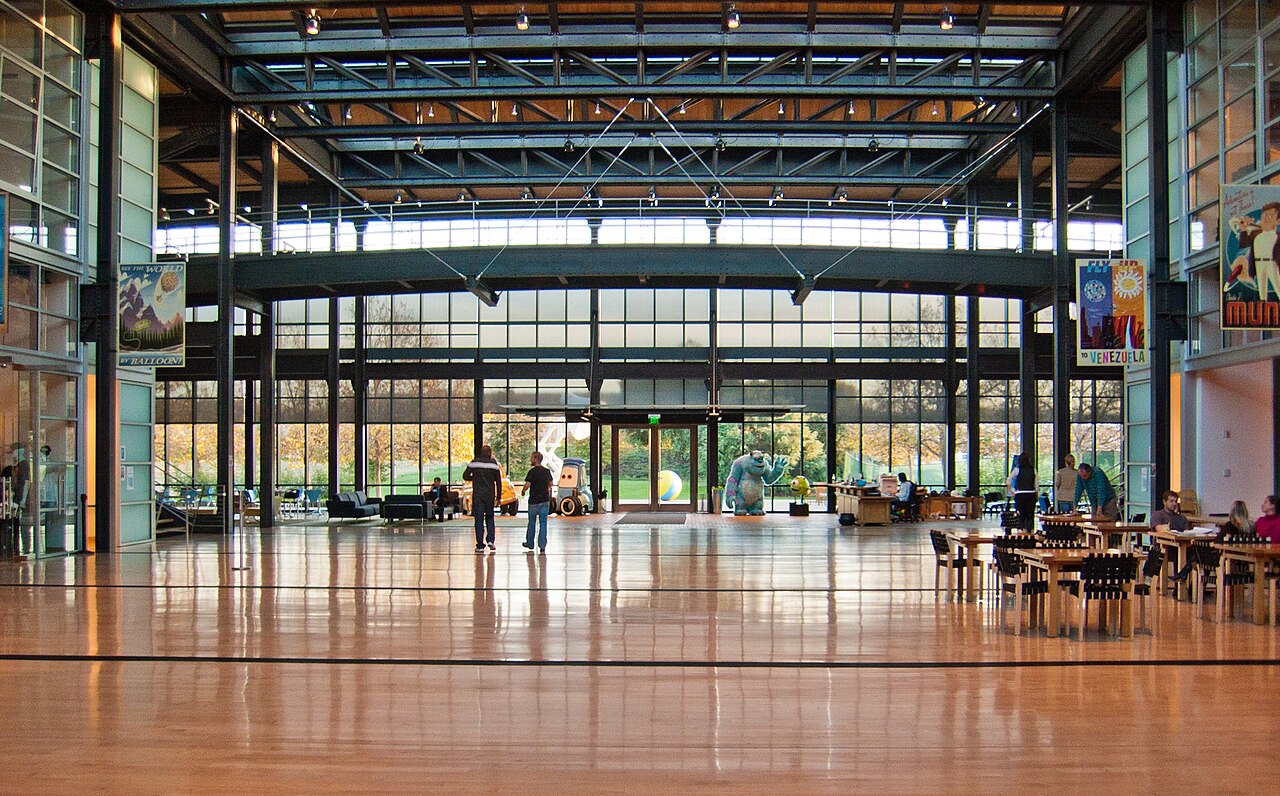
The Lucasfilm Graphics Group
The origins of Pixar lie in the computer graphics research division of Lucasfilm, founded by George Lucas to develop digital tools for film production. In 1979, Lucas hired Ed Catmull (a University of Utah PhD who had done foundational work on texture mapping and subdivision surfaces) to lead a computer graphics group that would develop digital editing, compositing, and eventually animation tools.
The group that assembled at Lucasfilm included Alvy Ray Smith, a color scientist and pioneer of digital painting; Loren Carpenter, whose 1980 short Vol Libre (a fractally generated flight over rocky, snow-capped mountains, shown at SIGGRAPH) first demonstrated realistic fractal terrain generation and earned him a job at Lucasfilm; John Lasseter, an animator fired from Disney who joined as an interface designer and director; and dozens of researchers who would later define the field.
The group’s own showcase short, The Adventures of André and Wally B. (1984), was Lasseter’s first computer-animated project and introduced the first use of motion blur in CG character animation.
One member followed Catmull and Smith through all three of their institutions, the New York Institute of Technology computer graphics lab, Lucasfilm and Pixar, and worked the entire time on the problem that decided whether any of the images could reach an audience: getting them onto film. David DiFrancesco built laser film recording, exposing digital frames directly onto negative with lasers rather than photographing a screen. He shared a 1994 Academy Scientific and Engineering Award for film input scanning with Gary Demos, Dan Cameron, Gary Starkweather and Scott Squires (see The CGI Revolution), designed the PixarVision laser scanner and recorder in 1996, which was tested on A Bug’s Life and used to produce Toy Story 2, and received his own Academy Technical Achievement Award for laser film recording in February 1999.
The group produced the first entirely computer-generated sequence in a major Hollywood film: the Genesis Effect in Star Trek II: The Wrath of Khan (1982), a one-minute sequence showing a planet’s surface transforming from barren rock to living landscape. Carpenter’s fractal algorithms generated the terrain; the sequence ran on the highest-performance workstations available.
Steve Jobs and the Acquisition
In 1986, George Lucas was going through a divorce and needed to sell assets. Ed Catmull and Alvy Ray Smith wanted to spin out the graphics group as an independent company. Steve Jobs (recently ousted from Apple) bought the group for $5 million and invested another $5 million, acquiring a majority stake and becoming chairman. The new company was named Pixar, an invented word coined by Alvy Ray Smith, who proposed “Pixer” as a faux-Spanish verb suggesting “to make pictures”; Loren Carpenter modified it to “Pixar” for a high-tech ring (echoing “radar”). The company took the name of its flagship product, the Pixar Image Computer.
Jobs initially envisioned Pixar as a hardware company, selling the Pixar Image Computer, a workstation for medical imaging and government intelligence analysis. The hardware business was marginal; the real value was in the software and the creative team.
RenderMan and the Rendering Standard
In 1988, Pixar released the RenderMan Interface Specification, a programming interface for describing 3D scenes and producing photorealistic rendered images. RenderMan defined a standard language for describing geometry, materials, lighting, and camera parameters; a compliant renderer would accept any RenderMan scene description and produce a correct image.
The underlying renderer, PRMan (PhotoRealistic RenderMan), used a rendering algorithm called REYES (Renders Everything You Ever Saw) developed by Loren Carpenter and Robert Cook. REYES divided scene geometry into micropolygons (tiny patches smaller than individual pixels) and rendered them with motion blur, depth of field, and procedural shaders that computed surface appearance point by point.
RenderMan’s procedural shading language (a programming language for describing how surfaces respond to light) allowed the definition of complex material appearances through code rather than prespecified parameters. Wood grain, marble, skin, water, fire, any appearance could be described as a program. This programmability gave artists control over visual appearance at a level of detail not previously achievable. The shading language was principally architected by Pat Hanrahan, a Pixar founding employee, who codified the idea that a surface’s response to light could itself be a small program. Hanrahan later moved to Stanford, where his research on rendering and GPU shading shaped real-time graphics, and he co-founded the data-visualization company Tableau (2003). In 2019 he and Ed Catmull shared the Turing Award “for pioneering efforts on computer-generated imagery.”
RenderMan became the standard for production visual effects and animation rendering. It was used to render every Pixar film; it was licensed to studios worldwide and used in the majority of major Hollywood visual effects films through the 2000s. James Cameron’s Titanic (1997), the Harry Potter films, and the Lord of the Rings trilogy all used RenderMan. The Academy gave RenderMan a Scientific and Engineering Award in 1993 and, at the Scientific and Technical Awards ceremony on 3 March 2001, an Academy Award of Merit (a statuette) to Ed Catmull, Loren Carpenter and Rob Cook, the first such award to a software product.
Toy Story: The Proof of Concept
Toy Story (1995) was the first feature-length film produced entirely through computer animation. The production required solving every rendering, animation, and storytelling challenge simultaneously on a timeline, the film went into production in 1993 and had to deliver theatrical release in 1995.
The technical challenges were formidable:
- Believable characters: Buzz Lightyear and Woody had to move convincingly enough that audiences would accept them as characters rather than geometry. Twenty-seven animators worked on the film, using around 400 computer models; Woody alone carried more than 700 animation controls, 212 of them in his face.
- Deliberate subject matter: plastic toys were chosen partly because rendering technology of the period handled hard, shiny, manufactured surfaces far better than skin, hair, cloth or foliage. The human characters in the film are the weakest images in it.
- Rendering at production scale: 114,240 frames across 1,561 shots, rendered at 1536 by 922 pixels on a farm of Sun Microsystems machines running around the clock, for roughly 800,000 machine hours. Output ran to less than thirty seconds of finished film per day.
Toy Story cost $30 million and has taken just over $401 million worldwide across its original release and later reissues. It received three Academy Award nominations (Original Screenplay, Original Song, and Original Musical or Comedy Score), and John Lasseter received a Special Achievement Award “for the development and inspired application of techniques that have made possible the first feature-length computer-animated film.”
The Research Programs
Pixar’s technical achievement rested on decades of underlying research:
Ed Catmull’s texture mapping (1974 PhD thesis at Utah): The technique for applying a two-dimensional image to the surface of a three-dimensional object, handling distortion at the mapping boundary. Texture mapping is used in virtually every computer-generated image produced today.
Catmull-Clark subdivision surfaces (Ed Catmull and Jim Clark, 1978): An algorithm for creating smooth curved surfaces by iteratively subdividing a polygonal mesh. Subdivision surfaces allow modelers to describe smooth organic shapes using relatively low-resolution control meshes; the subdivision algorithm generates the smooth surface mathematically. This is now the standard representation for organic shapes in animated films.
Path tracing and global illumination: James Kajiya, then at Caltech, formulated the rendering equation and path tracing at SIGGRAPH 1986; Pixar and the rest of the industry spent the following decades making it affordable. Physically accurate simulation of light transport, tracing light rays through a scene and computing their interaction with surfaces. Global illumination, including indirect lighting (light that bounces off surfaces before reaching the camera), makes computer-generated images look physically correct rather than artificially bright and plastic-looking. Pixar’s RenderMan progressively adopted physically-based rendering techniques; by the 2010s, path tracing was the industry-standard rendering approach.
Physically-based shading and materials (developed at Pixar and industry-wide through the 2000s-2010s): Material models derived from the physics of light-matter interaction, producing predictable and physically accurate appearances. The transition from arbitrary ad-hoc shaders to physics-based materials made scenes look correct under arbitrary lighting conditions.
Acquisition by Disney and the CAPS Legacy
Disney acquired Pixar in 2006 for $7.4 billion in an all-stock deal. Steve Jobs, Pixar’s majority shareholder, became Disney’s largest individual shareholder. John Lasseter became Chief Creative Officer of both Pixar and Walt Disney Animation. Ed Catmull became president of both studios.
The acquisition brought Pixar’s management and creative culture into Disney Animation, which had been struggling to produce competitive animated features since the late 1990s. Under Lasseter and Catmull’s leadership, Disney Animation produced Bolt (2008), The Princess and the Frog (2009), Tangled (2010), Wreck-It Ralph (2012), and Frozen (2013), a revival of quality that the studio attributed to the adoption of Pixar’s creative process (including its famous Braintrust, a feedback session where directors present work in progress to peers without authority to compel changes, only to offer perspective).
📚 Sources
- Wikipedia: Pixar
- Ed Catmull & Amy Wallace: Creativity, Inc. (2014) — Random House
- Wikipedia: RenderMan (software)
- Hanrahan & Lawson: A Language for Shading and Lighting Calculations — SIGGRAPH 1990
- ACM Turing Award: Patrick M. Hanrahan and Edwin E. Catmull (2019)
- Catmull: A Subdivision Algorithm for Computer Display of Curved Surfaces — PhD Thesis, University of Utah (1974)
- Catmull & Clark: Recursively Generated B-Spline Surfaces — Computer-Aided Design (1978)
- Kajiya: The Rendering Equation — SIGGRAPH 1986
- Wikipedia: Toy Story — 114,240 frames in 1,561 shots at 1536×922, 800,000 machine hours, 27 animators and 400 models, the $30 million budget, the three nominations and Lasseter’s Special Achievement Award citation
- Toy Story — Box Office Mojo — $401.2 million worldwide across the 1995 release and the 2009, 2020, 2023 and 2025 reissues
- The Pixar Touch: A History of Pixar — David Price (2008)
- Wikipedia: David DiFrancesco — founding member of the NYIT computer graphics lab, the Lucasfilm Computer Division and Pixar; laser film recording; PixarVision (1996), tested on A Bug’s Life and used for Toy Story 2; the 1994 film-input-scanning award and the February 1999 Technical Achievement Award
- ACM SIGGRAPH History Archives: Loren Carpenter — Vol Libre (1980)
- Wikipedia: The Adventures of André & Wally B. (1984)
- Image: Pixar Animation Studios Atrium.jpg by Jason Pratt (CC BY 2.0), via Wikimedia Commons