Ed Catmull
Abstract
Edwin Catmull (born 1945) spent forty years building the machine that replaced the animator’s pencil. His 1974 Utah dissertation gave computer graphics the z-buffer and texture mapping; a four-minute film of his own left hand, made in 1972, is in the National Film Registry. He ran the graphics labs at NYIT and Lucasfilm, co-founded Pixar in 1986, was its president for thirty-three years, and from 2006 ran Disney Animation as well. He shared the 2019 Turing Award with Pat Hanrahan. He also, by his own deposition, kept the animation studios’ no-poaching agreements going, which cost Disney $100 million in 2017.
The Hand
Edwin Earl Catmull was born in Parkersburg, West Virginia, on 31 March 1945 and grew up in Salt Lake City. He took a BS in physics and computer science at the University of Utah in 1969, which put him, when he came back for graduate work in 1970, inside the one department in the world where Ivan Sutherland and David Evans were treating pictures as a research subject. The same department produced Jim Clark, John Warnock and Alan Kay.
In 1972 he and Fred Parke made A Computer Animated Hand. Catmull cast his left hand in plaster of Paris, drew about 350 triangles and polygons on the cast in ink, digitised the vertices, and animated the result with a program he wrote himself. The film runs about four minutes, and a clip of it plays on a monitor in the 1976 feature Futureworld, one of the earliest appearances of 3D computer animation in a feature film. The Library of Congress added it to the National Film Registry in 2011.
His 1974 dissertation, A Subdivision Algorithm for Computer Display of Curved Surfaces, contained two ideas the industry has used every day since: the z-buffer, which resolves which surface is in front by storing a depth for every pixel, and texture mapping, which wraps a two-dimensional image around a three-dimensional shape. The same year he published, with Raphael Rom, the Catmull-Rom spline, and in 1978, with Jim Clark, the subdivision surface that turns a coarse cage of polygons into a smooth organic shape by repeated refinement. The technical story of these ideas is in The CGI Revolution and Pixar and Computer Animation; what follows is what Catmull did with them.
NYIT and Lucasfilm
He took a job at Applicon in 1974, and was almost immediately hired away by Alexander Schure, the founder of the New York Institute of Technology, who wanted to make a computer-animated feature film and had the money to try. In November 1974 Catmull became the first director of NYIT’s Computer Graphics Lab, and over the next five years it collected the people (Alvy Ray Smith, Ralph Guggenheim, David DiFrancesco and others) who would later be Pixar. Tween, Catmull’s 1977 program for interpolating between hand-drawn frames, was the lab’s attempt to help conventional animators; the feature film never got made.
In 1979 George Lucas hired Catmull as vice president of a new computer division at Lucasfilm, with three groups: digital film editing, digital audio, and computer graphics. The graphics group built the Pixar Image Computer and the rendering software that became RenderMan, and made the “Genesis effect” sequence in Star Trek II (1982). Lucas, going through a divorce, wanted to sell. In 1986 Steve Jobs bought the group for $5 million, and Catmull, Smith and Jobs incorporated it as Pixar with Catmull as president.
Pixar and Disney
For nine years Pixar was a hardware and software company that lost money, kept alive by Jobs and by the short films John Lasseter made to show off the rendering. Toy Story (1995) changed the business, and the run of features that followed made Pixar the most reliable studio in Hollywood. Catmull’s job throughout was the one he described in Creativity, Inc. (2014, with Amy Wallace): protecting the people who made the films from the company that owned them, including from Jobs. The Academy gave him Scientific and Technical Awards in 1993, 1996 and 2001 and the Gordon E. Sawyer Award in 2009; the IEEE gave him the von Neumann Medal in 2006.
When Disney bought Pixar in January 2006 for $7.4 billion, Catmull became president of both Pixar and Walt Disney Animation Studios, with Lasseter as chief creative officer. Under the two of them it produced Tangled (2010), Frozen (2013) and Zootopia (2016), and the studio that had been the acquirer was run, in animation, by the people it had acquired. He announced his retirement on 23 October 2018 and left in July 2019. In March 2020 the ACM gave him and Pat Hanrahan, the lead architect of RenderMan, the 2019 Turing Award for their contributions to 3D computer graphics and its use in filmmaking.
He has aphantasia, the inability to form mental images, which he discovered late in life.
The No-Poaching Agreements
The other thing Catmull did for thirty years was keep his competitors from hiring his staff. On 24 September 2010 the US Department of Justice filed a Sherman Act complaint against Adobe, Apple, Google, Intel, Intuit and Pixar over agreements not to cold-call one another’s employees; a separate complaint against Lucasfilm followed on 21 December. The civil class action that grew out of it, on behalf of more than 64,000 engineers, ended in 2015 with $435 million in settlements, of which Pixar and Lucasfilm paid a small share. Catmull’s deposition in that case, and emails in which he discussed keeping the arrangement going with other animation studios, led three animation workers to file a second suit in 2014. The plaintiffs traced the practice to an understanding between Lucas and Catmull in the mid-1980s, when Pixar was spun out, that neither would raid the other. On 1 February 2017 Disney, Pixar, Lucasfilm and Two Pic MC settled that case for $100 million; with DreamWorks ($50 million), Sony ($13 million) and Blue Sky ($6 million), the animation studios paid about $170 million in all. Catmull’s public position was that he did not apologise for the agreements. The courts, and the artists whose wages had been held down, took a different view.
📚 Sources
- Wikipedia: Edwin Catmull — birth, degrees, Applicon, NYIT November 1974, Tween 1977, Lucasfilm 1979, Pixar 1986, Disney 2006, retirement dates, awards, aphantasia, marriage
- Wikipedia: A Computer Animated Hand — plaster cast, 350 polygons, Futureworld, National Film Registry 2011
- Catmull, A Subdivision Algorithm for Computer Display of Curved Surfaces, PhD thesis, University of Utah, 1974
- Catmull & Clark, “Recursively Generated B-Spline Surfaces on Arbitrary Topological Meshes,” Computer-Aided Design 10 (6), 1978
- ACM Turing Award: Patrick M. Hanrahan and Edwin E. Catmull (2019)
- Ed Catmull & Amy Wallace, Creativity, Inc. (Random House, 2014)
- Wikipedia: High-Tech Employee Antitrust Litigation — DOJ complaints of 24 September and 21 December 2010, class action 2011, 64,000 employees, $435 million 2015, the Pixar and Lucasfilm shares
- Cartoon Brew: Disney, Pixar and Lucasfilm to pay $100 million in wage-theft lawsuit, 2017 — settlement filed 1 February 2017, Catmull’s deposition and emails, the other studios’ amounts, Catmull’s “I don’t apologize” position
- Variety: Animation workers reach $100 million settlement with Disney in wage-fixing suit, 2017 — the mid-1980s Lucas–Catmull origin claimed by the plaintiffs, the $170 million total
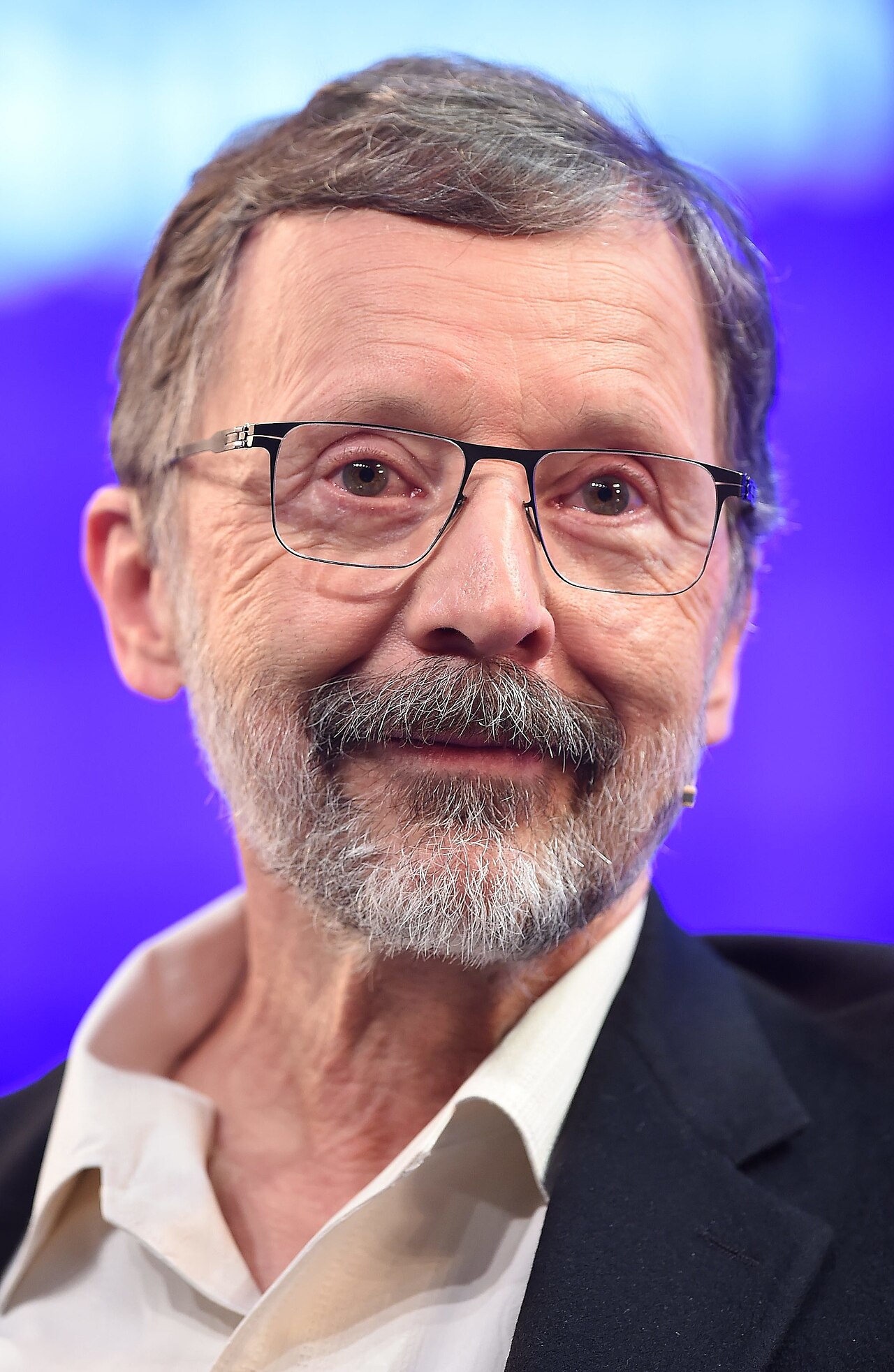
- Image: Ed Catmull at Web Summit 2015 (cropped).jpg by Web Summit (CC BY 2.0), via Wikimedia Commons