Regnecentralen and GIER: Denmark's Computer Company
Abstract
Regnecentralen was founded in Copenhagen on 12 October 1955 as an institute of the Danish Academy of Technical Sciences, paid for with 900,000 kroner of Marshall Plan money. It built Denmark’s first computer, DASK, in the dining room of a villa in Valby, then the transistorised GIER of 1961, a machine the size of a wardrobe that sold about fifty copies to universities and laboratories in Western and Eastern Europe; one of them ended up at an observatory in Australia. Its compiler group, led by Peter Naur, wrote GIER ALGOL; its RC 4000 carried Per Brinch Hansen’s multiprogramming nucleus, published in 1970 and an ancestor of the microkernel. The company went bankrupt in 1979, was rebuilt, sold the Piccolo and Piccoline school computers to Danish schools with the education ministry’s backing, and was absorbed by the British firm ICL between 1988 and 1991. Product development in Denmark ended in 1992.
A Committee and Marshall Plan Money
The Danish Academy of Technical Sciences (Akademiet for de Tekniske Videnskaber, ATV) set up a committee on calculating machines in the late 1940s, chaired by Richard Petersen, a mathematics professor at the Technical University. For years it had advice and no machine. The money arrived sideways. The Danish military had received a Marshall Plan grant for cipher machines it did not need, and the Ministry of Defence passed 900,000 kroner of it to the computing effort. On 12 October 1955 ATV founded Regnecentralen, formally “Dansk Institut for Matematikmaskiner”, as a self-governing institute. In April 1956 the group moved into a villa at Bjerregårdsvej 5 in Valby, on the western edge of Copenhagen.
Niels Ivar Bech (1920–1975) became director in September 1957 and ran the company for most of its independent life. Naur and Christian Gram later described the company’s policy as selling to universities, to reach a new generation of users through their students.
DASK in the Dining Room
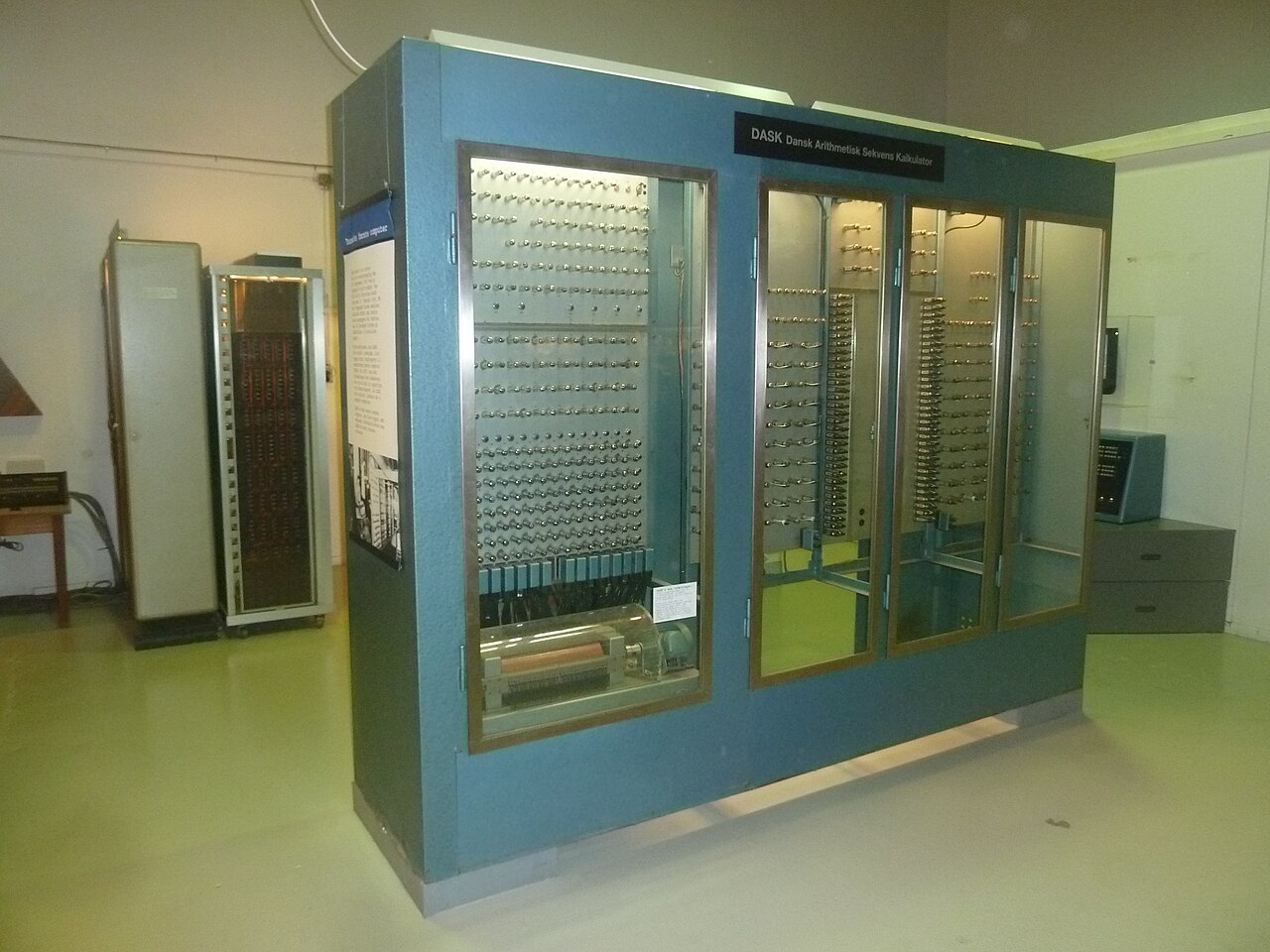
The first machine, DASK (Dansk Aritmetisk Sekvens Kalkulator), was based on the Swedish BESK, itself descended from the IAS machine in Princeton. Bent Scharøe Petersen was chief designer. The team numbered seven at the start and twelve by 1957. DASK had about 2,500 vacuum tubes, 1,024 words of 40-bit ferrite-core memory, 8,192 words on a magnetic drum turning at 3,000 rpm, and added two numbers in 56 microseconds. It drew 15 kilowatts, weighed 3.5 tonnes, and filled the villa’s dining room.
DASK was shown to the public, operated remotely from an exhibition at the Forum hall in Copenhagen, in the autumn of 1957, declared ready in January 1958, and on 13 February 1958 the Ministry of Defence formally handed it over to Regnecentralen. It ran as a service machine for ten years: military calculations, research, administrative jobs, and on election night 1960 the forecasts and vote count of the Danish parliamentary election. It was switched off in 1967. Parts of it survive at the Danish Museum of Science and Technology in Helsingør and at Datamuseum.dk.
GIER
Development of a transistorised successor began in 1959, and the Geodetic Institute (Geodætisk Institut), which needed to compute survey adjustments, ordered it. The name is the customer’s: GIER, Geodætisk Instituts Elektroniske Regnemaskine. A version was demonstrated at an exhibition on 24 August 1960, and the machine went into service at the institute on 14 September 1961, installed in Telefonhuset on Borups Allé.
GIER was meant to be a single machine. It became Regnecentralen’s product. It had 1,024 words of core store (about 5 kilobytes) and 12,800 words on a drum (about 62.5 kilobytes), arithmetic built for floating point, a console typewriter, and eight-hole paper tape. Where DASK filled a dining room, GIER fitted in a cabinet about the size of a wardrobe. The first series-built unit was ready in October 1961. The second went to the chemical engineering firm Haldor Topsøe, the third to the Risø research establishment, and later ones to laboratories and universities in Western and Eastern Europe, among them the Max Planck Institute in Heidelberg. A GIER cost about 600,000 kroner. How many were built depends on who is counting: Datamuseum.dk says about 40 sold, Lex and the Danish encyclopedia say about 45 or about 50, and Danmarks Teknologihistorie says about 55.
The machine’s best-documented customer was the Hamburg Observatory. The Danish astronomer Erik Høg, a former student of Peter Naur, needed a computer to reduce photon-counting measurements from the observatory’s meridian circle, which was going to Perth in Western Australia to observe southern reference stars. The observatory’s director wanted an IBM 1620. Høg compared the two and, by his account, threatened to leave the project if IBM won: GIER was 20 percent cheaper, about twenty times faster at computation, and read paper tape at 2,000 characters per second against the 1620’s 150. A GIER was delivered to Bergedorf by lorry on the afternoon of 2 November 1964 for 650,000 kroner and was running that evening. It was shipped to Perth with the telescope, and Regnecentralen stationed an engineer, Jørgen Otto Sørensen, in Australia full-time for the whole expedition to guarantee repairs. He was needed only a few times in five years. The observations fed the photon-counting method Høg later used in the design of ESA’s Hipparcos satellite. The Perth GIER’s last recorded use was on 22 September 1983.
The tape reader that made GIER fast became a product of its own. The RC 2000, sold separately from 1963, read 2,000 characters per second, which Danmarks Teknologihistorie puts at 18 kilometres of tape an hour. It remained the fastest reader of its kind into the early 1970s and sold between 1,200 and 1,500 units worldwide, depending on the source.
The Compiler Group
Peter Naur joined Regnecentralen in 1959, the year before he edited the ALGOL 60 report (see ALGOL and the ALGOL Family). The company treated the new language as its programming system rather than as a research topic. A DASK ALGOL compiler was complete by September 1961. GIER ALGOL, written by Naur and Jørn Jensen, was decided on in January 1962, went out to the GIER installations in a slightly restricted form in September 1962, and was distributed in its final form in February 1963. With 1,024 words of core the compiler could not sit in memory, so it was organised as a chain of passes pulled from the drum one after another. Naur described the design in the journal BIT in 1963. Edsger Dijkstra called the compiler a masterpiece. For Høg in Hamburg it meant he programmed the Perth reductions in ALGOL instead of in numeric machine code, as he had on an IBM 650.
The same group trained people who left for elsewhere. Per Brinch Hansen joined in 1963 and started by writing a COBOL parser for a Siemens 3003. Charles Simonyi came from Budapest in 1966 to work on the RC 4000 (see Hungary’s Computing Industry) and left for Berkeley in 1968. Naur left in 1969 for the new chair of datalogi at the University of Copenhagen.
Datacentralen Buys IBM
Regnecentralen’s home market had a hole in the middle of it. In 1959 the state set up I/S Datacentralen to run public administration by computer, and Datacentralen bought an IBM 7070, delivered in 1962. According to Høg, the Ministry of Finance held in the 1950s that one electronic computer would be enough for all of Denmark’s administrative work. GIER’s arrival led to open friction with the ministry, and from then on central government ran on foreign machines while the Danish maker sold to science, industry and schools.
Regnecentralen needed capital to build more than prototypes. In January 1964 it was reorganised as a limited company, Regnecentralen A/S, with shares held by banks, insurance companies and industrial firms. It had about 100 employees at the end of 1961 and more than 1,500 by 1979, with development in Ballerup, a factory in Præstø, and subsidiaries in the neighbouring countries.
RC 4000 and the Nucleus
The RC 4000 began with a contract from Haldor Topsøe for a large data logger at a fertiliser plant it was building in Puławy, Poland. The project started in earnest in January 1966, and the first machine went to Puławy in 1967. The RC 4000 was the company’s first computer built from integrated circuits: 24-bit words, byte addressing, and a 24-bit address space. It reached the Danish market in April 1969 and went to power stations (Vestkraft, Elsam, Nordkraft), to Aalborg Portland cement, to the Technical University and the Niels Bohr Institute, and abroad to Bulgaria and Norway. Sales fell sharply in 1970 and production stopped in December 1972. The Danish Wikipedia counts seventeen systems sold.
Its software outlived it. Brinch Hansen, head of RC 4000 software from the summer of 1967, saw that the Puławy system was a real-time monitor tailored to one plant and that every new customer would need another. His group built a small nucleus instead: a program that simulated processes, passed messages between them through a pool of buffers, and let processes create and control other processes, with scheduling and resource policy left to operating systems running on top. The RC 4000 Multiprogramming System was finished in 1969, and Brinch Hansen described it in “The Nucleus of a Multiprogramming System” in Communications of the ACM in April 1970. He wrote that the main problem in designing such a system “is not to define functions that satisfy specific operating needs, but rather to supply a system nucleus that can be extended with new operating systems in an orderly manner.” Dijkstra’s semaphores alone were rejected because, in a dynamic system, “some processes may turn out to be black sheep and break the rules of the game.”
That separation of mechanism from policy is the idea behind the microkernel, the design Andrew Tanenbaum argued for against Linux two decades later (see Operating System Concepts). Brinch Hansen moved to the United States and at Caltech wrote Concurrent Pascal, released in 1975, with the first implementation of monitors (see Concurrency and Parallelism).
Commercially the company hedged. It signed a licence with Data General in 1971 and sold the Nova as the RC 7000, followed by its own RC 3600. The RC 8000, presented in September 1975, ran RC 4000 programs three times faster at half the price, and about 150 were in use by the mid-1980s.
Bankruptcy and the Piccolo
Over five years in the 1970s turnover grew from 135 million to 400 million kroner, and the company still ran out of cash. In April 1979 Regnecentralen suspended payments. It was reconstructed and split into three companies: Regnecentralen af 1979 A/S (RC79) for hardware and software, RC Datacenter for the service bureaus, and DP Computers as agent for the American Datapoint. RC79 lost 10 million kroner in its first year and 36 million in its second. In 1981 ITT, through its Danish subsidiary SEK, bought half of it. Bech did not see any of this. He had died in 1975.
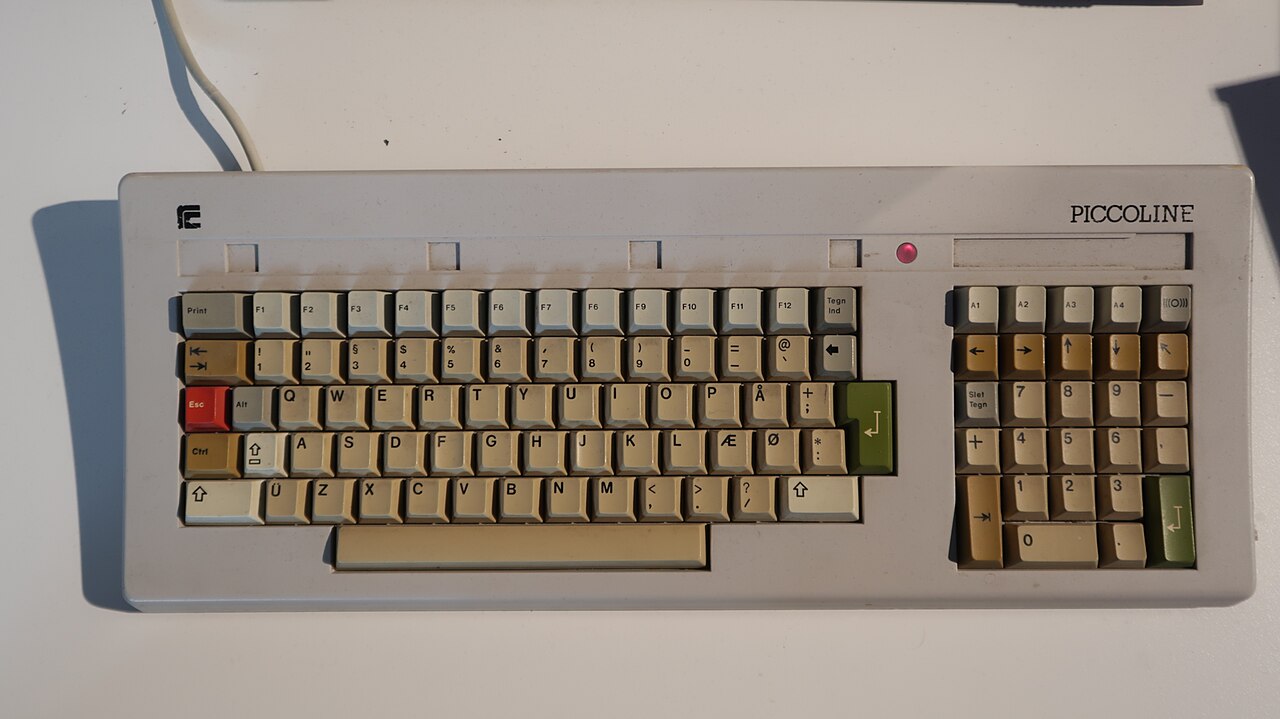
The product that carried RC79 had been sitting in a drawer. The RC700 Piccolo, a Z80 machine, was pulled out after the reconstruction; the RC701 appeared in November 1979 and the RC702 in August 1980. The development engineer Knud Erik Hansen later told DR: “We designed that computer in three weeks.” It ran COMAL, a Danish teaching language, and from September 1980 CP/M and UCSD Pascal, and it sold well to Danish schools and through subsidiaries in Germany, Britain and Finland. The RC759 Piccoline followed in 1984 with an Intel 80186 and Concurrent CP/M, three years after IBM’s PC had settled on DOS.
The schools bought Piccolines with the education ministry’s encouragement. DR reports that Regnecentralen sold equipment to the Danish primary schools worth, in today’s money, 126 million kroner in half a year. In January 1985 DR’s TV Avisen reported schools criticising the expensive equipment, and schools complained that the machines could not read IBM programs or diskettes. The minister of education, Bertel Haarder, said later: “Perhaps we in the ministry were a little too close to Regnecentralen.” In a 1996 debate article Arne Jacobsen named the result the Piccoline syndrome: piles of unusable Piccolines in dark attics under school roofs, or long since sold off.
Dead End: A National Computer Maker
ITT sold its European businesses to Alcatel in 1986. ICL took over Alcatel’s half of Regnecentralen in 1988 or 1989 (sources differ), and in 1991 the Danish pension fund Pensam and the other Danish shareholders sold ICL the rest. The company, by then RC International, stopped all product development in Denmark in 1992, and the employees were laid off. Fujitsu, which had bought 80 percent of ICL in 1990, took the remainder in 1998, and in 2003 the last Danish successor was renamed Fujitsu Services.
The reasons were the ones that ended most national computer makers of its generation. The state’s own data centre had chosen IBM in 1959, so the biggest domestic buyer was closed to Regnecentralen from the start. Science customers bought GIERs but were too few to pay for the next generation, and the RC 4000 sold seventeen systems. The school market was real but political, and it depended on machines that could not run the software the rest of the world was writing for the IBM PC. Danmarks Teknologihistorie names the last blow as the cheap PC clones of the 1980s.
Naur’s datalogi is still the Danish name for the discipline, and a GIER still runs at Datamuseum.dk in Hedehusene.
📚 Sources
- Regnecentralen, Danish Wikipedia: founding 12 October 1955, 900,000 kr Marshall aid, Richard Petersen, Bent Scharøe Petersen, GIER ca. 50, RC 4000 17 sold, closure 1993
- Regnecentralen, English Wikipedia: DASK ALGOL September 1961, RC 2000 1963 (1,500 sold), RC 7000 / RC 3600, ICL stake 1988
- DASK, English Wikipedia: Marshall Plan cipher-machine grant, 2,500 tubes, 15 kW, 1,024 × 40-bit core, 8,192-word drum at 3,000 rpm
- DASK, Datamuseum.dk (DDHF wiki): development from 1953, demonstration at Forum 1957, operational January 1958, handover 13 February 1958, 56 µs addition, 3.5 t, 1960 election, decommissioned 1967, surviving parts
- GIER, Datamuseum.dk (DDHF wiki): development 1959–61, wardrobe-sized, about 40 sold, Haldor Topsøe and Risø, the museum’s running GIER
- GIER, Danish Wikipedia: name, Geodætisk Institut at Borups Allé, machines no. 2 and 3, price about 600,000 kr
- GIER, Lex (Den Store Danske): about 50 built, 5 KB core and 62.5 KB drum, Datacentralen’s IBM 7070 (1962) and the conflict with the Ministry of Finance
- Regnecentralen, Lex (Den Store Danske): Bech director 1957, about 45 GIERs, A/S January 1964, RC 4000 project January 1966 and Topsøe contract, RC 8000 September 1975 (about 150), April 1979 bankruptcy and the three successor companies, ICL/Fujitsu sequence
- Regnecentralen, Datamuseum.dk (DDHF wiki): ATV committee, “knap 50” GIERs, RC 2000 1963, RC 4000 deliveries 1969 and the 1970 sales drop, Data General 1971, 135→400 million kr, RC79 losses, ITT/SEK 1981, Alcatel 1986, ICL 1988 and 1991, end of development 1992
- RC4000, Datamuseum.dk (DDHF wiki): Puławy 1967, April 1969 launch, 24-bit architecture, customers, end of production December 1972
- RC700 Piccolo, Datamuseum.dk (DDHF wiki): taken “out of the drawer” after the 1979 reconstruction, RC701 November 1979, RC702 August 1980, COMAL, CP/M September 1980, export subsidiaries
- Udpluk af Regnecentralens historie, Ingeniøren: move to Bjerregårdsvej 5 (April 1956), Bech director (September 1957), GIER demonstration 24 August 1960, first series GIER October 1961, ICL 1989, Fujitsu Services 2003
- Regnecentralen: en stor, men kortvarig succes, Danmarks Teknologihistorie: RC 2000 speed and about 1,200 sold, about 55 GIERs, over 1,500 employees by 1979, Datacentralen 1959, PC clones
- Høg, Erik: “GIER: A Danish computer from 1961 with a role in the modern revolution of astronomy”, Nuncius Hamburgensis 20 (preprint, arXiv:1704.05828, 2017): Hamburg delivery 2 November 1964, 650,000 kr, comparison with the IBM 1620, Perth engineer, last use 22 September 1983, Bech’s life dates, Ministry of Finance’s one-computer view, Dijkstra’s “masterpiece”
- Naur, Peter: “The design of the GIER ALGOL compiler, Part I”, BIT 3 (1963), pp. 124–140: 1,024 words of core, 12,800-word drum, multi-pass design, January 1962 decision, September 1962 and February 1963 distributions
- Brinch Hansen, Per: “The Nucleus of a Multiprogramming System”, Communications of the ACM 13(4), April 1970, pp. 238–242 (author’s reprint); ACM DOI
- Per Brinch Hansen, English Wikipedia: joined Regnecentralen 1963, Siemens 3003 COBOL, head of RC 4000 software 1967, Caltech 1972, Concurrent Pascal 1975
- Piccoline-syndromet: Da en sær dansk computer (næsten) blev enden på EDB i folkeskolen, DR: Knud Erik Hansen, 126 million kr, Piccoline 1984 and Concurrent CP/M, Haarder quote, Arne Jacobsen 1996, ICL 1991 and closure 1992
- Image: DASK at Danmarks Tekniske Museum.JPG by Leif Jørgensen (CC BY-SA 4.0), via Wikimedia Commons