Sergei Lebedev
Abstract
Sergei Alekseyevich Lebedev (1902–1974) was a Soviet power engineer who built the MESM, the first stored-program electronic computer in continental Europe, in the wing of a war-damaged former monastery building at Feofaniya outside Kyiv between 1948 and 1951. In Moscow he then led the BESM line, the M-20, and the BESM-6, which stayed in production for nineteen years. He spent his last years opposing the Soviet decision to copy IBM’s System/360, and lost.
Power Grids and Tank Guns
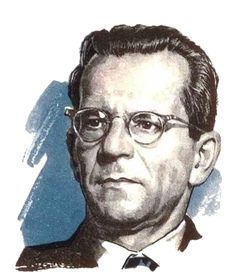
Lebedev was born on 2 November 1902 in Nizhny Novgorod into a teacher’s family. He studied electrical engineering at the Moscow Higher Technical School (the Bauman Institute), graduated in April 1928, and joined the V. I. Lenin All-Union Electrotechnical Institute (VEI) in Moscow, where he soon ran its laboratory for electrical networks. His speciality was the stability of power systems: in 1933 he and A. S. Zhdanov published a monograph on the parallel operation of power stations, and in 1939, without ever having taken the intermediate candidate’s degree, he defended a doctorate on the “artificial stability” of power grids.
During the war his group built a stabilisation system that let a tank aim and fire its gun while moving, and worked on guidance for air-launched missiles. Both needed analog computing elements for addition, multiplication, differentiation, and integration, and in 1945 Lebedev built an analog computer for solving the differential equations of power engineering. His wife, Alisa Grigorievna, remembered him in the first months of the war sitting in the bathroom of their Moscow flat by the light of an oil lamp, writing out binary arithmetic.
Feofaniya
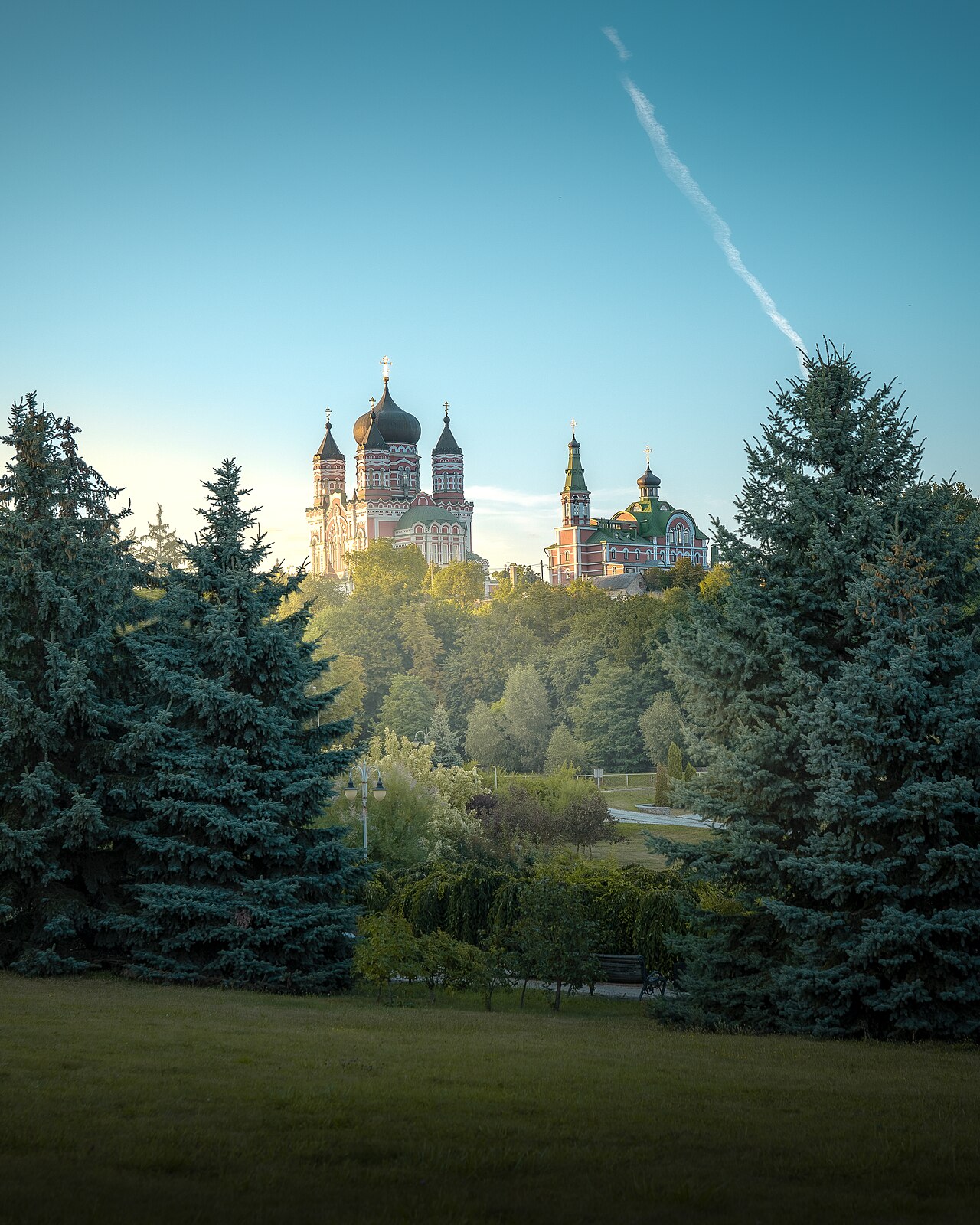
In 1946 Lebedev moved to Kyiv as director of the Institute of Electrical Engineering of the Ukrainian Academy of Sciences, and in 1947 he set up a laboratory there for modelling and computing. From the autumn of 1948, after reading in foreign journals that electronic digital computers were being built in the West, he turned it to the design of one. The institute had been given a two-storey building at Feofaniya, on the outskirts of the city, on the grounds of the former St. Panteleimon monastery. Before the war it had housed a branch of the Kyiv psychiatric hospital; when the German army reached Feofaniya in 1941 it murdered the patients and turned the building into a military hospital, and it was badly damaged in the fighting of 1943. The Academy handed it over in that condition in 1948.
The machine Lebedev planned there was meant as a working model for a larger one, so he called it the MESM, Malaya Elektronnaya Schetnaya Mashina, the Small Electronic Calculating Machine. It still needed about 6,000 tubes and barely fitted into the left wing of the building. To avoid waiting for a memory technology, its working store was built from flip-flop circuits, which kept it small; programs and data shared that store, making it a stored-program machine. The design target was about 100 operations per second on 16-bit binary numbers. Lebedev led a team of about twenty-five engineers, technicians, and fitters, with Lev Dashevsky and Ekaterina Shkabara as his main assistants, and he worked without access to John von Neumann’s reports, which reached the Soviet open press only in the 1950s.
The prototype ran its first test on 6 November 1950. After a year of enlarging the memory and refining the arithmetic, the MESM was accepted on 25 December 1951 by a commission from the USSR Academy of Sciences headed by Mstislav Keldysh, with Sergei Sobolev and Mikhail Lavrentiev among its members. Its first real job computed 585 values of a probability distribution, about 250,000 operations. Lebedev reported on the machine to the Presidium of the Academy on 4 January 1952. In 1952 its word was lengthened from 16 to 20 bits, and it worked around the clock on problems the visitors from Moscow brought, among them the stability of the Kuibyshev–Moscow high-voltage transmission line and, from November 1952 to July 1953, a long series of calculations for the Steklov Mathematical Institute. The MESM was scrapped in 1959. In Kyiv, Lebedev’s laboratory passed in 1958 to Victor Glushkov (see OGAS), and the programmer Kateryna Yushchenko learned her trade on the machine.
BESM and the Fight Over Memory
Even before the MESM was finished, Lebedev was designing its larger successor in Moscow, at the Academy’s Institute of Precision Mechanics and Computer Engineering (ITMVT). The BESM (the B stands for “high-speed” in the original name, though it is often rendered as “large”) was built for 8,000 to 10,000 operations per second. It had a rival: the Strela, developed at the ministry design bureau SKB-245 under Yuri Bazilevsky with Bashir Rameev as deputy. Both needed cathode-ray storage tubes for fast memory, and the tubes went to Strela. Lebedev had to fall back on acoustic mercury delay lines, 70 tubes about a metre long each, holding several hundred kilograms of mercury, which cut the BESM’s speed to Strela’s level.
At the hearings that followed, Bazilevsky argued that Strela, at 2,000 operations per second, could solve all the mathematical problems of the Soviet Union in four months, so a faster machine was unnecessary. Lebedev replied that a slow machine would not finish a long problem between two hardware faults. Strela was approved for series production, its designers received state prizes, and eight were built from 1953. A later commission comparing the two concluded that the BESM had better prospects, and only then, at the end of 1954, did the ITMVT get storage tubes. With a full set the BESM ran at its design speed, and in 1956, after it was commissioned a second time, Lebedev was named Hero of Socialist Labour. He had become director of the ITMVT in 1953, on Lavrentiev’s recommendation, and a full member of the USSR Academy of Sciences the same year, elected together with Andrei Sakharov.
The next machine, the M-20, named for its target of 20,000 operations per second, was designed by Lebedev with Mikhail Shura-Bura on the instruction set and Mikhail Golovistikov on the circuits. In 1958 the state committee called it the fastest computer in the world, and it went into series production alongside the BESM-2, which computed satellite orbits and the trajectory of the first rocket to reach the Moon. Both teams were nominated for the Lenin Prize for the M-20; Lebedev’s nomination was rejected, as the State Prize nomination for the MESM had been before.
BESM-6
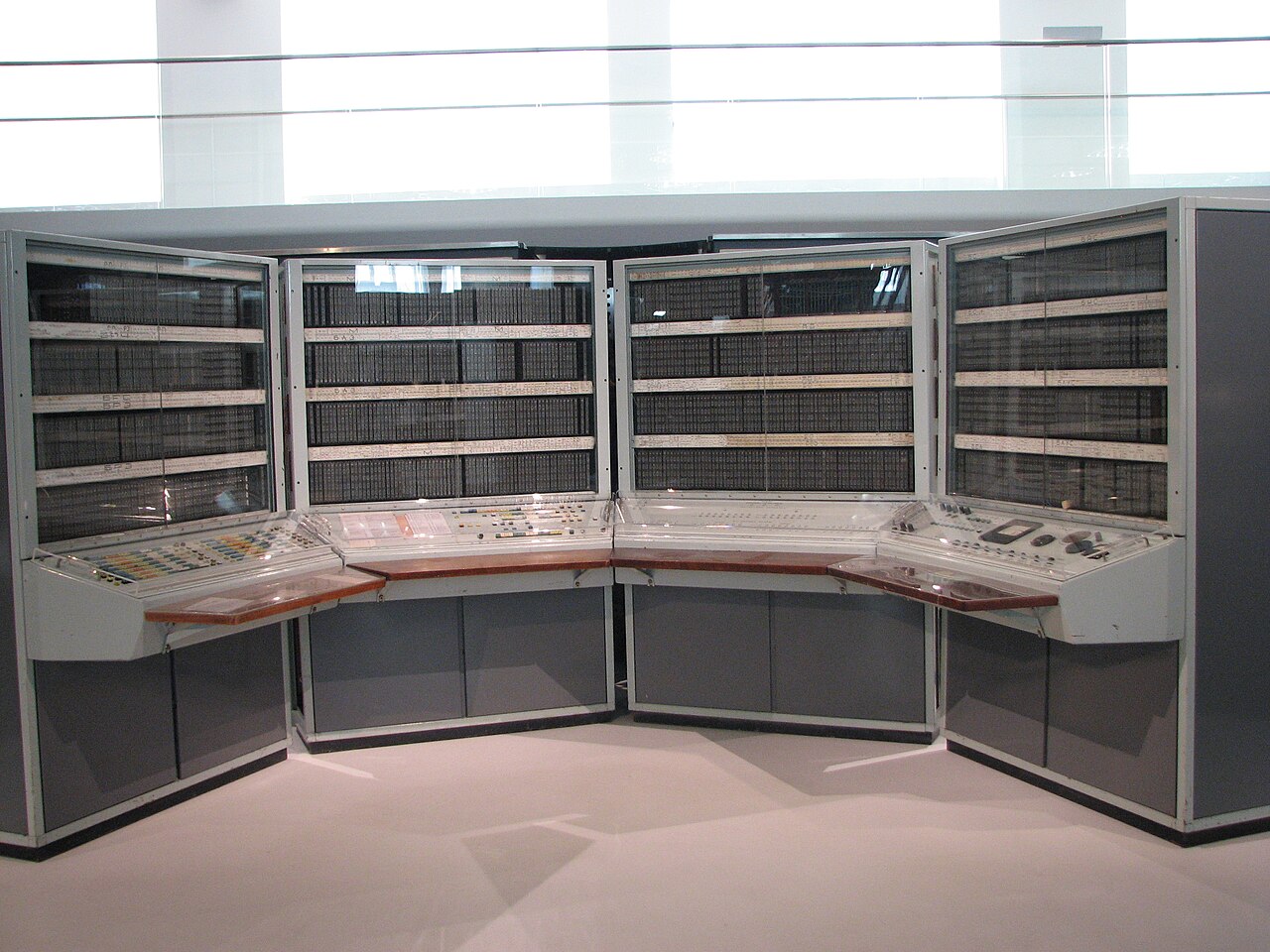
The BESM-6, designed by 1965 and in series production from 1968, was the ITMVT’s transistor machine: a 48-bit word, a 10 MHz clock, and about one million instructions per second, with instruction pipelining and a small fast buffer memory at a time when both were new in American machines too. It ran nuclear-weapons and space calculations; in 1975 a BESM-6 complex processed the telemetry of the Apollo–Soyuz Test Project. Production continued until 1987, 355 machines in nineteen years. The Science Museum in London bought one of the last survivors in 1992 (see Soviet and Russian Computing).
Dead End: Against the Clone
In the late 1960s the Soviet government decided that the socialist countries would build a single compatible computer family, the ES EVM, and that it would copy IBM’s System/360 (see Comecon Computing). The ITMVT, the country’s leading design institute, was not even named in the resolution. Its authors asked Lebedev to take part. After consulting his senior staff he refused, saying, in Boris Malinovsky’s account, “But we are going to make something extraordinary!”
Lebedev, a chain smoker, was by then seriously ill with a lung disease. He nevertheless sought a meeting with Alexei Kosygin to warn him that cloning the IBM machine would ruin the Soviet computer industry. He was sent to a deputy instead, and nothing came of it. His health declined further. He died in Moscow on 3 July 1974 and is buried in the Novodevichy Cemetery. On his last day Golovistikov visited him in hospital and told him about a recent trip to Feofaniya.
The ES EVM machines arrived years behind their IBM originals, and Soviet designers spent the following two decades copying each new IBM generation. The ITMVT itself, renamed the Lebedev Institute, went on to build the Elbrus machines. The IEEE Computer Society gave Lebedev its Computer Pioneer Award in 1996 for computer design and for founding the Soviet computer industry.
📚 Sources
- Malinovsky, Boris N.: Pioneers of Soviet Computing, ed. Anne Fitzpatrick, trans. Emmanuel Aronie (SIGCIS, 2010; CC BY-ND 3.0), Internet Archive copy (chapter 1: birth, VEI, 1933 monograph, 1939 doctorate, tank stabiliser, 1945 analog computer, Alisa Grigorievna, Feofaniya history, 6,000 tubes, flip-flop memory, design target, team, von Neumann note, 6 November 1950, 25 December 1951, Keldysh commission, first problem, 4 January 1952 report, 20-bit extension, Kuibyshev line, Steklov letter, Strela and SKB-245, mercury memory, Bazilevsky’s four months, storage tubes 1954–55, Hero of Socialist Labour 1956, director and academician 1953 with Sakharov, M-20 team and “fastest computer in the world”, Lenin Prize rejection, ES EVM refusal and quote, Kosygin, 3 July 1974)
- SIGCIS: Pioneers of Soviet Computing (edition and licence)
- Heinz Nixdorf MuseumsForum blog, “Die ersten Computer der Sowjetunion” (7 December 2021) (move to Kyiv 1946, laboratory 1947, start of MESM 1948, MESM scrapped 1959, BESM-2 and M-20 in 1958, eight Strela machines)
- Wikipedia: Sergey Lebedev (scientist) (finding aid: autumn 1948, BESM-2 orbits and lunar rocket, Novodevichy, Computer Pioneer Award 1996)
- Samokhin, V. P.: “Академик Сергей Алексеевич Лебедев (70 лет созданию советской вычислительной техники)”, Машиностроение и компьютерные технологии 6, 18–88 (2018), CyberLeninka
- Wikipedia: BESM-6 (finding aid: design 1965, production 1968–1987, 355 units, 48-bit word, clock, Apollo–Soyuz, Science Museum 1992)
- Image: Феофанія під час заходу сонця. Вид на Пантелеймонівський собор.jpg by Wavemeart (CC BY-SA 4.0), via Wikimedia Commons
- Image: BESM-6 Science Museum London 2018.jpg by Kristopher Doern (CC BY-SA 4.0), via Wikimedia Commons