Soviet and Russian Computing: Parallel History, Divergent Fate
Abstract
The Soviet Union built the first computer in continental Europe, produced mathematicians and engineers of the first rank, and at various points in the 1950s and early 1960s held a genuine competitive position in computing relative to the United States. By the 1980s, the gap was catastrophic. The decision taken in the late 1960s to systematically clone IBM’s System/360 architecture rather than develop indigenous designs (a decision driven by bureaucratic risk-aversion and Cold War technology transfer restrictions) locked Soviet computing into a permanent follower position. The story of Soviet computing is the story of what happens when a technically capable civilization subordinates technology development to political control and institutional secrecy.
The MESM and the Soviet Computing Pioneers
Sergei Lebedev built the MESM (Small Electronic Calculating Machine) at the Institute of Electrotechnics in Kyiv between 1948 and 1950, the first electronic stored-program computer to operate in continental Europe (the UK’s Manchester Baby preceded it, as did Konrad Zuse’s relay-based Z4 on the continent). Lebedev had developed the basic design independently, without knowledge of ENIAC or the Manchester Baby, working from first principles in a monastery building outside Kyiv. The MESM had about 6,000 vacuum tubes, performed roughly 50 operations per second (around 3,000 per minute), and consumed 25 kilowatts of power.
The MESM’s software side produced a pioneer of its own: Kateryna Yushchenko, who programmed the machine after its transfer to the Institute of Mathematics and in 1955 created the Address programming language, introducing indirect addressing (the concept behind the modern pointer) and founding the Soviet school of theoretical programming.
Lebedev moved to Moscow and led the development of the BESM series (Large Electronic Calculating Machine). The BESM-1 (1952) was the most powerful computer in Europe at the time of its completion.
A stranger road ran alongside the binary mainstream. At Moscow State University, Nikolay Brusentsov built Setun (1958), the only computer ever produced in series on a base other than two: it stored numbers in balanced ternary, using roughly 50 units to teach a generation of students before the planning ministries, committed to binary, shut it down.
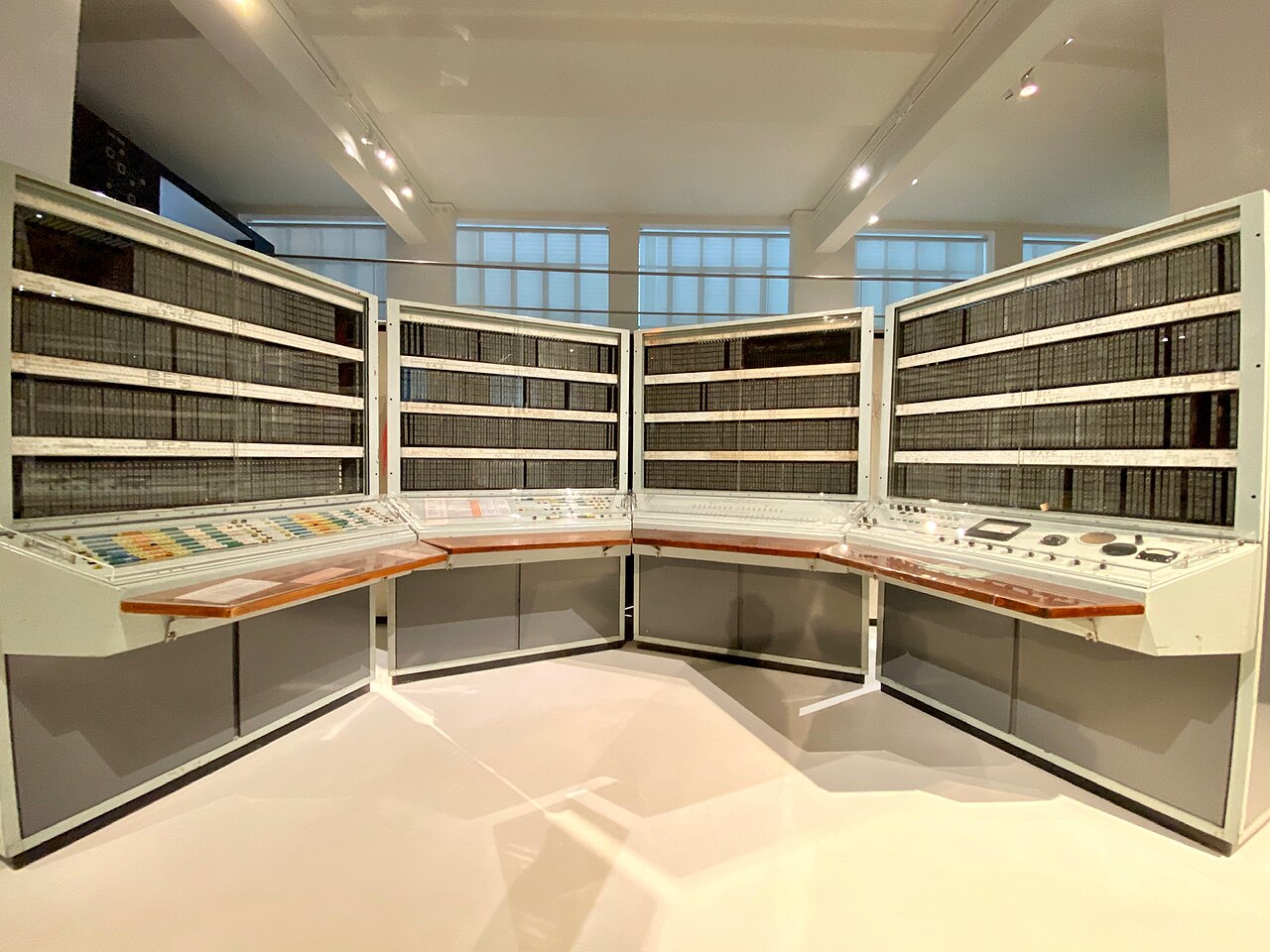
The BESM-6, designed by 1965 and in series production from 1968, was Lebedev’s masterpiece and the pinnacle of Soviet indigenous computing. It was a 48-bit architecture (not 64-bit, despite common misstatements) clocked at 10 MHz and rated at about one million instructions per second, roughly 0.4 MFLOPS in floating point. The BESM-6 ran two instruction pipelines, one for the control unit and one for the arithmetic unit, plus a data cache of sixteen 48-bit words, at a time when caching and pipelining were new even in American machines. Its operating systems, D-68, Dispak, and later Dubna, supported multiprogramming: multiple jobs running concurrently, sharing the processor.
Soviet scientists used the BESM-6 for nuclear weapons simulation, ballistic missile trajectory calculation, and the space program. The Venera probe missions to Venus, the Lunokhod lunar rovers, and the orbital calculations for Soviet cosmonauts were all computed on BESM-6 systems. Production ran from 1968 to 1987, 355 machines over nineteen years, an extraordinary lifespan that reflected both its genuine quality and the institutional inertia of Soviet procurement.
Its limitation was manufacturing: the BESM-6 used approximately 60,000 transistors, each individually tested and hand-soldered. Soviet semiconductor manufacturing could not match the yield and miniaturization that American and Japanese fabs achieved, meaning the BESM-6 was as large and power-hungry as machines with half its performance in the West.
Parallel to Lebedev’s work, Victor Glushkov at the Institute of Cybernetics in Kyiv developed a vision of networked computing for economic planning, a national computer network called OGAS (All-State Automated System): that he proposed to the Soviet government in 1962. The proposal was rejected by the Ministry of Finance, which feared that a national information network would reduce its bureaucratic power. Glushkov’s OGAS would have been, by some descriptions, a precursor to the internet; its rejection on institutional grounds rather than technical ones illustrates the broader forces shaping Soviet computing. The full story is told in OGAS: The Soviet Internet That Never Was.
The Elbrus and the Architecture Question
The Elbrus series, built at the Lebedev Institute in Moscow under chief designer Vsevolod Burtsev with Boris Babayan as lead architect, represented the most sophisticated indigenous Soviet computing architecture. The Elbrus-1 (1979) was a ten-processor machine with out-of-order execution and a tagged architecture borrowed in spirit from Burroughs: each word of memory carried type information alongside its data, enabling hardware-enforced type safety. The Elbrus-2 (1984) re-implemented the same architecture in faster emitter-coupled logic and reached about 125 MFLOPS.
The Elbrus was used exclusively for military and scientific applications and never entered civilian production at scale. Babayan’s team built a 16-processor VLIW design, the Elbrus-3, in 1990, one of the first VLIW machines anywhere and a decade ahead of the related idea Intel and HP shipped in the Itanium (2001). It never entered production. Babayan joined Intel in 2004 as an Intel Fellow, leading work on compilers, binary translation, and security technologies at its Moscow research center.
The IBM Clone Decision
Soviet economic planners had floated a unified computer series in 1966; by 1968 the leadership had settled on a decision that defined Soviet computing for the next two decades: rather than continuing to develop the Elbrus and BESM lineages, the USSR would produce clones of IBM’s System/360 architecture. The resulting ES EVM (Unified System of Electronic Computing Machines), also called the RYAD series (from Russian ryad, “series”), was produced cooperatively by the Comecon countries (the USSR, East Germany, Poland, Hungary, Czechoslovakia, Bulgaria, Romania, with Cuba supplying peripherals). Cloning work started in 1968; production began in 1972. East Germany’s contribution came from the Kombinat Robotron, the Bloc’s largest computer maker outside the USSR (see Computing in East Germany). The bloc-wide programme, its division of labour and the Hungarian and Bulgarian cases are in Comecon Computing.
The decision’s logic was bureaucratic: IBM’s software ecosystem was vast, Western software could be acquired (through espionage if not purchase), and cloning reduced development risk. The engineers opposed it; the bureaucrats prevailed. The consequences were severe. IBM continued improving the System/360 architecture; Soviet engineers spent their energy cloning each successive generation rather than innovating. The gap widened with each iteration. Soviet clone hardware consistently lagged two to three generations behind IBM, was less reliable, and lacked the software ecosystem that had developed around the genuine IBM systems.
The RYAD/ES EVM systems were used in Soviet industry, government, and research institutions through the 1980s. They ran IBM-compatible operating systems (VM, MVS clones) and software. The institutional knowledge and research capability required to develop competitive indigenous architectures atrophied.
The Software Gap
The hardware gap was serious; the software gap was fatal. The Soviet computing industry produced almost no commercial software. Software in the Soviet system was not a commodity but a service: programmers worked in research institutes or enterprise computing centers, writing programs for specific machines and specific tasks. There was no software market, no mechanism for distributing useful programs broadly, and no commercial incentive to create reusable software. When the West developed packaged software (operating systems, compilers, databases, business applications) the Soviet Union had to steal it or go without.
Computing in the Cold War: Espionage and COCOM
Western countries imposed export controls on computing technology to the Soviet bloc through the Coordinating Committee for Multilateral Export Controls (COCOM), established in 1949. The controls restricted not just military computers but commercial systems capable of useful dual-use work, effectively any computer faster than a few megaflops. The Soviet response was systematic technology acquisition through espionage.
The KGB’s Line X directorate, documented in the Farewell Dossier (intelligence passed to the CIA by French intelligence in 1981), ran a systematic program of acquiring Western technology through intelligence operatives and sympathetic insiders. Line X operations acquired semiconductor equipment, computer-aided design software, and manufacturing processes that the Soviet industry could not develop domestically. The scale of the operation (hundreds of acquisition tasks per year across dozens of countries) indicated how dependent Soviet technology had become on Western intellectual property.
The Farewell Dossier intelligence was used by the Reagan administration to selectively allow compromised technology to reach Soviet buyers, sabotaged chips, flawed turbine designs, and faulty industrial software among them.
Myth: A CIA software trojan blew up a Soviet gas pipeline in 1982
The story comes from one source, Thomas C. Reed’s memoir At the Abyss (2004), which claims doctored pipeline-control software bought from a Canadian firm caused a three-kiloton explosion on a Trans-Siberian pipeline in June 1982. No independent evidence links the two. Historian David Painter notes that a CIA corruption program and a 1982 Siberian pipeline explosion can both be real without being connected; former CIA historian Nicholas Dujmovic calls the sabotage story a “persistent myth,” and Marc Trachtenberg’s archival study found no supporting record. The Farewell counter-operation itself is well documented; this particular explosion is not part of it. See Myths and Misconceptions.
Post-Soviet Russia: Yandex, Kaspersky, and the New IT Industry
The Soviet collapse in 1991 released a generation of mathematically trained engineers into a newly commercial environment. Russia produced some of the strongest mathematicians in the world, and the gap between mathematical ability and engineering application (which had been institutional in the Soviet system) began to close.
Arkady Volozh and Ilya Segalovich had been building Russian-text search algorithms since 1990 and launched yandex.ru at the Softool exhibition in Moscow on 23 September 1997, a year before Google was incorporated; the search business was spun out as a standalone company in 2000. Yandex developed better algorithms for Russian-language search (Russian morphology, with its extensive inflection system, is harder for simple keyword matching than English) and stayed the dominant search engine in Russia even after Google entered, holding roughly 70% of Russian search queries by the mid-2020s. Yandex expanded into maps, ride-hailing (Yandex.Taxi), food delivery, and cloud services, a domestic tech conglomerate broadly comparable to Baidu.
Kaspersky Lab (Eugene Kaspersky, 1997) became one of the world’s largest cybersecurity companies, with its antivirus software widely used by governments, corporations, and consumers globally. The U.S. government banned Kaspersky software from federal systems in 2017, citing counterintelligence concerns; the UK and EU followed with varying degrees of restriction following Russia’s 2022 invasion of Ukraine.
The 2022 invasion triggered the largest technology sanctions regime since COCOM. Chip exports, cloud services, software licenses, and hardware were cut off. Many Western technology companies exited the Russian market. Russian IT professionals emigrated in large numbers (estimates of 100,000 to 200,000 departures in 2022) weakening a sector that had been a genuine Russian strength.
Dead End: The EC EVM as Innovation Killer
The ES EVM clone program’s most lasting damage was institutional, not technological. By committing the best Soviet computing engineers to the task of reproducing IBM’s designs, the program prevented the development of independent expertise, research traditions, and design capability. When the Soviet Union fell and Russian engineers entered the global market, they found they had world-class mathematics skills and severely limited experience with modern hardware design, software systems, and commercial product development. The Elbrus architecture survived and is still produced by MCST (Moscow Center of SPARC Technologies, a 1992 spinoff that also develops SPARC-compatible processors) for the Russian military market, but it has not competed commercially. The institutional decision to copy rather than create proved more durable than the Soviet state itself.
📚 Sources
- Peters, Benjamin: How Not to Network a Nation: The Uneasy History of the Soviet Internet (2016), MIT Press
- Ershov, Andrei: “Programming, the Second Literacy” — keynote at the 3rd IFIP World Conference on Computers in Education, Lausanne, July 1981; printed in Microprocessing and Microprogramming 8(1): 1–9 (1981)
- Goodman, Seymour E.: “Soviet Computing and Technology Transfer: An Overview” — World Politics, Vol. 31, No. 4 (1979)
- Gerovitch, Slava: From Newspeak to Cyberspeak: A History of Soviet Cybernetics (2002), MIT Press
- Lebedev, Sergei A.: Collected Works on Computing (in Russian), Nauka, Moscow, 1990
- Farewell Dossier: CIA declassified materials on Line X/COCOM, released 1996
- Trachtenberg, Marc: “Operation Farewell and the Siberian Pipeline Explosion: A Research Note” (UCLA) — evidence against the 1982 pipeline-sabotage story
- National Security Archive: “Agent Farewell and the Siberian Pipeline Explosion”
- BESM-6 — Wikipedia — word length, clock rate, pipelines, production run
- Elbrus (computer) — Wikipedia — Burtsev, tagged architecture, Elbrus-3 VLIW, MCST
- ES EVM — Wikipedia — RYAD naming, 1968 cloning start, 1972 production, Comecon participants