Kateryna Yushchenko and the Address Language
Abstract
In 1955, working on the first computer in continental Europe, the Ukrainian mathematician Kateryna Yushchenko (1919–2001) created the Address programming language, a language built around the idea of manipulating memory addresses themselves, including addresses that point to other addresses. That is the concept programmers today know as indirect addressing, the ancestor of the pointer in C. Her work founded the Soviet school of theoretical programming, yet remained almost unknown in the West: a reminder that behind the Iron Curtain, foundational ideas of software were developed in parallel, and in isolation.
A Daughter of the Terror
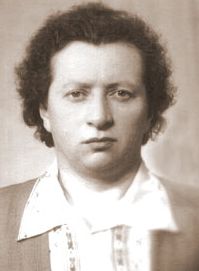
Kateryna Lohvynivna Rvacheva was born on December 8, 1919, in Chyhyryn, in central Ukraine. Her path to mathematics led through the catastrophes of Soviet history: she began her studies at Kyiv University in 1937, at the height of Stalin’s purges, and finished them in wartime evacuation at the Central Asian State University in Tashkent, graduating in 1942. In 1950 she earned her doctorate (Candidate of Sciences) at the Institute of Mathematics of the Ukrainian Academy of Sciences under the probability theorist Boris Gnedenko, and she would later become the first Soviet woman to earn a full doctorate in physical and mathematical sciences for work in programming.
Programming the MESM
The turning point came through hardware. Sergei Lebedev’s MESM, built outside Kyiv between 1948 and 1950, was the first computer to operate in continental Europe (see Soviet and Russian Computing). In 1954 the machine was transferred to the Institute of Mathematics, and Yushchenko joined the small group that operated and programmed it.
Programming the MESM meant what programming meant everywhere in the early 1950s: numeric machine code, absolute memory addresses, no symbolic layer between mathematician and machine (see Assembly, Machine Code, and Bytecode). Out of that experience came her central insight: the address is itself a mathematical object worth manipulating.
The Address Language
In 1955 Yushchenko developed the Address programming language (Адресна мова). Its defining feature was systematic operation on memory addresses, including higher-rank addresses, an address whose content is another address. Dereferencing such a chain is exactly what later languages call indirect addressing; a rank-one address behaves like what C programmers call a pointer.
This mattered for a practical reason: programs written with address manipulation could be relocated flexibly in memory and could express data structures whose shape was not fixed in advance. The language was influenced by the Kyiv logician L. I. Kaluzhnin’s work on mathematical logic and became, in the standard Soviet account, “the first fundamental achievement of the Soviet school of theoretical programming.” Address language and its ideas were used on the major Soviet machine families of the following decade.
Info
Priority, carefully stated. Ukrainian and Russian histories credit Yushchenko with introducing indirect addressing into a programming language earlier than any comparable Western design, the Address language predates FORTRAN (1957), and pointers entered Western mainstream languages only with PL/I and later C (1972). The claim is plausible and widely repeated, but Western and Soviet developments proceeded in mutual ignorance, and “first” claims across the Iron Curtain are hard to adjudicate. What is beyond dispute is independence and earliness: the concept was there, in Kyiv, in 1955.
Building a School
From 1957, Yushchenko worked at the newly founded computing institute in Kyiv that became Victor Glushkov’s Institute of Cybernetics (the center of Soviet computer science) where she headed the theory-of-programming department for four decades. She supervised 47 doctoral students, wrote textbooks from which generations of Soviet programmers learned, became a corresponding member of the Academy of Sciences (1976), and received two USSR State Prizes. Ukraine’s modern software industry (see Ukraine’s Developer Ecosystem) descends in a straight institutional line from the school she built.
Dead End: Science Behind the Curtain
The Address language itself left no direct descendants outside the Soviet sphere, and that is the historically instructive part. Yushchenko published in Russian and Ukrainian, in journals Western computer scientists did not read, under a regime that restricted travel and contact. When Western programming-language history was written (FORTRAN, ALGOL, LISP) the Kyiv school appeared nowhere in it. The same pattern that buried Zuse’s Plankalkül buried the Address language: an idea developed outside the Anglo-American publication network might as well not exist, however sound it is. Soviet computing eventually resigned itself to cloning Western designs (the 1969 ES EVM decision), and the indigenous theoretical tradition Yushchenko founded became a national heritage rather than a world influence. She belongs beside the figures in Women in Computing whose contributions were doubly invisible, as women, and as scientists on the wrong side of a closed border.
📚 Sources
- Wikipedia: Kateryna Yushchenko (scientist)
- Wikipedia: Address programming language
- Wikipedia: MESM
- Image: Kateryna Lohvynivna Yushchenko.jpg by Samoylen (CC BY-SA 3.0), via Wikimedia Commons