The Atari ST
Abstract
The Atari ST arrived in June 1985, designed in about five months by a small team under an owner in a hurry. It put a 16-bit Motorola 68000, a graphical desktop, a mouse, and 512 KB of RAM into a $799 machine at a time when an Apple Macintosh with less memory cost three times as much. In the home-computer market it fought the Commodore Amiga to a draw across Europe and lost in the United States. But one detail its rivals lacked decided its lasting place in history: two MIDI ports on the back, standard. That turned the ST into the default computer of the professional recording studio for a decade, the machine on which Cubase and the software that became Logic were born.
Five Months to Ship
When Jack Tramiel bought Atari’s consumer division in July 1984, he had just been forced out of Commodore, the company he founded. He wanted a 16-bit computer fast and cheap, and he wanted it to beat his former company to market. The engineer he handed the job was Shiraz Shivji, who had worked on the Commodore 64 before following Tramiel to Atari.
Shivji’s team designed the ST in roughly five months. The schedule shaped the machine. Rather than build custom chips the way the Amiga’s designers had, Shivji used off-the-shelf parts wherever possible and a Motorola 68000 doing most of the work directly. The name ST stood for Sixteen/Thirty-Two, after the 68000’s 16-bit external bus and 32-bit internal registers. The first model, the 520ST, shipped in June 1985, weeks before the Amiga reached buyers.
The Hardware
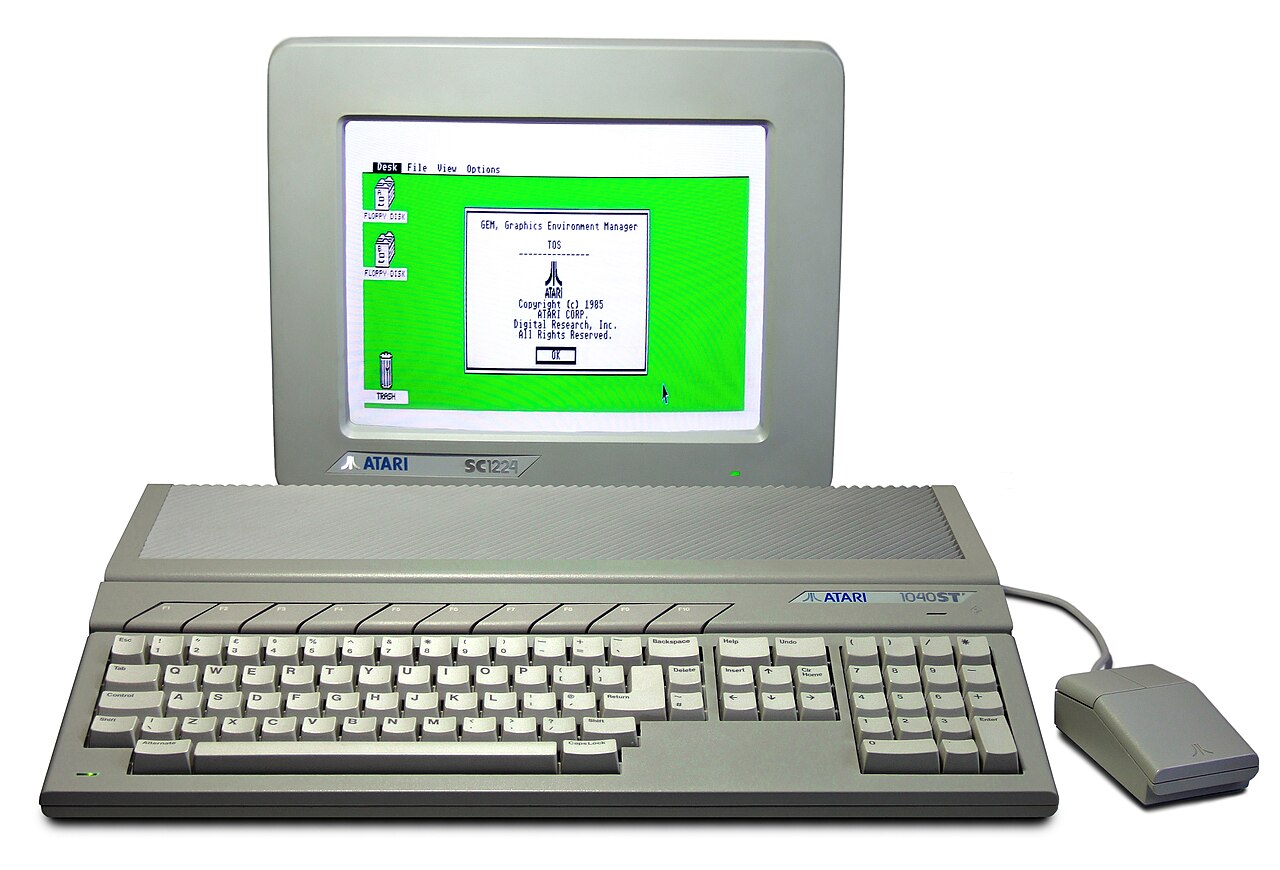
The 520ST ran a Motorola 68000 at 8 MHz with 512 KB of RAM, an external 3.5-inch floppy drive (the 1986 STF models moved it inside the case), and a mouse-driven graphical desktop. The operating system was TOS, with a windowed interface called GEM licensed from Digital Research, the company Gary Kildall had built. It sold for $799.99 with a monochrome monitor and $999.99 with a color one. The comparable Macintosh cost roughly $2,500.
The 1986 1040ST carried 1 MB of RAM and was described at launch as the first computer to cross the threshold of $1,000 per megabyte. Later the Mega ST added a detached keyboard and more memory, and the STE improved graphics and sound. More than three million ST-family machines sold, most of them in Europe, where the ST and the Amiga split the market and their owners split into camps (a rivalry covered in Dead End: The Amiga).
The MIDI Studio
The feature that mattered most was almost an afterthought. Shivji’s team put two MIDI ports on the ST, in and out, as standard equipment. MIDI, the 1983 protocol that let electronic instruments talk to one another (see Computing and Music Creation), was spreading fast, but on every other computer it required a separate interface card or box. On the ST it was already there, and the machine’s interrupt timing was steady enough to keep musical time reliably.
Software followed the hardware. Steinberg released Pro-24 and then, in April 1989, Cubase, a MIDI sequencer whose arrange-page layout still shapes how such programs look. C-Lab shipped Creator in 1987 and Notator in 1988, the latter the first sequencer with interactive real-time notation; the C-Lab team later became Emagic, and Notator’s successor became Logic, which Apple bought in 2002. Both companies established themselves in recording studios worldwide, running on a $799 computer.
Musicians used it because it worked and stayed in time. Depeche Mode ran an ST with Cubase through the sessions for Songs of Faith and Devotion (1993). The Pet Shop Boys replaced a Fairlight CMI, an instrument that had cost as much as a house, with an Atari ST. Producers kept the machines running long after they stopped making sense as general-purpose computers, because the studio setup around them worked and a working studio is not lightly rewired.
Games and Demos
The ST was also a games machine and a demo platform. European studios shipped hundreds of titles for it, often alongside Amiga versions, and its clean 68000 and predictable hardware made it a favorite of the demoscene, where programmers competed to wring effects from it that its five-month design had never anticipated.
Dead End: Atari Leaves the Desk
The ST’s decline tracked the same forces that killed the Amiga. Commodity IBM PC clones grew cheaper and more capable every year, Windows gave them a usable graphical interface by 1990, and the specialized advantages of a 68000 home computer eroded from both ends. Atari, always short of cash under Tramiel, could not invest fast enough to keep pace. It discontinued the ST line in 1993 and gambled its future on the Jaguar game console, which failed, and Atari left the computer business for good.
The machine’s afterlife is in sound rather than silicon. Long after the last ST shipped, the sequencer conventions written for it (the arrange page, the piano-roll edit, real-time notation) remained the working grammar of computer music, and the software lines it launched still run, under other names, in studios that never knew where they came from.
📚 Sources
- Atari ST — Wikipedia
- Shiraz Shivji and the five-month design of the ST — Wikipedia
- “A brief history of Steinberg Cubase” — MusicRadar
- “Instrumental Instruments: Atari ST” — Red Bull Music Academy Daily (2017)
- “In 1985 the Best Music Production Computer Wasn’t a Mac or PC” — Production Expert
- “Sommer 1985: Der 16-Bit-Heimcomputer Atari 520 ST” — Elektronikpraxis 12/2025, p. 6 (sg). Print only; no online edition.
- Image: Atari 1040STf.jpg by Bill Bertram (CC BY-SA 2.5), via Wikimedia Commons