Computing and Music Creation
Abstract
The influence of computing on music divides into two largely separate stories. One (covered in The Digital Music Revolution) is about how digital technology transformed the distribution and consumption of music: MP3, Napster, iTunes, Spotify. The other, less commercially visible but equally profound, is about how computing transformed the creation of music: how the Moog synthesizer gave way to the Prophet-5 and then the DX7; how the Synclavier and Fairlight CMI put computing inside the instrument itself; how MIDI rewired the architecture of every studio on earth; how sampling turned recorded history into raw material; how the DAW moved the studio onto a laptop; and how artificial intelligence arrived to generate music that no human composed. This story begins in 1957 at Bell Labs, traces the forty-year transition from analog voltage-controlled synthesis to digital workstations, and arrives at systems that produce a full song from a text prompt in seconds. Along the way it raises questions about authorship, craft, and what “music” means when the composer is a statistical model trained on everything humans have ever recorded. The visual-art counterpart to this story, from the 1965 plotter drawings of the Stuttgart school to text-to-image models, is told in Computer Art and Generative Art.
The First Computer Music: Bell Labs and Illinois, 1957
Computer music did not begin with the personal computer or the synthesizer. It began with a mainframe, a punch card deck, and a researcher who believed that mathematical processes could produce aesthetic results.
Max Mathews joined Bell Labs in 1955 as a researcher in acoustics and human perception. Bell Labs in the 1950s was the most productive research institution in the world; it had already produced the transistor (1947), information theory (1948), and the first operational cellular telephony concepts, and it gave its researchers unusual latitude. Mathews’s question was whether a digital computer could generate audio by computing the numerical values of a sound wave’s pressure variations and converting them to voltage. In 1957, using an IBM 704 and a custom digital-to-analog converter, he produced the first computer-generated musical sound.
The software Mathews wrote, MUSIC (later MUSIC II through MUSIC V), was the first computer music language. It described music as a collection of unit generators (oscillators, amplifiers, filters, envelopes) connected in a signal flow graph. A composer specified parameters; the program computed the output audio sample by sample. The process was entirely offline: MUSIC ran on the mainframe, generated a tape of audio samples, and the tape was played back on separate equipment. Real-time was not yet possible.
MUSIC’s unit generator concept survived. Every modern audio programming environment (Max/MSP, Pure Data, SuperCollider, and the modular synthesis paradigm) descends from the architecture Mathews designed in 1957. When a musician today connects a virtual oscillator to a virtual filter to a virtual amplifier in a software modular synth, they are using an abstraction Mathews invented on an IBM 704.
Meanwhile, at the University of Illinois in Urbana-Champaign, Lejaren Hiller and Leonard Isaacson were approaching computing and music from the opposite direction. Rather than generating audio computationally, they used the ILLIAC computer to compose notation: a program that applied statistical rules derived from traditional counterpoint, Markov chains, and information theory to generate musical scores. The result was the Illiac Suite for string quartet (1957), the first substantial work with significant computer-assisted composition, performed by human musicians from a score that a computer had written.
The Illiac Suite posed questions that the field has not entirely resolved: Who is the composer when a computer generates a score? Is Hiller the composer, because he wrote the generative rules? Is the computer the composer, because it produced the specific notes? Is the question even meaningful? The Illiac Suite was treated partly as a curiosity and partly as a genuine aesthetic achievement, and the argument has continued in various forms ever since.
The Analog Era: Voltage, Patch Cables, and the Limits of the Physical (1964–1983)
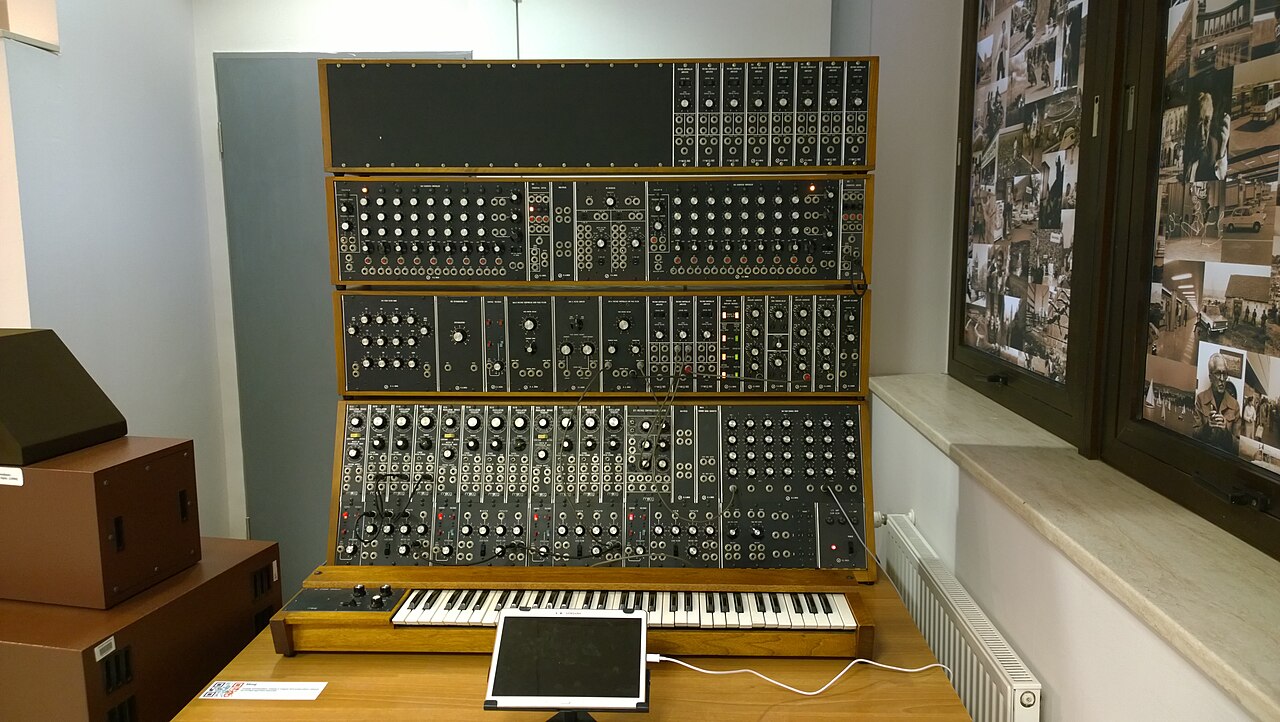
Before digital synthesis, electronic music was built from voltage. The governing paradigm was voltage-controlled synthesis: oscillators whose pitch was set by a control voltage, filters whose cutoff frequency responded to voltage, amplifiers whose gain tracked voltage envelopes. To route a sound through a signal chain, a musician used patch cables, connecting outputs to inputs on a matrix of sockets. Each connection was physical, each patch unique, and nothing could be saved, switching off the instrument erased the sound.
Robert Moog introduced the modular synthesizer at the AES convention in 1964. The Moog synthesizer’s distinctive architecture (subtractive synthesis, in which harmonically rich oscillator output is shaped by a resonant lowpass filter) gave it a character that analog purists still consider unreproduced by digital emulation. Wendy Carlos’s Switched-On Bach (1968), recorded entirely on a Moog, made the instrument famous, demonstrating that the synthesizer could produce music of structural complexity, not merely electronic novelty. The album won three Grammy Awards and sold over one million copies, a commercial result that no electronic music recording had previously achieved.
Don Buchla, working simultaneously in San Francisco, built instruments with a different philosophy: no keyboard (which he considered a step backward into acoustic instrument paradigms), touch-sensitive plates instead of keys, and a focus on unpredictable, evolving timbres suited to experimental composition. The Buchla tradition and the Moog tradition represented a fork that runs through synthesizer design to the present: the keyboard-based instrument optimized for melodic performance versus the modular system optimized for timbral exploration.
The limitations of first-generation modular synthesis were practical as much as musical. A modular synthesizer was large, expensive (a full Moog system cost $10,000–$30,000 in 1970s dollars), monophonic (one note at a time), and thermally unstable: oscillator tuning drifted with temperature. Patch memories did not exist; a sound that took an hour to design was gone when the patch cables were removed.
The Minimoog (1970) addressed the practical limitations by abandoning modularity: a fixed, compact signal path with pre-wired connections, in a single keyboard instrument that cost $1,500. It sacrificed flexibility for reliability and portability. The Minimoog became the synthesizer that appeared on virtually every 1970s rock and jazz-fusion recording that used synthesis (Keith Emerson, Rick Wakeman, Herbie Hancock, Jan Hammer) and established the keyboard synthesizer as a standard band instrument.
Polyphony (playing multiple simultaneous notes) required a separate oscillator, filter, and amplifier circuit for each voice, which made polyphonic analog instruments expensive. The ARP Odyssey (1972) was duophonic (two voices). The Polymoog (Moog, 1975) offered polyphony by dividing the keyboard into zones, each driven by a dedicated oscillator, expensive and heavy. The solution that actually worked was the Prophet-5 (Sequential Circuits, 1978), which used microprocessors to multiplex five complete synthesizer voices through shared digital control circuitry. More importantly, the Prophet-5 had patch memory: 40 programmable preset slots that stored the complete parameter state of a sound. For the first time, a synthesizer player could recall an exact sound reliably, turning synthesis from an ephemeral performance into a reproducible instrument configuration.
The Prophet-5’s microprocessor integration pointed toward digital synthesis without fully arriving there. Its audio signal chain remained analog (the oscillators, filters, and amplifiers all operated on voltage) but digital circuits controlled parameter values and managed voice allocation. The hybrid approach was a transitional form, made necessary by the economics of fully digital audio processing in the late 1970s.
Digital synthesis changed the economics and the sound.
John Chowning was a composer and researcher at Stanford University who, in 1967, discovered a synthesis technique while pushing vibrato rates past audibility in Mathews’s MUSIC program on the Artificial Intelligence Laboratory’s DEC mainframe. He found that frequency modulation, varying the frequency of one oscillator (the carrier) using the output of another (the modulator), produced complex, harmonically rich timbres when both oscillators operated in the audio range. The relationship between carrier frequency, modulator frequency, and modulation depth determined the resulting timbre; small changes in these parameters produced large changes in tone color.
Chowning’s technique, FM synthesis, could produce bright, bell-like, brass, and percussive timbres that analog synthesis could not achieve. More importantly, it was computationally inexpensive: FM synthesis required only multiplication and addition, operations that a relatively simple digital circuit could perform in real time.
Stanford licensed FM synthesis to Yamaha in 1975 in what became one of the most commercially successful technology licenses in the history of the music industry. Yamaha spent eight years developing it into a commercial instrument, a period that produced intermediate steps worth noting.
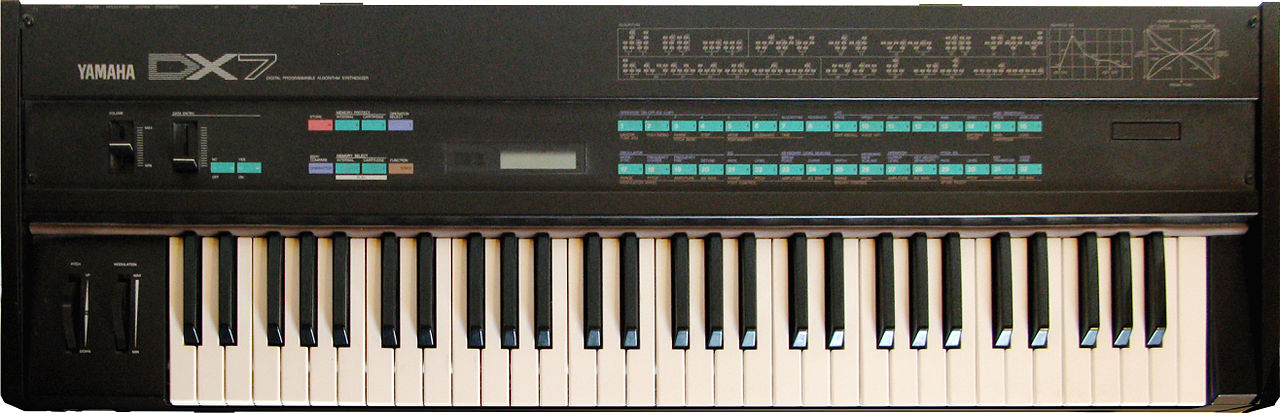
The Yamaha GS-1 (1980) was Yamaha’s first commercial FM synthesizer. It used custom LSI chips to implement FM synthesis in real time and offered a polyphonic keyboard with a touch of the DX7’s characteristic timbral palette. It was also almost entirely unaffordable: the GS-1 cost approximately $16,000 (roughly $60,000 in 2024 dollars), limiting it to professional studios and institutions. The GS-2 followed as a less feature-complete version at somewhat lower cost, and the DX1 (1983) offered a full-featured professional FM instrument at $13,900; only 140 were built. None of these were mass-market products. The result, also in 1983, was the Yamaha DX7.
The DX7 was not the first commercially available FM synthesizer, but it was the first affordable one. At $1,995 (less than any comparable analog polyphonic synthesizer) it brought sixteen-voice polyphony and a tonal palette that included realistic electric piano, vibraphone, marimba, and brass sounds that analog synthesis could not approximate. Yamaha sold 200,000 of them in three years, making it the best-selling synthesizer in history at the time.
The DX7’s sound defined the aesthetic of mid-1980s popular music. The electric piano patch (preset 11, “E. PIANO 1”) appeared on so many recordings between 1983 and 1989 that it became the sonic signature of an era: Whitney Houston, Lionel Richie, Phil Collins, Toto, A-ha, and thousands of other artists built recordings around it. The music of the decade is, in significant part, the music of a Stanford algorithm licensed to a Japanese instrument company.
Chowning’s royalties from the Yamaha license funded Stanford’s Center for Computer Research in Music and Acoustics (CCRMA), which became one of the world’s leading research centers for music technology. The financial consequence of a research discovery in a university computing lab reoriented the institutional landscape of an entire field.
The Late 1980s: Hybrids, Workstations, and the Close of the Analog Era
By 1987 it was clear that pure FM synthesis (dominant since the DX7’s 1983 launch) had both a distinctive sound and a distinctive limitation: it was difficult to program and poor at reproducing acoustic instruments convincingly. Two instruments that arrived in 1987 and 1988 defined the next phase and effectively closed the analog era.
The Roland D-50 (1987) used Linear Arithmetic (LA) synthesis, a hybrid approach that combined short digitally sampled attacks (the initial transient of a piano string being struck, a guitar pick hitting a string) with digitally synthesized sustain portions. The attack transient is the hardest part of acoustic instrument sound to synthesize because it is aperiodic and timbrally complex; by sampling it, the D-50 achieved convincing acoustic realism in the attack while using computationally cheaper synthesis for the sustain. The result sounded more “real” than FM synthesis for acoustic instrument imitation while requiring far less memory than full sample playback. The D-50’s distinctive pads and textures (crystalline, complex, with sampled orchestral attacks) defined late 1980s pop production and film scores.
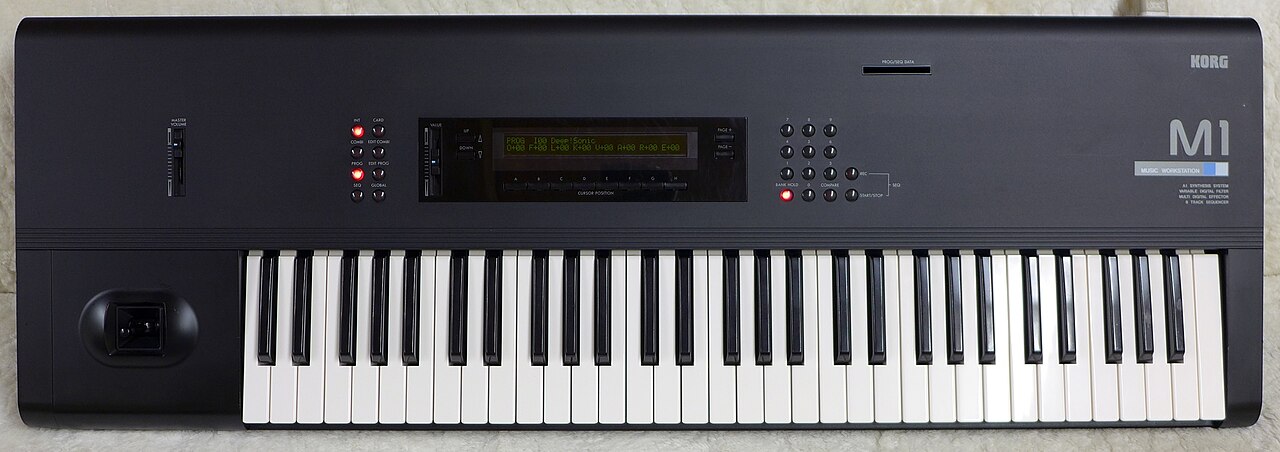
The Korg M1 (1988) went further: it was the first fully successful music workstation, combining multi-timbral sample playback, an onboard sequencer, digital effects processing, and a drum machine in a single keyboard instrument. The M1 used ROM-based samples (sounds stored in read-only memory chips, not loaded from disk) that could not be changed but were selected and played back under software control. At a street price around $2,150 (list $2,749), it was relatively affordable and complete: a musician could produce a full multi-instrument arrangement on the instrument itself without external sequencers, computers, or effects units. The M1 sold an estimated 250,000 units (often cited as the best-selling synthesizer of all time) and its “Universe/Piano” preset appeared on more late-1980s and early-1990s recordings than possibly any other single sound.
The M1 effectively established the rompler (ROM-based sample player) as the dominant commercial synthesizer paradigm for the 1990s, a category that includes the Roland Sound Canvas, the E-mu Proteus series, and eventually the software samplers that replaced them. Analog synthesis retreated to specialist use and the modular revival of the 2010s.
Info
The analog revival (2010s–present): Analog synthesis did not disappear; it retreated and then returned. Eurorack modular synthesis, standardized by Doepfer with the A-100 system (1996) and expanded by hundreds of manufacturers from the 2010s onward, represents the largest variety of analog and hybrid synthesis hardware ever produced. The combination of affordable manufacturing, internet-driven community, and a generation of musicians curious about physical signal processing has made modular synthesis more commercially significant in 2024 than at any prior point.
MIDI: The Protocol That Rewired the Studio
The Musical Instrument Digital Interface (MIDI) is one of the most successful technical standards in the history of consumer electronics: a 1983 protocol that is still in active use, essentially unchanged, over forty years later.
Before MIDI, electronic instruments were islands. A synthesizer from one manufacturer could not control a synthesizer from another. A drum machine could not synchronize with a sequencer. A keyboard player who wanted to trigger sounds from multiple instruments had to play each one separately or build expensive custom interfaces. The studio of the early 1980s was a tangle of proprietary analog control voltages and incompatible clocking signals.
Dave Smith of Sequential Circuits (makers of the Prophet-5 polyphonic synthesizer) proposed a universal digital interface in a 1981 paper presented to the Audio Engineering Society. The specification described a serial protocol (31,250 bits per second over a 5-pin DIN connector) that transmitted musical events: note on, note off, pitch bend, control change, program change, system synchronization. The data rate was a compromise between speed and the available inexpensive hardware of 1981.
The critical move was convincing competitors to adopt it. Smith worked primarily with Ikutaro Kakehashi of Roland, whose buy-in was essential: Roland was among the most influential synthesizer and drum machine manufacturers of the early 1980s (the TR-808 drum machine and the Juno-6 synthesizer were both Roland products). The two companies agreed on the specification and publicly demonstrated MIDI interoperability at the NAMM Show in January 1983, connecting a Sequential Circuits Prophet-600 to a Roland JP-6 synthesizer. Other manufacturers followed rapidly, and MIDI became the universal standard the industry had lacked.
The consequences were immediate and structural. A musician could now use a single keyboard controller to drive multiple synthesizers simultaneously, each playing its own timbre. A sequencer (software or hardware that recorded, edited, and played back MIDI events) could control any MIDI-equipped instrument. The recording studio became programmable. A drum machine’s patterns could synchronize with a synthesizer arpeggiator, with a digital delay unit, with a tape transport, all triggered from a single clock.
Info
MIDI did not transmit audio. This is the most common misunderstanding about the protocol. MIDI transmitted performance data (“key C4 pressed with velocity 80, key C4 released”) not sound. The receiving instrument generated its own audio from those instructions. This meant that the same MIDI sequence could drive a piano sound, a string pad, or a drum kit depending on what instrument received it, and that MIDI data was tiny (a complex musical performance required kilobytes, not megabytes). The distinction between performance data and audio was what made MIDI work: the protocol’s 31.25 kbps data rate was sufficient because it was transmitting instructions, not waveforms.
MIDI had direct compositional consequences. A musician who played a MIDI keyboard poorly could record the performance, correct wrong notes, adjust timing, and change the instrument sound without re-recording. The separation of performance data from sound data made music editable in the way word processors had made text editable. This lowered the barrier to musical production in ways that changed who could make records.
One computer captured that shift more than any other. The Atari ST (1985) shipped with MIDI ports built into every unit, where the Macintosh and the IBM PC needed an add-on interface. That single detail, plus timing steady enough to keep musical tempo, made the ST the standard sequencing computer of professional studios for a decade. Steinberg’s Cubase (1989) and C-Lab’s Notator (whose successor became Logic) were written for it, and acts from the Pet Shop Boys to Depeche Mode ran their studios on it.
The General MIDI standard (1991) extended MIDI to specify 128 standardized instrument sounds by program number (pianos at 1 to 8, chromatic percussion at 9 to 16, guitars at 25 to 32, with channel 10 reserved for the drum kit) ensuring that a MIDI file created on one instrument would trigger approximately equivalent sounds on any GM-compatible instrument. General MIDI enabled the MIDI file format: compact musical scores that any compatible device could play. MIDI files became a primary format for video game music throughout the 1990s, when storage constraints made full audio impossible but MIDI files could describe an entire soundtrack in kilobytes.
The First Digital Workstations: Synclavier and Fairlight (1977–1985)
Before FM synthesis made digital instruments affordable, two systems defined what fully digital music production could be, at a price that put them beyond individual musicians and into the territory of recording studios, universities, and wealthy professionals.
New England Digital (NED), founded in Vermont by Sydney Alonso, Cameron Jones, and Jon Appleton, released the Synclavier I in 1977, an all-digital instrument built around additive synthesis from banks of sine-wave oscillators, with FM available as an option, three years before Yamaha’s first FM product reached the market. Only about twenty Synclavier I systems were built, most of them sold to universities. The Synclavier II (1980) broadened the synthesis engine, and from 1982 an optional 16-bit sampling system let a musician record any sound and play it back at any pitch with millisecond-accurate timing.
The Synclavier’s defining characteristic was completeness: it integrated synthesis, sampling, sequencing, and hard-disk recording into a single system controlled from a unified interface. It was also a complete production environment in hardware form, a decade before DAW software made this possible on general-purpose computers. The price reflected this ambition: a basic Synclavier II cost $25,000 in 1980; a fully configured system with disk storage, the full software suite, and expanded voices reached $300,000–$500,000 by the mid-1980s.
Users included Frank Zappa (who used the Synclavier to realize orchestral compositions without live musicians), Michael Jackson (whose production team, with dedicated Synclavier operator Christopher Currell, used it extensively on Bad in 1987), Sting, Stevie Wonder, and dozens of major artists who could access it through commercial studios. NED ceased operations in 1993, displaced by general-purpose computers and affordable software. The Synclavier is the high-water mark of bespoke digital music hardware: a purpose-built computer for music that was more capable than anything else available and priced accordingly.
Sampling: Digital Memory Becomes an Instrument
Synthesis generates sound from algorithms. Sampling stores recordings of real sounds (a piano note, a drum hit, a human voice) and plays them back at different pitches and speeds under keyboard or sequencer control. The distinction matters musically: a sampled piano sounds like a piano because it is a recorded piano. A synthesized piano sounds like an approximation.
The technical precondition was affordable digital memory. In the late 1970s, an instrument that stored audio samples required expensive custom memory that put it out of reach of most musicians. The price of DRAM fell rapidly enough that by 1979 the first commercial samplers became viable.
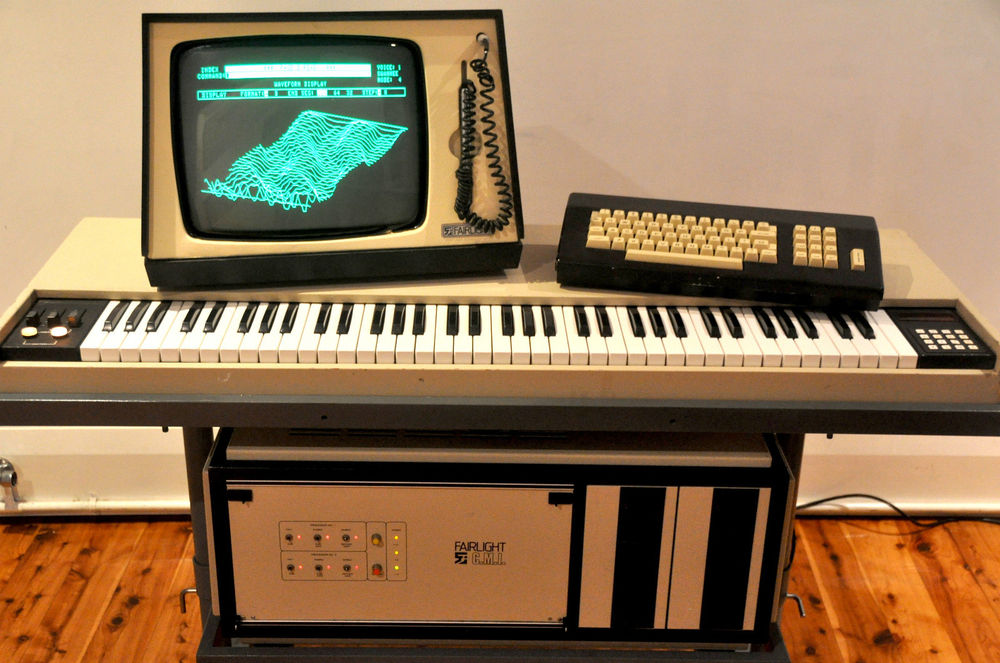
Peter Vogel and Kim Ryrie developed the Fairlight CMI (Computer Musical Instrument) in Sydney, Australia, shipping the first production units in 1979. The Fairlight was architecturally distinct from both the Synclavier and later samplers: it used two 8-bit Motorola 6800 microprocessors, a bespoke operating system (QDOS, derived from Motorola’s MDOS), two 8-inch floppy drives, and a monochrome CRT with a light pen for graphical waveform editing. A user could draw a waveform directly on screen, hear it immediately, and adjust it, an interaction paradigm that anticipated later DAW waveform editing by a decade.
The Fairlight’s Page R (its real-time sequencer) allowed pattern-based composition in a grid layout that directly anticipates the step sequencers and clip launchers of modern production software. Its sampling capability allowed recording any sound into memory and mapping it across the keyboard at pitched intervals. Because the Fairlight stored samples at a single pitch and pitch-shifted them for other keys, the sound quality degraded at extremes, a characteristic artifact that became, for a brief period, a recognizable aesthetic marker.
Its price (roughly $25,000 to $100,000 depending on configuration) limited it to professional studios and wealthy musicians. Kate Bush, who used the Fairlight’s sampled orchestral sounds on The Dreaming (1982) and Hounds of Love (1985), became its most prominent proponent; Bush learned the instrument extensively and credited it as central to her compositional process, not merely as a sound source. The instrument’s distinctive “ORCH5” sample (a recorded orchestral hit, also known as the “Fairlight stab”) appeared on recordings by Bush, Peter Gabriel, Stevie Wonder, Herbie Hancock, and dozens of others; its presence became a sonic signature of early 1980s art pop and progressive production.
The democratization of sampling required cheaper hardware and cheaper memory. The E-mu Emulator (1981, E-mu Systems) brought sampling to $10,000 by using lower sample rates and shorter maximum sample lengths. The Sequential Circuits Prophet-2000 (1985) and the Akai S612 (1985) pushed the floor to $1,200–$2,000. The Roland S-50 (1986) added a graphical editing display. Each generation sacrificed some fidelity for a price point, until the Akai S1000 (1988) delivered 16-bit, 44.1 kHz sampling (CD quality) at $5,000, effectively making professional-grade sample quality commercially available.
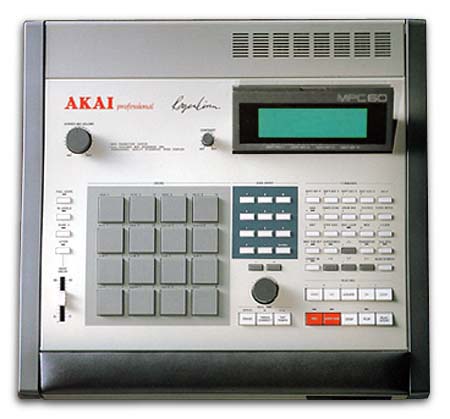
And in 1988, the Akai MPC60, designed by Roger Linn, who had previously invented the first drum machine to use digital samples of real drums (the LM-1, 1980), combined a 16-pad sampler with a step sequencer in a single instrument. The MPC’s interface was physical and tactile: sixteen rubber pads that could be struck to trigger samples, with velocity sensitivity that made the response track how hard you hit.
The MPC became the instrument of hip-hop production. J Dilla, DJ Premier, Pete Rock, Dr. Dre, and virtually every significant hip-hop producer of the 1990s and 2000s used the MPC or one of its successors as their primary instrument. The workflow (chop a sample from a vinyl record, map the pieces to pads, sequence them into a beat) produced the rhythmic and timbral vocabulary of an entire genre. The act of sampling transformed fragments of recorded history into new compositions, raising copyright questions the legal system spent two decades trying to resolve.
Warning
Sampling and copyright law: The legal framework for sampling was established reactively. The Grand Upright Music Ltd v. Warner Bros. Records case (1991) found that rapper Biz Markie had infringed copyright by sampling Gilbert O’Sullivan without clearance. Judge Duffy’s ruling (“Thou shalt not steal”) effectively required that all samples be cleared with copyright holders before use. The subsequent market for sample clearances favored major labels, which both owned large catalogs and could afford the legal infrastructure to negotiate clearances. Independent artists who could not afford clearances either avoided sampling or worked in legal gray zones. The Campbell v. Acuff-Rose Music case (1994, 2 Live Crew vs. Roy Orbison) established that parody sampling could qualify as fair use, but commercial sampling for non-parodic purposes required negotiation. The legal landscape shaped the aesthetics of hip-hop production: after 1991, producers moved toward shorter samples, loop-based production that minimized recognizable original content, and original recording of sampled-style elements.
The Digital Audio Workstation
The digital audio workstation (DAW) is the software that replaced the physical studio for most music production: a program running on a personal computer that records, edits, mixes, and processes audio and MIDI tracks without requiring dedicated hardware.
The preconditions were processing power and storage capacity. Recording audio digitally requires processing enough samples per second (44,100 at CD quality) that early personal computers could not handle it in real time. The systems that first managed it were expensive workstations.
Digidesign (later Avid) released Pro Tools in 1991, initially as a Macintosh application that used proprietary hardware for digital audio processing. Pro Tools replaced physical tape in professional recording studios through the 1990s by offering non-destructive editing (the ability to cut, move, and rearrange audio without destroying the original recording) that tape could not provide. A vocal take could be comped from the best phrases of multiple performances. A mistake could be corrected by replacing individual words. The edit was reversible; the tape was not.
Cubase (Steinberg, 1989) and Logic (Emagic, 1993; acquired by Apple, 2002) brought MIDI sequencing and later audio recording to personal computers at consumer prices. By the late 1990s, a musician with a Mac or PC, a audio interface costing a few hundred dollars, and a DAW could produce recordings of professional quality at home. The home studio (previously available only to musicians wealthy enough to build or rent dedicated recording spaces) became accessible to anyone with a moderately powerful computer.
Ableton Live (2001) introduced a paradigm that existing DAWs had not addressed: live performance. Traditional DAWs organized music along a linear timeline suited for recording and composition. Live’s Session View organized audio and MIDI clips in a grid, allowing musicians to trigger, loop, and combine them nonlinearly in real time. A performer could improvise the arrangement of a set while it was happening, layering loops and dropping elements without the linear timeline imposing structure.
Ableton Live became the central tool of electronic dance music production and performance. The laptop DJ/producer who builds and transforms music live on stage (a performance mode that defines festivals from Coachella to Berghain) typically works in Live. The software also influenced production methods far beyond electronic music: its clip-based workflow influenced the work of hip-hop producers, film composers, and pop songwriters who found the nonlinear arrangement approach more aligned with how they thought about structure.
The DAW era had a specific compositional consequence: it made revision essentially free. Analog tape imposed costs on revision (cutting, splicing, recording over) that shaped how musicians approached composition. A DAW revision costs nothing. The consequence was not only that recordings became more polished but that the creative process changed: producers iterated more, tried more variations, assembled songs from larger pools of raw material. The economics of revision changed the aesthetics of the result.
Auto-Tune and the Politics of Pitch
Andy Hildebrand spent his career as a geophysicist working on reflection seismic signal processing for oil exploration. The technique he developed (using autocorrelation algorithms to detect periodic patterns in seismic data) had nothing to do with music. In 1990 he moved from Exxon to found Antares Audio Technologies, applying his signal processing expertise to audio problems.
In 1997, Antares released Auto-Tune: software that used autocorrelation to detect the pitch of a vocal input and correct it toward the nearest note in a specified musical key. The algorithm detected the fundamental frequency of the incoming audio, measured its deviation from the target pitch, and applied a pitch shift in real time to move the note toward correct intonation. The pitch shift could be applied gradually (for subtle correction that retained the natural character of the performance) or instantaneously (for the robotic effect that became a deliberate aesthetic tool).
Auto-Tune was initially adopted as an invisible corrective tool: a safety net that allowed studio engineers to fix slightly flat or sharp notes without requiring re-recording. Its use was widespread within a year and its existence was not publicly acknowledged; the artifice was a professional secret. The sound of 1990s pop became, in retrospect, the sound of Auto-Tune used transparently.
Cher’s “Believe” (October 1998) changed that. Producer Mark Taylor used Auto-Tune at its most extreme setting (instantaneous pitch correction) on Cher’s vocals, producing a distinctive robotic glitch as her voice snapped between pitches. The effect was unlike anything that had been heard on a major pop release. “Believe” sold over ten million copies. The “Cher effect” or “Auto-Tune effect” entered the lexicon.
The subsequent cultural history of Auto-Tune divides into two streams. One stream, T-Pain, Kanye West on 808s & Heartbreak (2008), Young Jeezy, Future, Travis Scott, embraced the artifact as an expressive tool, a sonic signature of alienation or aspiration that was as legitimate as any other timbre. The other stream used Auto-Tune invisibly, as the industry had from the beginning, and its users sometimes attacked the first stream for “cheating.”
The argument about Auto-Tune is the argument about every digital processing tool, scaled to a culturally visible case: if a tool makes something easier, does using it devalue the result? The answer depends on what you believe is valuable about musical performance, the physical difficulty of producing correct pitch, or the emotional content that correct pitch serves. Auto-Tune’s widespread adoption suggests that most listeners, most of the time, are indifferent to the means and attentive to the effect.
Algorithmic Composition and Generative Music
Hiller’s Illiac Suite opened the question of computer-assisted composition; subsequent decades accumulated a range of answers.
Brian Eno developed the concept of generative music (music produced by a system that continuously generates unpredictable output within defined parameters) through a series of albums beginning with Discreet Music (1975) and Ambient 1: Music for Airports (1978). Eno’s early generative systems were based on tape loops of different lengths, not computers: loops that cycled at different speeds would combine and recombine without repeating. The compositional act was designing the system and its parameters, not composing the specific output.
By the 1990s, Eno was working with software that implemented the same principles computationally. His Koan collaboration and later the Bloom iOS application (2008, with Peter Chilvers) generated ambient music in real time on a mobile device, each playback different, infinite in duration, produced by generative algorithms rather than recorded sequences.
Miller Puckette at IRCAM in Paris developed Max (1986), a visual programming language for music and multimedia that allowed composers to construct real-time signal processing and algorithmic systems by connecting on-screen objects without writing traditional code. Max (later Max/MSP, later Max/MSP/Jitter) became the standard environment for computer music composition. Pure Data, Puckette’s open-source successor, is widely used in academic music technology.
SuperCollider (James McCartney, 1996) provided a text-based programming language specifically designed for real-time audio synthesis and algorithmic composition. Its community of users has produced an extensive body of work and contributed to a practice in which writing code and composing music are indistinguishable activities.
Info
IRCAM, the institutional center: The Institut de Recherche et Coordination Acoustique/Musique (IRCAM), founded in Paris in 1977 under the direction of composer Pierre Boulez, was the institutional center of computer music research in Europe. IRCAM developed spectral analysis and resynthesis techniques, computer-assisted orchestration tools, and the Max environment. The concentration of compositional ambition and computational resources in a single institution produced major works by composers including Tristan Murail, Gérard Grisey, Kaija Saariaho, and George Benjamin. IRCAM’s influence on academic computer music was roughly analogous to CCRMA’s, and together they defined the institutional landscape of a field that sat at the intersection of musicology, computer science, and studio practice.
The MOD Format and the Demo Scene
Parallel to the institutional and commercial development of computer music, a grassroots practice emerged from the limitations of home computer hardware.
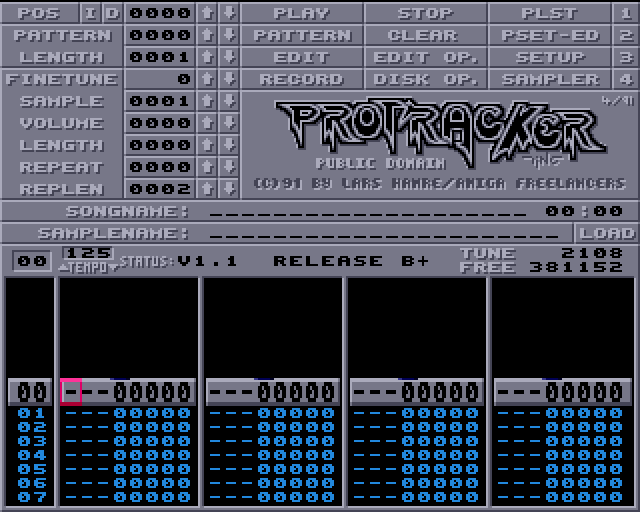
The MOD format was created by Karsten Obarski for the Amiga in 1987. A MOD file contained both sample data (short recordings of instruments or sounds) and a sequence of patterns specifying which samples to play at what pitch and when. The Amiga’s Paula chip played four independent audio channels via DMA, allowing the computer to produce four-channel polyphonic music without burdening the CPU. A MOD file containing a few hundred kilobytes of sample data could produce minutes of music.
The format spread through the demo scene, the European (primarily Scandinavian, German, and British) community of programmers who competed to produce audiovisual demonstrations that maximized the capabilities of constrained hardware. Demo scene musicians, called trackers (after the tracking software used to create MOD files), produced thousands of pieces that circulated on floppy disks through the early 1990s. The Mod Archive, online for over 30 years, preserves hundreds of thousands of these pieces.
Tracker music had distinctive aesthetic properties shaped by its constraints. The four-channel limit encouraged rhythmic density and counterpoint. The small sample library encouraged reuse and creative repurposing. The community’s competitive culture drove technical innovations, the ProTracker, FastTracker 2, and Impulse Tracker formats extended the original MOD format to more channels, higher sample resolution, and better effects. Video game soundtracks for Amiga, DOS, and early console games were frequently MOD-based; the aesthetic is instantly recognizable to anyone who played European games of the period.
The MOD tradition fed directly into contemporary music production. The tracker paradigm (patterns, channels, rows, effects) influenced DAW design and survives in tools like Renoise (2002), which applies the tracker interface to modern audio production.
Neural Networks and the End of the Composer?
The most recent phase of computing’s influence on music creation is the most disruptive in its implications, though its aesthetic consequences are still developing.
Neural network approaches to music generation progressed rapidly through the 2010s. Google’s Magenta project (2016) applied recurrent neural networks to melody continuation and style transfer. OpenAI’s MuseNet (2019) extended this to multi-instrument composition across multiple styles, generating four-minute pieces in styles ranging from Chopin to Lady Gaga. OpenAI’s Jukebox (2020) generated raw audio (not MIDI or notation, but actual waveforms) conditioned on artist, genre, and lyrical content, producing recognizable (if uncanny) pastiche of specific musicians.
These systems operated as prediction models: trained on large corpora of music, they learned to predict what came next, token by token, and used that predictive capability to generate new sequences. The architecture was the same transformer that powered text generation (discussed in The Transformer Architecture), attention-based sequence models that learned long-range dependencies in training data.
Suno (2023) and Udio (2024) brought this to consumer products: text-prompt-to-song systems that could generate a complete song (vocals, instrumentation, mix) from a description like “upbeat country song about a software bug.” The output was recognizably musical, with human-sounding vocals, conventional song structure, and production quality that would have required a professional studio a decade earlier. The systems had learned not just to generate notes but to simulate production aesthetics, vocal performance styles, and genre conventions.
The implications are genuinely unresolved. If a text-to-music system can produce a technically competent song in seconds, what is the value of the human composer’s craft? The answer depends on what that craft provides. One answer: efficiency. For music that must exist (advertising jingles, background music for video, functional accompaniment) the efficiency gain is real and the aesthetic requirements are modest. Another answer: meaning. A human composer who writes a song about a specific grief, a specific relationship, a specific moment in time produces something that a statistical model cannot, because the model has no grief, no relationship, no moment. Whether listeners care about this difference is an empirical question that the market is currently answering.
The copyright question raised by AI music systems recapitulates the sampling question from three decades earlier, at greater scale. If a model is trained on recordings whose creators were not compensated and did not consent, is the model’s output infringing? The legal frameworks of 2024 do not clearly answer this, and the courts are building precedent in real time.
The Continuous Thread
Computing’s influence on music creation is not a series of revolutions but a continuous thread of tools that progressively lowered the barriers between musical ideas and their realization.
Before MUSIC at Bell Labs, producing the sound of a specific synthesis required building analog circuits. After it, it required writing code. Before the DX7, polyphonic synthesizers cost tens of thousands of dollars. After it, they cost two thousand. Before the MPC, drum machine production required dedicated hardware. After it, it required a sampler and a record collection. Before the DAW, professional-quality recording required a professional studio. After it, it required a laptop. Before Auto-Tune, a vocal performance required the singer to hit the notes. After it, it required them to approximate the notes.
At each stage, the barrier lowered by computing enabled a new group of people to make music they previously could not. At each stage, critics argued that the lowering devalued what had been produced above the barrier. And at each stage, the music that emerged from behind the new lower barrier included work of genuine artistic consequence, because the barrier had never been the art.
The question now is whether the final barrier (the requirement that a human being make any creative decision at all) is also just a barrier, or whether it is the art itself. The history of computing and music creation does not answer this question. It only makes it urgent.
📚 Sources
- Image: 1973 Moog modular synthesizer.jpg by Attila Szász (CC BY-SA 4.0), via Wikimedia Commons
- Image: Yamaha DX7.jpg by Leo-setä (CC BY 2.0), via Wikimedia Commons
- Image: Korg M1 (2017-02-10 22.06.29 by deepsonic).jpg by deepsonic from Switzerland (CC BY 2.0), via Wikimedia Commons
- Image: Fairlight CMI-IIx.jpg by Peter Wielk (CC BY-SA 4.0), via Wikimedia Commons
- Image: Akai MPC60.jpg by Kimi95 (CC BY 3.0), via Wikimedia Commons
- Image: Protracker v1.1 by Lars Hawre 1991 01.png by Javier Perez Montes (CC BY-SA 4.0), via Wikimedia Commons
- Trevor Pinch & Frank Trocco: Analog Days: The Invention and Impact of the Moog Synthesizer (2002) — Harvard University Press
- Wendy Carlos: Switched-On Bach liner notes (1968)
- Prophet-5 — Wikipedia
- Synclavier — Wikipedia
- Fairlight CMI: History — Peter Vogel Instruments
- Orchestra hit — Wikipedia
- Roland D-50 — Wikipedia
- Korg M1 — Wikipedia
- Mathews, Max V.: “The Digital Computer as a Musical Instrument” — Science 142(3592): 553–557 (1963)
- Lejaren Hiller and Leonard Isaacson: Experimental Music (McGraw-Hill, 1959)
- John Chowning: The Synthesis of Complex Audio Spectra by Means of Frequency Modulation — Journal of the Audio Engineering Society (1973)
- Yamaha DX7 — Wikipedia
- MIDI — Wikipedia
- Akai MPC — Wikipedia
- Grand Upright Music Ltd v. Warner Bros. Records (S.D.N.Y. 1991)
- Auto-Tune — Wikipedia
- Brian Eno: Generative Music — Talk at MUTE (1996)
- IRCAM: History and Mission — IRCAM Official Site
- Jukebox: A Generative Model for Music — OpenAI (2020)
- The Mod Archive — History of Tracker Music
- Ableton Live — Wikipedia