The Xerox PARC Revolution
Abstract
Between 1970 and 1981, Xerox PARC (Palo Alto Research Center) built the graphical user interface, refined the computer mouse, invented Ethernet and the laser printer, and wrote Smalltalk, the first fully object-oriented language. Xerox made money from exactly one of these. The rest reached the market through Apple, Microsoft, 3Com and others, often carried there by the people who had built them.
The Laboratory
In 1970, Xerox dominated the office copier market and worried that a “paperless office” might one day make copiers obsolete. Chief scientist Jacob “Jack” Goldman, backed by CEO Peter McColough’s ambition to make Xerox “the architect of information”, founded a second research center in Palo Alto, California: the Palo Alto Research Center (PARC), opened on 1 July 1970 with physicist George Pake as its first leader. The mandate was to invent the future of information processing.
Under Bob Taylor, who had run ARPA’s computing office and ran PARC’s Computer Science Laboratory (associate manager from 1970, manager 1977 to 1983), the lab recruited from the ARPA research community and let its researchers set their own agendas. Corporate research labs of the day mostly worked on incremental product improvements; PARC did not.
The People
Alan Kay and the Dynabook
Alan Kay, a former professional jazz guitarist turned computer scientist, joined PARC in 1970 with a design for a portable personal computer the size of a notebook that a child could use, the Dynabook. It was never built, but it set the target for much of what PARC did next.
Kay’s lasting work was a language. Smalltalk built everything out of objects sending “messages” to one another. Simula 67 had introduced classes and objects; Smalltalk was the first language in which they were the whole system. Objective-C, Java, Ruby and Python all list it among their influences. At a 1971 meeting with Xerox planners who kept asking him about future trends, Kay answered: “The best way to predict the future is to invent it.”
Smalltalk and Object-Oriented Programming
Smalltalk, developed at PARC between 1972 and 1980, established object-oriented programming (OOP), the paradigm in which programs are built from self-contained “objects” that combine data and behavior. OOP underlies C++, Java, Python, Ruby, and Swift.
Charles Thacker, Butler Lampson, and the Alto
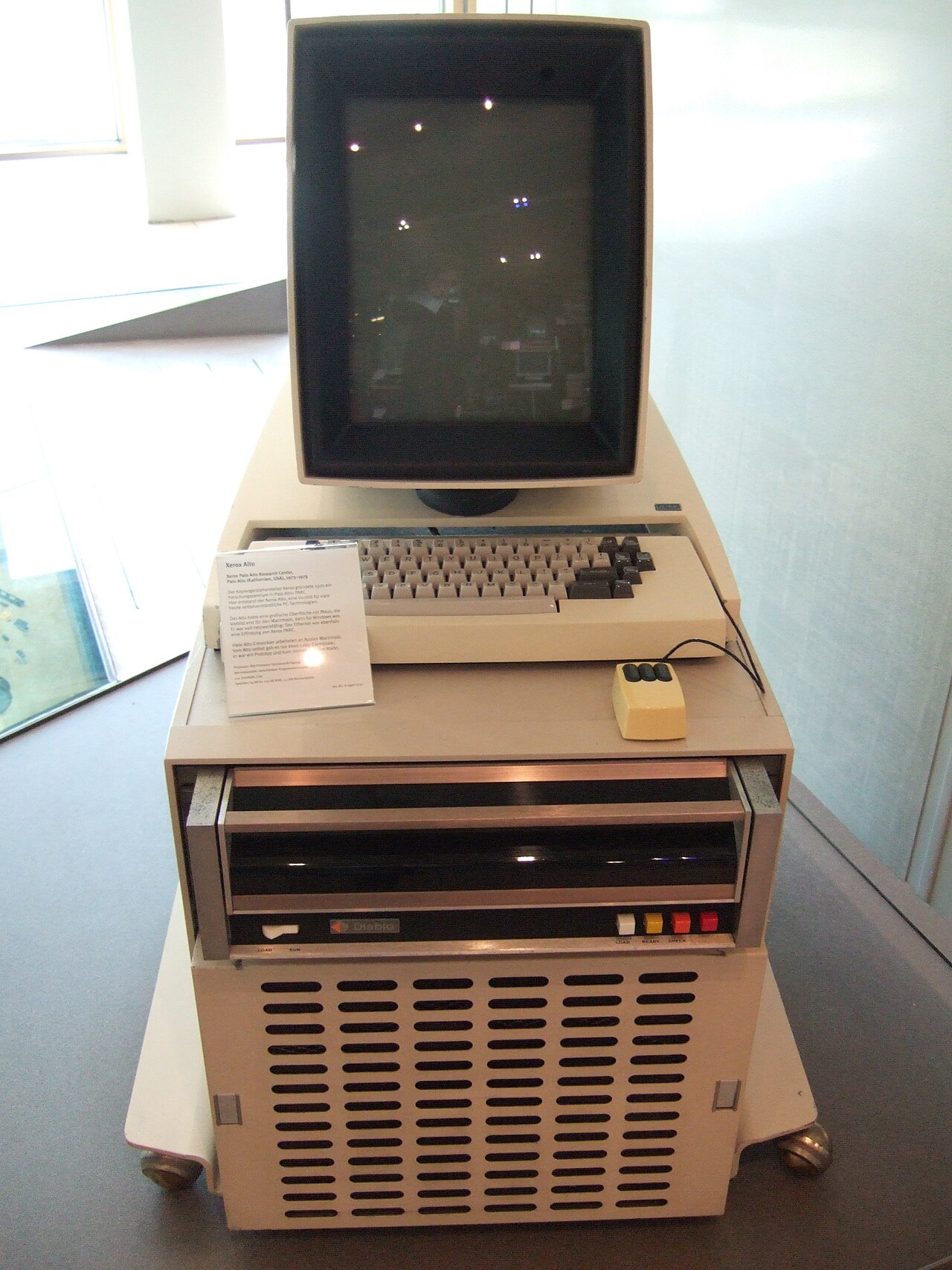
Charles Thacker and Butler Lampson designed the Alto workstation in 1973. It assumed from the start that each user would have a dedicated machine, at a time when the standard model was an expensive shared mainframe.
On the Alto, PARC built most of the WIMP paradigm (windows, icons, menus, pointer): overlapping windows, menus, and mouse pointing, largely through the Smalltalk environment. The last piece, icons and the desktop metaphor, was the work of David Canfield Smith for the Alto’s commercial successor, the Xerox Star.
The WIMP Model
WIMP shifted human-computer interaction from remembering commands to recognizing options: windows to organize tasks, icons as metaphors for files and applications, menus to list available actions, a pointer to navigate. It still governs nearly every desktop operating system.
Bob Metcalfe and Ethernet
With a room full of Altos, PARC needed a way to connect them. Bob Metcalfe, a new PhD from Harvard, and David Boggs built Ethernet in 1973, a packet-switching protocol for local area networks. Metcalfe adapted the idea from the ALOHANET radio network at the University of Hawaii to high-speed wired connections.
Ethernet let workstations share printers, file servers, and later the wider internet. It remains the standard for wired local networks more than fifty years on.
Gary Starkweather and the Laser Printer
Gary Starkweather came to PARC after colleagues at Xerox’s main research division in Webster, New York dismissed his ideas. In 1971 he modified a Xerox copier to accept input from a computer, using a laser to draw the image onto the photosensitive drum: the first laser printer.
Starkweather fought Xerox management for years to get funding. Inside PARC the technology ran as the Dover research printer; Xerox commercialized it as the 9700 in 1977, a machine that generated over a billion dollars a year and became the one PARC invention Xerox itself cashed in. The desktop laser printer market of the 1980s, built on Canon engines sold by HP and Apple, went to other companies.
The Mouse
A Note on Credit
The computer mouse was not invented at PARC. Douglas Engelbart invented it at the Stanford Research Institute (SRI) and demonstrated it in December 1968 in the “Mother of All Demos”. PARC’s engineers reduced it from a complex, expensive mechanism to a simpler, cheaper ball-based design and made it the Alto’s primary input device.
The Apple Visit
In December 1979, a delegation from a small company in Cupertino visited PARC. Steve Jobs and a team of Apple engineers had negotiated access to the lab in exchange for letting Xerox’s venture arm buy 100,000 pre-IPO Apple shares at $10.50, about a million dollars’ worth. In a few hours Jobs saw the Alto’s graphical interface, the mouse, overlapping windows, and the Smalltalk environment.
“Why aren’t you doing anything with this?” Jobs reportedly demanded of his guide. “This is the greatest thing! This is revolutionary!”
Apple’s engineers took notes. Within months, the team working on the Lisa (and later the Macintosh) began incorporating what they had seen. Jobs later acknowledged the debt in his own way: “Picasso had a saying: ‘Good artists copy, great artists steal.’ We have always been shameless about stealing great ideas.”
When Jobs accused Bill Gates in 1983 of ripping off the Macintosh for Windows, Gates answered: “I think it’s more like we both had this rich neighbor named Xerox and I broke into his house to steal the TV set and found out that you had already stolen it.”
Dead End: The Missed Market
Xerox owned every major building block of personal computing (the GUI, the mouse, Ethernet, the laser printer, object-oriented programming) and profited from one of them. The reasons were structural.
The copier company problem. Xerox’s corporate identity, sales force, and profit model were built around photocopiers. The Alto was a $32,000 machine, never sold commercially, in an era when copiers sold for a fraction of that. The business units that set Xerox’s strategy had no framework for pricing or selling a personal computer.
The Star’s pricing. When Xerox commercialized the Alto’s ideas as the Xerox Star in April 1981, it priced the workstation at $16,595, roughly ten times the base price of the IBM PC that appeared the same year, and a working office installation with file server and laser printer ran about $75,000. The Star was technically ahead in almost every way. It sold about 25,000 units before being discontinued in 1985; the IBM PC sold in the millions.
Myth: Xerox invented the graphical interface and then did nothing with it.
Xerox shipped it. The Star 8010 went on sale on 27 April 1981, almost three years before the Macintosh, with overlapping windows, icons, folders, a two-button mouse, WYSIWYG editing, Ethernet and a shared laser printer, built by a team of more than 200 people under David Liddle and written in Mesa on the Pilot operating system. What Xerox did not do was price it for anyone outside a large corporate document department: $16,595 for a workstation and about $75,000 for a working installation, against $1,565 for the base IBM PC of the same year. Roughly 25,000 were sold. The 1985 successor, the Xerox 6085 running ViewPoint, came down to a little over $6,000, by which time the Macintosh cost $2,495. The failure was pricing and packaging, not a refusal to commercialize. See Myths and Misconceptions.
Distance. PARC was physically and culturally isolated from the rest of Xerox: corporate headquarters had moved to Stamford, Connecticut in 1969, and the copier business and its engineering stayed in Rochester and Webster, New York, a continent away from Palo Alto either way. Researchers complained for years that visiting executives failed to grasp what they were seeing. PARC’s inventions had to travel upward through several layers of management skeptical of anything outside the copier business.
The talent drain. Many of PARC’s researchers left to found or join startups, taking their ideas with them. Alan Kay went to Atari and later Apple. Bob Metcalfe founded 3Com to commercialize Ethernet. Gary Starkweather moved to Apple. The exodus hollowed out the institution that had produced the ideas.
Structural Lesson
Invention and commercialization need different organizational cultures, and a research lab optimized for radical ideas can be starved by a parent optimized for a different business. Compare The Lisp Machine Era, where the failure came from the market; here it came almost entirely from inside.
The ideas left anyway. The GUI reached the mass market through Apple’s Macintosh (1984) and Microsoft Windows (1985). Ethernet became the standard for wired networking. The laser printer created a new industry. Object-oriented programming became the dominant paradigm of software development. For how these ideas entered the mass market, see The Personal Computing Explosion; the language side is in The Rise of High-Level Languages.
📚 Sources
- Smith, Douglas K. & Alexander, Robert C.: Fumbling the Future: How Xerox Invented, then Ignored, the First Personal Computer (1988), William Morrow
- Hiltzik, Michael: Dealers of Lightning: Xerox PARC and the Dawn of the Computer Age (1999), HarperBusiness
- Kay, Alan: “The Early History of Smalltalk” — ACM SIGPLAN Notices, Vol. 28, No. 3 (1993)
- Metcalfe, Robert & Boggs, David: “Ethernet: Distributed Packet Switching for Local Computer Networks” — Communications of the ACM, Vol. 19, No. 7 (1976)
- Engelbart, Douglas: “Mother of All Demos” — SRI International, December 9, 1968 (video archive)
- Isaacson, Walter: Steve Jobs (2011), Simon & Schuster — Chapter “Picasso”
- Xerox Celebrates Xerox 9700 Innovation (Xerox Newsroom) — the 9700 launched 1977, routinely more than one billion dollars in annual revenue
- IEEE Milestone: Development of the Commercial Laser Printer, 1971–1977 (ETHW) — the Dover as PARC’s research printer, laser printing demonstrated 1971, computer-generated images 1972
- PARC (Wikipedia) — founded 1 July 1970 by chief scientist Jack Goldman, George Pake as first leader, Bob Taylor as CSL associate manager 1970–1977 and manager 1977–1983
- Xerox Alto (Wikipedia) — first machines 1 March 1973, designed mostly by Thacker, $32,000, roughly 2,000 built, never sold commercially
- Xerox Star (Wikipedia) — introduced 27 April 1981, $16,595 per workstation, about $75,000 for a basic installation, roughly 25,000 sold, David Canfield Smith’s icons and desktop metaphor, David Liddle leading a team of over 200, Mesa and the Pilot operating system, the system’s slowness, and the 1985 Xerox 6085 with ViewPoint at a little over $6,000
- IBM Personal Computer (Wikipedia) — debuted 12 August 1981 at $1,565 for the base configuration
- Macintosh 128K (Wikipedia) — launched 24 January 1984 at $2,495
- History of Xerox Corporation (FundingUniverse) — the 1969 headquarters move from Rochester to Stamford, Connecticut
- What Really Happened: Steve Jobs @ Xerox PARC ‘79 (Living Computers Museum) — the December 1979 visits, Xerox Development Corporation’s purchase of 100,000 Apple shares at $10.50
- Quote Investigator: “We Cannot Predict the Future, But We Can Invent It” — Kay’s own account of the 1971 meeting with Xerox planners
- Smalltalk (Wikipedia) — languages listing Smalltalk as an influence, including Objective-C, Java, Ruby and Python
- Gary Starkweather (Wikipedia) — the Webster Research Center and the 1971 PARC system
- Andy Hertzfeld: A Rich Neighbor Named Xerox (folklore.org) — the 1983 Jobs–Gates confrontation and the “rich neighbor” quote