The MIT Media Lab
Abstract
The MIT Media Laboratory opened in 1985 in a new I. M. Pei building on MIT’s east campus, the result of seven years of fundraising by Nicholas Negroponte and the former MIT president Jerome Wiesner. It grew out of Negroponte’s Architecture Machine Group, whose Aspen Movie Map of 1978–79 was a street-level virtual tour of a town funded by the Pentagon, and it ran on a model unusual for a university: companies paid a membership fee into a common pool, and researchers judged by what they could show working, under the motto “demo or die.” The lab’s people produced LEGO Mindstorms, Scratch, E Ink, affective computing, the hardware behind One Laptop per Child, and the company that made Guitar Hero. The model also produced a Dublin offshoot that the Irish government paid €35 million to start and that went into liquidation in 2005, and in 2019 the revelation that the lab’s director had taken money from Jeffrey Epstein after his conviction and hidden it as anonymous.
Arch Mac
Negroponte, an MIT architecture graduate, founded the Architecture Machine Group with Leon Groisser in the School of Architecture and Planning in the late 1960s. “Arch Mac” began with the idea of computers that would help design buildings and turned into a laboratory for interfaces, with much of its money coming from military research agencies.
Its best-known project came out of a military lesson. After the Israeli raid on Entebbe in 1976, in which commandos had rehearsed on a mock-up of the airport, ARPA wanted a way to let soldiers learn an unfamiliar place quickly. The Aspen Movie Map, led by Andrew Lippman, filmed the streets of Aspen, Colorado in 1978 and 1979 with four 16mm cameras on a car, one frame every ten feet, and stored the footage on laserdiscs; a user at a touch screen could drive through the town, turn at any corner and look in four directions. In 1980 Richard Bolt’s “Put-That-There” let a user in a chair move objects on a wall-sized screen by pointing and speaking. Lippman and Walter Bender, who had worked on the Movie Map, became senior figures in the lab that followed.
Demo or Die
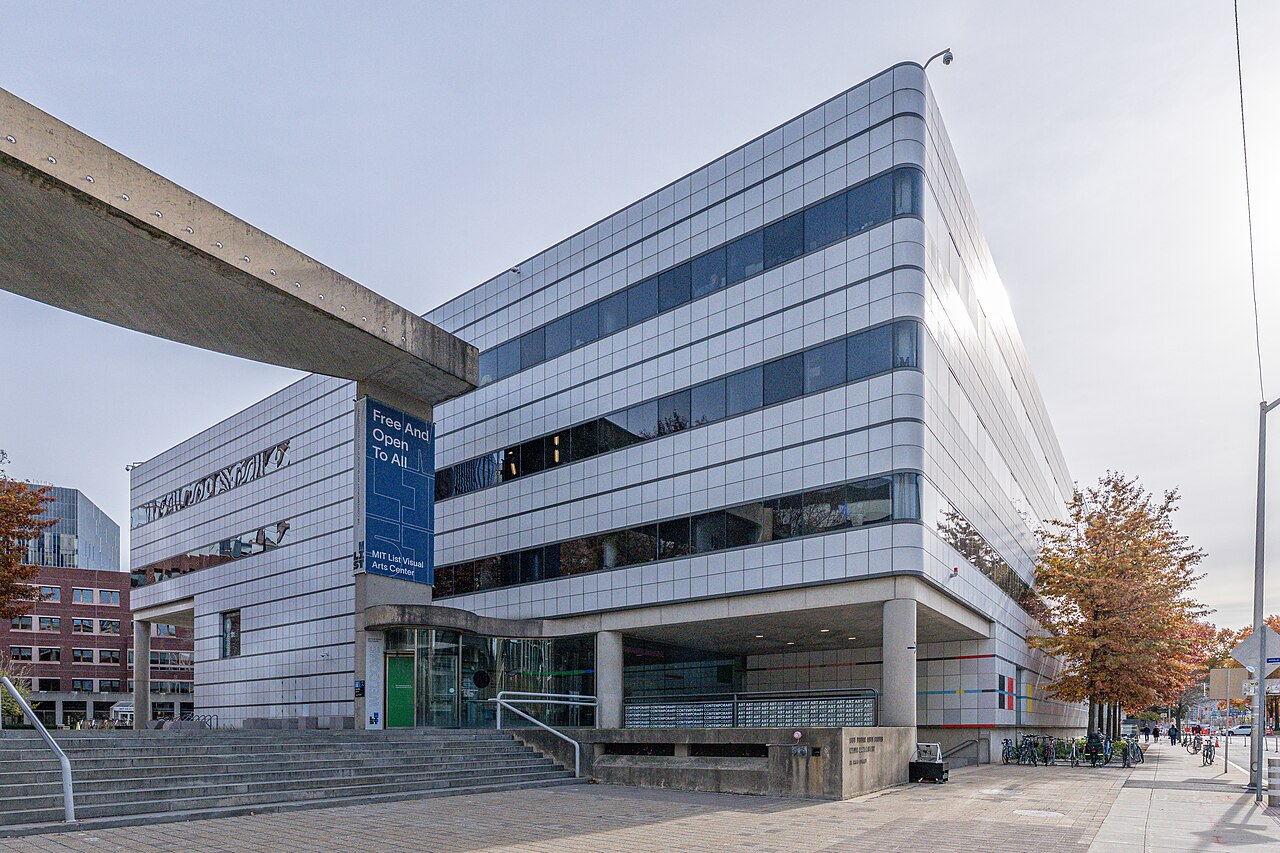
Negroponte and Wiesner, who had been John F. Kennedy’s science adviser, pitched a lab for the convergence of broadcasting, publishing and computing, and toured and lectured for seven years to raise the money. The result was a $45 million facility, the Wiesner Building, dedicated in 1985. It combined Arch Mac with Muriel Cooper’s Visible Language Workshop, the Center for Advanced Visual Studies and Barry Vercoe’s computer music group, and brought in Marvin Minsky and Seymour Papert as faculty.
Stewart Brand, who worked there for three months in 1986 and wrote The Media Lab: Inventing the Future at M.I.T. (1987), described a place funded by a hundred sponsors, most of them corporate and many of them Japanese, from IBM, General Motors and the Washington Post to Sony, NEC and the toy maker Bandai. Sponsored research came to $3.7 million in fiscal 1985–86 and $6 million the next year, against about $1 million a year from MIT’s academic budget. Sponsors bought access to all the lab’s work rather than a particular contract; Negroponte told Brand that for less than $200,000 a sponsor was “not really worth our time.” Brand also recorded the lab’s motto. The byword, he wrote, was not “publish or perish” but “demo or die”: “make the case for your idea with an unfaked performance of it working at least once.” In the 2020s the lab had roughly 90 member companies paying at least $250,000 a year toward an operating budget of $75–80 million.
What It Made
The groups produced a long list of things that later reached the market, often through students who left to start companies:
- Papert’s group, with the LEGO Group as sponsor, built programmable bricks that shipped as LEGO Mindstorms in 1998; Mitchel Resnick’s Lifelong Kindergarten group then built Scratch, released in 2007, the most widely used programming environment for children (see Computer Science Education).
- Joseph Jacobson’s students developed microencapsulated electronic ink and founded E Ink in 1997, whose displays went into the Kindle.
- Rosalind Picard founded the field of affective computing with her 1997 book of that name; her lab’s spin-off Affectiva was co-founded by Rana el Kaliouby.
- Two students in Tod Machover’s music group, Alex Rigopulos and Eran Egozy, founded Harmonix on 10 May 1995; it developed Guitar Hero and Rock Band.
- Neil Gershenfeld’s course “How to Make Almost Anything”, first taught in 1998, led to the network of Fab Labs; the wearable-computing project began in the early 1990s.
- Cynthia Breazeal, whose robot Kismet was built at the AI Lab, set up the Personal Robots group at the Media Lab, and Mary Lou Jepsen, a Media Lab alumna, became the first employee of One Laptop per Child, which Negroponte launched from the lab in 2005.
Dead End: Media Lab Europe
In July 2000 the Irish government and MIT opened Media Lab Europe in a former Guinness building in Dublin’s Liberties, with €35 million of Irish public money to start and the expectation that corporate sponsors, as in Cambridge, would carry it afterwards. A Media Lab Asia in India was started the following year. The sponsors did not come in the numbers needed after the dot-com crash, MIT would not award degrees for work done there, and Irish reviews criticised its management and its low output of patents. When the government and MIT could not agree on a new funding model, the board announced a voluntary liquidation on 14 January 2005, and the lab closed on 1 February with about 100 staff and fourteen patent applications to its name. Negroponte’s explanation was that “the bursting bubble and downturn in the digital and telecommunications industries made a difficult task impossible.” A membership model that depended on companies wanting to be near MIT did not travel to a place that was not MIT.
The Epstein Money
Negroponte handed the directorship to Walter Bender in 2000; Frank Moss followed in 2006 and the internet entrepreneur Joi Ito in 2011. On 15 August 2019, days after Jeffrey Epstein’s death in jail, Ito apologised for having taken money from him for the lab and for his own investment funds; on 4 September he told staff the sums were $525,000 for the lab and $1.2 million for his funds. On 6 September The New Yorker published Ronan Farrow’s account, based on documents from a former development associate, Signe Swenson, of how the lab had solicited Epstein’s money after his 2008 conviction and recorded it as anonymous; staff had referred to him as “Voldemort”. Ito resigned the next day. At the end of that 4 September meeting Negroponte had defended the donations: “If you wind back the clock, I would still say, ‘Take it’” (see Nicholas Negroponte).
MIT’s review by the law firm Goodwin Procter, published on 10 January 2020, counted ten Epstein donations to MIT between 2002 and 2017, totalling $850,000. The first, $100,000 in 2002, went to Marvin Minsky; the nine after the conviction totalled $750,000, of which the Media Lab received $525,000 and the physicist Seth Lloyd $225,000. Three MIT vice presidents had known since 2013 that the lab was taking money from a convicted sex offender and had allowed it on condition that it stay anonymous. Epstein had visited the campus nine times between 2013 and 2017. The report found no evidence for the New Yorker’s claim that Epstein had directed $7.5 million from Bill Gates and Leon Black to the lab.
Dava Newman became director in 2021. In 2025 the lab split the job: Tod Machover became faculty director in July, and Jessica Rosenworcel, who had just stepped down as chair of the US Federal Communications Commission, executive director in September.
📚 Sources
- Brand, Stewart, The Media Lab: Inventing the Future at M.I.T. (Viking, 1987), digitised text (“Demo or Die”, the $45 million I. M. Pei facility, seven years of fundraising by Negroponte and Wiesner, a hundred sponsors, $3.7 million and $6 million in sponsored research, the $200,000 remark, the 1985 Wiesner Building dedication)
- MIT Media Lab, Wikipedia (directors and their dates, about 90 members at a minimum of $250,000, the $75–80 million budget, the Architecture Machine Group origin, Media Lab Asia, the Epstein donations to individual researchers)
- Aspen Movie Map, Wikipedia (ARPA funding, the Entebbe motive, Lippman, four cameras every ten feet, laserdisc) and Bolt, Richard A., “‘Put-that-there’: Voice and gesture at the graphics interface”, SIGGRAPH 1980
- “In memory: Seymour Papert”, MIT Media Lab and “Professor Emeritus Barry Vercoe, a pioneering force in computer music, dies at 87”, MIT SA+P (the 1985 merger of the Architecture Machine Group, Visible Language Workshop and CAVS; Vercoe as a founding faculty member)
- “A home for responsible optimists”, MIT Technology Review, 25 August 2026 (1985 opening, Fab Labs and the 1998 course, E Ink 1997, the 1991 wearable-computing project, OLPC 2005, the 2025 leadership)
- Harmonix, Wikipedia and Eran Egozy, Wikipedia (founded 10 May 1995; Egozy’s work with Machover)
- Media Lab Europe, Wikipedia (July 2000, €35 million, the Guinness building, accreditation dispute, criticism of management and patents) and “Media Lab Europe to close”, MIT News, 2005 (announcement 14 January, closure 1 February 2005, about 100 staff, fourteen patent applications, Negroponte’s statement)
- “Joi Ito, director of MIT Media Lab, resigns over ties to Jeffrey Epstein”, MIT Technology Review, 7 September 2019 (the 15 August apology, the New Yorker claims, Swenson, “Voldemort”, the $525,000 and $1.2 million)
- “MIT releases results of fact-finding on engagements with Jeffrey Epstein”, MIT News, 10 January 2020 and the Goodwin Procter report (PDF) and “Eight revelations from MIT’s Jeffrey Epstein report”, MIT Technology Review, 10 January 2020 (ten donations, $850,000, $750,000 after conviction, the three vice presidents in 2013, anonymity condition, nine visits, no evidence for the $7.5 million)
- “MIT Media Lab founder: Taking Jeffrey Epstein’s money was justified”, MIT Technology Review, 5 September 2019 (Negroponte’s remark at the 4 September all-hands meeting)
- “MIT, Indian government establishing Media Laboratory Asia joint project”, MIT News, 2001 (the June 2001 agreement)
- “Nicholas Negroponte, Leon Groisser, Jerome Wiesner: The Architecture Machine Group and The Media Lab”, Radical Pedagogies (Arch Mac founded 1967 by Negroponte and Groisser)
- “Jessica Rosenworcel Named Executive Director of the MIT Media Lab”, MIT Media Lab, 2025
- Image: MIT List Visual Arts Center - Wiesner Building (Building E15) (54960888559).jpg by ajay_suresh (CC BY 4.0), via Wikimedia Commons