Cynthia Breazeal
Abstract
Cynthia Breazeal (born 1967) built Kismet at the MIT Artificial Intelligence Lab between 1997 and 2000: a robot head with ears, eyebrows, lips and a jaw that read the tone of a human voice, ignored the words entirely, and answered with an expression. It could do no useful work, and visitors who had been told exactly how it worked talked to it anyway. The thesis Kismet produced started the field of social robotics. Breazeal spent the following decade building robots for hospital wards, classrooms and diet plans, then took the idea to market in 2012 with Jibo, a home robot that burned close to $73 million, shipped in 2017 at $899 into a market Amazon had already filled with $50 speakers, and had its servers switched off in March 2019. She went back to MIT, where she runs the Personal Robots group and an AI-literacy programme that has reached more than a million schoolchildren.

Albuquerque to the AI Lab
Breazeal was born on 15 November 1967 in Albuquerque, New Mexico, to two computer scientists who worked at national laboratories, which meant machines in the house before most children saw one. The robots that stuck were fictional: she saw Star Wars as a child and wanted the droids, which had personalities and opinions and got on each other’s nerves, rather than the industrial arms that were the actual state of the art.
She took a B.Sc. in electrical and computer engineering at the University of California, Santa Barbara in 1989 and went to MIT for graduate work, landing in the Artificial Intelligence Lab under Rodney Brooks, whose behaviour-based approach argued that intelligence comes from an embodied agent reacting to the world rather than from a planner reasoning over a model of it (see Robotics). Her master’s work in 1993 was on Brooks’s humanoid Cog, which had arms, eyes and no social life.
The question that redirected her arrived from Mars. In July 1997 NASA landed Sojourner, a six-wheeled rover the size of a microwave oven, and the world watched it drive across another planet. Breazeal’s reaction was that robots had got to Mars and had not got into anyone’s kitchen, and that the missing part was not mobility or manipulation but the ability to hold up one end of an interaction.
Kismet
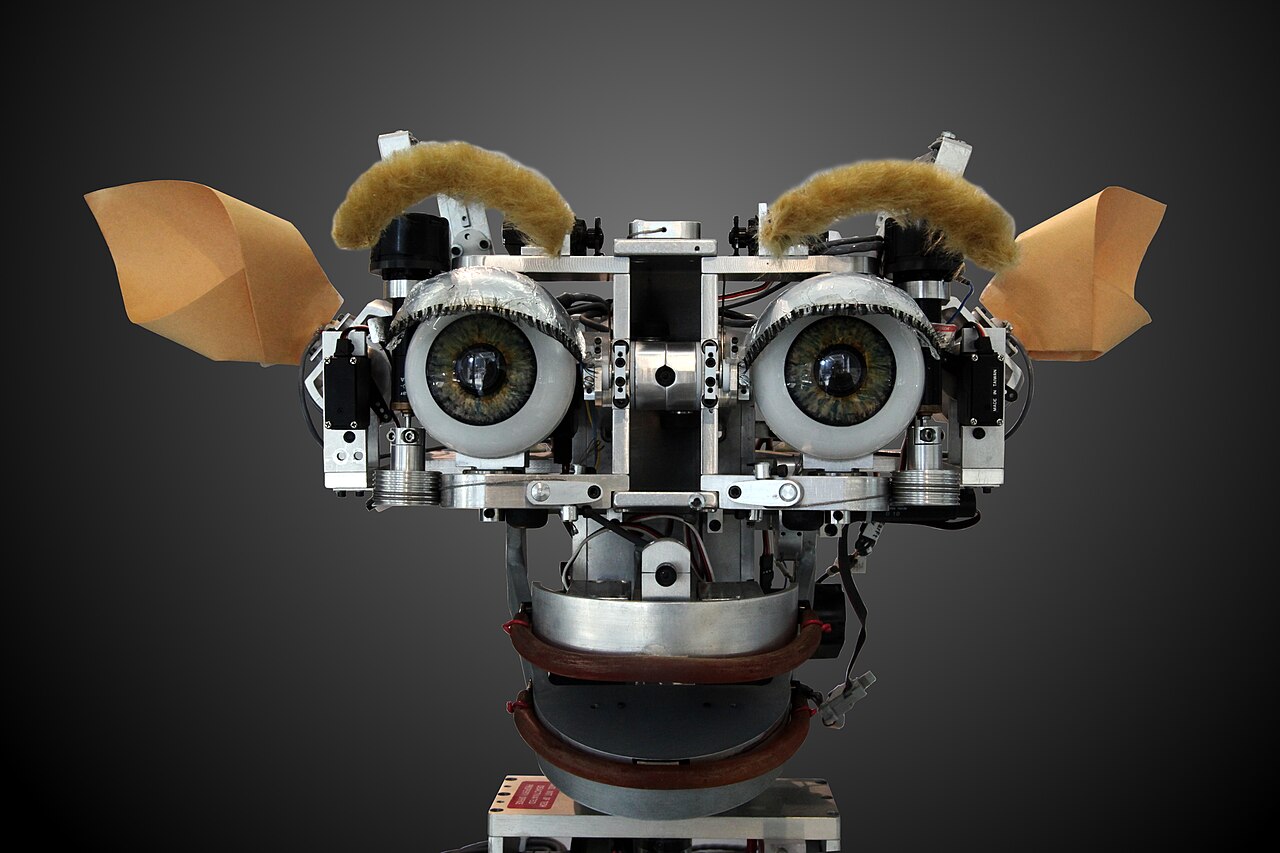
Work on Kismet began in 1997. It was a head on a bench: two cameras behind large blue eyes, microphones in floppy ears, and motors driving eyebrows, eyelids, ears, lips and jaw, running on roughly fifteen networked computers. The design borrowed from animation and from infant development, because both fields had already worked out which proportions make an adult want to look after something.
Kismet did not understand speech. It classified the prosody of speech directed at it into five categories, approval, prohibition, attention-getting, comfort and neutral, and it responded with facial expression and babble. Everything else was a loop: find a face, track it, judge whether the person was too close or too far, get bored if nothing happened, act pleased if something did. Breazeal’s graduate collaborators included Paul Fitzpatrick, Paulina Varchavskaia and Lijin Aryananda, and the funding came from the Office of Naval Research, DARPA and NTT.
The result that mattered was in the visitors. People who came in knowing that the machine had no language leaned toward it, raised their pitch, used the sing-song register adults use with babies, and waited for it to take a turn. The thesis, Sociable Machines: Expressive Social Exchange Between Humans and Robots, was submitted in May 2000; the book that followed, Designing Sociable Robots, appeared from MIT Press in 2002 and became the field’s first textbook. Kismet has been on display in the MIT Museum since 2000.
The Robots After
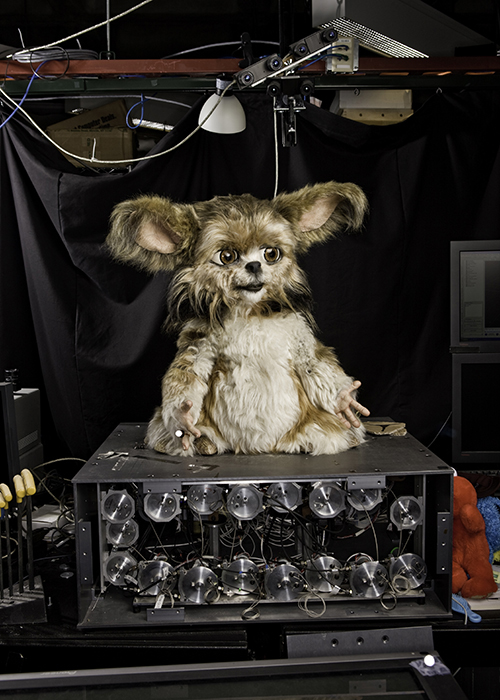
Breazeal joined the MIT Media Lab as a professor and founded the Personal Robots Group. Her next robot, Leonardo, was built with Stan Winston Studio, the effects shop behind the Terminator and Jurassic Park creatures, which gave academic robotics a face built by people whose job was making audiences believe in one. Leonardo was used for social learning and theory-of-mind experiments, including versions of the false-belief tasks developmental psychologists give to children. Wired put both Leonardo and Kismet on its “50 Best Robots Ever” list in January 2006. Breazeal also consulted on Steven Spielberg’s A.I. Artificial Intelligence in 2001.
The group’s later machines each attacked a specific job. Nexi, a mobile robot with a dexterous torso and an expressive face, was named by Time one of the 50 best inventions of 2008. Autom, built by her doctoral student Cory Kidd, coached people through diet and exercise plans and kept them engaged longer than a screen-based equivalent. Huggable was a teddy bear for hospitalised children, working alongside child-life specialists. Tega was a learning companion for preschoolers that played language games as a peer rather than a tutor. Cyberflora, a garden of robotic flowers that responded to visitors, was shown at the Smithsonian Cooper-Hewitt’s 2003 National Design Triennial.
The common finding across those studies was dull and useful: physical presence changed behaviour. The same software in the same room did better through a body than through a screen.
Jibo
Breazeal co-founded Jibo, Inc. in 2012 and served as chief scientist. The product was a swivelling cylinder with a round screen for a face, sold as “the world’s first family robot”: it recognised who was in the room, turned toward them, told stories to children and took photographs. The Indiegogo campaign that opened on 16 July 2014 took more than $3.5 million in preorders, and the company went on to raise close to $73 million in venture capital.
Then it took three more years. Units began shipping in September 2017 and retail sales opened that October at $899. Time put Jibo on the cover of its 25 best inventions of 2017. By then Amazon’s Echo had been on sale for three years at a quarter of the price, Google Home was out, and both had thousands of third-party skills; Jibo had a handful. Overseas orders had been cancelled in mid-2016 because localising for 45 countries was beyond the company, and Indiegogo had already been forced to refund backers who waited a year past the promised date. Chinese imitations appeared at CES in 2017.
The Series B never closed. Most of the staff were laid off in 2018, the assets were sold, and in March 2019 the servers went dark. Each remaining Jibo delivered the news itself: “While it’s not great news, the servers out there that let me do what I do are going to be turned off soon.” Then it did a last dance. Owners filmed the goodbye and reported crying at it. NTT Disruption bought the assets in 2020 and put the robot into healthcare and education pilots.
Dead End: The Family Robot
Jibo failed for reasons that had little to do with whether people liked it. The hardware took five years from campaign to shelf, and consumer electronics does not forgive that: the category Jibo defined in 2014 was occupied by 2017 by a competitor selling a cylinder with no face, no motors and no cameras for $50, subsidised because it sold things. A social robot is an expensive body wrapped around the same voice assistant, and the body has to earn its price in a way that is hard to put on a spec sheet. Honda, Sony, Samsung and Toyota had all tried consumer home robots and stopped; iRobot had succeeded only by giving up on personality and selling a vacuum cleaner (see The Voice Assistant Revolution).
The shutdown also demonstrated the thing the research had been claiming for twenty years. Owners grieved a lamp-shaped speaker that had no inner life, exactly as Kismet’s visitors had spoken to a head they knew was empty, and exactly as Weizenbaum’s secretary had asked him to leave the room. Affective response to machines is not something a company needs to earn (see Affective Computing). It is something the customer brings, and Jibo proved it in the one experiment nobody had planned to run.
Teaching Children About AI
Breazeal returned to MIT full time and turned the group toward AI literacy. With Eric Klopfer and Hal Abelson she launched MIT RAISE (Responsible AI for Social Empowerment and Education) in 2021, and its Day of AI curriculum, free for schools, has reached over a million K-12 students in 170 countries (see Computer Science Education). In January 2022 she was named MIT’s dean for digital learning at MIT Open Learning, alongside her professorship in Media Arts and Sciences. She was elected a fellow of the AAAI in 2020 and of the AAAS in 2024.
📚 Sources
- Cynthia Breazeal — MIT Media Lab (professor of Media Arts and Sciences, director of the Personal Robots Group, MIT dean for digital learning, founder of MIT RAISE, Day of AI reaching over a million K-12 students in 170 countries)
- Cynthia L. Breazeal, Sociable Machines: Expressive Social Exchange Between Humans and Robots, Sc.D. thesis, MIT, May 2000 (Kismet’s design, the five prosodic categories, the degrees of freedom and the computing hardware, the interaction experiments)
- “Team builds sociable robot” — MIT News, 2001 (Kismet’s eyes, ears, eyebrows and lips, roughly fifteen computers, the team of Fitzpatrick, Varchavskaia and Aryananda under Rodney Brooks, funding from the Office of Naval Research, DARPA and NTT, and the developmental-psychology basis of the design)
- Cynthia Breazeal — Wikipedia (born 1967 in Albuquerque to two computer scientists at national laboratories; UCSB B.Sc. 1989, MIT M.S. 1993 and Sc.D. 2000; the 1997 Mars landing as the trigger; Kismet in the MIT Museum since 2000; Leonardo with Stan Winston Studio and the Wired 2006 listing; Nexi and Time’s 2008 list; Autom by Cory Kidd; Huggable, MeBot and Tega; Cyberflora at the 2003 National Design Triennial; the 2001 A.I. consultancy; RAISE in 2021 with Eric Klopfer and Hal Abelson; dean for digital learning in January 2022; AAAI 2020 and AAAS 2024)
- Cynthia Breazeal, Designing Sociable Robots (MIT Press, 2002)
- “Wired’s Top-50-Ever Robot Billing to Lab’s Leonardo, Mindstorms” — MIT Media Lab (the January 2006 Wired list)
- “Jibo social robot: Analyzing what went wrong” — The Robot Report, 2019 (founded 2012, over $3.5 million on Indiegogo, close to $73 million burned, shipping from September 2017 and retail from October 2017 at $899, the cancelled overseas orders in 2016, Indiegogo refunds, Chinese imitations at CES 2017, and the failures of Honda, Sony, Samsung and Toyota in consumer home robots)
- “The lonely death of Jibo, the social robot” — TechCrunch, 4 March 2019 (the shutdown message and the last dance)
- “Jibo social robot assets acquired by NTT Disruption” — The Robot Report, 2020
- Jibo — Wikipedia (the Indiegogo launch on 16 July 2014, the November 2017 release, the Time 25 best inventions cover, and the failed Series B)
- Image: Cynthia Breazeal.jpg by MIT Media Lab (CC BY-SA 4.0), via Wikimedia Commons
- Image: Kismet-IMG 6007-gradient.jpg by Rama (CC BY-SA 3.0 fr), via Wikimedia Commons
- Image: Leonardo-by-bill-cramer.jpg by BillCramer (CC BY-SA 4.0), via Wikimedia Commons