Mary Lou Jepsen
Abstract
Mary Lou Jepsen (born 1965) is a display engineer who has spent her career making screens cheaper, then trying to make hospitals cheaper. At the MIT Media Lab in 1989 she helped build the first holographic video system; a brain tumour that went undiagnosed for five years nearly ended her doctorate in 1995. As first employee and chief technology officer of One Laptop per Child from 2005 she designed the XO-1’s dual-mode screen, a 200-dpi LCD that read in full sunlight with the backlight off and drew as little as 0.1 W, the part that made a $188 laptop possible; the machine went into production in November 2007 and Time put her on its 100 list in 2008. She left to commercialise the screen at Pixel Qi (2008–2015), which shipped millions of panels and died when its one factory dropped it, ran display and consumer-electronics projects at Google X and then at Facebook’s Oculus, and in 2016 founded Openwater, which is trying to replace the MRI machine with near-infrared light, holography and consumer-electronics manufacturing. She holds more than 200 patents.
Holograms
Jepsen took two degrees at Brown University in 1987, an Sc.B. in electrical engineering and an A.B. in studio art, and went to the MIT Media Lab for a master’s in 1989. There, in Stephen Benton’s spatial imaging group, she was part of the team that built the first fully computed holographic video system, which synthesised three-dimensional holograms from digital data rather than photographing them; it started a research subfield that is still running. She then spent several years in Europe and Australia, as a computer-science lecturer at RMIT in Melbourne and as a fellow at the Academy of Media Arts in Cologne, where she built holographic displays at the scale of a city block, before returning to Brown for a doctorate in optical physics.
In 1995 she was in a wheelchair, with a drooping face, headaches and sores, and had dropped out of the programme. A professor paid for the MRI scan she could not afford; it showed a pituitary tumour that had been growing undetected for five years. Surgery removed it, and she petitioned her way back into the doctorate, finishing in 1996. The tumour took her pituitary gland with it, and she has managed her hormones ever since with a dozen pills a day, becoming enough of an expert to advise other patients. Two things from that year stayed with her: what it costs to get one scan, and what it feels like to be the patient who cannot pay.
Screens
She co-founded MicroDisplay Corporation in 1995 as chief technology officer, developing the first low-cost single-panel microdisplays for projectors and building its fab in Richmond, California, and later ran technology strategy as chief technology officer of Intel’s display division. The idea that made her known was simpler than either. In April 2005 Nicholas Negroponte, who was interviewing her for a Media Lab faculty post, hired her instead as chief technology officer and first employee of One Laptop per Child (see The History of Displays for the technology around it).
The display is the most expensive part of most laptops, and Jepsen’s job was to make one for about $35. Her starting point was the small LCDs in portable DVD players. The XO-1 screen she designed is a 7.5-inch, 1200 × 900 transflective LCD at 200 dots per inch, higher resolution than any laptop of its price, that works in two modes: with the backlight on it shows colour, and in bright light with the backlight off it shows a sharp monochrome image lit by the sun itself, so a child can read outdoors. Power draw is between 0.1 and 1.0 W depending on mode, against several watts for an ordinary panel. The critical trick was removing the colour filters that absorb most of a backlight’s output; the XO instead uses a plastic diffraction grating, stamped with the same equipment that makes DVDs, to split the white LED backlight into red, green and blue and steer each onto its pixel, and the panel could be made on existing LCD lines. The rest of the machine was designed around the same constraint: a low-power processor, flash storage, a mesh radio run at 2 Mbit/s to save power, a rubber-sealed keyboard, and hand-crank and solar charging. Bill Gates, in public, criticised the screen. Quanta began full production on November 6, 2007, at $188 rather than the $100 on the label; the Give One Get One campaign that Christmas sold pairs for $399. Brewster Kahle’s Time 100 entry for her in 2008 put the achievement in one line: half the world’s children learn outdoors, and she had built the machine that worked there.
She left OLPC on December 31, 2007, and in January 2008 announced Pixel Qi, a company in San Bruno to license the screen and its low-power ideas to other manufacturers. Its 3Qi panel went into mass production in late 2009 and appeared in the Notion Ink Adam tablet in January 2011, then in a rugged military tablet and several netbooks; the company said in 2012 it had shipped more than three million displays across some fifteen products. A 3M investment that year pointed it at military and government buyers. In June 2013 Chunghwa Picture Tubes, its sole manufacturing partner, stopped supplying, and Jepsen left within months; her husband, John Ryan, ran what remained until it wound down in 2015. The intellectual property went to the original investor.
Dead End: The Sunlight Screen
Pixel Qi’s screen solved a problem the market decided not to have. The dual-mode panel needed the customer to want to read outdoors on a laptop, and the customers who did, schools in the developing world and soldiers, were small and slow buyers. Everyone else got a brighter backlit LCD and, for reading, an E Ink device, which was worse at everything except sunlight and battery life, and that was enough (see Project Gutenberg and the E-Book). A niche display company that depends on one panel factory is a single-point failure, and in 2013 the point failed. The OLPC screen’s lasting effect was indirect: it showed that a laptop could be built for under $200 and pulled the industry into netbooks and later Chromebooks.
Google, Facebook, Openwater
In 2013 she joined Google X, where she directed display and consumer-electronics programmes; one was a modular “Lego TV” of seamless snap-together screens for video walls. In 2015 she moved to Facebook as executive director of engineering for Facebook and Oculus, working on displays for virtual and augmented reality, including sunglass-sized prototypes (see The History of Virtual Reality and Palmer Luckey). In a 2013 TED talk she had already asked whether future devices could read images out of the brain, and in 2016 she left to find out.
Openwater, founded that year in San Francisco, is her attempt to turn the 1995 MRI into something a clinic in a poor country can afford. An MRI scanner costs millions and about $500,000 a year to run. Her proposal is to image the body with near-infrared light, to which flesh is partly transparent, using holographic techniques to unscramble the scattering and LCD-derived components with micron-scale pixels, packaged with the manufacturing methods of smartphones rather than of medical equipment; a second line uses low-intensity focused ultrasound as a therapy. The company’s devices went into first human studies at Hartford Hospital in 2020, followed by a multi-centre study at Brown and the University of Pennsylvania, and its 2024 work shrank the imaging unit from a cart to a wearable with a console. In January 2024 she announced $54 million of new funding, bringing the total to $100 million, and a decision to publish the platform as open source under the AGPL, on the argument that the bottleneck in medical devices is a closed, slow development model rather than the FDA (see The Open Hardware Movement). In March 2025 Aaron Timm became chief executive and Jepsen moved to chair of the board. Whether light can replace the magnet is unproven; the company was, as of 2025, selling pre-orders of imaging and ultrasound units to researchers, not diagnoses to patients. She received Optica’s Edwin H. Land Medal in 2011 and was made an Optica Fellow in 2012. “We can stop making this decision,” she has said of medical imaging, “of the rich live, the poor die.”
📚 Sources
- Mary Lou Jepsen — Optica biography (Brown 1987, MIT 1989, PhD 1996, MicroDisplay 1995, Intel, OLPC 2005, Facebook 2015, Openwater 2016, the Land Medal 2011 and Fellowship 2012)
- Mary Lou Jepsen — Engineering and Technology History Wiki (born 1965, Cologne holograms, Pixel Qi 2008, Google X 2013, Facebook 2015, over 200 patents)
- Mary Lou Jepsen — The 2008 TIME 100, by Brewster Kahle (the 1989 holographic video system, the tumour undetected for five years, a dozen pills, $100 target and $188 price, children who learn outdoors)
- How holography could get us to non-invasive surgery — MIT Sloan (the 1995 wheelchair and MRI story, MRI costs, the “rich live, the poor die” quote, over 200 patents)
- OLPC XO — Wikipedia (Negroponte’s April 2005 hire, the $35 estimate and the DVD-player LCDs, 1200 × 900 at 200 dpi, 0.1–1.0 W, the diffraction grating, the 2 Mbit/s radio, Gates’s criticism, production from November 6, 2007, $188 and the $399 Give One Get One)
- As Laptop Begins Production, OLPC Faces Competition — The Tech (MIT), February 5, 2008 (Jepsen’s departure on December 31, 2007 to start Pixel Qi)
- Pixel Qi: Towards A $75 Laptop? — TechCrunch, January 10, 2008
- Pixel Qi — Wikipedia (San Bruno, the Notion Ink Adam of January 2011, the military tablet, defunct by 2015, IP to the original investor)
- The rise and fall of Pixel Qi — Good e-Reader (mass production late 2009, three million displays by 2012, the 3M investment, the June 2013 loss of Chunghwa Picture Tubes, Jepsen’s departure and John Ryan)
- Mary Lou Jepsen — Wikipedia (RMIT, Cologne, UCSD, MicroDisplay’s Richmond fab, Lego TV, the Hartford, Brown and Penn studies, the January 2024 founder’s letter and AGPL, the 2025 transition to Aaron Timm)
- Openwater Announces New CEO — BioSpace, March 2025 (Aaron Timm as CEO, Jepsen as chair, pre-orders for imaging and ultrasound units)
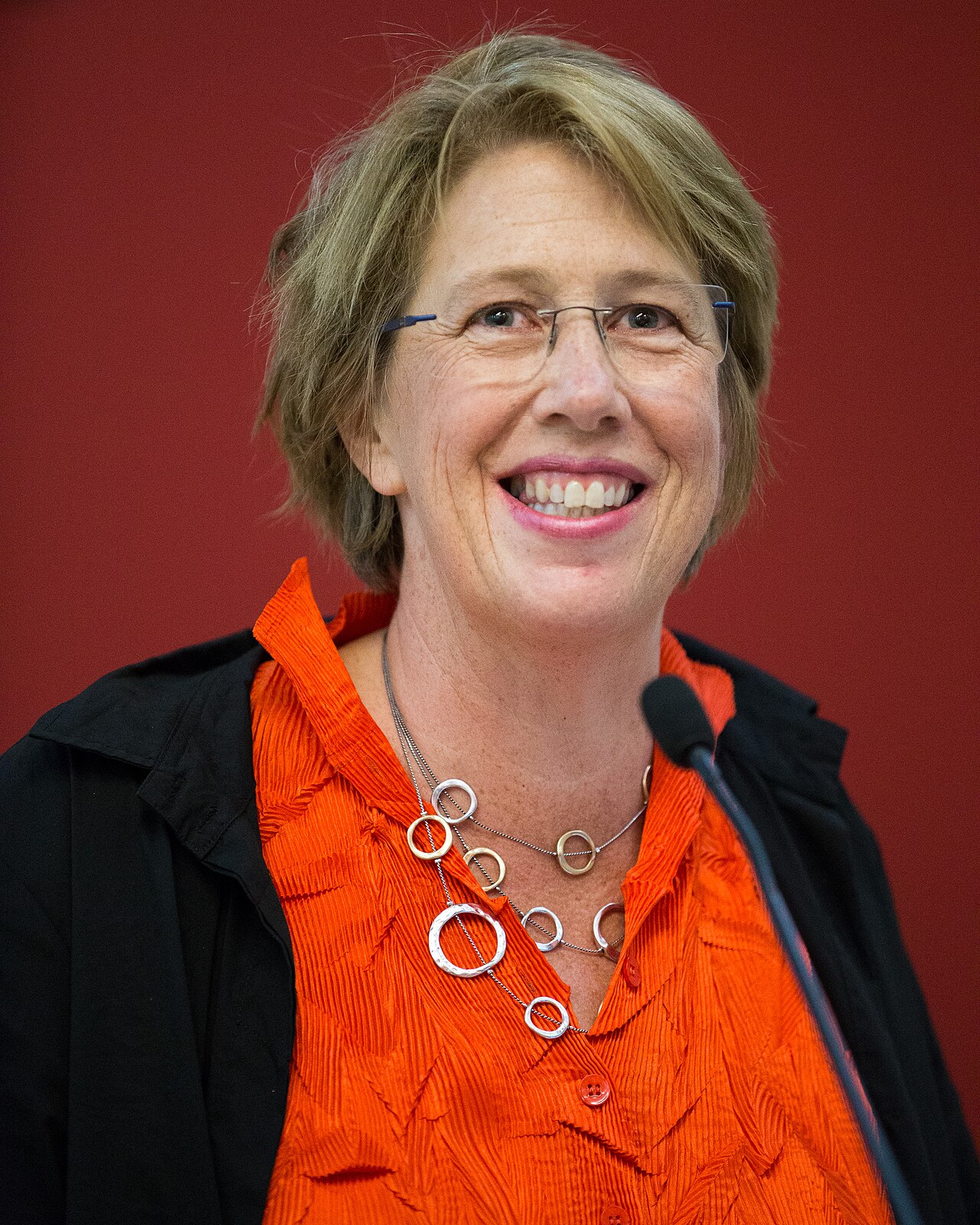
- Image: Mary Lou Jepsen technology pioneer.jpg by Kenneth C. Zirkel (CC BY-SA 3.0), via Wikimedia Commons