IBM: The Company
Abstract
No company has been central to computing for longer. IBM began in 1911 as a holding-company mashup of scale makers, time-clock manufacturers, and Hollerith’s tabulating machines; Thomas J. Watson Sr. turned it into the world’s most disciplined sales organization, and his son bet the company ($5 billion, twice IBM’s annual revenue) on the System/360 and won the mainframe age outright. IBM Research produced five Nobel laureates and invented the hard disk, DRAM’s memory cell, the floppy disk, the relational database, FORTRAN, and RISC. The same company armed the Nazi census through its German subsidiary, fought a 13-year federal antitrust siege, created the independent software industry by accident with one 1969 pricing decision, handed its PC empire to Microsoft and Intel, nearly died of it in 1993 (the largest corporate loss in US history to that point) and reinvented itself as a services-and-software firm that no longer makes the machines it is still named after. Every era of this encyclopedia has an IBM chapter; this is the through-line.
Watson’s Machine (1911–1956)
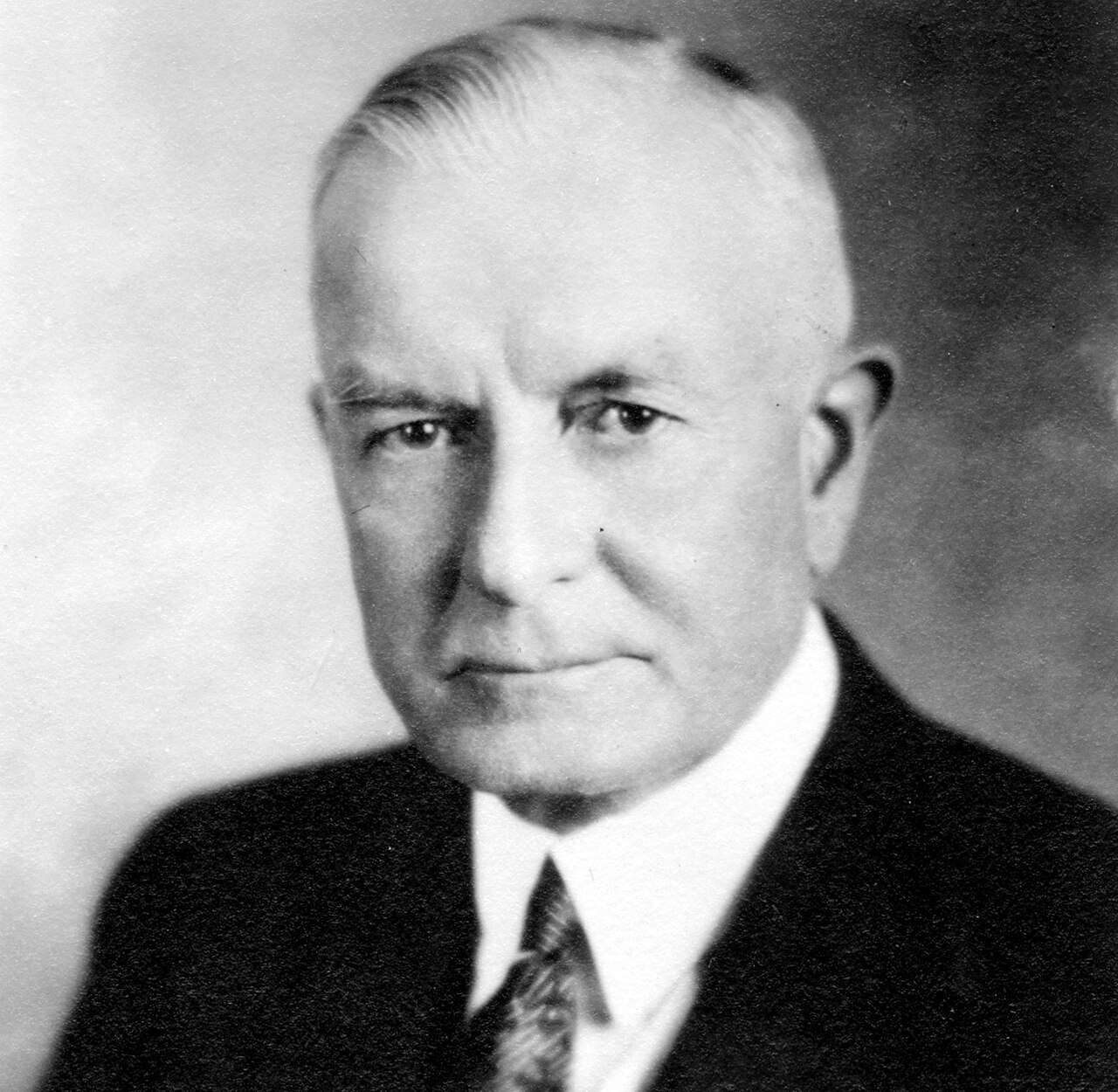
Financier Charles Flint assembled the Computing-Tabulating-Recording Company in 1911 from four firms selling butcher scales, time clocks, and Hollerith tabulators. Its transformative hire came in 1914: Thomas J. Watson Sr., freshly convicted (later vacated) of antitrust violations at NCR, who brought NCR’s sales discipline, quotas, commissions, dark suits, company songs, and the one-word gospel he’d coined: THINK. President by 1915, he renamed the company International Business Machines in 1924, when it was neither international nor making business machines much grander than punch-card tabulators. The name was a plan.
Punched cards were the plan’s engine: IBM leased machines and sold the cards, billions of them, a recurring-revenue model that saw the company through the Depression profitably. That business had a dark chapter: IBM’s German subsidiary Dehomag supplied and serviced punch-card systems used by the Nazi state, including for censuses that helped identify Jewish citizens. Edwin Black’s IBM and the Holocaust (2001) argued the New York parent kept effective control longer and knew more than it admitted; IBM disputes aspects of the account. What is not disputed is that the machines were there and the leases were paid (see Germany’s Computing Pioneers for the wider context of German data infrastructure).
IBM co-funded and built Howard Aiken’s Harvard Mark I (1944), electromechanical and instantly obsolescent; its first commercial electronic computer, the 701, followed in 1952, and the drum-based 650 became the workhorse first computer of a generation of universities. RAMAC (1956) shipped the world’s first hard disk drive: 3.75 MB on fifty 24-inch platters (see The Storage Revolution). Backus’s FORTRAN (1957) proved high-level languages practical. Watson Sr. handed the company to Thomas Watson Jr. in 1956, weeks before dying; the son’s memoir frames the succession as the biggest gamble the father ever took.
The Bet and the Empire (1956–1981)
Watson Jr.’s System/360 (announced April 7, 1964) is still the largest bet-the-company decision in the industry’s history: roughly $5 billion (about twice IBM’s annual revenue) to replace all of IBM’s incompatible product lines with one binary-compatible family from small to large. It nearly broke the company (the OS/360 software death march gave Fred Brooks the material for The Mythical Man-Month) and then it conquered: by 1970 IBM had ~70% of the world computer market, and “nobody ever got fired for buying IBM” entered the language (see The IBM Mainframe Era).
Dominance drew the state. Facing a 1969 federal antitrust suit that would run thirteen years before being dropped as “without merit” in 1982, IBM unbundled software and services from hardware pricing in June 1969, the single decision that created the independent software products industry: if software cost extra, someone else could sell it cheaper. IBM Research meanwhile compounded: Dennard’s one-transistor DRAM cell (1966), the floppy disk (1971), Codd’s relational model (1970) and System R’s SQL, John Cocke’s 801 (the machine that seeded RISC) plus Mandelbrot’s fractals, Frances Allen’s optimizing compilers, and, in time, five Nobel laureates across three Physics prizes (Esaki 1973; Binnig and Rohrer 1986 for the scanning tunneling microscope; Bednorz and Müller 1987 for high-temperature superconductivity).
The Open Door (1981–1993)
The IBM PC (1981), built in a year from off-the-shelf parts by a renegade Florida unit, set the standard for personal computing and gave away the two monopolies inside it: the operating system to Microsoft, the processor to Intel (see The IBM PC and Gary Kildall and the OS IBM Didn’t Take). Clones ate the hardware margin; the OS/2 counterattack failed; mainframe revenue stalled just as minicomputers and workstations surged. The reckoning came fast by IBM standards: cumulative losses through the early 1990s peaked with $8.1 billion in 1993, then the largest annual corporate loss in US history, and the board seriously weighed breaking the company into pieces.
Gerstner’s Services Pivot and After (1993–)
Lou Gerstner (the first outside CEO, from RJR Nabisco) arrived in 1993, kept the company whole (“the last thing IBM needs right now is a vision,” he told the press, before supplying one), and turned IBM’s size into the product: services (running other companies’ IT) plus middleware software, with hardware demoted from identity to component. The no-layoffs covenant of the Watson era died in the same restructuring; a company culture built on lifetime employment absorbed a quarter-million job cuts.
The next decades were a long editing-down toward software and services: PCs sold to Lenovo (2005), disk drives to Hitachi, chips fabs paid away, ThinkPad nostalgia outsourced. Public spectacles kept the research brand alive: Deep Blue beating Kasparov (1997), Watson winning Jeopardy! (2011) (see Fun Fact: Watson on Jeopardy), and IBM led US patent grants for 29 consecutive years (1993–2021) before deliberately retiring the metric. The decisive modern moves: the $34 billion Red Hat acquisition (2019), the largest software acquisition to that date, betting the company on hybrid cloud after losing the public-cloud war to AWS, Azure, and Google; the Kyndryl spinoff (2021), shedding the low-margin half of Gerstner’s own services empire; and a genuine frontier position in quantum computing hardware. IBM in the 2020s is a fraction of the industry it once was, and still, uniquely, present in its second century.
⚠️ Dead End: Watson Health
The instructive modern failure is what IBM did with its Jeopardy! moment. Watson Health (2015) promised AI-driven medicine (oncology decision support above all) and IBM spent roughly $4 billion buying health-data companies to feed it. The gap between demo and clinic proved unbridgeable: hospitals found recommendations unsafe or unhelpful, the flagship MD Anderson project collapsed after $62 million, and internal documents leaked of the system recommending treatments no oncologist would sign. In January 2022 IBM sold Watson Health’s assets for a reported ~$1 billion, a quarter of what it had spent assembling it. The failure pattern is old IBM in inverted form: System/360 was an enormous bet on engineering the company could verify; Watson Health was an enormous bet on marketing extrapolated from a quiz show. It stands as the canonical pre-LLM warning that “AI” sold ahead of its evidence burns exactly the customers (medicine, government) that computing most needs to keep (see Dead End: IBM Watson Health for the full account, and The Rise of Artificial Intelligence).
Fun Fact
IBM’s corporate songbook, Songs of the IBM (1927), included “Ever Onward,” sung at sales rallies by men in identical dark suits. Sample lyric: “We’re bound for the top to never fall! Right here and now we thankfully / Pledge sincerest loyalty / To the corporation that’s the best of all!” Tech-company culture has changed genre (the loyalty oath became equity vesting) but not subject.
📚 Sources
- Wikipedia: History of IBM · IBM · Watson Health
- IBM Heritage: company history archive
- Thomas J. Watson Jr.: Father, Son & Co.: My Life at IBM and Beyond (Bantam, 1990)
- Louis V. Gerstner: Who Says Elephants Can’t Dance? (HarperBusiness, 2002)
- Edwin Black: IBM and the Holocaust (Crown, 2001), and IBM’s response statement (2001)
- Computer History Museum: IBM System/360 announcement (April 7, 1964)
- STAT News: IBM’s Watson recommended “unsafe and incorrect” cancer treatments (2018)
- Reuters: IBM sells Watson Health assets to Francisco Partners (January 2022)
- Image: Thomas J Watson Sr.jpg by IBM (uploaded by Paul C. Lasewicz) (CC BY-SA 3.0), via Wikimedia Commons