SABRE and Airline Reservation Systems
Abstract
SABRE, built by IBM for American Airlines between 1957 and 1964, was the first large commercial system in which thousands of people at terminals in dozens of cities read and changed one shared set of records at the same moment. It borrowed its architecture from the SAGE air-defence network, cost about $40 million, and cut the time to book a seat from somewhere between 45 and 90 minutes, depending on the account, to a few seconds. Its software became IBM’s PARS package and the TPF operating system, which ran most of the world’s airline reservations for the next half-century, and the pattern it set, short transactions against a central database from many terminals at once, is what the industry later called online transaction processing. Once travel agents got SABRE terminals in 1976, American found a second use for it: listing its own flights first. The resulting “display bias” case of 1984 was one of the first times a government regulated how a computer ranked its answers.
Seats on a Board
Before computers, an airline seat was a card in a file. American Airlines ran reservations as “sell and report”: agents sold seats against availability boards and reported each sale to a central control office, where clerks kept the flight inventory by hand, in the 1950s on rotating card files around which at most eight people could sit. The whole task, from request to confirmation, took about 90 minutes on average, and errors were routine. American tried electromechanical help from the Teleregister company: the Reservisor of 1946 kept a simple count of available seats, and the Magnetronic Reservisor of 1952 stored it on a magnetic drum. Neither held the passenger’s name, which still lived on paper, so the two records drifted apart and seats were sold twice or not at all.
Two Smiths on a Plane
In 1953 an IBM salesman named R. Blair Smith found himself seated next to American’s president, C. R. Smith, on a flight from Los Angeles to New York. The airline chief complained about reservations; the salesman, who knew what IBM was building for the Air Force, suggested a computer could keep the passenger’s name, itinerary and phone number together with the seat. Blair Smith passed the conversation up to Thomas J. Watson Jr., and IBM’s engineers began studying American’s operation.
What IBM knew in 1953 was SAGE, the Semi-Automatic Ground Environment, a continental network of radar sites and telephone lines feeding duplexed computers that operators queried in real time. An airline had the same shape of problem with seats instead of bombers. IBM and American formalised the joint project in 1957, and American committed to the development cost. IBM’s internal code name was SABER; American’s public name became the Semi-Automated Business Research Environment, SABRE, announced in 1961.
The System
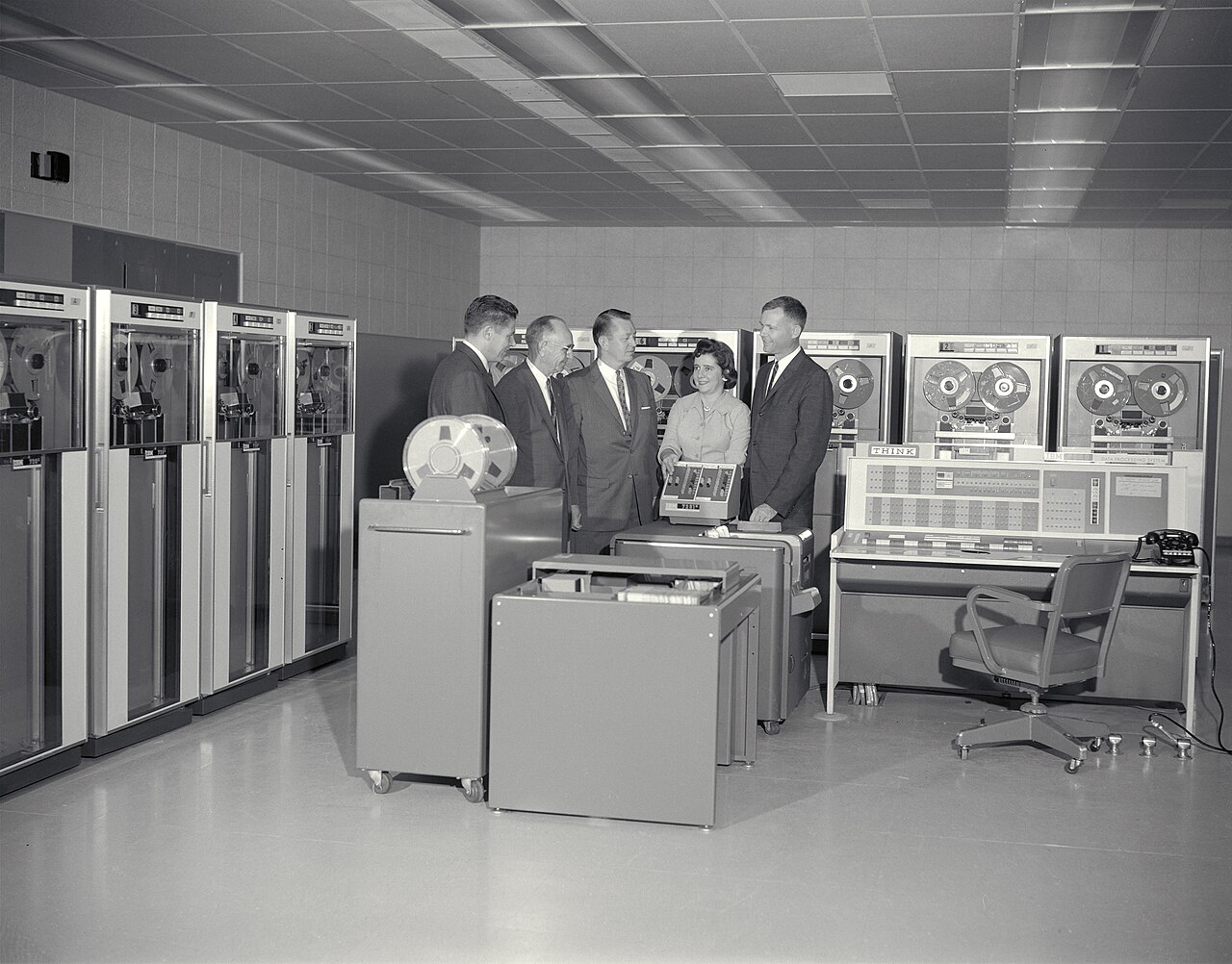
The central site at Briarcliff Manor, New York, got its computers in 1960: a pair of IBM 7090s holding the flight inventory and the passenger records. Agents worked at terminals connected over leased telephone lines. Cities were cut over one at a time, starting with Hartford in 1962, and the network was complete in 1964, when it was the largest commercial real-time data-processing system in the world. The Computer History Museum counts 2,000 terminals in 65 cities, each getting an answer on any flight in under three seconds; other accounts give about 1,500 terminals, depending on the date and what is counted. At full load it handled about 84,000 telephone calls a day and up to 7,500 reservations an hour. The whole project took an estimated 400 man-years, and Computerworld later put the saving to American at 30 percent of its reservations labour cost.
The engineering problem was the one every later transaction system inherited. Thousands of short requests arrived in random order; each had to see the current state of a flight, change it, and leave it consistent before the next request touched the same seat, and the system could not stop, because a stopped reservations system meant a stopped airline. SABRE solved it with duplicated hardware and custom programming on machines built for scientific work. The theory of what it was doing, atomic transactions and concurrency control, came a decade later from database researchers such as Jim Gray.
The Industry Standard
IBM had talked to three airlines at once. Pan Am’s PANAMAC and Delta’s DELTAMATIC followed SABRE, all delivered in 1964 and 1965 on different IBM hardware. For the System/360 IBM generalised the three into one product, the Programmed Airline Reservations System (PARS): Eastern Air Lines ran it from 1965 as “System One”, BOAC ran the international version as BOADICEA, and once American had moved to it, nine of the ten largest US carriers ran PARS. Its operating system, the Airline Control Program, was renamed the Transaction Processing Facility (TPF) and outlived the machines it was written for by decades. American moved SABRE onto the PARS platform between 1971 and 1973 and consolidated it in Tulsa, Oklahoma.
SABRE was not alone even at the start. Evelyn Berezin at Teleregister built a reservation system for United Airlines delivered around 1962, and in 1958 Hitachi’s MARS-1 began reserving seats on Japanese National Railways trains. SABRE was the one with IBM’s product line behind it, and that is why its design spread.
Screen Science
In 1976 American put SABRE terminals into travel agencies, 130 locations by the end of that year; United did the same with its Apollo system. Agents who had phoned each airline could now see everyone’s flights on one screen, and the airlines owning the systems let competitors list their flights for a fee per booking. By 1983 about 80 percent of US travel agencies were automated, and the systems of United and American together were in 80 percent of the automated locations.
Employees at American noticed that agents usually booked something from the first screen, each of which showed about eight flights, and often from the first line. They called the craft of arranging the list “screen science”. The ranking rules could favour American without naming it, by weighting the features its own flights happened to have, such as particular connecting hubs; competitors found their flights at the bottom of the last screen, and the fees they paid for better placement rose from 1981, from 25 cents a booking to as much as three dollars. American’s 1982 annual report was open about SABRE’s value to the airline. Asked by Congress, American’s president Robert Crandall said that “the preferential display of our flights, and the corresponding increase in our market share, is the competitive raison d’etre for having created the system in the first place.”
The Civil Aeronautics Board issued rules for carrier-owned reservation systems on 27 July 1984. They forbade ranking flights by the identity of the carrier and fees that discriminated between airlines without a difference in cost, and obliged each system to give anyone who asked “the current criteria used in editing and ordering flights” and “the weight given to each criterion”. United challenged the rules; Judge Richard Posner, for the Seventh Circuit, upheld them “without hesitation.” Researchers auditing search engines and recommendation algorithms a generation later went back to the case as an early instance of what they were studying (see AI Ethics and Algorithmic Bias).
Dead End: The Airline That Owned the Screen
Owning the reservations screen stopped paying once the rules said the screen had to be neutral and the customer could see it directly. SABRE reached consumers through easySabre on CompuServe and other online services from 1985, and in 1996 through Travelocity on the web. The US Department of Transportation lifted the remaining reservation-system rules in 2004, by which time the argument had moved to search engines and price-comparison sites. Airlines sold their systems off: Amadeus (led by Air France and Lufthansa), Galileo (United, British Airways, KLM and others) and the Delta–Northwest–TWA Worldspan became independent distributors, and AMR, American’s parent, spun Sabre off as a separate company in March 2000. In January 2011 American Airlines sued Sabre, by then an independent supplier, for downplaying American’s flights in the results it showed travel agents.
The software lasted longer than the ownership. Sabre announced in 2001 that it would migrate its 25-year-old mainframe system to other platforms, and in the 2020s it was still at it. By February 2024 it had moved nearly 90 percent of its workloads to Google Cloud and closed 17 data centres; its plan to be off TPF by the end of 2023 had slipped.
📚 Sources
- Sabre, IBM History (the 1953 meeting, Watson Jr., the SAGE lineage, about $40 million, 7,500 reservations an hour, 1976 travel agents, 1985 easySabre, 1996 Travelocity)
- “How SABRE Transformed Aviation (and IT)”, Airways (sell and report, the 1946 and 1952 Reservisors, eight clerks at a card file, 90-minute bookings, 400 man-years, the 1982 annual report, the 1984 rules, 2004 deregulation)
- 1964, Timeline of Computer History, Computer History Museum (2,000 terminals, 65 cities, two 7090s, under three seconds, SAGE lineage)
- “Sidebar: Sabre Timeline”, Computerworld (1957 partnership, 1960 Briarcliff Manor installation, 84,000 calls a day, 1964 completion at $40 million, 30 percent labour saving, 1972 Tulsa, 130 agency locations in 1976, 2000 spin-off, 2001 migration plan)
- SABRE Airline Reservation System, Engineering and Technology History Wiki (the November 1961 announcement, the two 7090s, 45 minutes versus three seconds, Pan Am and Delta)
- Sabre (travel reservation system), Wikipedia (SABER code name, 1960 experimental system, 1964 full operation, March 2000 separation) and Programmed Airline Reservations System, Wikipedia (PANAMAC, DELTAMATIC, System One, BOADICEA, ACP and TPF, 1971–1973 SABRE migration, nine of the ten largest US carriers) and Computer reservation system, Wikipedia (MARS-1 1958, Apollo, Amadeus, Galileo, Worldspan)
- Head, Robert V., “Getting Sabre off the Ground”, IEEE Annals of the History of Computing 24 (4), 2002 (memoir of an IBM participant; Hartford as the first city cutover, 1962, via secondary summaries) and Copeland, Duncan G. and James L. McKenney, “Airline Reservations Systems: Lessons From History”, MIS Quarterly 12 (3), 1988
- Locke, Larry G., “Flying the Unfriendly Skies: The Legal Fallout over the Use of Computerized Reservation Systems as a Competitive Weapon in the Airline Industry”, Harvard Journal of Law & Technology 2, 1989 (automation shares, eight flights per screen, cohost fees from 1981, the September 1983 proposed rules, the 27 July 1984 CAB rules, Posner in United Air Lines v. CAB)
- Sandvig, Christian et al., “Auditing Algorithms: Research Methods for Detecting Discrimination on Internet Platforms”, 2014 (“screen science”, the Crandall quotation via Petzinger’s Hard Landing, the disclosure requirement of 14 CFR 255.4)
- “American sues Sabre in battle over flight listings”, NBC News / Associated Press, 10 January 2011
- “Mammoth migration to Google Cloud nears completion”, The Register, 27 February 2024 and “Sabre is Getting Off the Mainframe, One Way or Another”, Planet Mainframe, June 2023