Barcodes and the UPC
Abstract
The barcode is the most successful piece of computing infrastructure almost nobody thinks about, a thicket of black bars that silently binds every product to a database. Its story begins in 1948, when graduate students Bernard Silver and Norman Joseph Woodland set out to automate the grocery checkout, and Woodland, idly dragging his fingers through Florida beach sand, stretched the dots and dashes of Morse code downward into thin and thick lines. Their 1952 patent described a bullseye symbol decades ahead of the electronics needed to read it, and the pair sold it for a pittance. Two decades later George Laurer at IBM turned the idea into the rectangular Universal Product Code (UPC), adopted by the U.S. grocery industry in 1973 and first scanned on a pack of Wrigley’s Juicy Fruit in Troy, Ohio, on 26 June 1974. From that beep grew the entire modern supply chain (inventory, just-in-time logistics, self-checkout) and eventually the two-dimensional QR code, invented in Japan in 1994, which the COVID-19 pandemic pushed onto every restaurant table.
Two Students and an Overheard Conversation
In 1948, Bernard Silver, a graduate student at the Drexel Institute of Technology in Philadelphia, overheard a local food-chain executive begging one of the deans to develop a system that could capture product information automatically at the checkout. The dean declined. Silver mentioned it to his friend Norman Joseph Woodland, a fellow Drexel graduate, and the two decided to try.
Woodland (born 6 September 1921) was confident enough that he quit his teaching post and moved to his grandfather’s apartment in Miami Beach to think. The breakthrough is one of the great origin anecdotes in computing history. Woodland had learned Morse code as a Boy Scout, and while sitting on the beach he began drawing dots and dashes in the sand. As he later recalled, “I just extended the dots and dashes downwards and made narrow lines and wide lines out of them.” He then swept his four fingers through the sand and, seeing the parallel lines, imagined bending them into a circle so a scanner could read the pattern from any direction, the bullseye barcode.
Silver and Woodland filed a patent for “Classifying Apparatus and Method” on 20 October 1949. It was granted on 7 October 1952 as U.S. Patent 2,612,994, and it described both a linear and a circular (bullseye) symbology, to be read by a moving spot of light. The idea was sound; the technology to make it practical (a bright, cheap, coherent light source and fast electronics) simply did not yet exist. The laser was still years away.
A Patent Sold Too Soon
This is the article’s central irony, and its dead end. Woodland joined IBM in 1951, and the inventors shopped their concept around. It was too far ahead of its time to build economically: an early reading device Woodland assembled used a 500-watt bulb and a photomultiplier tube, and reading the reflected signal in a store full of ambient light was hopeless with the components of the era.
Discouraged and short of resources, Silver and Woodland sold their patent in 1962 for a mere $15,000, to Philco, which later sold it on to RCA. That sum was the only money either man ever made directly from the invention. It is a textbook case of a pioneer being right but early: the concept was correct, but the enabling technology (the laser, the integrated circuit, cheap computing) arrived a full generation later, by which time the founding patent had expired or changed hands and its inventors had no claim on the boom.
Bernard Silver never saw that boom at all. He died on 28 August 1963, of complications from leukemia, at just 38 years old, more than a decade before the first barcode was scanned in a real store.
IBM, George Laurer, and the Rectangle
By the late 1960s the grocery industry was desperate for automation, and the enabling parts had finally arrived. A committee of grocery trade associations formed the Uniform Grocery Product Code Council to settle on a single national standard, so that a can of soup would carry one symbol readable in every store.
Several companies competed. RCA (holder of the descendant of Woodland and Silver’s patent) championed a bullseye design, which it had piloted in a Cincinnati Kroger store. IBM, which had transferred Woodland to its Research Triangle Park facility in North Carolina in 1971, put forward a rectangular symbol designed principally by engineer George J. Laurer.
Laurer’s rectangle beat the bullseye for a very practical reason: printing. A circular symbol smeared badly when printed at high speed on a press running in one direction, ink drag distorted the concentric rings and made scans fail. Laurer’s parallel vertical bars, by contrast, could be smeared lengthwise by the presses and still scan cleanly, because the scanner only cared about the widths of the bars, not their height. In 1973 the committee chose IBM’s design as the Universal Product Code (UPC). The bullseye (the very shape Woodland had first imagined in the sand) lost.
The First Beep
On the morning of 26 June 1974, at 8:01 a.m., at a Marsh Supermarket in Troy, Ohio, a cashier drew a 10-pack of Wrigley’s Juicy Fruit chewing gum across a scanner. It rang up 67 cents. That pack of gum (chosen more or less at random, and now preserved at the Smithsonian) was the first retail item ever scanned by UPC. The invisible infrastructure had gone live.
How a Barcode Actually Works
A linear (1D) barcode is, at heart, a way of writing binary with ink. Data is encoded in the relative widths of the bars and the spaces between them, a wide bar and a narrow bar are two different symbols, much like Woodland’s thick and thin Morse lines. The scanner sweeps a beam across the pattern and measures how long the reflected light stays dark or light; the pattern of widths, not any absolute measurement, carries the meaning, which is why a stretched or smeared code still reads.
Several conventions make this reliable:
- Quiet zones: blank margins on either side tell the scanner where the code begins and ends.
- Guard bars: fixed patterns at the start, middle, and end that establish the scanner’s timing and orientation. They carry no product data.
- Check digit: the final digit of a UPC-A code is computed from the others by a weighted formula. The scanner recomputes it and, if it disagrees, rejects the read, catching essentially all single-digit errors and most digit swaps. This is why a bad scan simply fails rather than charging you for the wrong item.
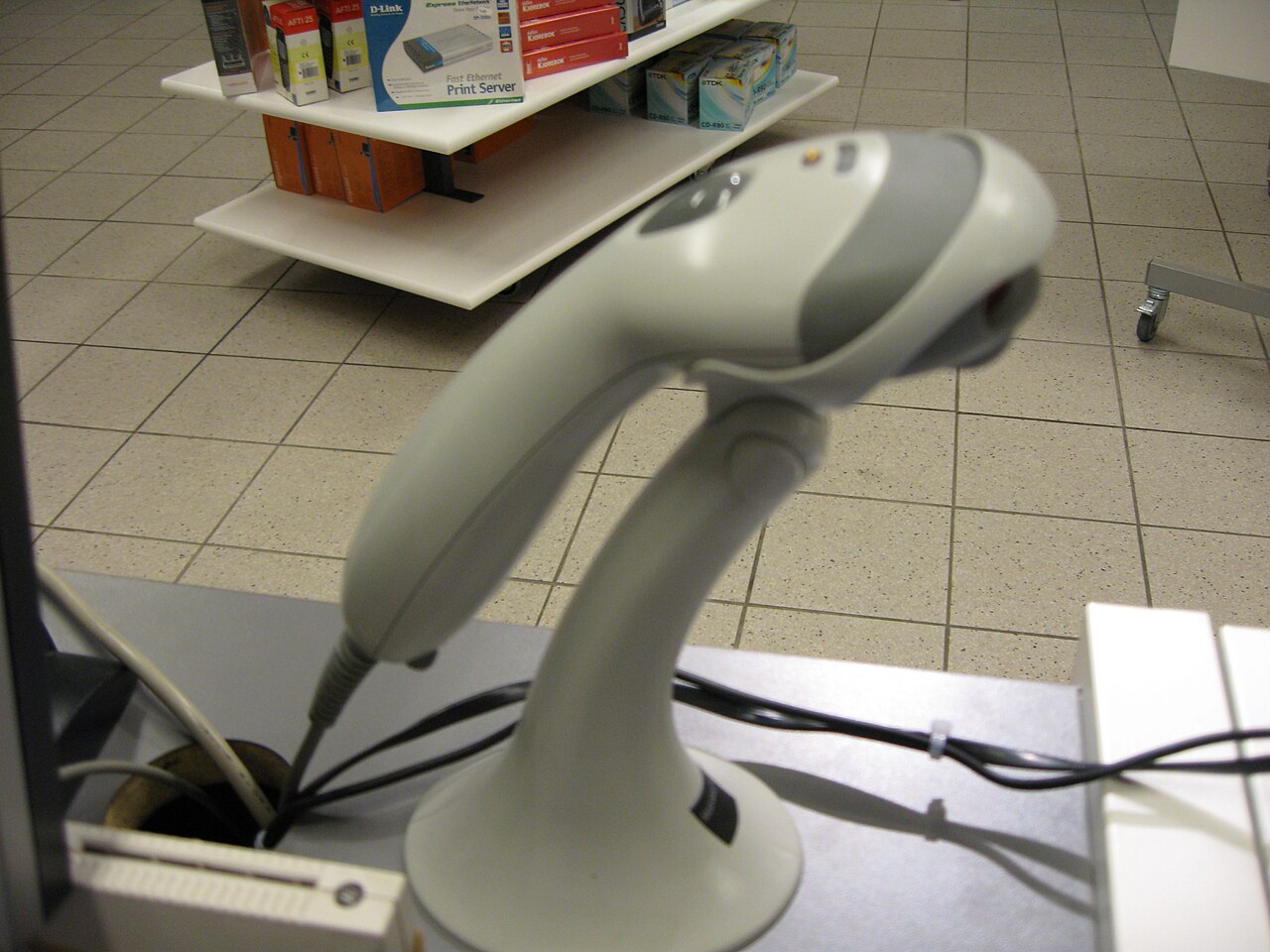
The rule that maps digits to bar patterns is called a symbology. UPC is one symbology; there are hundreds. Reading hardware evolved from incandescent bulbs to helium–neon lasers and then to solid-state laser diodes and CCD imagers. Internationally, the EAN (European Article Number, now International Article Number) system was built as a superset of UPC: EAN-13 simply prepends a digit to the twelve-digit UPC, multiplying the space of possible codes and turning a national grocery scheme into a global standard for nearly every manufactured good on Earth.
Fittingly, the barcode is a distant descendant of an older idea about encoding data in physical media for machines to read, the same lineage as Herman Hollerith and the Punched Card, the punched-card technology that helped build IBM, the very company that turned the barcode into a global standard.
The Myth of the Beast
Myth: Every barcode secretly contains the number 666, the “Mark of the Beast.”
The guard bars at the start, middle, and end of a UPC do superficially resemble the bar pattern that encodes the digit 6, which is how the rumor started. But the guard bars are not digits at all: they are fixed timing references that encode no value, not even a 6. Look closely and the genuine digit 6 has a wide white space beside its bars that the guard patterns lack. There is no 666 hidden in your groceries. See Myths and Misconceptions.
The Invisible Empire
The UPC’s real impact was not the beep at the register but everything behind it. Because every scan updates a database in real time, retailers gained continuous knowledge of exactly what was selling and what remained on the shelf. That data made modern inventory management and just-in-time logistics possible: warehouses could restock automatically, suppliers could be triggered by demand rather than guesswork, and the entire supply chain tightened into the system that later made e-commerce fulfillment feasible. Self-checkout, loyalty programs, and package tracking all descend from the same short strip of black and white. The staggering volumes of transaction data it generated helped drive the storage revolution and the science of squeezing more into less, from indexing to data compression.
Into the Second Dimension: QR Codes
A linear barcode holds only a dozen or so digits, enough to name a product, not to describe it. In 1994, engineer Masahiro Hara at Denso Wave, a subsidiary of the Japanese automotive-parts giant Denso, invented the QR code (“Quick Response”) to track components on Toyota’s assembly lines, where a single 1D barcode could no longer hold enough information and workers were tired of scanning ten labels per part.
Hara’s insight, reportedly inspired partly by the black-and-white patterns of the board game Go, was to make the code two-dimensional, a grid of black and white cells with three prominent square “finder” markers in the corners that let a camera locate and orient the code instantly, from any angle. A QR code can store thousands of characters where a UPC stores a handful, and it includes error correction so it scans even when partly dirty or damaged.
Denso Wave chose not to enforce its patent for consumer use, and the QR code quietly spread, especially in Japan’s digital culture, where it was on billboards and business cards years before the West noticed. Its global moment came during the COVID-19 pandemic, when contactless everything was suddenly essential: restaurant menus, payments, tickets, and check-ins all collapsed into a square you pointed your phone at. A code invented to count car parts became the interface between the physical world and the internet.
⚠️ Dead End: The Bullseye That Lost
The tragedy and lesson of the barcode is compressed into one shape. Woodland’s original 1949 vision was the bullseye, chosen precisely because a circle can be read from any direction, an elegant solution to the orientation problem. Yet the bullseye died, twice over. First, in the 1950s, because no affordable technology could read it. Then again in 1973, when it lost the industry standard to Laurer’s rectangle, not on elegance but on the mundane physics of ink smearing on a fast printing press. The idea that was conceptually superior lost to the one that was manufacturable. And the two men who conceived it captured almost none of the trillions of dollars in commerce it eventually enabled: Silver was long dead, and Woodland (who lived until 9 December 2012) spent his career as an IBM engineer, honored late with the 1992 National Medal of Technology and, with Silver, a 2011 induction into the National Inventors Hall of Fame, but never rich from his invention.
Fun Fact
The first-ever scanned item, that 10-pack of Wrigley’s Juicy Fruit gum from the Marsh Supermarket in Troy, Ohio, is held in the collection of the Smithsonian’s National Museum of American History, a 67-cent purchase turned into a museum piece because of the beep it made.